Semi Open vs Closed Rhinoplasty, Which Should You Choose?
Key points
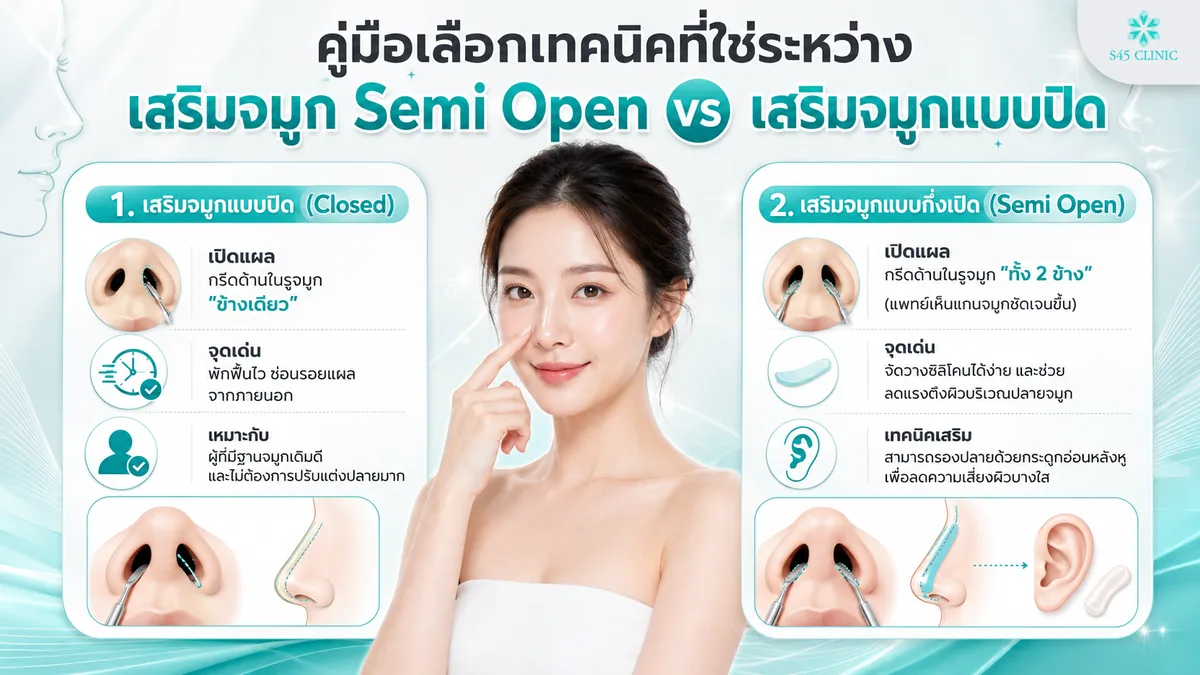
- Semi-open and closed rhinoplasty differ in where the incisions are made. Closed rhinoplasty uses an incision inside 1 nostril, while semi-open rhinoplasty uses incisions inside both nostrils so the surgeon can see the nasal framework more clearly.
- Closed rhinoplasty keeps the scar hidden from the outside and usually has a shorter recovery time, depending on each person. It suits people who already have a good nasal base and do not want much reshaping of the nasal tip.
- The semi-open technique lowers skin tension around the nasal tip, which makes it easier to position the silicone implant. It can be combined with an ear cartilage tip graft to lower the chance of the skin over the nose becoming thin.
- Assessing the thickness of your skin and your original nasal alignment with the surgeon plays an important part in choosing a technique that suits your face.
Choosing between semi-open and closed rhinoplasty can be very confusing if you want to reshape your nose. Many people worry that choosing a technique that does not suit their existing bone structure could lead to problems and a second operation to reshape the nose in less than 1 year.
For this reason, S45 has put together a comparison of the 2 techniques, from where the scars are and the shape limits of each technique to how long bruising and swelling last after surgery. You can use this information as a guide to help you decide with confidence before you see a surgeon.
In This Article
Semi-Open vs Closed Rhinoplasty, How Do They Differ?
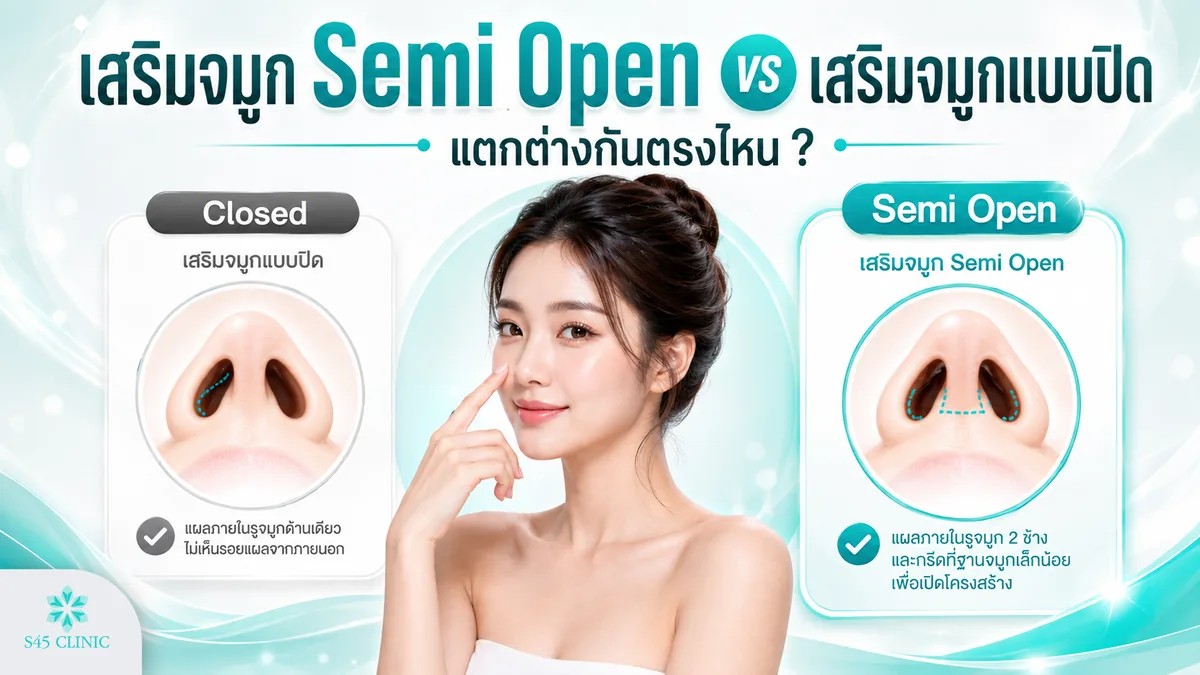
The main differences between semi-open and closed rhinoplasty are where the incisions are made and how much of the structure inside the nose the surgeon can see during the operation, as follows.
Closed Rhinoplasty With a Hidden Incision
Closed rhinoplasty uses a small incision inside 1 nostril only, through which a silicone implant is placed along the bridge of the nose. With this technique the scar is hidden inside the nostril once the wound has healed. The surgeon creates a pocket under the membrane covering the bone (the periosteum) so the implant sits closely against your existing nasal bone.
The operation takes 30 to 45 minutes and causes little trauma to the surrounding tissue, so bruising and swelling usually settle sooner than with other methods. The resulting shape focuses mainly on raising the height of the nasal bridge. It suits people who already have a fairly good nasal base and do not want much reshaping of the nasal tip.
Semi-Open Rhinoplasty With Incisions in Both Nostrils
Semi-open rhinoplasty uses incisions inside both the left and right nostrils, so the surgeon can see the nasal framework and the space inside more clearly than with standard closed rhinoplasty. The 2 incisions lower skin tension while the skin is lifted to insert the silicone implant, which makes it easier to place the implant in a suitable position, especially along the bridge and at the tip of the nose.
This method lowers the chance of the nose becoming crooked or tilted, because the surgeon can balance the implant against your existing nasal bone more precisely than with a single incision. The operation takes about 45 to 60 minutes. The small incisions are all hidden inside the nostrils, which lowers the chance of the scars being noticed from the outside after the first week of recovery.
Results and Limits to Know Before Choosing a Technique
Choosing a rhinoplasty technique that suits your existing structure is key to the shape of your nose and how satisfied you are in the long term. Assessing the advantages and limits of each technique in detail with the surgeon helps lower the chance of needing another operation to correct the nose in future.
Choosing a suitable surgical method also helps lower the chance of a thin nasal tip or implant extrusion (the implant pushing through the skin), which often happens when an implant that is too high is forced into a nose with limited soft tissue. The table below gives a basic comparison of the 2 techniques to help you consider your options.
| Comparison | Closed rhinoplasty | Semi-open rhinoplasty |
|---|---|---|
| Incision site | Hidden inside 1 nostril | Inside both nostrils |
| Structural reshaping | Limited to the nasal bridge | Some tip reshaping and interdomal suturing possible |
| Bruising and swelling | 7 to 10 days on average | 10 to 14 days on average |
What to Know If You Are Considering Closed Rhinoplasty
The main feature of closed rhinoplasty is that the incision is hidden inside 1 nostril only, so the scar cannot be seen from the outside. It suits people who already have a good nasal base and want a higher, more defined nasal bridge. The operation is fairly short, taking about 30 to 45 minutes on average.
Because the small incision is made inside the nostril, there is less trauma to the tissue under the skin, so bruising and swelling after surgery are usually mild and recovery is usually shorter. However, this technique is limited in how much it can reshape the nasal tip, and it is not well suited to a nose with a very crooked or deviated framework.
What to Know If You Are Considering Semi-Open Rhinoplasty
When choosing between semi-open and closed rhinoplasty, it helps to know that the semi-open technique lowers skin tension at the nasal tip more than the closed technique, because the surgeon makes incisions inside both nostrils. This gives the surgeon a clearer view of the structure inside, makes it easier to reshape the tip with ear cartilage than with a single incision, and the incisions on both sides also reduce pulling on the skin, which helps lower the chance of the implant tilting.
After this type of surgery, clean both nostrils thoroughly to prevent a build-up of blood and fluid.
Check Your Nasal Structure, Which Technique Suits You?

Choosing a rhinoplasty technique depends mainly on your existing nasal bone and on how flexible the skin is over the bridge and tip of your nose. Assessing the thickness of the skin at the tip and your nasal alignment shows the limits of your own structure.
The surgeon checks the strength of the cartilage at the tip and measures the angles of your face to choose a shaping method that lowers the chance of implant extrusion in the long term. Noses can be divided into the following groups to help decide on a surgical approach.
Limited Nasal Tissue and a Moderate Change in Shape
If you have limited nasal tissue and want a shape that does not put too much strain on the skin, closed or semi-open rhinoplasty with a moderate increase in height can suit you, because thin skin over the bridge limits how high an implant can be. Forcing too much height can stretch the skin and make it thinner over time. Using a silicone implant only 1mm to 2mm thick helps reduce tension and lowers the chance of implant extrusion.
If the 2-incision semi-open technique is chosen, the surgeon can see inside the nose more evenly than with the closed technique and can place the implant in the middle without it tilting. Reshaping the tip with a tip graft also helps spread pressure so the skin does not become thinner.
A Crooked or Deviated Nasal Structure
A nose that is crooked because of the existing bone or a deviated septum cannot be straightened with closed rhinoplasty, because the surgeon cannot see the bony framework inside. Semi-open rhinoplasty, with incisions in both nostrils, gives the surgeon a clearer view of the tilt than a single incision, but it may still not be enough to realign a severely twisted nasal bone.
If the nasal bone is clearly crooked, the surgeon needs to use rasping of the dorsal hump or nasal osteotomy (reshaping the nasal bones) to balance the surface before placing the silicone implant on top. If an implant is forced onto a tilted base without realigning the bone, the nose can easily become crooked along the line of the original base within 90 days after surgery.
Semi-Open vs Closed Rhinoplasty, How Do the Prices Compare?
The cost of the 2 types of surgery differs according to how complex the structure is and how long the operation takes. Closed rhinoplasty has a lower price because the operation is short and done under local anaesthetic. Semi-open rhinoplasty costs about THB 5,000 to THB 15,000 more on average than closed rhinoplasty, because incisions are made in both nostrils to reshape the structure inside and rearrange the cartilage at the nasal tip.
Another reason semi-open rhinoplasty costs more is interdomal suturing to make the nasal tip slimmer, which needs dedicated instruments and more time for careful suturing. Prices may change depending on the silicone implant chosen and whether a previous operation also needs correcting.
| Comparison | Closed rhinoplasty | Semi-open rhinoplasty |
|---|---|---|
| Approximate price range | THB 15,000 to THB 30,000 | THB 25,000 to THB 50,000 |
| Operation time | 30 to 45 minutes | 60 to 90 minutes |
| Anaesthesia | Local anaesthetic | Local anaesthetic with general anaesthetic (in some cases) |
| Complexity of structural reshaping | Focuses on raising the nasal bridge | Tip reshaping and interdomal suturing possible |
Choosing Rhinoplasty Materials to Suit Your Nasal Structure
The material used to reshape the nose with each technique depends mainly on the thickness of your skin and the shape you want. The surgeon assesses whether to combine a synthetic implant with tissue from your own body to lower tension at the nasal tip. Silicone implants for the bridge are usually 1mm to 3mm thick on average, depending on your skin.
Silicone Combined With Fat or Tissue From Your Own Body
Raising the nasal bridge with a silicone implant while covering the nasal tip with a layer of fat or tissue from your own body helps lower the chance of the skin becoming thin in the long term. This method can be used with both semi-open and closed rhinoplasty to add thickness at a nasal tip that needs extra projection.
During the procedure, the surgeon often uses a layer of fat from under the skin or a dermofat graft from the tailbone area, stitched over the tip of the silicone implant before it is placed in position. Using your own tissue in this way reduces tension and friction between the implant and the skin inside, which helps the wound heal and settle within 14 days.
Ear Cartilage Tip Grafts
Using ear cartilage as a tip graft helps lower the chance of implant extrusion and adds thickness to the nasal tip for a softer look. This technique can be used with both closed and semi-open rhinoplasty, but it suits the semi-open technique better, because incisions inside both nostrils give the surgeon a better view to place the cartilage evenly.
To take the graft, the surgeon makes a small incision of about 1cm to 2cm in the fold behind the ear and removes part of the conchal cartilage (the cartilage in the bowl of the ear) that does not affect the shape of the ear. The scar behind the ear is hidden in the fold, so it is hard to notice once it has healed.
After the cartilage is removed, the body forms scar tissue to fill the space, so the ear keeps its usual shape. This wound needs care and time to settle, and the stitches are removed at the same time as those from the nose, within 7 to 14 days.
Preparing for Surgery and Caring for the Wound Afterwards

Preparing for surgery and caring for the wound afterwards are similar for semi-open and closed rhinoplasty, with some small differences because of the incisions. The details are summarised below.
Preparing Your Body Before Surgery Day
- Stop taking aspirin-type painkillers, ibuprofen and all supplements, including vitamin E, fish oil and ginseng, at least 14 days before surgery, because they slow blood clotting and can cause more bruising and swelling after surgery than usual.
- Stop smoking and drinking alcohol of any kind at least 14 days before surgery. Nicotine in cigarettes narrows the blood vessels, which reduces blood circulation and slows wound healing.
- Get at least 8 hours of sleep the night before surgery, so your body is ready for the procedure and your blood pressure stays in the normal range.
- Shower, wash your hair and clean your body before travelling to the clinic. Do not wear make-up, fingernail or toenail polish, or any jewellery on the day of surgery, to keep the operating room clean.
How to Look After Yourself After Surgery
- Apply cold compresses around the cheeks and forehead regularly for the first 3 days after surgery, to help control blood flow and reduce fluid building up under the skin.
- Switch to warm compresses from day 4 onwards, to help stimulate blood circulation and help the bruising around the eyes fade.
- Sleep with your head raised about 30 to 45 degrees above your chest for the first week, to prevent blood and fluid collecting around the wound.
- Avoid salty and strongly flavoured food and instant food for the first 14 days, to limit water retention, which can make the nasal tip swell.
The differences are in wound cleaning and stitch removal. With the closed technique, you clean and apply ointment only to the nostril with the incision, and the stitches are removed within 7 to 10 days.
With the semi-open technique, you need to clean both nostrils thoroughly to prevent blood building up. The surgeon usually removes the stitches a little later, at 10 to 14 days, so the wounds on both sides can heal fully.
Why Choose S45 Clinic for Rhinoplasty?
At S45 Clinic we focus on designing a nose shape that suits your individual proportions. Attention to detail and systematic care help you feel confident at every step. Our surgeons give straightforward advice on everything from standard techniques to structural reshaping with rib cartilage.
Care by Our Surgeons
Rhinoplasty at S45 Clinic is carried out by our surgeons, who are experienced in reshaping the nose. The surgeon assesses your nose and plans treatment case by case, choosing a technique that suits your skin and existing structure, from semi-open rhinoplasty to septal extension and your own rib cartilage, to give the nose a strong structure in line with medical standards.
Detailed Individual Assessment of Your Nasal Structure
A detailed assessment of your nose shape before surgery helps lower the chance of the implant shifting or tilting and helps achieve a shape that suits your face. This includes measuring the thickness of your skin, the strength of the cartilage at the tip and the angle between your forehead and upper lip. The surgeon uses this information to design an implant with a width and length that fit your actual nasal bone.
Operating Rooms and Infection Control
S45 Clinic controls cleanliness and sterility in the operating room to lower the risk of infection after rhinoplasty. We use a HEPA air filtration system that can trap dust and small airborne contaminants, up to 99.97% of them. Every surgical instrument is sterilised with ethylene oxide gas before use.
FAQ About Semi-Open and Closed Rhinoplasty
Does Semi-Open Rhinoplasty Hurt?
How much discomfort you feel with semi-open rhinoplasty differs from person to person. Local anaesthetic is injected to numb the area throughout the operation, so during the procedure you usually feel only light pressure and tightness at the nasal tip. When the anaesthetic wears off, you may feel tight and sore, similar to a large inflamed spot, which can be relieved by taking painkillers every 4 to 6 hours.
I Had Closed Rhinoplasty Before. Can I Have It Revised With the Semi-Open Technique?
If you have had closed rhinoplasty before, the nose can be reshaped with the semi-open technique, which opens both nostrils so the surgeon can reshape the nose and remove old scar tissue. This allows a new silicone implant to be placed together with a tip graft to lower the chance of implant extrusion, without major surgery. For revision cases, wait at least 6 months after the first operation so the tissue inside can soften and be ready for another procedure.
How Many Days Until the Wound Is Fully Dry?
The incisions inside the nostrils usually dry and close within 7 to 14 days. In the first week, the wounds start to scab and heal together until the stitches can be removed at your appointment. Keep the area clean by gently wiping away blood around the wound with a cotton bud dipped in saline twice a day to prevent bacteria building up.
Summary
Choosing between semi-open and closed rhinoplasty depends mainly on your existing nasal bone and on how flexible the skin at the nasal tip is. Closed rhinoplasty uses a single incision inside 1 nostril, and the wound usually heals in about 14 days, depending on each person. It suits people who already have a good nasal base. Semi-open rhinoplasty uses incisions in both nostrils, which gives a clearer view of the nasal framework and allows reshaping with a tip graft to lower the chance of implant extrusion.
Choosing a method that suits your own anatomy helps lower the chance of side effects and of needing corrective surgery in future. If you are planning to reshape your nose in balance with your face, an assessment of your skin thickness and the bone and cartilage at the tip by a surgeon will give you accurate information to help you decide.
Because every nose structure…
is different
An otolaryngologist with subspecialty training in facial plastic and reconstructive surgery assesses every case before treatment and gives advice based on your actual concerns.
“Reveal the beauty within you”
Message us online
Surgery and medical procedures carry risks. Find out about them and consult a doctor before you decide. Results depend on each person.