How Long Do Nose Implants Last? The Facts in 2026 and Warning Signs They Need Replacing

One of the questions many people search for before or after rhinoplasty is “how long do nose implants last?”, “do they really need replacing every 10 years?” or “I had my nose done 10 years ago, should I replace the implant now?” The confusion comes from scattered information on social media and in reviews, which sometimes contradicts itself.
Key points
- Medical-grade silicone nose implants do not have a set expiry date and can stay in place long term if there are no complications. The belief that they must be replaced every 10 years is a misunderstanding.
- Reasons for replacement: not because the silicone wears out, but because of complications such as a shifted implant, thin tissue, skin changes, wanting a different shape, or an accident.
- Types of silicone implant: pre-formed, semi-pre-formed and custom-shaped. Each type suits different cases.
- Implant show-through happens when the skin of the nose becomes so thin that the silicone can be seen through it. It is a warning sign to see a surgeon.
- A ‘floating’ implant is one that has moved from its original position, making the nose look tilted or stick-like.
- Symptoms that need prompt replacement: thin skin with the implant showing, a dark red tip, pus, ongoing pain, or an unusually tilted shape.
- Had rhinoplasty 10 to 20 years ago: there is no need to replace the implant if you have no unusual symptoms. Many people who had it done more than 20 years ago still have no problems.
This article brings together answers about silicone nose implants, from the facts about how long they last and the myth about 10 years, to the types of silicone used, implant show-through and shifting implants, warning signs that an implant needs replacing, silicone-free rhinoplasty, and how to care for an implant so it lasts. It aims to help you know what is worth watching for and what you do not need to worry about.
In This Article
What Is a Silicone Nose Implant?
A silicone nose implant is a material the surgeon places inside the nose to raise the bridge and reshape the nose to the planned design. Silicone has been used in rhinoplasty for several decades and is widely accepted when used to the correct standards.
The silicone used in rhinoplasty is ‘medical-grade silicone’, which is different from the general silicone used in industry. It is approved by public health authorities in many countries and is accepted by the human body, and most people have no allergic reaction to it.
In Thailand, medical-grade silicone used in rhinoplasty must meet the standards of the Food and Drug Administration (the Thai FDA). An experienced surgeon chooses good-quality silicone to lower long-term risks.
Properties of Medical-Grade Silicone
- approved by public health authorities
- most people have no allergic reaction to it
- durable and does not break down in the body
- can be shaped as needed
- is not absorbed and does not dissolve on its own
Why Silicone Is a Commonly Used Material
In rhinoplasty, silicone is widely used because it can be shaped precisely, it is affordable, its results can last a long time depending on each person, and it comes in several grades and shapes so the surgeon can choose what suits each case. However, silicone on its own may not suit every case, especially when the nasal tissue is thin or you want a particularly soft result.
Read more about rhinoplasty (nose surgery) to understand the whole process.
How Long Do Nose Implants Last? The Facts You Need to Know
The short answer to the question “how long do nose implants last” is that they can stay in place long term if there are no complications. What many people do not know is that medical-grade silicone does not have an ‘expiry date’ of its own. It does not break down in the body and does not dissolve away, and the material itself is not usually what causes problems.
What leads to misunderstandings about how long implants last is the ‘external factors’ that make replacement necessary, rather than the silicone wearing out. Examples include the skin of the nose becoming thinner with age, an accident that affects the nose, an implant that was the wrong size from the start, or wanting a different nose shape.
Understanding this matters, because it reduces unnecessary worry and helps you know what is really worth watching for.
How Long Silicone Lasts on Its Own Compared With Inside the Body
- Silicone on its own: does not expire and stays durable for decades
- Silicone inside the body: can stay in place long term if there are no complications
- Common problems: come from changes in the surrounding tissue, not from the silicone wearing out
When an Implant ‘Needs Replacing’, It Is Not Because the Silicone Has Worn Out
- the skin becomes thinner with age until the implant can be seen through it (translucency)
- an accident that makes the implant shift or push through the skin
- the implant size does not suit the nasal tissue (wrong from the start)
- you want to change your nose shape to follow a trend
- complications such as capsular contracture (the scar tissue capsule tightening too much)
When an Implant Can Truly Stay in Place Long Term
- good-quality silicone is chosen from the start
- an experienced surgeon places it in the right position
- there is enough nasal tissue and it is healthy
- there are no accidents that affect the nose
- you follow the aftercare advice
The Myth That Implants Must Be Replaced Every 10 Years
One widespread belief in Thailand is that “silicone implants must be replaced every 10 years“. This is a misunderstanding passed on through reviews and the media. The medical fact is that there is no fixed rule saying an implant must be replaced on a schedule.
This belief probably comes from confusion with ‘breast implants’, where there used to be advice to have them checked every 10 years (and this is still general advice in Western countries). But ‘checking’ does not mean ‘replacing’. Breast implants do not need replacing either if there are no problems.
For silicone nose implants, check-ups are important, but there is no need to replace the implant on a schedule. It depends on each person’s actual condition.
Where the 10-Year Belief Comes From
- confusion with breast implants
- stories passed on without medical evidence
- some clinics use it as a marketing tactic
- real cases where implants were replaced because of problems, not age
The Medical Facts
- medical-grade silicone has no set product lifespan
- no research confirms that implants must be replaced on a schedule
- replacing an implant is a decision based on symptoms, not on how old it is
- people who had an implant placed 20 to 30 years ago or more and have no symptoms do not need to replace it
When You Really Need a Check-Up
- once a year when it has been 5 years or more since surgery
- when you have any unusual symptoms
- when you reach 50 or older and your skin starts to become thinner
- when you want to change your nose shape
Read about revision rhinoplasty if you want to replace an implant.
Types of Silicone Nose Implant and How Durable Each One Is
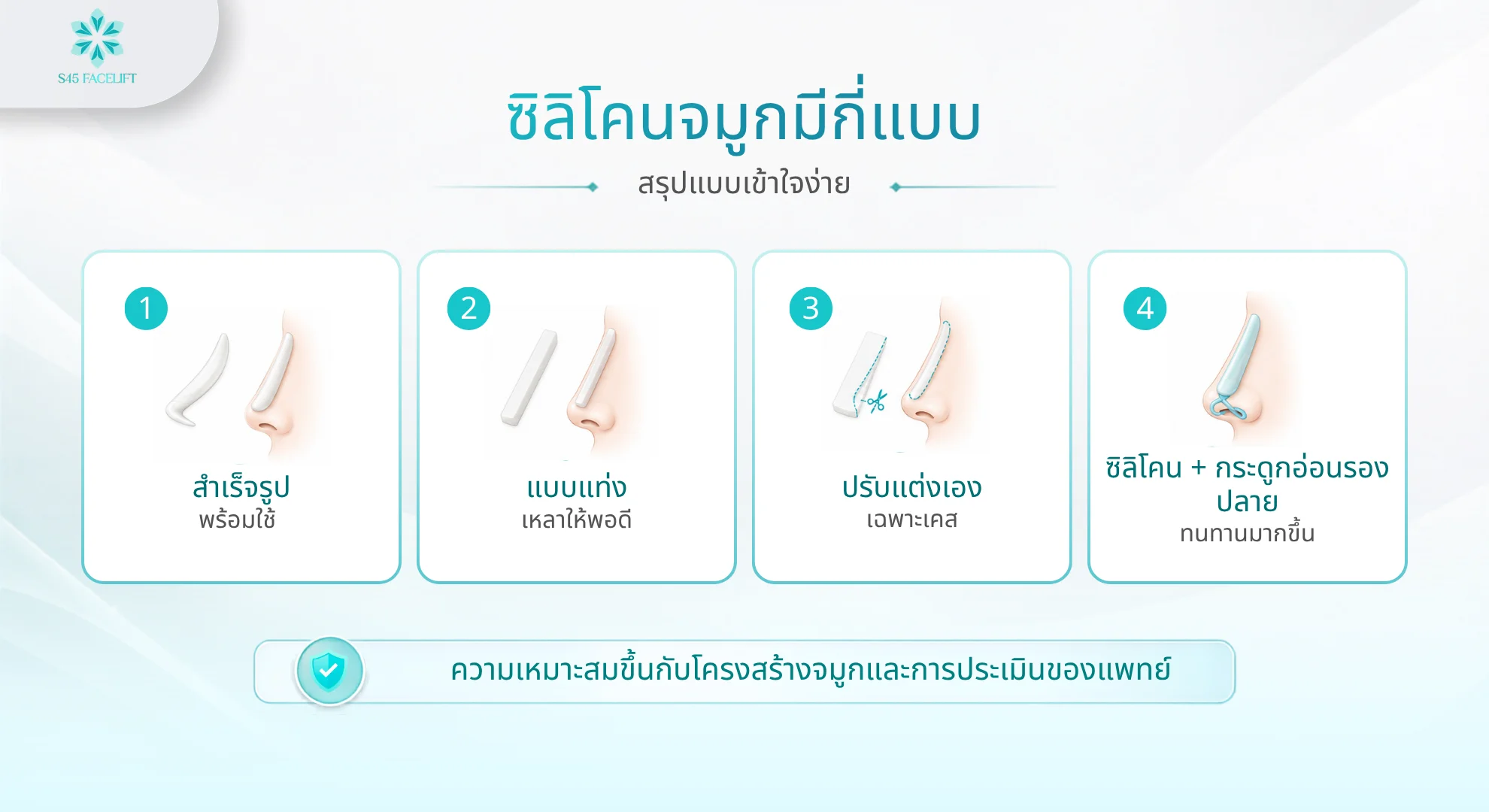
There are several types of silicone nose implant on the market, and each has different properties and suits different cases. Choosing the type that suits your case affects both the result and how durable it is in the long term.
The surgeon chooses the type of silicone based on the structure of your nose, the thickness of your tissue, the result you want and your budget. No single type ‘suits everyone’. Every type has its own advantages and limitations.
These are the main types commonly used.
1. Pre-Formed Silicone
- What it is: made in a finished shape at the factory, in several sizes and shapes
- Advantages: lower cost and shorter operating time
- Limitations: can be adjusted only a little and may not fit every facial structure
- Suits: straightforward cases with a typical facial structure
2. Block Silicone
- What it is: a block of silicone that the surgeon carves to fit each person’s nose
- Advantages: can be shaped precisely and fits the face more closely
- Limitations: longer operating time and higher cost, and the result depends on the surgeon’s skill
- Suits: cases that need a highly individual shape
3. Custom Silicone
- What it is: designed and cut to fit each patient’s nasal structure
- Advantages: fits the nasal structure precisely and gives a distinctive shape
- Limitations: higher cost and needs an experienced surgeon
- Suits: complex cases and cases that need a specific shape
4. Silicone With a Cartilage Tip Graft
- What it is: a silicone implant with your own cartilage used as a tip graft under the nasal tip
- Advantages: lowers the chance of tip extrusion and is durable in the long term
- Limitations: needs surgery to harvest the cartilage
- Suits: people with thin nasal tissue and people who want a very durable result
Comparison Table
| Type | Customisation | Durability | Cost | Suits |
| Pre-formed | Limited | Standard | Low to moderate | Standard cases |
| Block | High | Good | Moderate | Cases needing an individual shape |
| Custom | Highest | Very good | High | Complex cases |
| With cartilage | High | Very good | High | Thin tissue or a very durable result |
See more about techniques that use cartilage in thin nasal tissue for cases that need extra durability.
What Is Implant Show-Through, and Should You Be Concerned?

Implant show-through, or translucency, is something many people search for and worry about. It is when the skin of the nose becomes so thin that the outline of the silicone can be seen through it. It is usually clearest in bright light, especially in photos or when light falls on the nose at certain angles.
Show-through is a warning sign worth paying attention to, because it shows that the skin of the nose is becoming thinner and there is a chance of long-term problems such as a red tip or tip extrusion. However, how severe it is can vary, from barely visible to clearly visible.
An accurate assessment needs an examination by an experienced surgeon, to decide whether to monitor it or correct it with surgery.
Causes of Implant Show-Through
- Thin nasal skin from the start: the original nasal tissue was thin or the implant chosen was too large
- Skin thinning with age: the skin becomes thinner as you get older
- Large weight loss: less tissue under the skin makes the implant easier to see
- The wrong type of silicone: silicone that is too firm for thin tissue
Levels of Severity
- Mild: visible only in strong light at some angles, so monitor it
- Moderate: visible at times in daily life, so see a surgeon for an assessment
- Severe: clearly visible in all lighting and the skin looks pale, so corrective surgery is advisable
Treatment Options
- Mild cases: filler injections under the skin to add thickness
- Moderate cases: replacing the implant with a smaller one and adding tissue support under the tip
- Severe cases: removing the implant and rebuilding the shape with your own cartilage
Read more about thin nasal tips in a projecting nasal tip with thin tissue to understand how it is assessed and treated.
How to Spot a Shifted Implant
A ‘floating’ or shifted implant is when the implant moves away from the position where the surgeon placed it. This makes the nose look abnormal, tilted, stick-like, or makes the implant too prominent. It is uncommon, but when it happens it needs correcting.
A shifted implant can have several causes, including imprecise surgery, an implant of the wrong size, an accident, or poor self-care after surgery. Knowing the signs helps you notice the problem and see a surgeon early.
If you think your implant has shifted, see a surgeon for an examination. Do not try to push the implant back yourself, as this may make things worse.
Signs That an Implant Has Shifted
- the nose is clearly tilted
- the bridge no longer looks straight
- the implant stands out like a stick
- you can feel the implant move when you touch your nose
- pain or discomfort around the nose
- thin skin in some areas over the implant
Causes of a Shifted Implant
- Imprecise surgery: the pocket the surgeon created is larger than the implant
- Wrong implant size: too large or too small for the nasal structure
- Accidents: a hard knock to the nose in the first 6 months
- Incorrect self-care: pressing hard on the nose while the capsule is forming
- Uneven capsule formation: the capsule tightens more on one side than the other
How a Shifted Implant Is Corrected
The surgeon assesses how severe it is:
- early cases: may be adjusted with targeted massage if caught early
- moderate cases: surgery to reposition the existing implant
- severe cases: removing the old implant and placing a new one of a suitable size
Read more about shifted silicone implant problems, an article that explains this topic in depth.
Does an Implant Need Replacing 10 or 20 Years After Rhinoplasty?
Questions such as “I had my nose done 10 years ago, do I need to replace the implant?” and “I had my nose done 20 years ago, will it still be fine?” worry many people, especially those who had rhinoplasty a long time ago and are starting to hear warnings about how long implants last.
The short answer is that you do not need to replace it if you have no unusual symptoms. If you had an implant placed 10 years, 20 years or longer ago and it is still fine with no problems, there is no need to replace it ‘because of age’, because the silicone itself does not expire.
However, a yearly check-up once it has been 5 years or more since surgery is good practice, to look for early signs of problems and correct them before they become serious.
10 Years After Surgery, What to Check
- Is the nose still as straight as before?
- Is the skin over the bridge and tip still of normal thickness?
- Is there any redness or dark spot on the tip?
- Do you feel pain or discomfort around the nose?
- Is the implant still in its original position?
20 Years After Surgery, What to Watch For
- the skin starts to become thinner with age, which raises the chance of show-through
- there is less tissue under the skin, so the implant may become more visible
- the shape of the face changes with age
- the skin becomes less elastic
When to Consider Replacement Even Without Symptoms
- you want to change your nose shape to follow a trend
- you feel the shape no longer suits a face that has changed with age
- you want to switch to a more durable material, such as cartilage
When an Implant Definitely Needs Replacing
- a dark red tip or the start of extrusion
- skin so thin that the implant is clearly visible
- ongoing pain
- an unusually tilted shape
- pus or a bad smell
Which Rhinoplasty Techniques Are Designed to Last Long Term?
The search “which rhinoplasty lasts for life” reflects what many people want: to have rhinoplasty once and not need revision. The answer is that some techniques are designed to be durable in the long term, but how long a result lasts also depends on aftercare and individual factors.
Techniques that are durable in the long term usually use your own cartilage together with silicone, or cartilage only, because tissue from your own body is less likely to be rejected and becomes part of the nasal structure.
Before choosing a technique, have a consultation with a surgeon to assess which technique suits your case and budget, because more durable techniques usually cost more.
Techniques That Are Durable in the Long Term
1. Open rhinoplasty with your own cartilage uses cartilage from your ear or septum together with silicone. The nasal tip is supported with your own cartilage, which makes it very durable.
2. Open rib rhinoplasty uses rib cartilage to build the structure of the nose. It is a very durable technique and suits complex cases, such as a very flat nasal base or revision.
3. Septorhinoplasty uses cartilage from your own septum for augmentation. The structure attaches to the existing tissue and is durable in the long term.
Factors That Affect Durability
- the quality of the material chosen
- the skill and experience of the surgeon
- a design that suits your nasal structure
- self-care after surgery
- avoiding accidents that may affect the nose
- your overall health
Read more about techniques that use your own cartilage in dense scar tissue and a stiff, stick-like nose, which covers cases that need extra durability.
Silicone-Free Rhinoplasty, Pros and Cons
Silicone-free rhinoplasty has attracted more interest in recent years, especially among people concerned about long-term complications of silicone such as show-through, shifting or extrusion. This option uses only your own cartilage to build the shape.
The main advantages are a low chance of rejection, fewer long-term risks and a soft feel. However, there are limits on how much height can be added, the cost is higher, and it needs a surgeon with specific skills.
Before deciding, make sure you clearly understand both the advantages and disadvantages.
Advantages of Silicone-Free Rhinoplasty
- Low chance of rejection: the material comes from your own body and becomes part of the nasal structure.
- Durable in the long term: there is no silicone to show through, shift or push through the skin.
- Soft look and feel: the feel and shape can be close to a nose that has not had surgery.
- Fewer long-term concerns: there is no foreign material in the body to worry about.
Disadvantages of Silicone-Free Rhinoplasty
- Limited augmentation: it cannot create as high or defined a bridge as silicone.
- Higher cost: the surgery takes longer and is more complex.
- Cartilage has to be harvested: there is an extra wound at the ear or rib.
- Some absorption is possible: part of the cartilage may be absorbed over the long term.
- Needs a skilled surgeon: not every clinic offers it.
Who It Suits
- people who have had problems with a silicone implant (revision)
- people concerned about foreign material in the body
- people who want a particularly soft result that blends in with their features
- people with thin nasal tissue who have a higher chance of tip extrusion
- people who want a small change for a balanced look
5 Reasons an Implant May Need Replacing
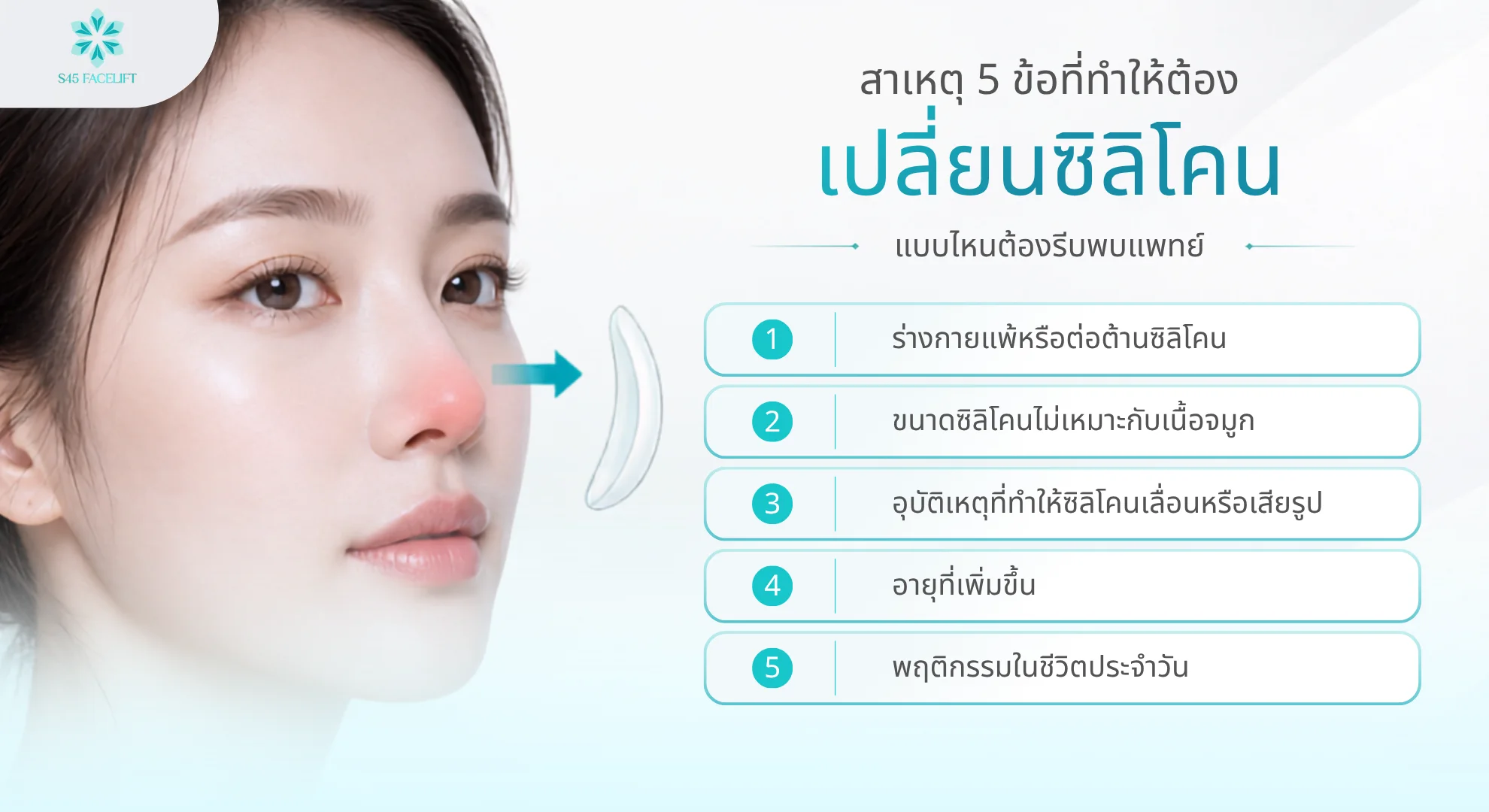
Although a silicone nose implant can stay in place long term on its own, there are reasons why some people need a replacement. Understanding these reasons helps you know what to watch for and how to prevent problems.
Most reasons come from external factors, not from the silicone wearing out. Choosing an experienced surgeon from the start and looking after yourself properly can help lower these risks.
These are the main reasons people need to replace an implant.
1. The Body Reacts to or Rejects the Silicone
Although most people have no reaction to medical-grade silicone, in some people, though this is uncommon, the body may respond by forming unusually thick tissue, with swelling, redness, itching or ongoing pain. In this case the implant has to be removed and replaced with a different material.
2. The Implant Size Does Not Suit the Nasal Tissue
If the surgeon chooses an implant that is too large for the original nasal tissue, over the long term the skin may become thinner, which can cause show-through, a red tip or a chance of extrusion. Choosing the right size from the start is important.
3. An Accident That Makes the Implant Shift or Lose Its Shape
- a hard knock to the nose
- a car accident
- sports that involve impact to the face
- a fall onto the face
In these cases the implant may shift or bend, and corrective surgery is needed.
4. Getting Older
With age, the skin of the nose becomes thinner and less elastic. In people who had an implant placed 20 to 30 years ago or more, the outline of the implant may start to show through the skin more. This is a normal part of ageing, not the silicone wearing out.
5. Daily Habits
- sleeping face down regularly
- wearing heavy glasses that press on the bridge all the time
- massaging the nose hard
- rubbing the nose often
- losing a lot of weight in a short time
These habits may make the implant shift, change the shape of the nose, or make the skin thinner over time.
Symptoms That Suggest an Implant Needs Replacing
Knowing the warning signs helps you replace an implant in good time, before problems become serious and harder to treat. Symptoms to watch for fall into 2 groups: ‘needs prompt attention’ and ‘noticeable, see a surgeon for an assessment’.
If you notice symptoms in the first group, see a surgeon within 1 to 2 days, because waiting may let the problem spread. For the second group, you can book an appointment within the next few weeks or month, but do not leave it untreated.
Compare your own symptoms with the lists below.
Symptoms That Need a Prompt Visit to a Surgeon
- thin skin with the implant clearly visible, or a white spot starting to appear
- a dark red nasal tip, or a dark spot starting to appear
- pus or a bad smell from the nose area
- ongoing or worsening pain that painkillers do not help
- swelling, redness and heat that increase quickly
- a fever of 38°C or higher
- the implant starting to push through the skin
Symptoms That Need an Appointment for an Assessment
- the implant has moved, making the nose tilted or stick-like
- mild to moderate show-through, with the implant visible through the skin in strong light
- the tip has changed shape from before
- the skin of the nose keeps getting thinner
- ongoing numbness that does not go away
- a new lump on the nasal tip
- you want to change the nose shape to suit a face that has changed
Symptoms That Are Normal and Not a Concern
- a feeling of tightness in the nose on cold days
- a slightly firm nasal tip from time to time
- itching around the wound after surgery
- slight tightness when smiling or laughing
When Can Implant Extrusion Happen, and How Can You Prevent It?
How many years before implant extrusion happens is a search that reflects the worry many people have that the implant will push through the nasal tip. In fact, extrusion does not happen on a schedule. It happens because of specific factors that make the skin thinner until the implant pushes out.
When the implant is chosen well and you look after yourself, extrusion is very uncommon, even many years after surgery. But when the implant is too large or the nasal tissue is thin, extrusion can happen within just a few years.
Preventing extrusion depends on the right choices from the start and long-term care.
Factors That Raise the Chance of Extrusion
- Thin nasal tissue from the start: silicone on its own has a chance of tip extrusion over the long term.
- An implant that is too large: the skin cannot bear the load.
- No cartilage support under the tip: a weak point where extrusion can happen.
- Accidents that affect the nose: these can damage the skin.
- Chronic infection: the surrounding tissue becomes weak.
Average Time Before Extrusion May Happen
There is no exact figure, but in cases with problems:
- high-risk cases: extrusion may happen within 2 to 5 years (an implant that is too large and thin tissue)
- typical cases: most never have extrusion at all
- cases with good care and a suitable implant choice: can last for decades without problems
Signs Before Extrusion
- the skin on the nasal tip starts to turn dark red
- the outline of the implant is clearly visible at the tip
- a white or yellow spot starts to appear on the tip
- a tingling feeling around the tip
- the skin on the tip keeps getting thinner
How to Prevent It
- choose an implant size that suits your nasal tissue
- use cartilage support under the tip when the tissue is thin
- avoid pressing on or knocking the nose
- see a surgeon when you first notice signs
- replace the implant as soon as problems start, rather than waiting for extrusion
Read more about nasal tips close to extrusion in symptoms of nose implant extrusion to understand the warning signs and treatment.
How to Help a Nose Implant Last

To help a silicone nose implant last without problems, long-term self-care matters as much as choosing the surgeon and implant in the first place. Many people think that once rhinoplasty is done and the capsule has formed, that is the end of it, but care needs to continue for as long as you have the implant.
These steps are not complicated, but they need to be done consistently. Some are part of daily life, and some need extra care when you do activities that could affect the nose.
A little extra effort on self-care is more worthwhile than needing corrective surgery in the long term.
1. Avoid Hard Knocks to the Nose
- take care during sports that could affect the face
- wear protective equipment when needed
- avoid sleeping face down
- take care when applying make-up or washing your face
- do not press or massage the nose hard
2. Keep the Skin of the Nose Healthy
- use a moisturiser that helps keep the skin in good condition
- apply SPF 50+ sunscreen every day
- avoid scrubbing or using harsh chemicals on the nose
- do not wear glasses that press on the bridge for long periods
3. Have a Yearly Nose Check-Up
- see a surgeon every 1 to 2 years once it has been 5 years or more since surgery
- look for early signs before problems become serious
- take comparison photos every year to notice any changes
4. Look After Your Overall Health
- eat food that contains protein and collagen
- exercise regularly
- get enough sleep
- stop smoking, which damages collagen in the skin
- reduce stress
5. Watch for Changes and See a Surgeon as Soon as You Have Symptoms
- look after yourself and watch for changes
- do not wait until problems become serious
- deal with small problems before they become big ones
Why Choose Rhinoplasty at S45 Clinic
Rhinoplasty that helps an implant stay in place long term depends on choosing an implant that suits the case, the surgeon’s skill, and an aftercare system that follows up over the long term. S45 Clinic plans every case individually, under our promise “Because every beautiful result comes from care”.
Surgeons Trained in Otolaryngology and Facial Plastic Surgery
Our surgeons are otolaryngologists (ear, nose and throat surgeons) with a subspecialty in facial plastic and reconstructive surgery. They help choose the implant and technique for cases that need long-term durability, with the aim of a result that lasts.
Good-Quality Silicone and a Range of Options
S45 Clinic uses good-quality medical-grade silicone, with options including pre-formed silicone, block silicone and custom silicone, as well as techniques that use your own cartilage when the nasal tissue is thin or extra durability is needed. This means each case gets a material that suits the condition of the nose.
Long-Term Aftercare
- follow-up appointments at 1 week, 1 month, 3 months and 6 months
- a LINE channel where you can send questions to our team
- a yearly check-up service once it has been 5 years or more since surgery
- comprehensive revision services for cases that need correction in the long term
Read about revision rhinoplasty if you want to replace an existing implant.
FAQs About Silicone Nose Implants
How Long Do Nose Implants Last?
The silicone itself does not have an expiry date and can stay in place long term if there are no complications. How long it actually lasts depends on external factors, such as whether the implant size suits your nasal tissue, the skill of the surgeon, self-care after surgery, and accidents that affect the nose. Many people who had an implant placed 20 to 30 years ago or more still have no problems.
Can My Nose Implant Stay in for the Rest of My Life?
In theory it can, because medical-grade silicone does not break down in the body. In practice, it depends on whether complications develop over the long term, such as thinning skin, a shifted implant or an accident. If you look after it well and choose an experienced surgeon from the start, there is a good chance the implant will not need replacing.
I Had Rhinoplasty 10 Years Ago, Do I Need to Replace the Implant?
You do not need to replace it if you have no unusual symptoms. The belief that implants “must be replaced every 10 years” is a misunderstanding that has been passed on. In medicine there is no fixed rule about replacing an implant on a schedule. Have a yearly check-up once it has been 5 years or more since surgery, and replace the implant only if you have unusual symptoms.
Is It Normal for My Nose Implant to Show Through the Skin?
No, it is not normal, and it is a warning sign worth paying attention to. It happens when the skin of the nose becomes so thin that the outline of the implant can be seen through it. Severity varies from barely visible in strong light at some angles to clearly visible from every angle. See a surgeon for an assessment to decide whether to monitor it, add thickness with filler injections, or replace the implant.
What Should I Do If My Implant Has Shifted?
A shifted implant is one that has moved from where the surgeon placed it, making the nose look tilted or stick-like. Do not try to push it back yourself. See a surgeon for an examination. Early cases may be adjusted with targeted massage, but when the implant has clearly moved, surgery to reposition it or a new implant is needed.
Which Type of Rhinoplasty Lasts Long Term?
Very durable techniques usually use your own cartilage together with silicone, or cartilage only, such as open rhinoplasty with your own cartilage, open rib rhinoplasty (using rib cartilage) and septorhinoplasty, because tissue from your own body is less likely to be rejected and becomes part of the nasal structure.
Is Silicone-Free Rhinoplasty Better?
It is not necessarily better in every case. Its advantages are a low chance of rejection, high durability and a soft feel, but its limitations are limited augmentation, higher cost, the need for surgery to harvest cartilage, and possible slight absorption over the long term. It suits people concerned about foreign material in the body or who want a particularly soft result that blends in with their features.
How Many Years Before Nose Implant Extrusion Happens?
There is no fixed time. Extrusion happens because of specific factors that make the skin thinner until the implant pushes out. In typical cases where the implant is chosen well and cared for, extrusion may never happen. In high-risk cases (an implant that is too large and thin tissue), extrusion may happen within 2 to 5 years. To prevent it, choose a suitable size, use cartilage support under the tip when the tissue is thin, and see a surgeon when you first notice signs.
I Had Rhinoplasty 20 Years Ago, Will My Implant Still Be Fine?
Yes, it can be. In medical experience, some people have had their rhinoplasty implants for 20 to 30 years or more without major problems. What to watch for after many years is skin thinning with age and less tissue under the skin, which can make the implant more visible. Yearly check-ups and regular skincare can help the implant last longer.
Which Symptoms Mean I Need to Replace My Implant Soon?
Symptoms that need a prompt visit to a surgeon include thin skin with the implant clearly visible or a white spot, a dark red tip or a dark spot, pus or a bad smell, ongoing pain that painkillers do not help, swelling, redness and heat that are increasing, a fever of 38°C or higher, and the implant starting to push through the skin. These symptoms are signs of complications that need prompt treatment.
Summary
Medical-grade silicone nose implants do not have a set expiry date of their own and can stay in place long term if there are no complications. The belief that they must be replaced every 10 years is a misunderstanding that has been passed on. In medicine there is no fixed rule about replacing an implant on a schedule.
What makes replacement necessary is not the silicone wearing out, but external factors such as an implant that was the wrong size from the start, skin thinning with age, accidents, infection, or wanting a different shape. Warning signs include implant show-through, a shifted implant, a dark red tip and skin that keeps getting thinner.
Choosing an experienced surgeon and a suitable implant, and looking after yourself over the long term, are the keys to helping an implant last. For cases that need extra durability, using your own cartilage with silicone or cartilage only is an option that can help lower long-term risks.
Read more medical information about the risks and safety of rhinoplasty at ASPS, rhinoplasty risks and safety
Because every nose structure…
is different
An otolaryngologist with subspecialty training in facial plastic and reconstructive surgery assesses every case before treatment and gives advice based on your actual concerns.
“Reveal the beauty within you”
Message us online
Surgery and medical procedures carry risks. Find out about them and consult a doctor before you decide. Results depend on each person.