How Long Does an Alarplasty Scar Take to Heal? Wound Care Timeline and What to Do About Wounds That Open, Become Raised or Scab
After alar base reduction, many people worry about their wounds: when they will heal, how to care for them, whether what they are noticing is normal and whether they will leave a lasting scar. These worries are understandable, because a wound on the face can affect your confidence in the long term.
Key points
- Alar base reduction wounds come in 2 types depending on the technique: internal wounds (inside the nostril, not visible from the outside) and external wounds (in the crease at the side of the alar base). Each type has a slightly different healing timeline and care.
- How long alar base reduction wounds take to heal: stitches are removed at 5 to 7 days, the wounds are dry and smooth at 2 to 4 weeks, and the marks fade close to your normal skin at 3 to 6 months.
- Common normal symptoms: swelling and bruising in the first 7 days, scabbing at 7 to 14 days and mild redness for 1 to 3 months. All of these are a normal part of healing.
- Warning signs that need a doctor promptly: unusually severe pain, swelling with redness and warmth, fever, pus, a wound that opens, or bleeding that does not stop.
- Raised scars and keloids: you can lower the chance of them by applying silicone gel, avoiding the sun and seeing the doctor at your follow-up appointments. If they do develop, treatments include creams, steroid injections and laser.
- Caring for the wounds correctly in the first month is key to whether the marks fade well or leave a lasting scar.
This article brings together information about alar base reduction wounds, from the features of each type of wound, the day-by-day healing timeline, wound care at each stage, how to clean the wounds correctly and how to manage scabs, to telling normal symptoms from warning signs and treatments for problems such as wounds that open and raised scars, so you can care for your wounds with confidence and help them heal well.
In This Article
What Are Alar Base Reduction Wounds and Where Are They?
An alar base reduction wound is the wound left by surgery to reduce the size of the alae (alarplasty). Where the wound sits depends on the technique the surgeon chooses. The surgeon places it along an existing facial crease or inside the nostril so it is hard to notice in the long term.
The wounds are fairly small, usually about 0.5cm to 1.5cm long on each side, depending on how much of the alae needs to be reduced. Although the wounds are small, they are in a place people see every day, so good care is important for how they look in the long term.
When rhinoplasty is combined with alar base reduction, the alar base reduction wounds are separate from the rhinoplasty wounds, even though they are close together. Care for each wound separately as the surgeon advises. Read more about alar base reduction to understand the whole process.
Why the Position of the Wound Matters
The position of the wound directly affects both how it looks in the long term and how it heals. A wound in an existing crease is easier to hide and harder to notice once it has settled, while a wound inside the nostril cannot be seen from the outside at all. An experienced surgeon places the wound where it blends with the structure of the face.
What the Wound Looks Like on the First Day After Surgery
On the first day after surgery, the wound is closed with fine stitches and may have adhesive tape to support it. Swelling and bruising around the wound are normal. You may feel tightness and pressure around the alae, but the pain should not be severe. If you have unusually severe pain, tell the surgeon.
Types of Alar Base Reduction Wound, Internal and External
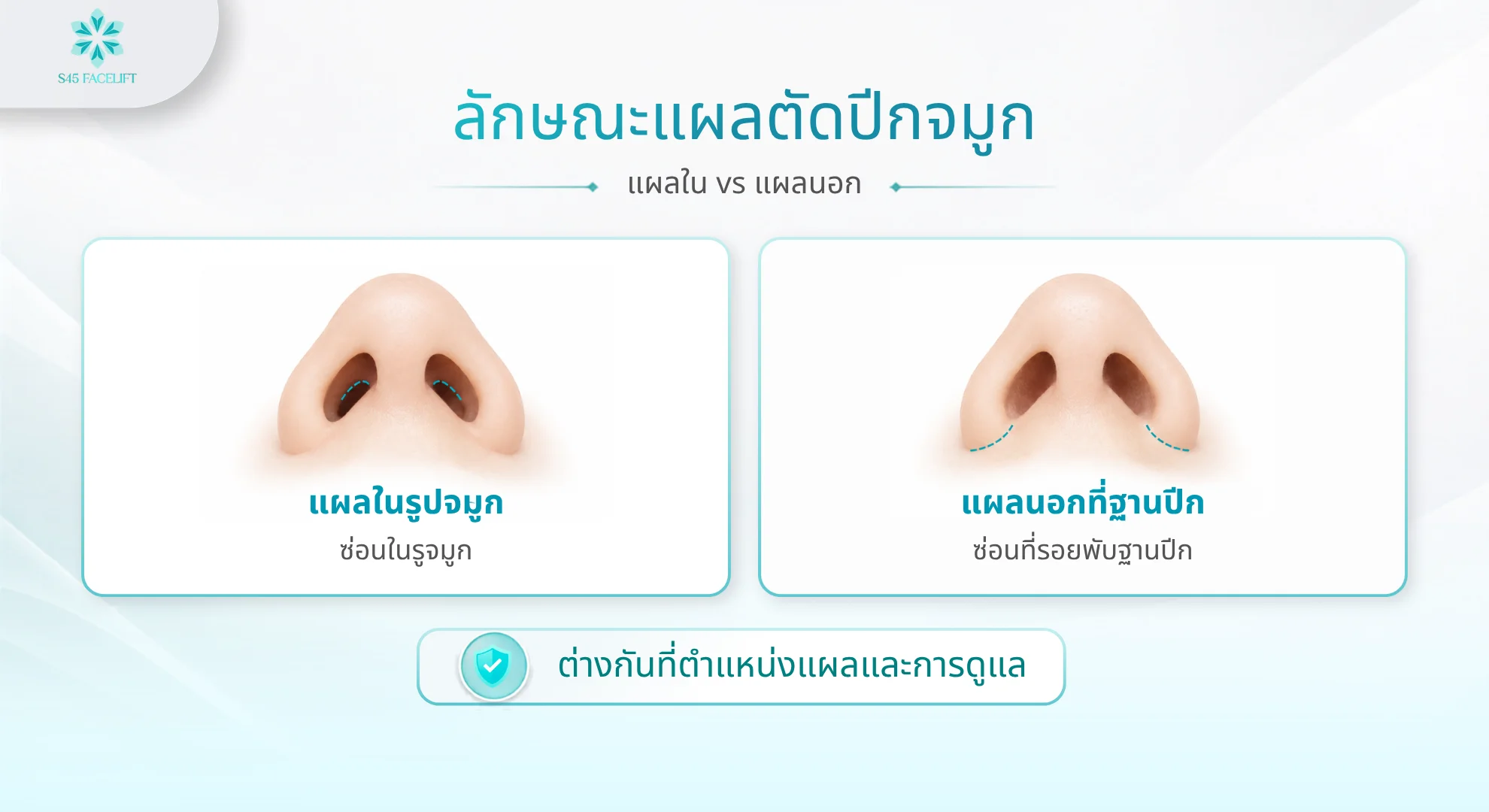
Before learning how to care for the wounds, you need to know which type of wound you have, because internal and external wounds differ slightly in how they look, how long they take to heal and how to care for them. After alar base reduction, the surgeon will always tell you which technique was used.
The main difference between the 2 techniques is the position of the wound and the chance of scarring. The internal technique leaves no visible wound on the outside, while the external technique leaves a wound at the alar base that is hidden in the existing crease.
Both techniques have their own advantages and limitations. The choice depends on what suits each case, and neither technique is the right choice for every case.
Internal Incision (Inside the Nostril)
- Position: inside the nostril, on the upper side of the alar base
- Visibility: no visible wound on the outside
- Chance of keloid: much lower than with an external incision, because the wound is in the inner lining
- Healing: faster, usually fully dry within 2 to 3 weeks
- Care: rinse with saline spray and apply ointment as the surgeon prescribes
External Incision (At the Alar Base)
- Position: the crease at the side of the alar base
- Visibility: a visible wound on the outside, but hidden in the shadow of the facial contours
- Chance of keloid: higher than with an internal incision, especially if you have a history of keloids
- Healing: takes longer, and the mark usually fades close to your normal skin within 3 to 6 months
- Care: clean with saline, apply antibiotic ointment and apply silicone gel after the stitches are removed
How Long Do Alar Base Reduction Wounds Take to Heal? The Healing Timeline
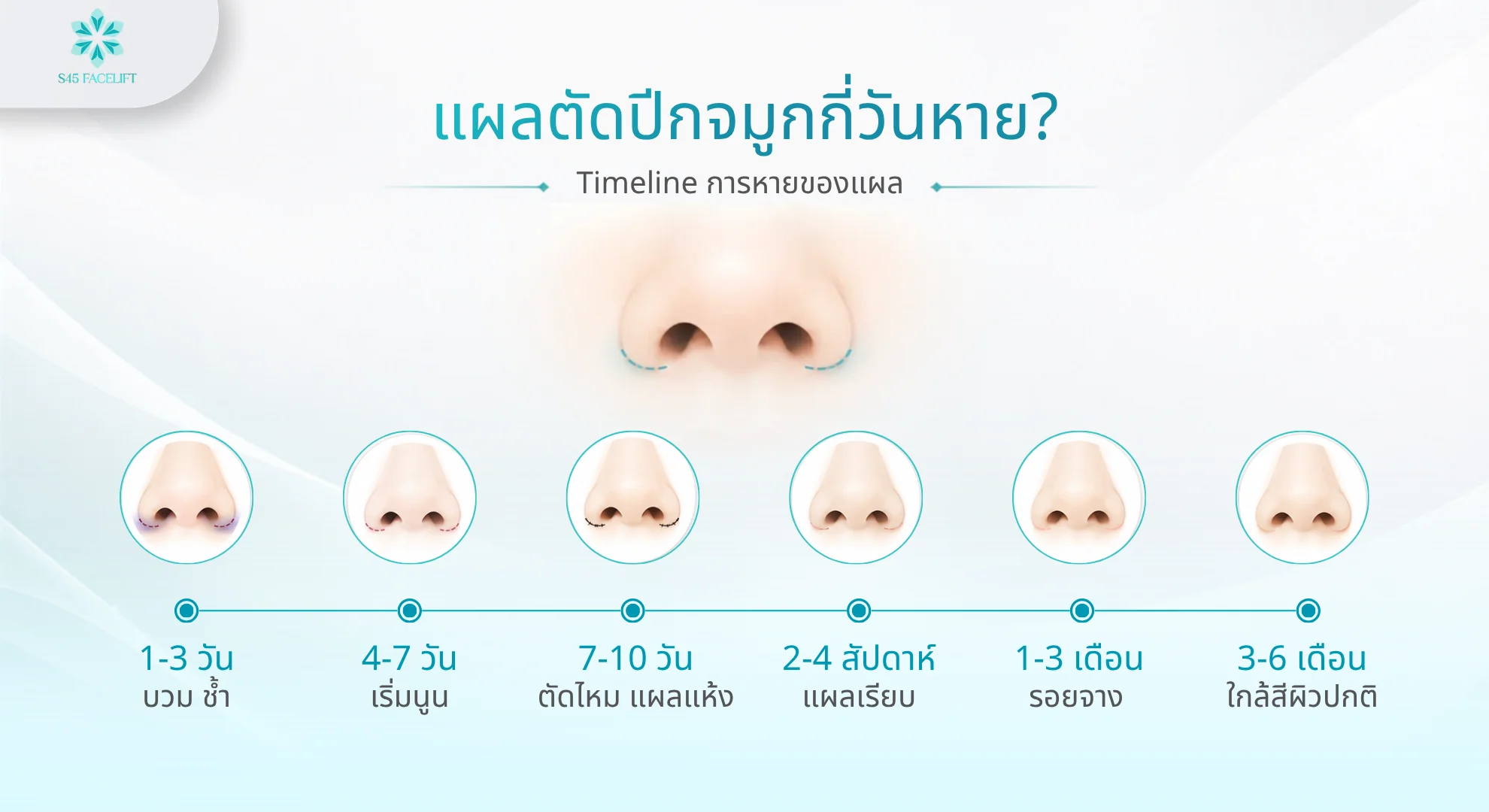
One of the questions people search for most is “How long do alar base reduction wounds take to heal?” There is no single exact answer, because “healed” can mean several different stages, from when the stitches can be removed to when the mark fades close to your normal skin.
Understanding each stage of the healing timeline helps you know when you can return to different activities and check whether your wound is healing normally.
However, this timeline is a general picture. The actual time for each person may be slightly faster or slower, depending on your skin, your general health and how carefully you look after yourself.
Days 1 to 3, Swelling and Bruising at Their Peak
At this stage the wound is still fresh, with clear swelling and bruising. The wound is closed with stitches and supporting adhesive tape. You may feel tightness and pressure around the alae. Apply a cold compress for 15 minutes every 2 to 3 hours during the first 48 hours to reduce swelling.
Days 4 to 7, Swelling Starts to Go Down
Swelling and bruising gradually go down. By days 5 to 7, about 50% to 60% of the swelling remains. You can leave the house for light errands, but still avoid knocks to the nose and do not wear glasses that press on the nose.
Days 7 to 10, Stitches Removed and the Wound Fully Dry
This is when the surgeon schedules stitch removal (for the external technique). The wound starts to dry and close fully. The skin around the wound may be slightly itchy as it heals. Do not pick or scratch it under any circumstances.
2 To 4 Weeks, the Wound Is Smooth and the Swelling Almost Gone
During this stage the wound becomes dry and smoother, and the swelling almost goes away. You start to see the new shape of the alae, close to the shape they will settle into. The wound will still show as a faint pink line.
1 To 3 Months, the Mark Gradually Fades
The mark gradually fades from pink to a colour close to your normal skin. Applying silicone gel and avoiding the sun during this stage are very important, because UV rays can darken the mark and make it clearly noticeable in the long term.
3 To 6 Months, the Wound Fades Close to Your Normal Skin
Usually the wound fades close to your normal skin within 3 to 6 months after surgery. If the surgeon stitches carefully and you care for the wound as advised, the mark at the alar base can blend into the existing crease so it is hard to notice up close, although this depends on each person.
6 Months to 1 Year, the Mark Settles
During this stage the wound fades to a stable level, and any mark that remains usually blends with the surrounding skin. The settled mark should be assessed during this stage, not in the first 1 to 3 months when it has not yet fully faded.
How to Care for Alar Base Reduction Wounds in the First 7 Days
The first 7 days after surgery are important for wound healing and for the chance of complications. Correct care during this stage directly affects how smooth the scar is in the long term.
The surgeon gives wound care advice specific to your case, and gives you antibiotics, anti-swelling medicine and wound ointment to take home. Follow the advice closely and do not miss any doses.
As well as caring for the wound itself, looking after your body as a whole matters. Getting enough rest and eating healthy food help the wound heal well.
Cold Compresses in the First 48 Hours
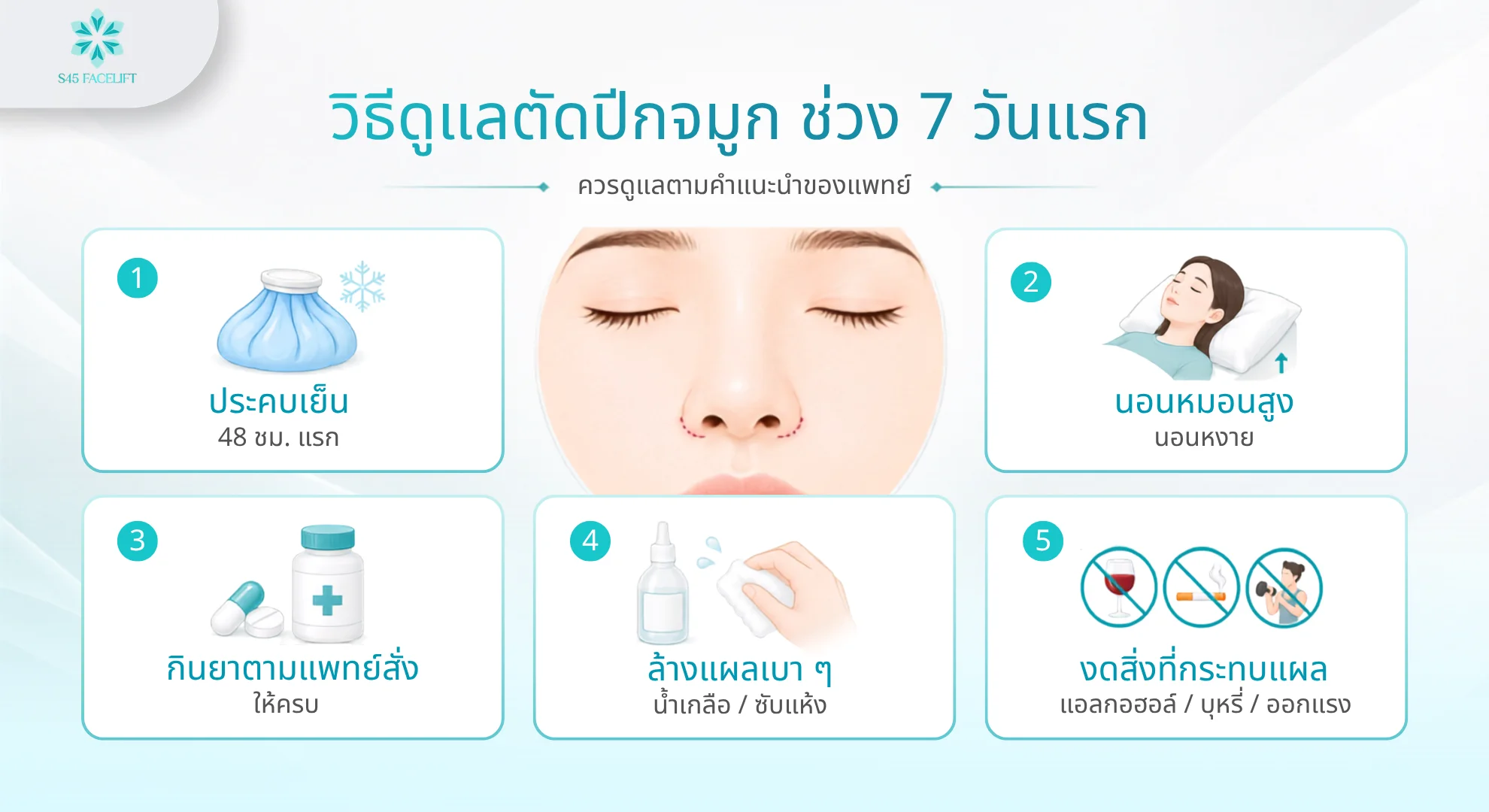
Wrap a cold pack in a clean cloth and hold it on your cheeks and nose for 15 minutes at a time, every 2 to 3 hours. Do not put the cold pack directly on your skin, because the cold can burn the skin. Cold compresses help reduce swelling and bruising.
Sleeping With Your Head Raised
Sleep on your back with your head raised on pillows at about 30 degrees for 7 to 14 days. Do not sleep face down or turn your face to the side, because pressure on the face disturbs the wound and makes the swelling worse.
Taking Medicines as the Surgeon Prescribes
- Antibiotics: finish the full course the surgeon prescribes, even if you feel better
- Painkillers and anti-swelling medicines: take them when you have symptoms
- Avoid medicines and supplements that affect bleeding, such as aspirin, ibuprofen and vitamin E, in the first week
Food and Drinks to Avoid
In the first 7 days, avoid food and drinks that affect wound healing:
- alcohol of any kind
- cigarettes (both smoking and second-hand smoke)
- strongly flavoured or very spicy food
- pickled and fermented food
- large amounts of sweet food
Activities to Avoid in the First 7 Days
- hard exercise
- bending your head down for long periods
- lifting heavy objects
- hot baths and saunas
- using make-up on the wound area
- wearing glasses that press on the bridge of the nose
How to Care for the Wounds From 1 Month to 6 Months
After the stitches are removed and the wound has fully closed, long-term care still matters, because the scar keeps changing for another 3 to 6 months. Good care during this stage affects whether the mark fades well or leaves a lasting scar.
Many people think that once the stitches are out, it is all over. In fact, months 1 to 3 are when the tissue under the wound is still adjusting and making new collagen, so care during this stage clearly affects the long-term result.
The following steps help the wound fade well and lower the chance of keloid scarring.
Applying Silicone Gel or Silicone Sheets
Silicone gel is a medical approach that helps lower the chance of keloid scarring and helps the wound fade faster. Apply it 2 to 3 times a day for 2 to 3 months, or as the surgeon advises. You can start once the wound is fully dry, usually around day 14 after surgery.
Avoiding the Sun
UV rays darken the mark and make it fade more slowly than usual. In the first 3 months:
- apply SPF 50+ sunscreen every day when you go out in the sun
- wear a face mask or use an umbrella in strong sun
- reapply sunscreen every 2 to 3 hours
- avoid sunbathing and long periods of activity in the sun
Taking Vitamins to Support Wound Healing
- Vitamin C: helps the body make collagen
- Vitamin E: helps the wound fade faster (take it only after 2 weeks or more)
- Protein: eat enough to build new tissue
- Water: drink at least 1.5 to 2 litres a day
Returning to Exercise Gradually
- First 2 weeks: gentle walking only
- 3 to 4 weeks: start light exercise that does not affect your nose
- 1 month or more: normal exercise is fine, but avoid sports that could knock your nose
- 2 to 3 months: return to full exercise
Seeing the Surgeon at Your Follow-Up Appointments
- 1 week: stitch removal and wound assessment
- 1 month: follow-up on healing and assessment of the scar
- 3 months: assessment of how the mark has faded
- 6 months: assessment of the settled mark
Read more about looking after yourself after rhinoplasty at how to reduce swelling after rhinoplasty
How to Clean Alar Base Reduction Wounds Correctly
Cleaning the wound correctly helps lower the chance of infection and helps the wound heal smoothly. Many people worry about doing it wrong and making the wound worse, but the steps are not complicated if you follow the advice.
You need only a few supplies, and they are easy to find. Most clinics give you a wound cleaning kit and antibiotic ointment to take home. The key point is to wash your hands thoroughly every time before touching the wound.
Clean the wound 2 to 3 times a day, especially after it gets sweat or everyday dirt on it.
Supplies You Need
- 0.9% saline or saline spray for wound cleaning
- cotton buds or clean gauze
- antibiotic ointment as the surgeon prescribes (such as bacitracin or mupirocin)
- clean water and mild soap for washing your hands
How to Clean an External Wound
- Wash your hands thoroughly with soap and clean water.
- Spray saline onto a cotton bud, or soak gauze in saline.
- Wipe the wound gently from the middle outwards. Do not rub hard.
- Let it dry on its own or pat it gently with clean dry gauze.
- Apply a thin layer of antibiotic ointment as the surgeon prescribes.
- Cover with surgical tape if needed.
How to Clean an Internal Wound
- Spray saline inside the nostril as the surgeon advises.
- Do not push cotton buds deep into the nostril.
- Do not pick your nose or blow it hard in the first 2 weeks.
- Apply ointment around the nostril opening as the surgeon advises.
What Not to Do When Cleaning the Wound
- Do not use alcohol, hydrogen peroxide or iodine tincture directly on the wound, because they damage new tissue.
- Do not rub the wound with cotton wool, because the fibres may stick to it.
- Do not wash the wound directly with tap water.
- Do not pick or scratch the wound, however itchy it is.
Read more about using antiseptics on wounds at worried about wound infection, can I use Betadine?
Scabbing After Alar Base Reduction, Is It Normal and How Should I Care for It?
A common question is “Is it normal for alar base reduction wounds to scab?” The answer is yes. Scabbing is normal and part of the healing process. A scab is a protective layer the body makes to protect the new tissue that is forming.
However, handling scabs the wrong way can slow healing, cause infection or lead to scarring. Letting scabs fall off on their own is the right approach and helps the wound heal well. Do not pick or scratch them under any circumstances.
How long the wound scabs and how long the scabs take to fall off on their own varies from person to person, depending on your skin and how you care for it.
How Long Scabbing Lasts
- Days 4 to 7: thin scabs start to form
- Days 7 to 14: the scabs become thicker and dry
- Days 14 to 21: the scabs start to fall off on their own, little by little
- Days 21 to 30: the scabs have almost all fallen off, showing new skin underneath
What to Do When the Wound Scabs
- Let the scabs fall off on their own.
- Dab on saline gently to soften the scabs so they come off more easily.
- Apply antibiotic ointment as the surgeon advises.
- Keep the wound moist with a thin layer of ointment.
What Not to Do
- Do not pick the scabs off yourself under any circumstances, because this pulls away the new tissue too, which slows healing and raises the chance of scarring.
- Do not rub hard around the scabs.
- Do not wipe with a rough towel.
- Do not wash your face with hot water.
When Is a Scab Not Normal?
- the scab smells bad
- the area around the scab is swollen, red and warm
- pus is coming out from under the scab
- the scab stays on for more than 1 month without coming off
If you have any of these symptoms, see a doctor promptly for a check. Read more about caring for scabbing wounds to lower the chance of keloids at caring for scabbing wounds so they do not become keloids
Warning Signs That Need a Doctor Promptly
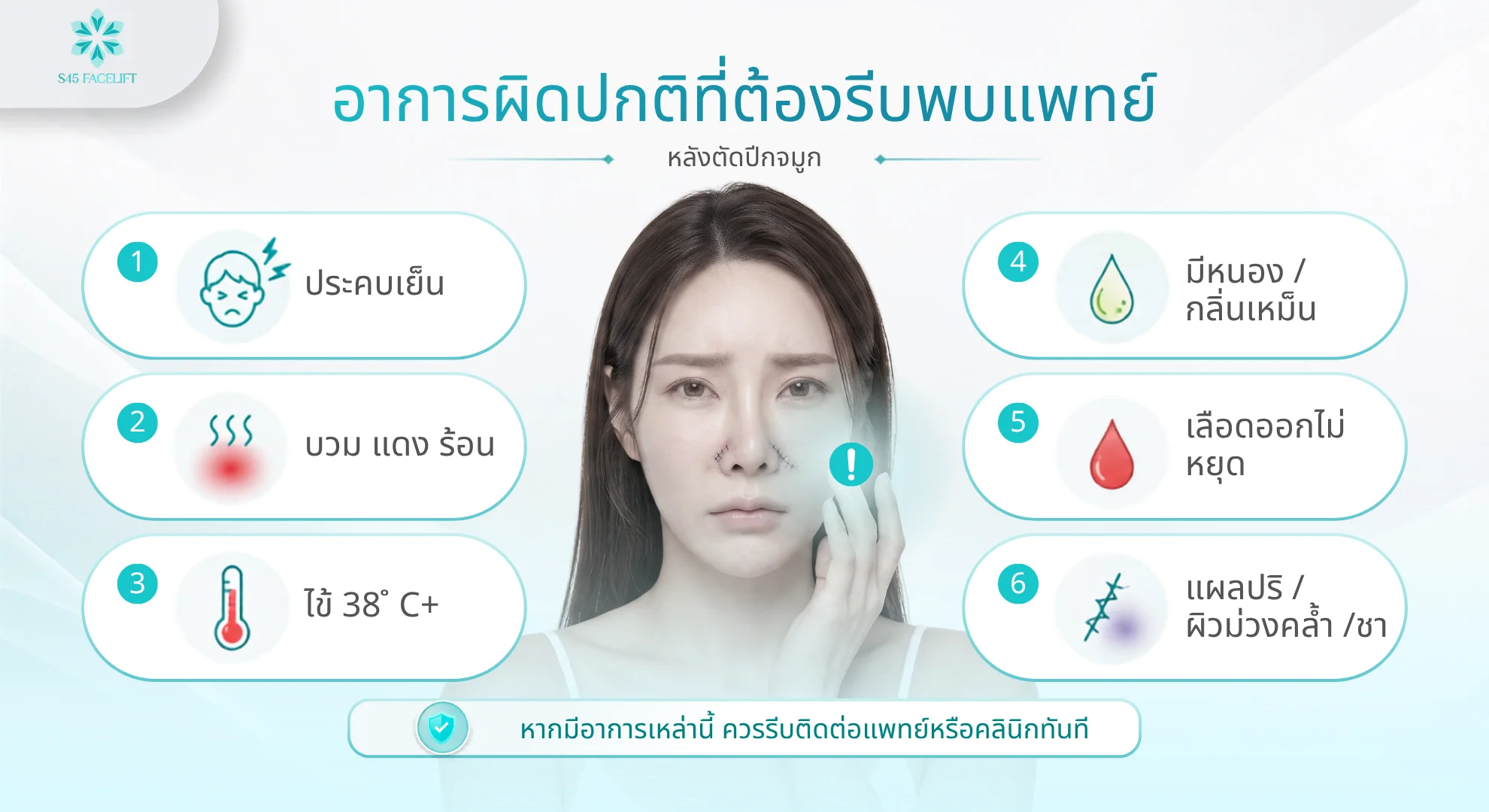
Although alar base reduction wounds are small, complications can happen, as with any other surgery. Knowing how to tell normal symptoms from those that need a doctor promptly is important for everyone.
In the first 7 to 14 days you may get symptoms that worry you, such as swelling, bruising and mild pain. Most of these are a normal part of healing, but some symptoms are signs of a complication that needs urgent treatment.
If you have any of the symptoms in the list below, contact the clinic or the surgeon who operated on you straight away. Do not wait for the symptoms to get worse, because complications treated late are harder to fix.
Symptoms That Need a Doctor Promptly
- unusually severe pain that normal painkillers do not help
- swelling, redness and warmth around the wound that get worse instead of better
- a fever of 38°C or higher
- pus coming out of the wound
- a bad smell from the wound area
- bleeding that does not stop, or bleeding that starts again after stopping
- a wound that opens or splits
- skin around the wound turning black or purple
- numbness in the face that does not go away
Normal Symptoms That Are No Cause for Worry
On the other hand, these symptoms are a normal part of healing and are no cause for alarm:
- swelling and bruising in the first 7 to 14 days
- tightness and pressure around the alae
- mild itching as the wound heals (do not scratch)
- faint redness around the wound for 1 to 3 months
- a feeling of a firm lump under the wound at first (this is scar tissue that gradually flattens)
- dry skin around the wound that peels in small flakes
If You Think Something Is Not Normal
If you are not sure whether a symptom is normal, take a photo of the wound and send it to the clinic to assess first. A good clinic should have an aftercare system that responds quickly and gives correct advice. A photo helps the doctor assess the wound more accurately than a description in words.
Read more about moist, itchy wounds after rhinoplasty at moist, itchy wounds after rhinoplasty
Alar Base Reduction Wounds That Open, Causes and Treatment
An alar base reduction wound that opens is an uncommon complication, but when it happens it needs the right treatment. A wound opening means the edges of the wound separate before the tissue has fully healed, which slows healing and raises the chance of a noticeable scar.
A wound can open for several reasons, both from incorrect self-care and from factors you cannot control. Understanding the causes can help lower the chance of it happening in most cases.
If a wound opens, do not panic or try to manage it yourself. See a doctor promptly for assessment and treatment. Early treatment helps limit the effect on how the wound looks in the long term.
Causes of Alar Base Reduction Wounds Opening
- a hard knock to the wound area
- rubbing your eyes or nose in the early stage
- infection weakening the tissue around the wound
- hard exercise before the wound has fully closed
- coughing, sneezing or blowing your nose hard in the early stage
- health factors, such as diabetes, which slows wound healing
Signs That a Wound Has Opened
- a gap in the wound that was not there before
- fluid coming out of the wound
- a sudden increase in pain
- sometimes, some oozing blood
- wound edges pulling apart
What to Do If a Wound Opens
- Do not panic. Stay calm and check how large the opening is.
- Cover the wound with clean gauze to keep dirt out.
- Contact the clinic straight away and send photos for the doctor to assess.
- Go to see the doctor as arranged, and do not put it off.
- Do not apply anything yourself until the doctor advises you to.
How an Opened Wound Is Treated
The doctor assesses the size of the opening and decides on treatment:
- small cases: the wound may be left to heal on its own with close care, ointment and frequent dressing changes
- moderate cases: the wound is stitched closed again in a minor operating theatre
- large cases or cases with infection: the wound may need to be opened, cleaned and stitched closed again once the infection is under control
Raised Alar Base Reduction Scars or Keloids, How Are They Treated?
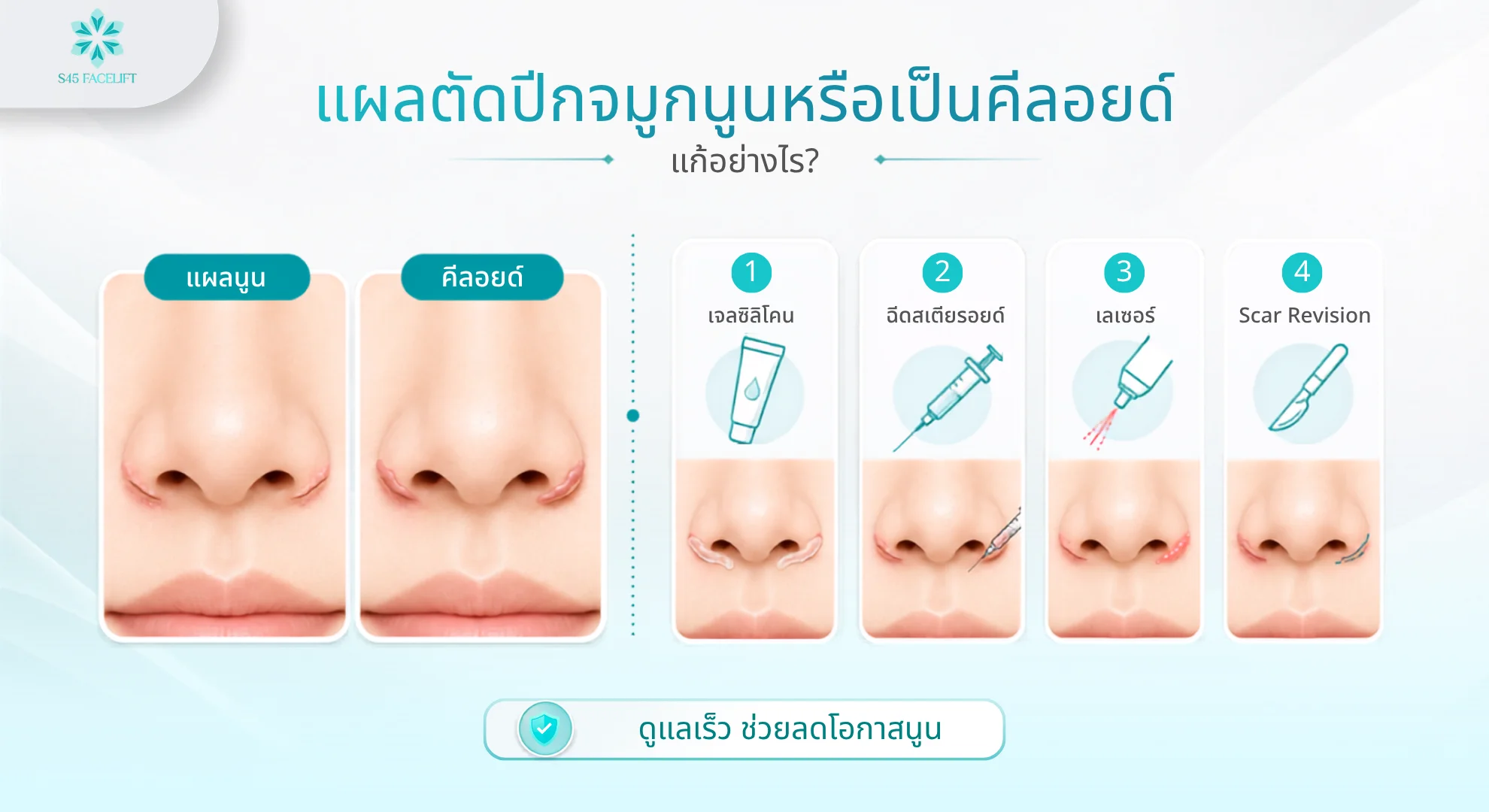
A raised alar base reduction scar, or keloid scar, is when the body makes more scar tissue than it needs, so the scar is raised above the surrounding skin. Many people worry about this because it is hard to treat and affects how the scar looks in the long term.
The chance of a keloid depends on genetics, skin colour and where the wound is. People who have had keloids before, or who have family members with keloids, have a higher chance than other people.
Although keloids cannot be 100% prevented, good care in the first 1 to 3 months after surgery can lower the chance.
Raised Scars Compared With Keloids
Before deciding whether a scar is a keloid, it helps to understand the difference.
Ordinary raised scar (hypertrophic scar)
- raised only within the wound area and does not spread
- often fades and flattens on its own within 6 months to 1 year
- responds well to treatment
Keloid
- raised and spreads beyond the edges of the original wound
- does not flatten on its own and may keep growing in the long term
- firm and may be itchy or painful
- responds to treatment more slowly
How to Lower the Chance of Raised Scars and Keloids
- Apply silicone gel: from when the wound is fully dry, for at least 2 to 3 months
- Avoid the sun: in the first 3 months
- Avoid pulling on the wound: take care with movements that stretch it
- Press gently: press gently on the wound with your finger for 5 to 10 minutes a day (after the wound is fully dry)
- Take vitamins that support healing: such as vitamin C and protein
How Raised Scars and Keloids Are Treated
If one does develop, there are several treatment options, depending on how severe it is and how it responds.
1. Silicone gel or sheets: used as a first-line treatment and often works well for slightly raised scars. Use them continuously for 3 to 6 months.
2. Steroid injections: the doctor injects a steroid directly into the scar to reduce inflammation. This is often used for moderately to very raised scars and needs repeat injections every 4 to 6 weeks.
3. Laser: helps reduce how raised the scar is and brings its colour closer to your normal skin. It is used when the scar does not respond to creams.
4. Surgical correction (scar revision): for large keloids that do not respond to other treatments, the doctor may consider surgically removing the keloid and stitching the wound again, with additional care to lower the chance of it coming back.
Read more about keloid treatment at keloids after rhinoplasty and more medical information at Cleveland Clinic, Scars
How to Reduce Alar Base Reduction Scars in the Long Term
Even after the wound has fully healed, some people can still see a fine line at the alar base. Reducing a scar in the long term is possible, with options ranging from self-care to medical treatments.
Before choosing a treatment, have the scar assessed by a doctor, because each type of scar responds to treatment differently. Ordinary marks that fade slowly respond well to home care, while raised scars or keloids need medical treatment.
Treatment time varies with each method. Realistic expectations and consistency are key to a good result, and results depend on each person.
1. Scar-Reducing Creams
Use a cream or gel with ingredients that help reduce scars, such as onion extract (Allium cepa) or Mederma, 2 to 3 times a day for 2 to 3 months. This suits ordinary scars that have not fully faded.
2. Silicone Gel Sheets
Silicone gel sheets help the wound fade and lower the chance of it becoming raised. Wear a sheet on the wound for 12 to 24 hours a day for 2 to 3 months. This suits lowering the chance of keloids and helping the mark fade.
3. Laser Scar Treatment
Lasers such as fractional CO2 or pulsed dye laser help bring the colour and texture of the scar closer to your normal skin. They are used for scars that are dark or slightly raised. Several sessions are needed, with the result assessed after each one.
4. Steroid Injections
The doctor injects a steroid directly into the raised scar to reduce inflammation and flatten it. This is used for raised scars or keloids and needs repeat injections as the doctor advises.
5. Surgical Scar Correction (Scar Revision)
For large or very raised scars, or keloids that do not respond to other treatments, the doctor may consider surgically removing the old scar and stitching again, with additional care to lower the chance of it coming back. This is used when other options have not worked.
Choosing a Treatment
- Ordinary fading marks: start with creams and silicone gel
- Dark marks: add sun protection and consider laser
- Slightly raised marks: keep applying silicone gel
- Very raised scars or keloids: see an experienced doctor to consider steroid injections or laser
- Scars that do not respond: consider surgical correction
Why Choose Wound Care After Alar Base Reduction at S45 Clinic
Caring well for alar base reduction wounds does not end the day you leave the operating theatre. It continues for another 6 months to 1 year. A thorough aftercare system and doctors who are available for consultation throughout help you feel reassured along the way, although results depend on each person. This reflects our promise “Because all beauty comes from care”
Surgeons With Training in the Relevant Fields
Our surgeons are otolaryngologists (ear, nose and throat doctors) with sub-specialty training in facial plastic and reconstructive surgery, and they look after alar base reduction cases and wound care. Fine, careful stitching is an important first step towards a wound that heals smoothly.
Aftercare for 6 Months
- Follow-up appointments at 1 week, 1 month, 3 months and 6 months
- Advice on caring for your wound at each stage
- A LINE chat for asking our team about any symptoms that concern you
- Risk assessment and advice on lowering the chance of keloids from the first day
- Care if complications from surgery occur, under the clinic’s terms
Individual Advice, Not a One-Size-Fits-All Plan
Each person has different skin, healing and risks. The doctor assesses your case and recommends care specific to you, rather than using the same guide for everyone. People with a history of keloids get more intensive advice, while people whose wounds are healing well get care adjusted to suit them. We look after you from after surgery until the wound has settled.
FAQ, Common Questions About Alar Base Reduction Wounds
How Long Does an Alarplasty Scar Take to Heal?
“Healed” has several stages: stitch removal at 5 to 7 days, the wound fully dry at 2 to 4 weeks, the mark fading close to your normal skin at 3 to 6 months, and the mark settling at 6 months to 1 year. Timing varies with your skin, your health and how carefully you care for the wound.
Is It Normal for Alar Base Reduction Wounds to Scab?
Yes, it is normal and part of the healing process. Scabs start to form on days 4 to 7, become thicker on days 7 to 14 and start to fall off on their own on days 14 to 21. Do not pick the scabs off yourself under any circumstances, because this pulls away the new tissue too, which slows healing and raises the chance of scarring.
What Should I Do If My Alar Base Reduction Wound Opens?
Do not panic or try to manage it yourself. Cover the wound with clean gauze, contact the clinic straight away and send photos for the doctor to assess, then go to see the doctor as soon as possible. The doctor assesses the size of the opening and decides on treatment, which may mean letting it heal on its own or stitching it closed again, depending on how severe it is.
Is a Raised Alar Base Reduction Scar a Keloid?
Not necessarily. An ordinary raised scar (hypertrophic scar) is raised only within the wound area and often fades on its own within 6 months to 1 year, while a keloid is raised beyond the edges of the original wound and does not flatten on its own. Treatments for both range from silicone gel and steroid injections to laser and surgical correction.
How Do I Clean an Alar Base Reduction Wound Correctly?
Wash your hands first, use 0.9% saline spray and wipe the wound gently with a cotton bud from the middle outwards. Let it dry on its own or pat it gently dry, then apply antibiotic ointment as the surgeon prescribes. Do this 2 to 3 times a day. Do not use alcohol, hydrogen peroxide or iodine directly on the wound.
What Should an Alar Base Reduction Wound Look Like at 1 Month?
At 1 month after surgery, the wound should be fully closed and the scabs should all have fallen off. The mark shows as a faint pink line that gradually fades. Swelling and bruising should be almost gone, and you start to see the new shape of the alae, close to the shape they will settle into. If the wound is still red and warm or very swollen at this stage, see a doctor promptly.
When Do I Need to See a Doctor Promptly?
Symptoms that need a doctor promptly include unusually severe pain that painkillers do not help, swelling, redness and warmth that are getting worse, a fever of 38°C or higher, pus or a bad smell from the wound, bleeding that does not stop, a wound that opens, skin turning black or purple, and numbness in the face that does not go away.
How Many Days Until I Can Wear Glasses?
After alar base reduction on its own, you can wear glasses once the wound is fully dry, at about 1 to 2 weeks. If you also had rhinoplasty, wait 4 to 6 weeks for the bridge of the nose to settle first, because pressure from glasses may disturb the settling of the silicone implant.
How Do I Use Sunscreen After Alar Base Reduction?
You can start applying sunscreen once the wound is fully dry, at about day 14 after surgery. Choose an SPF 50+ sunscreen that is fragrance-free and suitable for sensitive skin. Apply it every day, even indoors, and reapply every 2 to 3 hours when you are in the sun. Sun protection is key to helping the wound fade and not darken in the long term.
When Can I Start Exercising?
- First 2 weeks: gentle walking only
- 3 to 4 weeks: light exercise is fine, such as gentle yoga or Pilates
- 1 month or more: normal exercise is fine, but avoid sports that could knock your nose
- 2 to 3 months: return to full exercise, including sports that could knock your face
Summary
Alar base reduction wounds are small wounds inside the nostril (internal wounds) or in the crease at the side of the alar base (external wounds). The healing timeline has these main stages: stitch removal at 5 to 7 days, the wound fully dry at 2 to 4 weeks, the mark fading close to your normal skin at 3 to 6 months and the mark settling at 6 months to 1 year. Good care at each stage affects how smooth the scar is in the long term.
Normal symptoms include swelling and bruising in the first 7 days, scabs that form and fall off on their own within 14 to 21 days, and faint redness for 1 to 3 months. If you notice warning signs such as severe pain, swelling with redness and warmth, fever, pus, a wound that opens or bleeding that does not stop, see a doctor straight away. Early treatment helps limit the effect on how the wound looks in the long term.
Opened wounds, raised scars and keloids can be treated in several ways, from silicone gel and sun protection to steroid injections, laser and surgical correction. A consultation with an experienced doctor to assess your scar and choose a suitable treatment is key to a good result.
Because every nose structure…
is different
An otolaryngologist with subspecialty training in facial plastic and reconstructive surgery assesses every case before treatment and gives advice based on your actual concerns.
“Reveal the beauty within you”
Message us online
Surgery and medical procedures carry risks. Find out about them and consult a doctor before you decide. Results depend on each person.