How Long for Your Nose to Settle After Rhinoplasty? What Settling Is and How to Care for It

After rhinoplasty, one question almost everyone has is ‘Has my nose settled yet?’ Some people are impatient for the shape to settle quickly, some worry that it will not settle well, and many wonder what this process actually is, as it is often mentioned but rarely explained clearly.
Key points
- Nose settling is the process in which the body forms fibrous tissue (scar tissue) around the silicone implant or other nasal implant until it is held firmly in the tissue under the skin, so the silicone stays in place and does not move.
- Complete settling takes 3 to 12 months. It starts to show in month 3, becomes firm by month 6 and is fully complete at month 12.
- 5 signs your nose has settled, swelling has almost gone, the tip is softer, the shape is stable, the silicone does not move when pressed, and the nose feels like part of your face.
- After settling, the nose does look higher because the swelling goes down and the final shape settles into place, and the tip looks smaller because the fibrous tissue draws it into a slimmer shape. This means the shape that was designed becomes clearer, not that the nose actually shrinks.
- Does settling hurt? Most people feel tightness or firmness rather than pain. The tightness gradually eases until it goes in months 3 to 6.
- Uneven settling on one side, or a shape you are unhappy with, can have several causes, including sleeping position, daily activities or surgical technique. If you notice this, have a consultation with your surgeon promptly.
This article explains nose settling in detail, from what it is and how it works, a timeline of each stage and 5 signs that your nose has settled, to the truth about the tip looking smaller and the bridge looking higher, 8 ways to look after yourself as your nose settles, uneven settling or a shape you are unhappy with, and how it compares with botulinum toxin injections to sharpen the nose.
In This Article
What Nose Settling Is and Why It Matters
Nose settling is the process in which the body forms fibrous tissue around the silicone implant or cartilage that the surgeon placed in the nose. This fibrous tissue gradually holds the implant firmly to the surrounding tissue, so the silicone stays where the surgeon placed it and does not move out of position.
This process starts straight after surgery but takes several months to complete. It is the body’s normal response to something foreign (a foreign body response). This matters because, before the nose settles, the silicone can still move and pressure can change the shape of the nose, so in the early stage take extra care with your sleeping position, wearing glasses and touching your nose.
How the Tissue Settles
The body forms new tissue during 4 stages of wound healing, inflammation, proliferation (forming new tissue), remodelling (reorganising the structure) and maturation (strengthening). Each stage follows on from the last and is needed for complete settling. Find out more in ASPS Rhinoplasty Recovery
Why It Helps to Understand Settling
Understanding this process helps you decide when you can return to normal activities, such as sleeping on your side, doing hard exercise, wearing glasses that rest on the bridge or touching your nose. Doing these things before your nose has settled may change the shape of your nose.
Settled and Unsettled Nose, What Is the Difference?
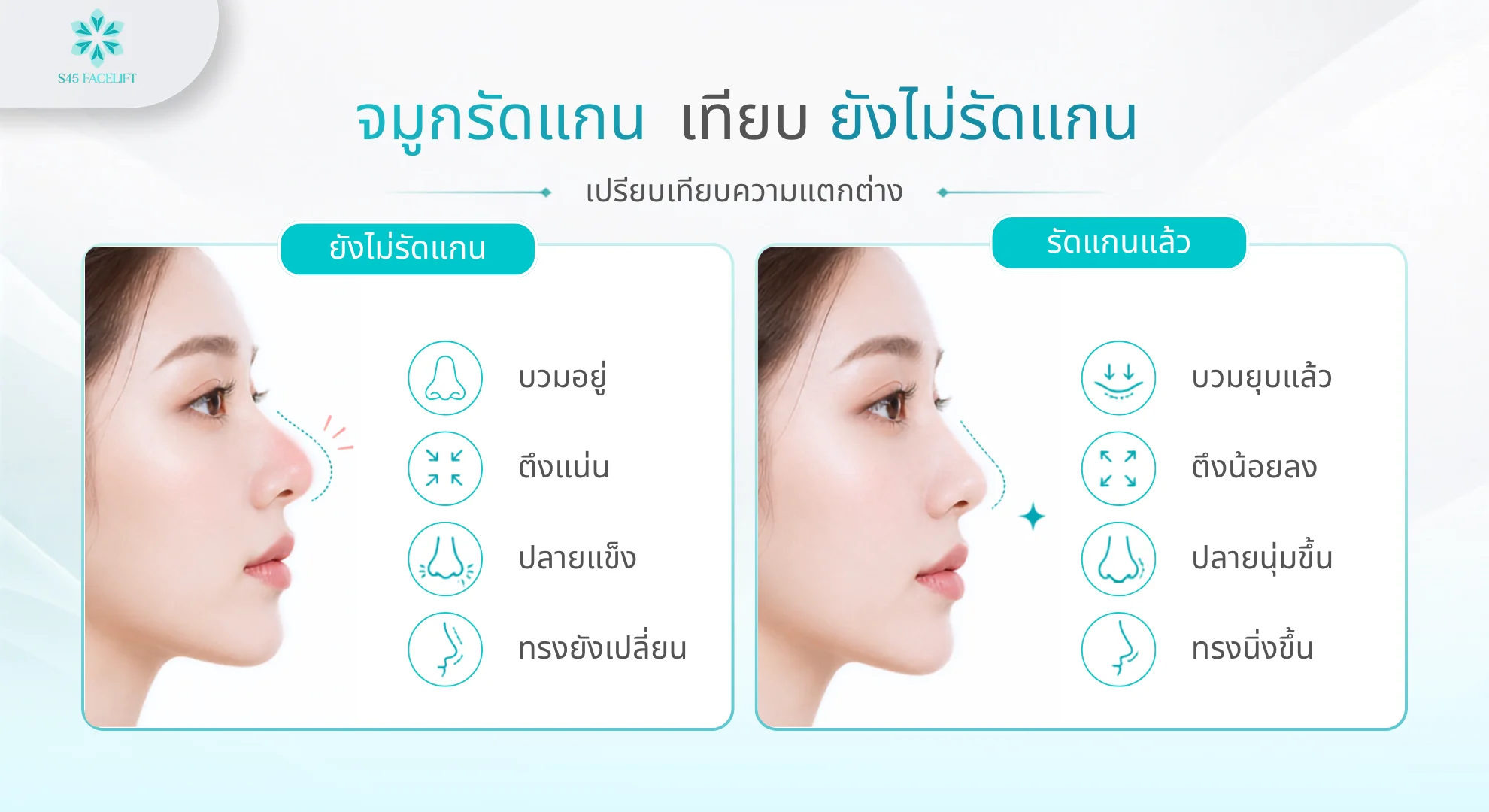
Many people wonder how they can tell whether their nose has settled or not, because the process happens in the tissue under the skin where it cannot be seen. In fact, there are differences you can notice both in how it looks and how it feels. In the early stage before the nose settles, the silicone is like a piece floating in the tissue under the skin, and pressure or strong facial movements can make it move. Once the nose has settled, the silicone is held firmly in the tissue under the skin.
| Feature | Nose not yet settled | Nose settled |
|---|---|---|
| Swelling | Still swollen | Swelling almost gone |
| Tightness | Tight and firm | Little or no tightness |
| Nasal tip | Hard, not soft | Soft, moves easily |
| Pressing on the nose | Silicone feels like it moves | Silicone stays still |
| Nose shape | May change from week to week | Stable, not changing |
| Scar colour | Red or pink | Faded |
| Overall feeling | Feels like something foreign | Feels like part of your face |
| Activities you can do | Limited, take care | Almost all |
How It Feels Before the Nose Settles
In the early stage after surgery, you may feel tightness as if something is pinching your nose. The tip feels hard, and when you touch it you can feel something firm inside. When you smile or talk, your nose may feel stiff. This happens because the tissue under the skin has not yet settled and the fibrous tissue has not fully formed.
How It Feels Once the Nose Has Settled
After settling, the tightness almost disappears. The tip becomes softer and moves more freely, and smiling and talking feel normal. Most importantly, the shape of the nose becomes stable and no longer keeps changing from week to week as it did in the early stage.
How Long for Your Nose to Settle After Rhinoplasty, a Detailed Timeline
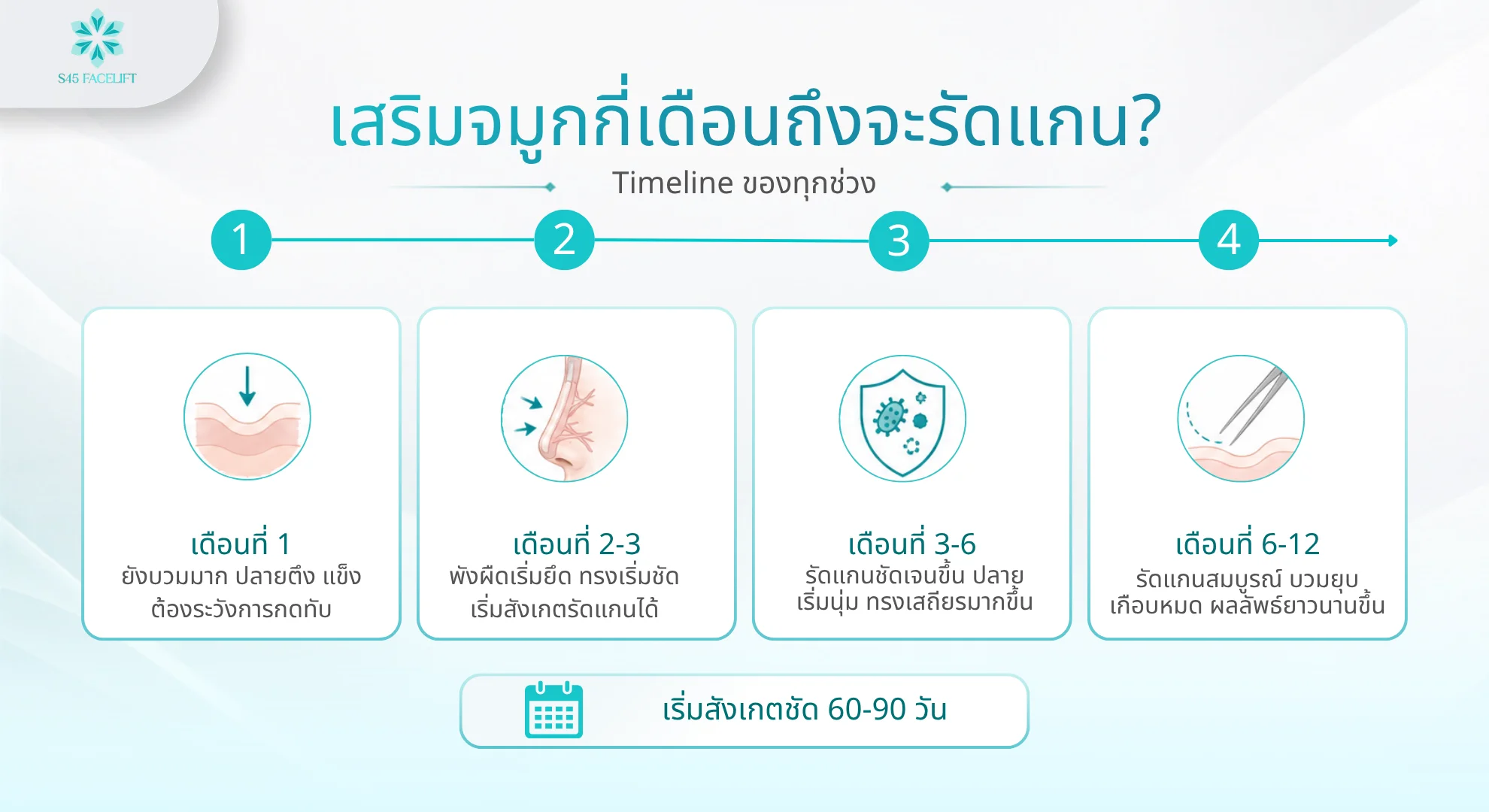
Settling takes different lengths of time at each stage, and most people need 3 to 12 months for complete settling. The exact time depends on several factors, such as the technique used, your health and age, how you look after yourself after surgery, and nutrition. In cases using rib cartilage (open rib rhinoplasty), settling takes slightly longer than with other techniques.
Try to be patient if your nose has not settled by month 3 or 6, because each case takes a different amount of time. If you still feel something is wrong after 12 months, have a proper consultation with your doctor. See more about recovery in general in How to reduce swelling after rhinoplasty
Month 1, Swelling and Starting to Settle
At this stage, the nose is still about 70% to 90% swollen, and the swelling goes down week by week. The tip is still hard and tight, the silicone can still move, and you need to take extra care with your sleeping position. The fibrous tissue has started to form but not enough yet. At this stage, some people may still feel pain 1 month after rhinoplasty, which is normal.
Months 2 to 3, Fibrous Tissue Starts to Hold
Swelling has gone down by almost 90% and the shape of the nose becomes clearer. The fibrous tissue starts to hold the silicone to some extent, so the silicone is harder to move, but strong pressure is still a risk. In month 3, many people start to feel their nose has settled, which is the start of visible settling.
Months 3 to 6, Settling Becomes Clear
The shape of the nose becomes more stable, the tightness eases noticeably, the tip starts to soften and the scar fades. You can sleep on your side without affecting your nose. In typical cases, the nose is fairly firmly settled by month 6, but there are still small changes.
Months 6 to 12, Settling Is Complete
The final shape settles into place, the swelling has gone and the tip is soft and moves easily. The silicone is held firmly in the tissue under the skin. The result you see at month 12 is usually the long-term result, although this depends on each person. The final assessment of rhinoplasty should be made 12 months or more after surgery.
5 Signs Your Nose Has Started to Settle
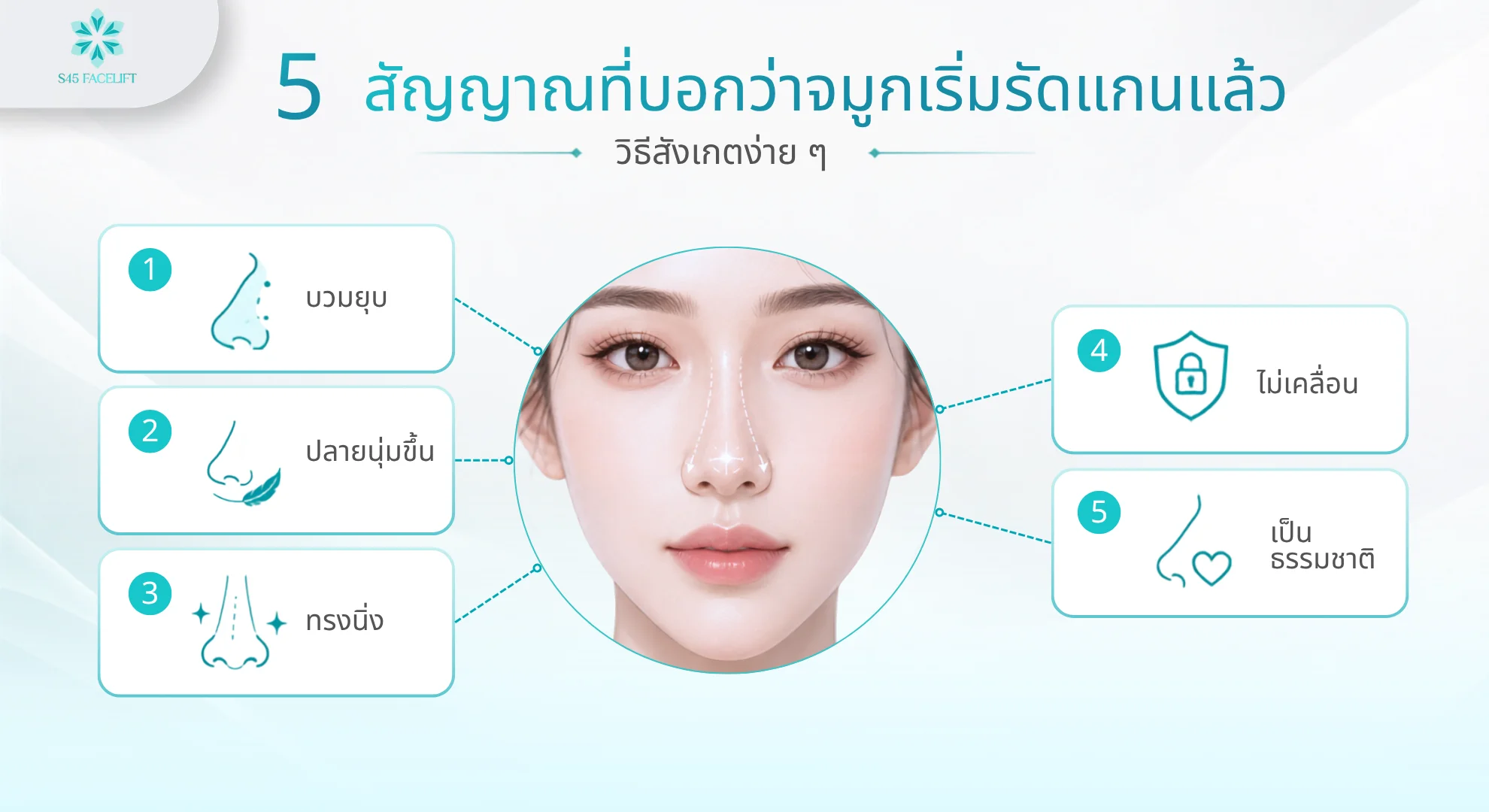
The changes in the tissue under the skin happen inside and cannot be seen directly, but several outward signs give a fairly accurate picture. Even so, an accurate assessment needs a check by your surgeon. Do not rely on outward signs alone to decide when to return to activities that could affect your nose.
Sign 1, Swelling Has Almost Gone
The swelling has gone down by about 90% or more. The size and shape look close to the shape the nose will settle into, the nasal structure is clearly visible, and the swelling around the eyes and nearby areas has gone.
Sign 2, the Tip Feels Softer
The tip, which was hard and tight in the early stage, gradually softens as the nose starts to settle. When touched gently, it can move slightly and no longer feels as hard as before.
Sign 3, the Shape Is Stable and Not Changing
When you look in the mirror or take photos, you see the same nose shape each time, without the week-to-week changes of the early stage. This is a sign that the structure has settled into place.
Sign 4, the Silicone Does Not Feel Like It Moves When Pressed Gently
Gently touch both sides of your nose. If the silicone feels like it stays in the same position and does not move easily, the fibrous tissue is holding it firmly. Do not press hard to test it, because this could move the silicone if your nose has not fully settled.
Sign 5, the Nose Feels Like Part of Your Face
In the early stage, it may feel as if there is something foreign in your nose, but once the nose has settled, this feeling goes away. Your new nose feels like part of your face, and you can smile, talk and laugh comfortably.
What Does Settling Feel Like, and Does It Hurt?
During settling, most people feel tightness or firmness rather than pain, with some unfamiliar sensations in the area. How much people feel varies widely. Some people hardly feel anything, while others feel it clearly, depending on how sensitive their nerves are and their general health.
Tightness and Firmness (Normal)
In the first 1 to 3 months, you will feel tightness along the bridge and tip, as if something is pinching your nose. This is more noticeable when you smile widely or talk. As for how many days after rhinoplasty the tightness goes, it has usually almost gone after about 3 to 6 months.
Numbness and Mild Itching (Normal)
In the early stage, you may feel numbness at the tip or under the nose, because small nerves are affected during surgery. This improves within 3 to 6 months. You may also feel itching around the nose, which is a sign that the tissue under the skin is healing. Do not scratch it.
Symptoms That Are Not Normal
If you have severe pain that continues for 2 weeks or more, swelling that comes back in months 2 to 3, or pain 1 month after rhinoplasty that keeps getting worse, go back to see your doctor for an assessment. Do not wait and watch the symptoms yourself for too long.
Does the Bridge Look Higher and the Tip Smaller After Settling?
The answer is yes to both, but not in the way many people think. In the early stage after surgery, swelling and fluid build-up make the nose look larger and less defined. The final shape the surgeon designed is still ‘hidden’ under the swelling. As the swelling goes down and the nose settles, the designed shape becomes clearer.
The Truth About the Bridge Looking Higher After Settling
The bridge looks higher for 2 main reasons. The swelling that hid the true height of the bridge goes down, and the fibrous tissue holding the silicone makes the shape sharper and more defined. The true height of the bridge is what the surgeon designed from the start, not the silicone pushing itself higher.
Why the Tip Looks Smaller and Slimmer
In the early stage, the tip is swollen and tight, which makes it look larger and rounder. As the swelling goes down and the fibrous tissue tightens the tissue under the skin, the tip looks slimmer. This is the final shape the surgeon planned from the start. Find out more in Will my nasal tip get smaller as my nose settles?
Does the Nose Actually Shrink?
The size of the nose does not actually change. What changes is the proportions and definition of each part. The bridge, tip and alae look slimmer and more defined as the swelling goes down and the fibrous tissue settles into place.
8 Ways to Look After Yourself as Your Nose Settles

Although settling is a process your body goes through on its own, looking after yourself properly helps it go smoothly. Many people ask whether there is a way to make the nose settle faster. What you can do is support the process, especially in the first 1 to 3 months when settling is most active.
1. Sleep on Your Back With Your Head Raised for the First 2 Weeks
Use 2 to 3 pillows to keep your head raised above your heart at 30 to 45 degrees. This helps reduce the build-up of fluid and blood, helps the swelling go down and helps keep the silicone in place. Find out more in How many days after rhinoplasty can I sleep on my side?
2. Use Cold Compresses for the First 48 Hours
Use a cold cloth or cold gel pack around the nose (not directly on the nose) for 10 to 15 minutes at a time, every 1 to 2 hours. This helps reduce swelling and bruising in the early stage. After 48 hours, switch to warm compresses to help blood flow.
3. Eat a High-Protein Diet With a Full Range of Vitamins
Good-quality protein (eggs, chicken, freshwater fish, tofu), vitamin C (oranges, guava, kiwi), vitamin E (avocado, nuts) and zinc help stimulate the formation of collagen and fibrous tissue. See more food advice in What to eat after rhinoplasty
4. Avoid Foods That Increase Swelling and Inflammation
Avoid seafood, pickled and fermented foods, spicy food, durian, alcohol and caffeine in the first month, as they may increase swelling and slow healing.
5. Avoid Hard Exercise for 1 Month
Hard exercise makes your blood pump faster and may affect the nose. You can start light exercise, such as walking, after 2 weeks, and return to full exercise after 1 month.
6. Avoid Sunlight and Use Sunscreen
Sunlight may darken the scar and trigger inflammation. Apply SPF 50+ sunscreen every day and avoid being in direct sun for the first 3 months.
7. Do Not Smoke or Drink Alcohol
Both damage the cells that repair wounds and reduce blood flow to the tissue under the skin. Stop for at least 1 month and limit them during the first 3 months.
8. Get Enough Sleep and Manage Stress
Sleep 7 to 8 hours a night, which is when the body repairs itself well. Stress raises the hormone cortisol and interferes with healing.
Uneven Settling on One Side, Causes and What to Do
‘Uneven settling on one side’ is when one side of the nose looks settled while the other side is still swollen or does not look even. In the first 1 to 3 months, uneven settling between both sides is common and nothing to panic about. After 3 to 6 months, the difference is usually smaller, but if you can still see a clear difference after 6 months, have a consultation with your surgeon.
Causes of Uneven Settling on One Side
It may be caused by several factors, such as repeatedly sleeping on one side in the first 1 to 2 months, sleeping on your front, regularly chewing on one side, uneven cartilage structure to begin with, or differences in how the tissue under the skin heals on each side depending on your body.
How to Check and What You Can Do
Check by looking at your face straight on in a mirror, or by taking photos from the front and both sides to compare. During recovery, avoid repeatedly lying with pressure on one side, do not sleep on your front, take care to avoid knocks and attend your follow-up appointments. Only massage your nose if your doctor advises it.
What to Do If You Are Unhappy With the Shape After Settling
If, after 6 to 12 months, the result is not what you expected, for example the shape is not as you hoped, the nose is crooked, the tip droops, the silicone is clearly visible or the bridge is too high, these problems can often be corrected with revision rhinoplasty, depending on each person. Before deciding on a correction, wait at least 12 months for the shape to fully settle.
Factors That Can Lead to an Unsatisfactory Shape
It may be caused by a silicone implant size that does not suit your face, a nose shape that does not match your existing nasal base, a surgical technique that does not match how complex the case is, too little nasal tissue, or fibrous tissue pulling and changes in the tissue under the skin after surgery.
Correction With Revision Rhinoplasty
Correction is more complex than the first surgery, because the existing fibrous tissue has to be released and the changed tissue under the skin has to be managed. Choose a surgeon with experience in revision rhinoplasty. Find out more about revision rhinoplasty
Which Symptoms Are Not Normal and Need a Doctor Promptly?
Telling normal symptoms apart from abnormal ones is important, because waiting can make problems worse. Normal symptoms are those that happen during recovery and gradually improve. Abnormal symptoms are those that do not go away or keep getting worse.
Symptoms That Need a Doctor Straight Away
If you have severe pain after 2 weeks, unusual swelling, redness and warmth, pus or discoloured fluid leaking from the wound, a high temperature above 38.5°C, skin on the nose that turns very dark, or a clear feeling that the silicone moves after 1 month, see a doctor straight away.
Normal Symptoms That Are Not a Concern
Mild swelling in months 1 to 3, a feeling of tightness or firmness, mild numbness at the tip or under the nose, itching around the wound, or a scar that is still red in the first 1 to 3 months may happen during recovery. If these symptoms get worse or do not gradually improve, go back to see your doctor for an assessment.
Settling After Surgery and Botulinum Toxin Injections to Sharpen the Nose, What Is the Difference?
Many people confuse a nose settling after surgery with botulinum toxin injections to sharpen the nose, as both share the same everyday name in Thai, but they are different things. Settling after surgery is a process your body goes through after rhinoplasty. Botulinum toxin injections to sharpen the nose are a non-surgical aesthetic procedure, injected into the muscles at the sides of the nose to make the bridge look sharper.
| Feature | Settling after surgery | Botulinum toxin injections to sharpen the nose |
|---|---|---|
| Type | A process the body goes through | Injection procedure |
| When it happens | Automatically after rhinoplasty | Can be done at any time |
| Duration | 3 to 12 months | Effect visible within 1 to 2 weeks |
| Result | The rhinoplasty shape settles into place | Bridge looks sharper for 2 to 3 months |
| Change in shape | The designed shape | Slight adjustment |
| Surgery | Rhinoplasty needed first | No surgery needed |
What Are Botulinum Toxin Injections to Sharpen the Nose?
Botulinum toxin is injected into the nasalis muscle at the sides of the bridge, at 2 to 5 units on each side. This relaxes the muscles at the sides of the nose so the bridge looks higher and sharper. It suits people who do not want surgery and want only a small change.
Which Option to Choose
Choose surgery if you want to adjust the structure or change the shape of your nose clearly. Choose botulinum toxin if you want to try a small adjustment first or are not ready for surgery. See a comparison of rhinoplasty techniques in open and closed rhinoplasty
Recovery Consultation at S45 Clinic
A nose that settles well into the designed shape is key to a good rhinoplasty result. S45 Clinic is a plastic surgery clinic that focuses on the nose and puts importance on continuous care for you, from before surgery to follow-up until your nose has fully settled, under our promise ‘Because all beauty comes from care’.
Doctors With Recognised Specialty Training
Our doctors are trained in otolaryngology (ear, nose and throat) with sub-specialty training in facial plastic and reconstructive surgery, and they focus on nose cases. They can assess how your nose is settling at each stage of your rhinoplasty (nose surgery)
Ongoing Follow-Up
Our follow-up system checks on you throughout the settling process, at 7 days, 1 month, 3 months, 6 months and up to 12 months. At each stage, the doctor assesses how your nose is settling, tells you what to watch out for and gives advice for your case.
Advice for Your Case Based on Technique
Each case settles differently depending on the technique used. People who have open rib rhinoplasty settle differently from people who have closed rhinoplasty, so the self-care advice and timeline are different. We give advice specific to your case.
FAQ About Nose Settling
What Is Nose Settling?
Nose settling is the process in which the body forms fibrous tissue around the silicone or cartilage placed in the nose, so the implant is held firmly to the surrounding tissue. It starts straight after surgery and is complete within 3 to 12 months.
How Many Months Does It Take for the Nose to Settle?
Usually 3 to 12 months. It starts to show in month 3, becomes firm by month 6 and is fully complete at month 12. With open rib rhinoplasty, it may take slightly longer.
How Many Days After Rhinoplasty Does the Nose Settle?
Settling starts straight after surgery but becomes clearly noticeable after 60 to 90 days, or 2 to 3 months. In the first 1 to 30 days, the nose is not yet considered settled and the silicone can still move, so take care with your sleeping position and touching your nose.
How Can I Tell If My Nose Has Settled?
The 5 main signs are swelling that has almost gone, a softer tip, a stable nose shape that is not changing, silicone that does not feel like it moves when pressed gently, and a nose that feels like part of your face. An accurate assessment needs a check by your doctor.
Does Nose Settling Hurt?
Most people feel tightness or firmness rather than pain. Settling is a gradual process and does not usually cause sudden pain. The tightness eases and goes in months 3 to 6. If you have severe pain after 2 weeks, contact your doctor.
Will My Nose Look Higher Once It Settles?
Yes, because the swelling that hid the true height of the bridge goes down, and the fibrous tissue makes the shape sharper and more defined. The height you see is the shape the surgeon designed from the start, not the silicone pushing itself higher.
Will My Nasal Tip Get Smaller as My Nose Settles?
Yes. In the early stage, the tip is swollen and tight, which makes it look larger and rounder. As the swelling goes down and the fibrous tissue tightens the tissue under the skin, the tip looks slimmer, which is the final shape the surgeon planned.
Is It Normal to Still Have Pain 1 Month After Rhinoplasty?
To some extent, yes. Tightness, numbness or slight twinges in the nose in month 1 are common. But if you have severe pain that does not ease, swelling with redness and warmth, or a high temperature, contact your doctor promptly, as it may be a complication.
How Many Days After Rhinoplasty Does the Tightness Go?
The tightness starts to ease after 2 to 3 weeks and has almost gone by months 3 to 6. With open rib rhinoplasty, it may take longer. Any tightness left after 6 months usually goes on its own during months 6 to 12.
Is It Normal for My Nose to Settle Unevenly on One Side?
In the first 1 to 3 months, it is common and not a problem. But if you can still see a clear difference after 6 months, have a consultation with your surgeon. It may be caused by repeatedly sleeping on one side, pressure on the nose, or each side healing differently.
Summary
Nose settling is the process in which the body forms fibrous tissue around the silicone so that it is held firmly in the tissue under the skin. It takes 3 to 12 months in total. It starts to show in month 3, becomes firm by month 6 and is complete at 12 months. It is a normal process your body goes through after rhinoplasty, and it is needed to hold the implant firmly to the structure.
The 5 signs that your nose has settled are swelling that has almost gone, a softer tip, a stable shape, silicone that does not move, and a nose that feels like part of your face. After settling, the bridge looks higher and the tip smaller because the final shape the surgeon designed becomes clearer once the swelling goes down, not because the nose has changed shape.
Following the 8 points of aftercare properly helps support the settling process. If your nose settles unevenly on one side or you are unhappy with the result, do not wait until it is too late. Have a consultation with your surgeon during follow-up so they can assess it and plan a correction if needed.
Because every nose structure…
is different
An otolaryngologist with subspecialty training in facial plastic and reconstructive surgery assesses every case before treatment and gives advice based on your actual concerns.
“Reveal the beauty within you”
Message us online
Surgery and medical procedures carry risks. Find out about them and consult a doctor before you decide. Results depend on each person.