Nose Implant Removal, What It Is, 6 Reasons for Removal, Recovery Time and Cost
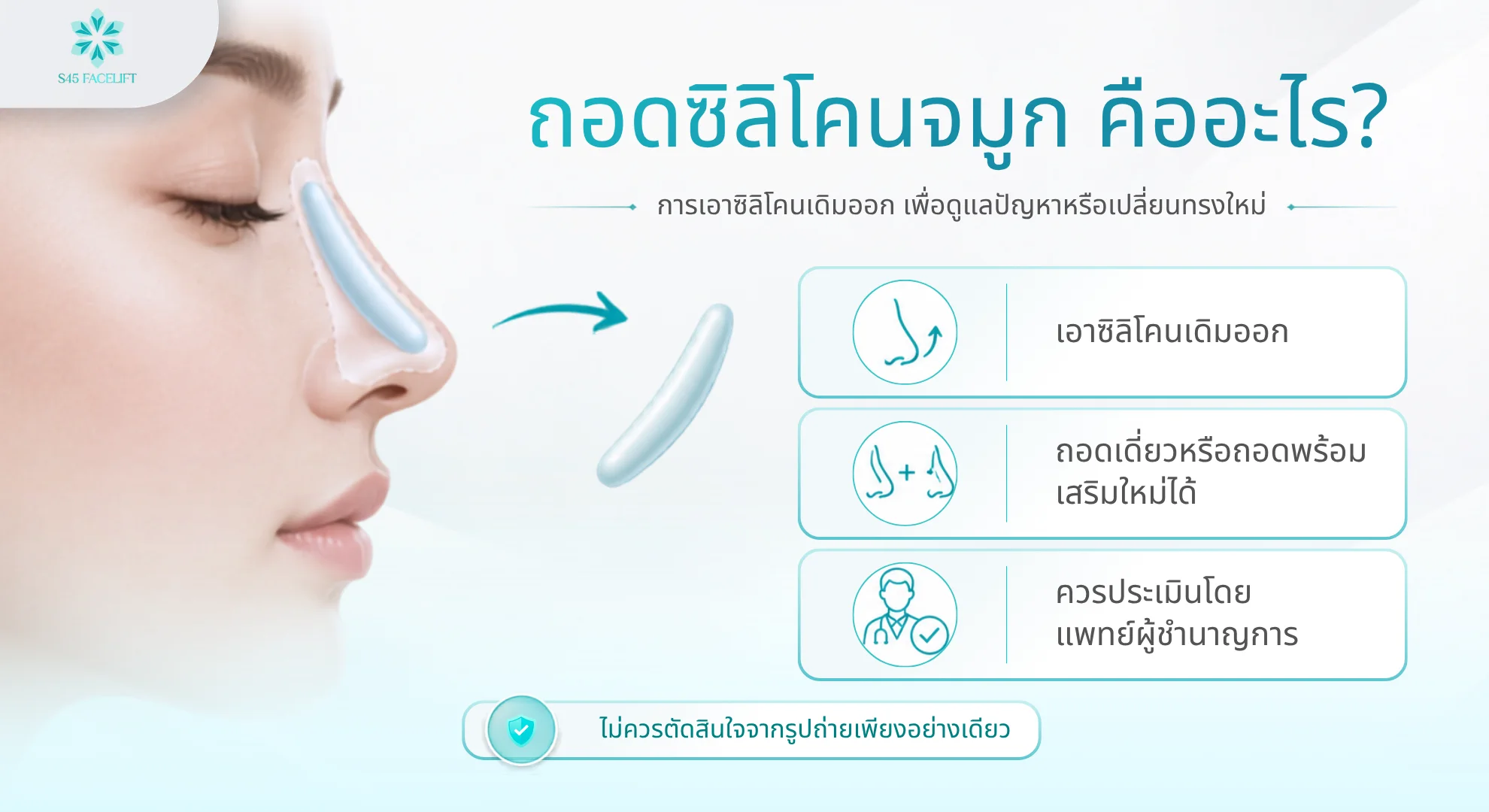
Rhinoplasty with a silicone implant is one of the procedures people often have in Thailand, but in some cases people who have had rhinoplasty may need ‘nose implant removal’, whether because of a health complication, a result they are not happy with or a wish to change to a new nose shape.
In This Article
Key points
- Nose implant removal is surgery to take out a silicone implant placed in the nose, to correct a problem such as a tilted nose, infection, tip extrusion (the implant pushing through the skin at the tip), or a wish to change to a new shape.
- There are 6 main reasons for removal: infection, a shifting silicone implant, tip extrusion, capsular contracture (tight scar tissue around the implant), a crooked or tilted nose, and a wish to change to a new shape.
- The procedure takes only 30 to 60 minutes under local anaesthetic. The surgeon makes a small incision inside the nostril and takes out the silicone implant, and the area is numbed during the procedure.
- Recovery time: swelling goes down in the first 7 to 14 days, you can return to normal daily life in 2 to 3 days, the wound starts to heal in 2 to 4 weeks, and the tissue recovers fully in 3 to 6 months.
- A sunken or dented nose can be caused by tissue thinned by long-term pressure, capsular contracture, a previous infection, or a removal technique that does not protect the tissue. The chance of this can be lowered with a suitable technique and by adding new tissue.
- You can have a new implant after 3 to 6 months of recovery if your nose has healed well, and difficult cases may need rib cartilage to build a new structure.
- Prices vary with the complexity of the case, from thousands to tens of thousands of baht, and removal with a new implant at the same time costs about the same as a new rhinoplasty.
This article brings together information on nose implant removal, from what it is, the 6 reasons for removal, warning signs, the surgical steps, pain, recovery time, a sunken or dented nose, aftercare, having a new implant and costs, to how to choose a clinic that meets standards, so you can make an informed decision and feel less worried.
What Is Nose Implant Removal
Nose implant removal, also called nose silicone removal, is surgery to take out a silicone implant placed in the nose, to correct a problem from previous rhinoplasty, whether a complication, a result you are not happy with or a wish to change your nose shape. Removing a silicone nose implant is a procedure that needs precision and an assessment by an experienced surgeon.
In some cases, the silicone implant can be removed on its own without a new implant. But in most cases, the surgeon recommends removing it and placing a new one in the same operation, so the nose keeps its shape and you do not need 2 operations. This depends on the reason for removal and the condition of each person’s nose.
The decision to have nose implant removal therefore needs careful thought and an in-person examination by a surgeon. It is not a decision that can be made from photos alone.
Why It Helps to Understand Nose Implant Removal
Although most people who have rhinoplasty have no problems for many years, if something goes wrong, such as a red tip, an unusually thin tip or inflammation, knowing about implant removal can help you decide quickly before the problem gets worse.
Removal Only vs Removal With a New Implant
Removal only suits people who want to return to their original nose, while removal with a new implant in the same operation suits people who want to change shape or correct an existing problem. Removing and replacing the implant at the same time reduces the number of operations, but needs an experienced surgeon to assess and plan the treatment.
Why Nose Implants Are Removed, 6 Main Reasons
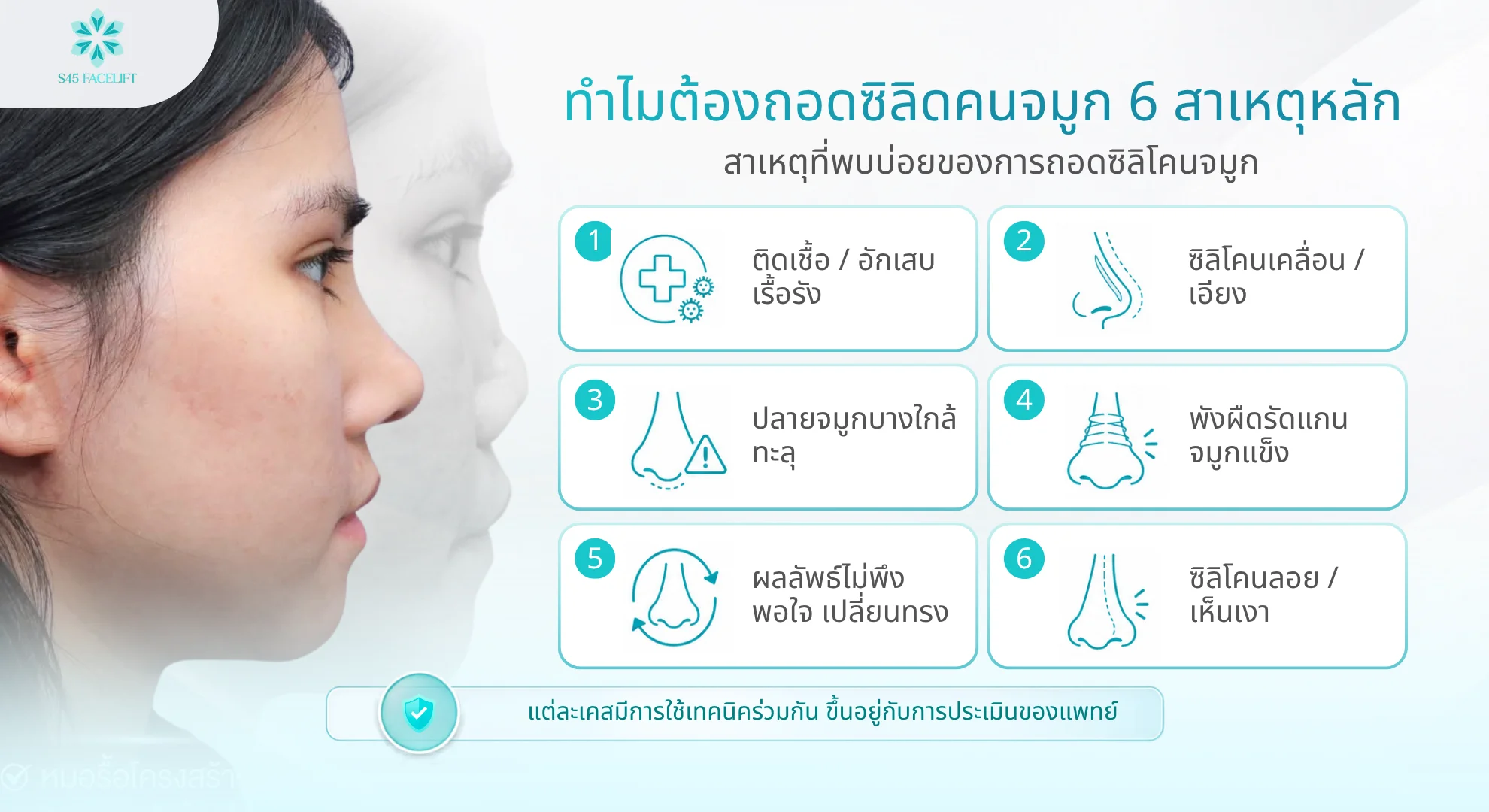
Not everyone who has rhinoplasty will need the implant removed, but in some cases removal is needed to protect the health of the nose over the long term. Understanding the reasons for removal can help you recognise warning signs and decide quickly.
Reasons for removal range from health problems that need urgent surgery to dissatisfaction with the result, where there may be time to let the nose recover first. An assessment by a surgeon can help set the urgency and plan suitable treatment.
In urgent cases, such as infection or a tip that is close to extrusion, do not leave the problem for long, because it may get worse and become harder to correct. The 6 main reasons for nose implant removal are as follows.
1. Infection or Long-Term Inflammation
Swelling, redness, warmth, pain or pus in the nose are signs of an infection that needs prompt treatment. If left untreated, it may spread and cause lasting tissue damage. In severe infections, the surgeon recommends removing the silicone implant to remove the source of infection, and gives antibiotics before considering a new implant later.
2. A Shifting or Tilted Silicone Implant
A silicone implant can shift in some cases, making the nose tilt to one side or causing an unusual bump. This can happen when the implant was not placed securely enough, or after an external impact such as a knock or firm massage. In this case, the surgeon removes the old silicone implant and places a new one in the correct position.
3. A Thin Tip or a Tip Close to Extrusion
One problem to watch for is a tip thinned by pressure from the silicone implant, or a tip close to extrusion. Signs include a red, thin tip, the outline of the silicone implant showing through the skin, or grazes starting to appear on the skin of the tip. In this case, the implant needs removing promptly and the tip rebuilding with your own cartilage. Read more in Symptoms of nose implant extrusion and A projecting tip with thinning skin
4. Capsular Contracture and a Stiff, Rigid Nose
The body forms scar tissue around the silicone implant as a normal protective response, but in some people this scar tissue tightens too much (capsular contracture), making the nose stiff and rigid, feel tight and look artificial. In this case, the silicone implant needs removing and the scar tissue scraped away. See more in Tight scar tissue and a stiff nose
5. An Unsatisfactory Result or a Wish to Change Shape
For some people, the result of rhinoplasty may not match their expectations, such as a bridge that is too low, a tip that does not project, a shape that does not suit the face, or a wish to change to a newer trend. In this case, the old silicone implant can be removed and a new one placed to create the shape you want. See more in Which noses need correcting
6. A Floating or Visible Silicone Implant
If the nasal tissue is thin, the outline of the silicone implant may show through the skin as a line or shadow, which makes the nose look artificial. This problem often happens when the silicone implant is too large for the amount of nasal tissue or is placed too shallow. Read more in A floating silicone implant
Warning Signs That a Nose Implant Needs Removing
Many people do not realise their nose has a problem until it is too late. Noticing warning signs early can help you see a surgeon promptly for an assessment and treatment before the problem gets worse.
Some warning signs are minor and easy to ignore, such as a slightly red tip, but they may be the start of a bigger problem. Other symptoms are emergency signs that mean you need to see a doctor straight away.
An examination by an experienced surgeon can tell you the exact condition of your nose and help plan treatment early, before more complex surgery is needed.
Signs That Need a Doctor Straight Away
- swelling, redness, warmth, severe pain or a fever, which are signs of infection
- fluid or pus coming from the nose
- a grazed or broken tip, or the silicone implant showing through
- a tip that turns dark, which is a sign of poor blood flow
Signs to Have an Assessment
- a tip that stays unusually red for a long time
- a tip that keeps getting thinner until the outline of the silicone implant shows
- a nose that has become tilted to one side
- an unusual feeling of tightness or pressure in the nose
- a bump or a hard, rigid area on the nose
Signs That It May Be Time to Consider a New Shape
- the original nose shape no longer suits your face as you get older
- the result did not match your expectations from the start
- a wish to change to a newer shape that is in demand today
- the original silicone implant has deteriorated after many years
See more on the risks and complications of nose surgery from an academic source in ASPS – Rhinoplasty Risks & Safety
Steps of Nose Implant Removal
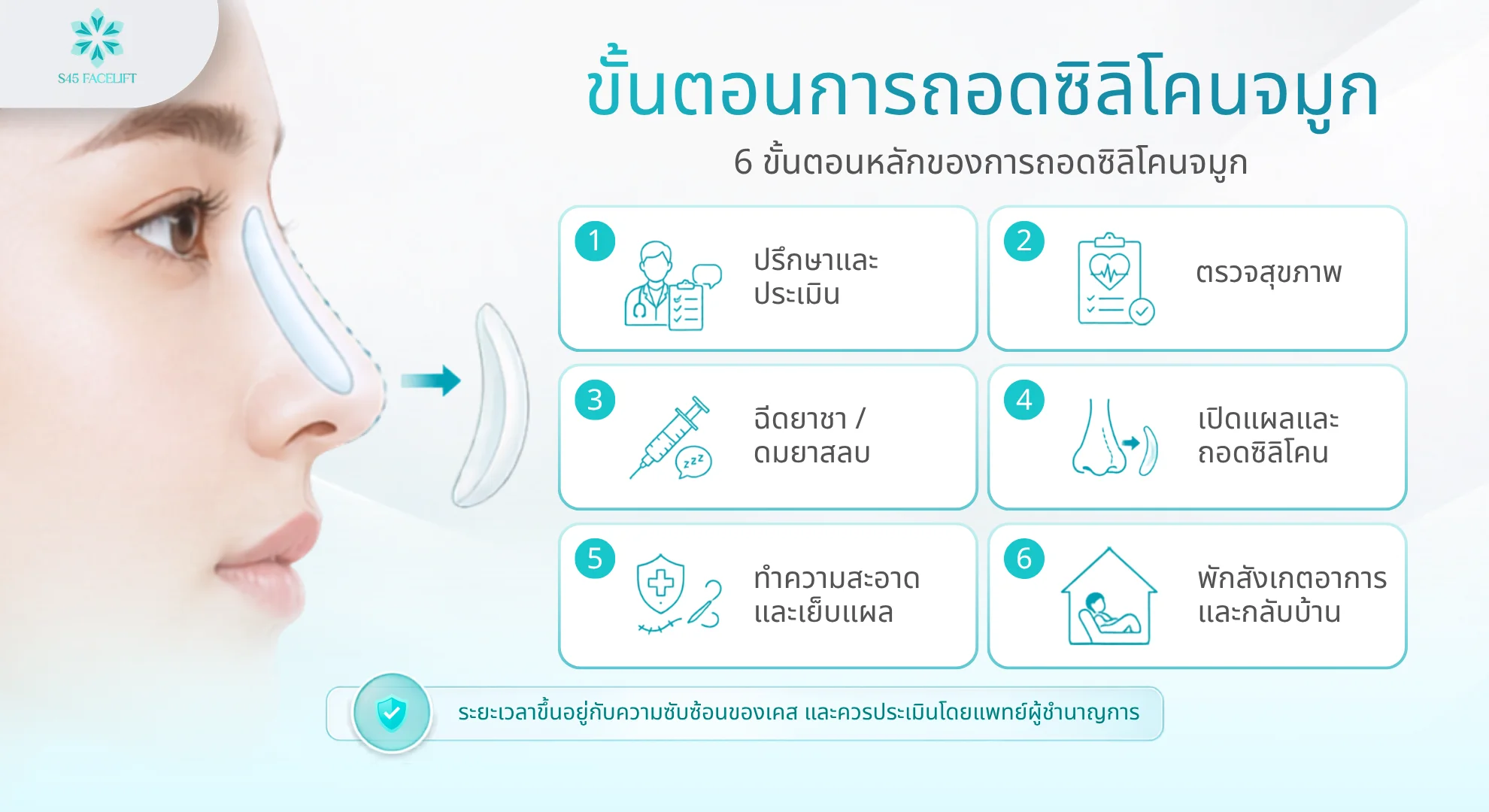
Nose implant removal is a process that needs precision. Although it may seem simpler than a new rhinoplasty, it needs an experienced surgeon who takes care to protect the existing tissue.
The whole procedure takes about 30 to 60 minutes, depending on the complexity of the case. Cases without much scar tissue take less time, cases with tight scar tissue or an implant firmly attached to the tissue take longer, and cases with removal and a new implant at the same time take longer, at 2 to 4 hours.
The surgeon explains every step on the day of your consultation before surgery, so you understand what will happen and can prepare correctly.
Step 1, Consultation and Assessment Before Surgery
The surgeon examines your nose in detail, checking the position of the silicone implant, the thickness of the tissue and any scar tissue, and discusses whether your goal is removal only or removal with a new implant. An accurate assessment helps lower the risks of surgery.
Step 2, Health Check Before Surgery
For cases under local anaesthetic, a short basic health check may be done. For cases under general anaesthetic (such as removal with a new implant), you have blood tests, an electrocardiogram (ECG) and an assessment by an anaesthetist before surgery.
Step 3, Local Anaesthetic or General Anaesthetic
Removal only usually uses local anaesthetic in the nose, so you stay awake but the area is numbed during the procedure. Complex cases of removal with a new implant may use general anaesthetic, with an anaesthetist looking after you throughout the surgery.
Step 4, Making the Incision and Removing the Silicone Implant
The surgeon makes a small incision inside the nostril (closed technique) or at the base of the columella (open technique), as suits your case. The old silicone implant is then carefully freed and removed while protecting the tissue, and any necessary scar tissue is scraped away.
Step 5, Cleaning and Closing the Wound
After the silicone implant is removed, the surgeon cleans the inside of the wound, checks the condition of the tissue and stitches the wound closed. If a new implant is planned, it is placed in the same operation.
Step 6, Observation and Going Home
After surgery, you rest at the clinic for 1 to 2 hours for observation. The surgeon gives you painkillers, antibiotics and detailed aftercare advice before you go home.
Does Nose Implant Removal Hurt
One of the most common questions from people deciding on the procedure is ‘Does nose implant removal hurt?’ During the procedure, the area is numbed with local anaesthetic or you are under general anaesthetic, so most people feel only slight pressure.
After surgery, the level of pain depends on each person, but most people have mild to moderate pain in the first 24 to 48 hours, which can be eased with painkillers prescribed by the surgeon.
After that, the pain gradually goes down, leaving only tightness and swelling that do not affect daily life. Most people say the pain is manageable.
Pain During Surgery
During surgery, the area is numbed by the anaesthetic. You may feel only pressure or hear sounds as the surgeon works, which is not usually painful.
Pain After Surgery
In the first 24 to 48 hours, you may have pain and tightness, which is normal. Painkillers prescribed by the surgeon can help ease it, and symptoms gradually improve by days 3 to 5.
Factors That Affect Pain
- the complexity of the case (removal only vs removal with a new implant)
- the amount of scar tissue that needs freeing
- each person’s sensitivity to pain
- following the surgeon’s aftercare advice
How Long Does Recovery From Nose Implant Removal Take
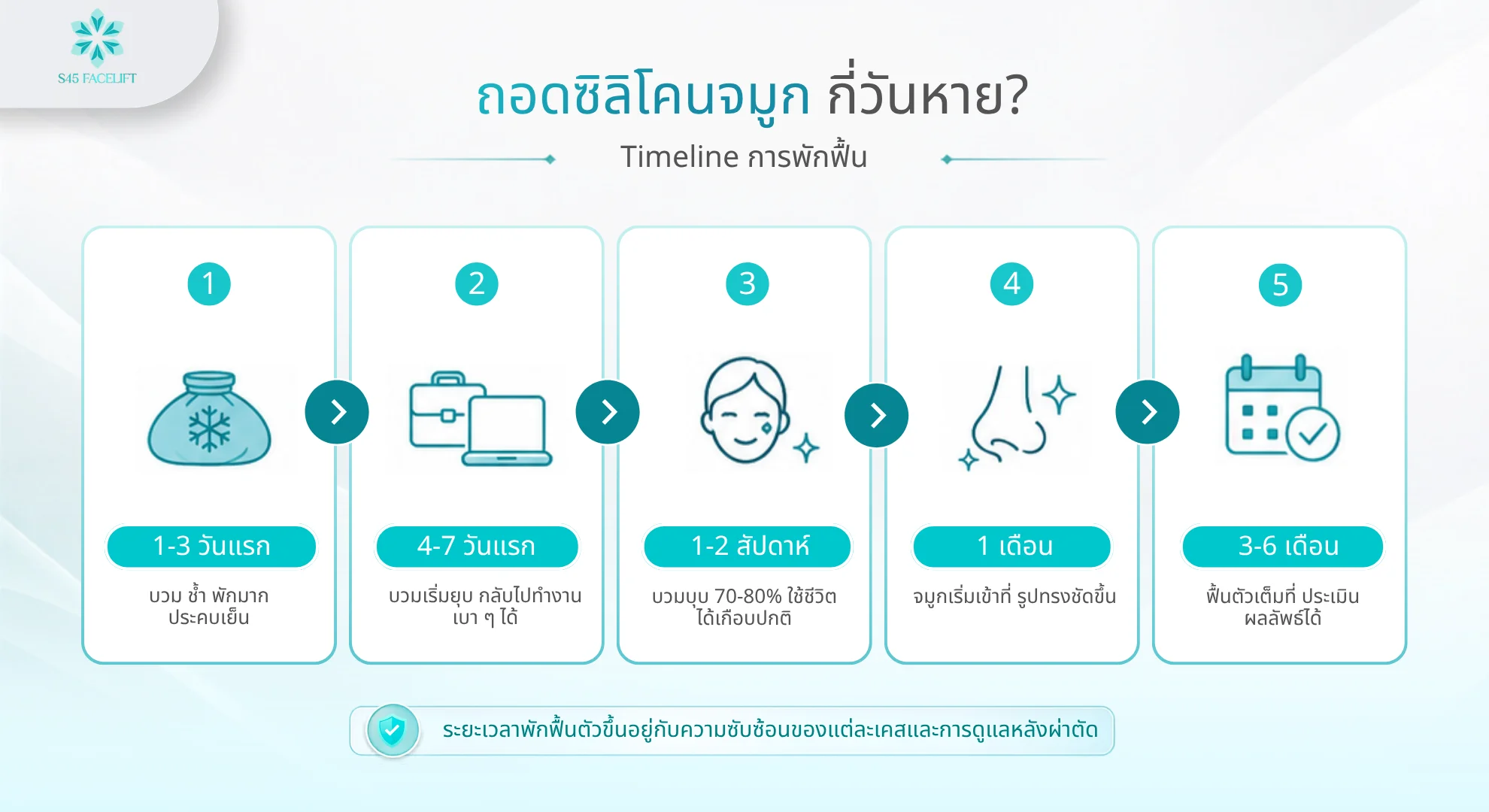
‘How long does it take to recover from nose implant removal?’ is a question many people worry about, because they need to plan time off work and appointments in advance. Recovery time depends on the complexity of the case and how each person looks after themselves.
In general, swelling and bruising gradually improve in the first 1 to 2 weeks, and you can return to light activities within a few days, but full recovery and the final shape take several months.
Following the surgeon’s advice closely at each stage helps the wound recover better and lowers the chance of complications. The recovery stages are as follows.
Days 1 to 3, Early Recovery
Swelling, bruising and pain are greatest at this stage. Use cold compresses to reduce swelling, sleep with your head raised on pillows, get enough rest and take your medicines exactly as prescribed by the surgeon.
Days 4 to 7, Swelling Starts to Go Down
Swelling starts to go down and pain is much less. You can return to light work or daily life, but avoid heavy exertion for now.
Weeks 1 to 2, Most Swelling Has Gone Down
About 70% to 80% of the swelling has gone down, the nose shape becomes clearer and the internal wound starts to heal. In cases of removal only, you can return fully to normal life.
Month 1, Tissue Starts to Recover
Almost all the swelling has gone down and the tissue starts to settle. In cases with a new implant placed at the same time, the shape starts to look close to the final result.
Months 3 to 6, Full Recovery
The tissue recovers fully and the scar tissue softens. In cases of removal only, the nose becomes stable. In cases with a new implant, the shape settles and softens, and the final result is ready to assess at month 6. Timings depend on each person.
What Causes a Sunken or Dented Nose After Implant Removal
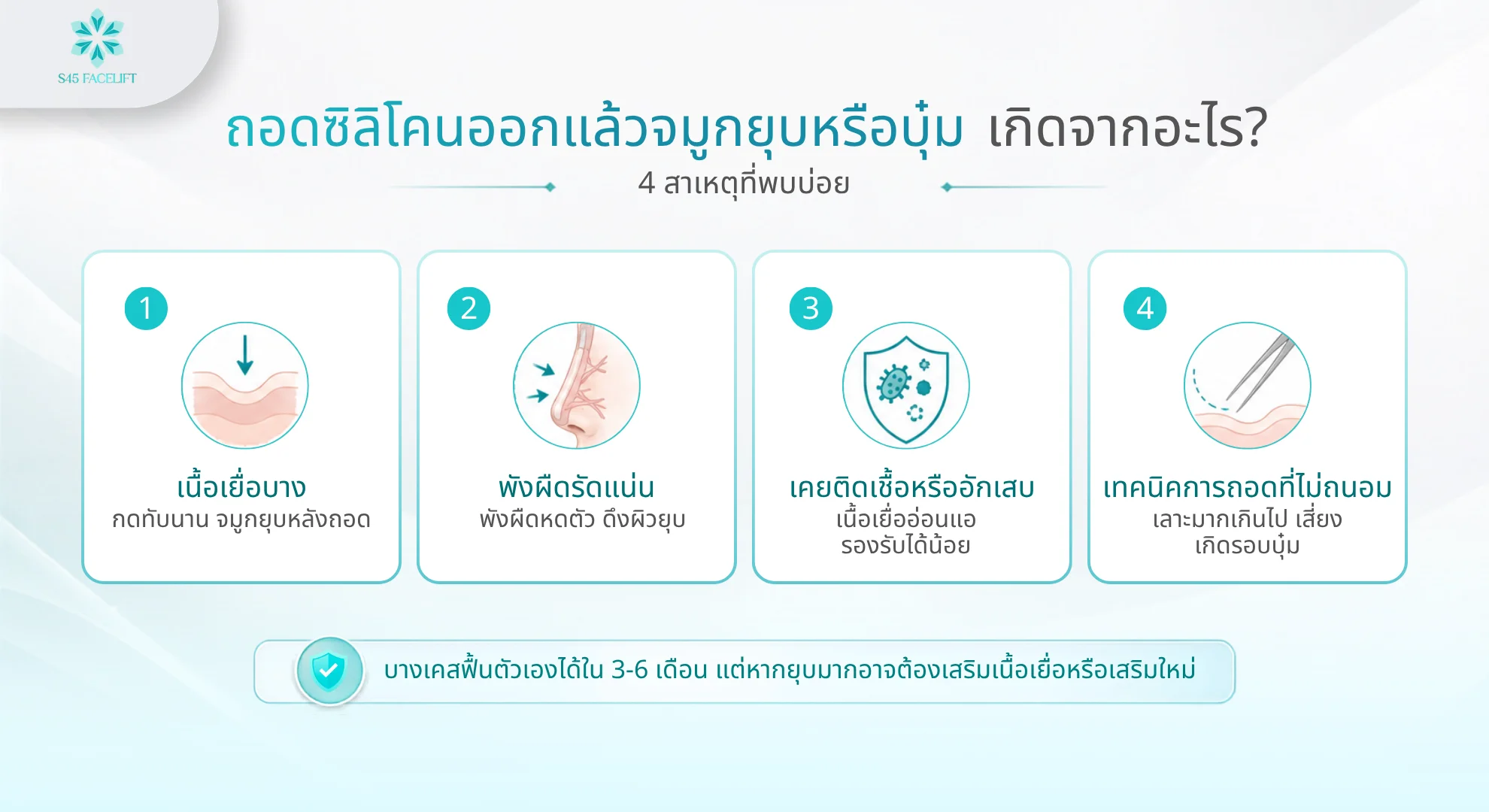
One worry for people planning implant removal is what happens if ‘the nose sinks after silicone implant removal’ or ‘the nose becomes dented after silicone implant removal’. This problem does happen in some cases, and the chance of it can be lowered by choosing a suitable surgeon and technique.
A sunken or dented nose does not happen to everyone. It depends on the condition of the existing tissue, the size of the silicone implant, how long it was in place and the technique used for removal. Understanding the causes can help you prevent and manage the problem from the start.
In cases of a slightly sunken or dented nose, the tissue can recover on its own within 3 to 6 months, but in cases with a lot of sinking, correction with added tissue or a new implant using your own cartilage is needed.
Cause 1, Tissue Thinned by Long-Term Pressure
A silicone implant that is too thick or too large presses on the tissue and cartilage for a long time. After many years, the tissue becomes thinner, so when the silicone implant is removed, the nose sinks to follow the changed shape of the tissue.
Cause 2, Capsular Contracture (Tight Scar Tissue)
The scar tissue the body forms around the silicone implant can become too tight. When the silicone implant is removed, the scar tissue shrinks and pulls the tissue inwards, causing a dent in the skin of the nose.
Cause 3, a Previous Infection or Inflammation
In cases with previous inflammation or infection, the tissue is damaged and changed. When the silicone implant is removed, the weakened tissue structure cannot support the original shape, causing a deep dent.
Cause 4, a Removal Technique That Does Not Protect the Tissue
Removing a silicone implant needs precision in freeing it, without scraping away too much scar tissue or damaging normal tissue. If the surgeon lacks experience, the tissue may be damaged and a deep dent may form.
How to Prevent and Correct a Sunken or Dented Nose
In cases of slight sinking or denting, you can wait for the tissue to recover on its own within 3 to 6 months, eating foods with protein, vitamin C and collagen to help repair.
In moderate cases, your own fat may be injected (fat grafting), or filler injections may be used to fill the dent.
In severe cases, a suitable option is a new rhinoplasty with your own cartilage, such as ear cartilage, septum or rib cartilage, to build a stable structure that suits your face. See more in Rib cartilage rhinoplasty
Aftercare After Nose Implant Removal
Correct aftercare after nose implant removal directly affects your recovery and result. Following the surgeon’s advice closely helps lower the chance of complications.
Common symptoms after nose implant removal include swelling, slight bruising, a feeling of tightness and possibly a small amount of fluid. These symptoms are normal and gradually improve, but watch for unusual symptoms that may be signs of infection.
Many people overlook nutrition and rest, but both are as important as wound care, because your body needs energy to repair injured tissue.
Wound Care and Hygiene
- clean the wound with sterile saline as advised by the surgeon
- apply antibiotic ointment as prescribed
- do not pick or scratch the wound under any circumstances
- keep water out of the wound for the first 3 to 5 days
- take the full course of antibiotics
Reducing Swelling and Bruising
- use cold compresses in the first 24 to 48 hours
- sleep with your head raised on pillows to reduce swelling
- avoid bending your head down for long periods
- sleep on your back, and do not sleep on your side or front for 1 to 2 weeks
Diet, What to Avoid Eating After Nose Implant Removal
Foods to avoid in the first 1 to 2 weeks, to lower the chance of inflammation and allergic reactions:
- pickled and fermented foods, and seafood that may cause itching or allergies
- all alcoholic drinks
- strongly flavoured or very spicy foods
- cigarettes and drinks high in caffeine
- foods traditionally avoided after surgery in Thailand, as advised by the surgeon
Foods to eat:
- high-protein foods, such as meat, eggs and milk
- vitamin C, such as citrus fruits
- green leafy vegetables that contain iron
- at least 2 litres of clean water a day
Activities to Avoid
- strenuous exercise for 2 to 4 weeks
- swimming and saunas for at least 1 month
- wearing glasses that press on the bridge of the nose for 4 to 6 weeks
- using make-up on the nose in the first week
Follow-Up With the Surgeon
Attend every follow-up appointment. Appointments are usually at 7 days, 14 days, 1 month, 3 months and 6 months after surgery, to assess your recovery and check for any problems.
Can You Have a New Implant After Nose Implant Removal
One of the questions people often ask is ‘Can I have a new implant after nose implant removal?’ The answer is yes, depending on the condition of your nose after removal and the reason the silicone implant was removed in the first place.
If the implant is removed because you want to change shape, removal and a new implant can be done in the same operation. If it is removed because of infection or a serious complication, you need to wait for the nose to recover before having a new implant.
The surgeon assesses the tissue, scar tissue and existing nasal structure in detail before planning a new implant. If the nose is badly damaged, your own cartilage may be needed to build a new structure.
Case 1, Removal and a New Implant at the Same Time
If the nasal tissue is still in good condition without serious infection or inflammation, the old silicone implant can be removed and a new one placed in a single operation. The advantages are that you do not need 2 operations and you save recovery time.
Case 2, Waiting 3 to 6 Months to Recover
If there has been an infection, tight scar tissue or tissue damage, you need to wait for the nose to recover fully for at least 3 to 6 months before having a new implant. During this time, your nose will be in its post-removal condition, which may look sunken or dented.
Case 3, Complex Cases That Need Rib Cartilage
If the nose is badly damaged, for example very thin tissue, a lot of scar tissue or several previous operations, the new rhinoplasty may need your own rib cartilage to build a stable nasal structure that suits your face. This counts as a revision rhinoplasty case that needs an experienced surgeon.
Can You Choose Not to Have a New Implant, and Will Your Nose Look as It Did Before
Another question people often ask is ‘Will my nose look the same as before after nose implant removal?’ If you choose not to have a new implant after removal, this is possible, but your nose may not return to how it looked before your first rhinoplasty.
How close it gets to your original nose depends on several factors, such as the technique used in the first rhinoplasty, the size of the silicone implant and how long it was in place, and whether there were complications. Some people may return to about 80% to 90% of their original nose, while others change noticeably.
If you decide not to have a new implant, understand that your nose may look different from before, and be prepared that it may not look exactly the same.
What May Happen If You Do Not Have a New Implant
- the bridge is lower than with the implant, but may not return to its height before rhinoplasty
- the tip may drop slightly, particularly if the silicone implant was in place for a long time
- small dents may appear if some of the tissue was damaged
- the overall shape may not look exactly the same, depending on changes in the tissue
Factors That Affect How Close the Nose Gets to Its Original Shape
- the original technique (closed or open rhinoplasty), as open rhinoplasty involves more tissue dissection
- the size of the silicone implant, as a larger implant causes more change
- how long the implant was in place, as the longer it was in place, the more the tissue changes
- previous infection or inflammation
- the surgeon’s skill in protecting the tissue during removal
People Who May Suit Not Having a New Implant
- people who want to return fully to their original nose
- people who had a serious complication and do not want the risk of a new implant
- people whose original nose is in good condition and who do not want any changes
- people who may change their mind in the future and want to let the nose rest first
Cost of Nose Implant Removal
The cost of nose implant removal varies from case to case and depends on several factors, from the complexity of the case and the technique used to the surgeon and the clinic’s standards. It helps to understand the factors that affect the price before comparing clinics.
In general, ‘silicone implant removal only’ costs from thousands to tens of thousands of baht, while ‘removal with a new implant at the same time’ costs about the same as a new rhinoplasty, which is more than removal only because extra materials and techniques are needed.
An unusually low price may reflect the quality of the surgeon or clinic standards that are lower than usual. For surgery that affects your face and health like this, do not choose mainly on price.
Factors That Affect the Price
- Complexity of the case: cases with a lot of scar tissue or infection take more time and skill.
- Removal technique: removal only vs removal with a new implant.
- Material for the new implant: silicone implant vs ear cartilage vs rib cartilage.
- The surgeon: experience and field of training.
- Clinic standards: licence, operating room and anaesthetist.
- Additional services: medicines, stitch removal and follow-up.
What to Check in a Quotation
- whether the anaesthetist’s fee is included (for cases under general anaesthetic)
- whether medicines after surgery are included
- whether stitch removal and follow-up checks are included
- whether the operating room fee is included
- whether there is a guarantee, and its conditions
A Warning About Unusually Low Prices
An unusually low price may reflect a surgeon with little experience, a clinic that does not meet standards, or no aftercare system. For plastic surgery that affects your health and face over the long term, saving money in the wrong place may mean paying more for corrections in the future.
Where to Have Nose Implant Removal
Choosing a clinic for nose implant removal is a very important decision, because it directly affects the result and your recovery. When choosing ‘where to have nose implant removal’, consider several factors together, not only price or how close the clinic is to home.
Many people choose a clinic by searching for ‘nose implant removal near me’ on a map, which may be convenient but is not the only criterion. Consider the surgeon’s quality and the clinic’s standards as well.
Particularly when the implant is removed because of a problem, such as infection or tight scar tissue, it matters even more to choose a clinic that can manage complex cases, because poor management may make the problem worse.
Criteria for Choosing a Clinic
- a valid clinic licence, checked on the website of the Department of Health Service Support
- a surgeon certified in otolaryngology or facial plastic surgery
- operating room standards comparable to a hospital, with an anaesthetist team
- transparent pricing, with a clear quotation and no extra charges added later
- a clear aftercare system, with follow-up for 3 to 6 months after surgery
- real review cases, including a range of removal and correction cases
Qualifications to Look for in a Surgeon
Look for a surgeon certified in otolaryngology with subspecialty training in facial plastic and reconstructive surgery who focuses on nose cases, particularly complex revision cases.
Things to Watch for When Choosing a Clinic
- clinics that push you to decide too quickly
- clinics without a licence or with an expired licence
- clinics with prices far below the usual range
- clinics without a clear aftercare system
- clinics where the surgeon has no certified training in otolaryngology or facial plastic surgery
Why Choose Nose Implant Removal and Revision Rhinoplasty at S45 Clinic
Nose implant removal is a procedure that needs care to protect the tissue and an accurate assessment of the nose. S45 Clinic is a plastic surgery clinic that focuses on the nose and looks after complex removal and revision cases, under our promise “Because every kind of beauty comes from care”
Our Surgeons
Our surgeons are certified in otolaryngology with subspecialty training in facial plastic and reconstructive surgery, focus on nose and revision cases, and assess your nose to plan removal and a new implant that suit you.
Removal and Rebuilding Techniques
S45 Clinic offers both silicone implant removal only and removal with a new implant in the same operation. In complex cases, such as capsular contracture, a thin tip or damaged tissue, we use open rib rhinoplasty, which uses rib cartilage to build a new structure. See more in Revision rhinoplasty
Operating Room and Aftercare
In our operating room, an anaesthetist provides one-to-one care for cases under general anaesthetic, and our aftercare system follows up with you for 3 to 6 months after surgery to check that your recovery is going well and your result is settling as planned.
FAQs About Nose Implant Removal
How Much Does Nose Implant Removal Cost?
Prices vary with the complexity of the case, the technique used, the surgeon and the clinic’s standards. In general, ‘removal only’ costs from thousands to tens of thousands of baht, while ‘removal with a new implant’ costs about the same as a new rhinoplasty. An accurate estimate needs an examination by a surgeon. Message the clinic on LINE to ask for a quotation for your case.
How Long Does It Take to Recover From Nose Implant Removal?
Swelling goes down in 7 to 14 days, you can return to daily life in 2 to 3 days, the wound starts to heal in 2 to 4 weeks, and the tissue recovers fully in 3 to 6 months. How quickly you recover depends on the condition of your nose, following the surgeon’s advice and how you look after yourself.
Does Nose Implant Removal Hurt?
During surgery, the area is numbed with local anaesthetic or you are under general anaesthetic. After the anaesthetic wears off, you may have mild to moderate tightness and pain around the wound, which can be eased with painkillers prescribed by the surgeon. Symptoms gradually improve in the first 24 to 48 hours.
How Can a Sunken Nose After Implant Removal Be Corrected?
A sunken or dented nose after silicone implant removal can be corrected in several ways. In slight cases, wait for the tissue to recover on its own in 3 to 6 months. In moderate cases, your own fat or filler injections can be used to fill the area. In severe cases, a new rhinoplasty with your own cartilage is needed, particularly rib cartilage, which gives stable support.
Will My Nose Look the Same as Before After Implant Removal?
It will not return exactly to how it looked before your first rhinoplasty. This depends on the technique used in the first rhinoplasty, the size of the silicone implant and how long it was in place, and changes in the tissue. Some people may return to about 80% to 90% of their original nose, while others change noticeably.
What Symptoms Are There After Nose Implant Removal?
Common symptoms in the first 3 to 7 days include slight swelling, bruising around the surgical area, a feeling of tightness and pressure in the nose, and possibly a small amount of fluid. These symptoms gradually go down and clear within 1 to 2 weeks. If you have severe pain, swelling with redness and warmth, a fever or pus, contact the clinic straight away.
What Should I Avoid Eating After Nose Implant Removal?
Avoid pickled and fermented foods, seafood that may cause itching or allergies, alcoholic drinks, cigarettes, strongly flavoured or very spicy foods and drinks high in caffeine for the first 1 to 2 weeks. Focus on foods high in protein, vitamin C and collagen to help the wound recover.
Can I Have a New Implant at the Same Time as Silicone Implant Removal?
Yes, if the nasal tissue is still in good condition without serious infection or inflammation. The advantages are that you do not need 2 operations and you save recovery time. If there has been an infection or a lot of scar tissue, you need to wait 3 to 6 months for the nose to recover before having a new implant. An assessment by an experienced surgeon can help decide which approach suits your case.
Summary
Nose implant removal (nose silicone removal) is surgery to take out a silicone implant placed in the nose, to correct 6 main types of problem: infection, a shifting silicone implant, tip extrusion, capsular contracture, a tilted nose, or a wish to change shape. The procedure takes only 30 to 60 minutes, the area is numbed with anaesthetic during the procedure, and recovery takes 3 to 6 months.
A problem many people worry about is ‘the nose sinking after silicone implant removal’ or ‘a dented nose’, which is caused by tissue thinned by long-term pressure, tight scar tissue, a previous infection or a removal technique that does not protect the tissue. The chance of this can be lowered by choosing an experienced surgeon, and in severe cases a new implant using your own cartilage can build a stable structure.
The key point is to choose a clinic and an experienced surgeon who look after complex removal and revision cases, because poorly performed silicone implant removal may cause lasting damage to the appearance of the nose. A consultation with an experienced surgeon as soon as you notice warning signs helps your result follow the plan.
Because every nose structure…
is different
An otolaryngologist with subspecialty training in facial plastic and reconstructive surgery assesses every case before treatment and gives advice based on your actual concerns.
“Reveal the beauty within you”
Message us online
Surgery and medical procedures carry risks. Find out about them and consult a doctor before you decide. Results depend on each person.