Alarplasty Infection and Pus in the Wound, Is It Dangerous? Causes, Symptoms, Care and When to Get Urgent Medical Help

Finding pus in an alar base reduction wound can be very alarming, especially if you had surgery only a few days ago. The first worries are usually “Is it dangerous? Will it leave a scar? Will I need another operation?” If you are dealing with this problem, try to stay calm and read this article to the end first.
Key points
- Pus in an alar base reduction wound is a sign of a bacterial infection in the surgical wound. It usually appears in the first 3 to 7 days after alar base reduction and shows as a red, swollen, hot wound with increasing pain and thick yellow to green fluid leaking out.
- Clear wound fluid (straw-coloured) and thick pus (yellow to green) are different. Clear fluid is normal in the first 1 to 3 days, but if it turns into thick, smelly pus and the wound feels hot, consult a doctor promptly.
- 5 main causes: the wound getting wet, incorrect wound care, low immunity, contamination during surgery, and picking or touching the wound with unwashed hands.
- 3 levels of severity: level 1 is mild inflammation that can be treated with an antiseptic ointment / level 2 is visible pus that needs antibiotics / level 3 is a lot of pus with the wound opening, which needs the pus drained and may need new stitches.
- Never do these: squeeze the pus, pick the scabs, apply alcohol, apply strong povidone-iodine (Betadine), buy antibiotics to take on your own, or leave it for more than 24 to 48 hours.
- Healing after treatment usually takes 7 to 14 days if you get treatment promptly, but it may leave a raised scar or keloid that needs ongoing care for 3 to 6 months.
This article covers pus in an alar base reduction wound, from how to tell normal wound fluid from dangerous pus, the 5 common causes, early and severe symptoms, first aid you can do yourself before reaching the clinic and warning signs that mean you need to see a doctor straight away, through to how to prevent scars and keloids after surgery, so you can deal with the situation correctly.
In This Article
What Is Pus in an Alar Base Reduction Wound
Pus in an alar base reduction wound (alarplasty infection) happens when the surgical wound on the side of the nostril becomes infected with bacteria. Your body sends white blood cells to fight the infection, and the result is thick yellow, light green or brown fluid leaking from the stitches, together with redness, swelling, heat and more pain than usual.
This is one of the complications that can happen after minor plastic surgery, however strict a clinic’s sterilisation standards are. General figures suggest it happens in about 1% to 3% of people who have alar base reduction, and most cases can be managed if you see a doctor promptly.
Pus is most often found in the first 3 to 7 days after surgery, when the wound is still open and new cells have not fully joined together. Knowing how to recognise symptoms early helps you decide in good time when to consult a doctor.
Where Pus Is Most Often Found
External alar base reduction wounds (in the crease at the base of the nose) tend to get pus more easily than wounds inside the nostril, because they are exposed to more dirt and sweat. Wounds inside the nose are in a moist area, which makes an alar base reduction wound more likely to become soft and broken down, and they can become infected in a different way.
Why Alar Base Reduction Wounds Can Become Infected
The sides of the nose have many oil and sweat glands and sit close to the nostrils, which let bacteria in from outside. This makes them different from surgical wounds elsewhere on the body, so wounds in this area need extra care.
Normal Wound Fluid vs Dangerous Pus, How to Tell Them Apart
A common source of confusion is not being able to tell the difference between clear wound fluid, which is a normal part of healing, and pus, which shows there is an infection. Some people panic unnecessarily, while others leave it until the symptoms become severe.
The difference between the two lies in the fluid’s appearance, colour, smell and thickness, and in the other symptoms that come with it. Understanding the differences helps you assess the situation better and decide correctly when to see a doctor.
The fluid that comes from the wound changes at different stages. In the early stages of healing you may sometimes see both types in turn, but if you still see clear fluid after the normal period, you also need to be careful.
Comparison Table of Wound Fluid vs Pus
| Feature | Normal wound fluid | Dangerous pus |
| Colour | Clear or pale yellow, like straw | Dark yellow, green or brown |
| Thickness | Thin, runs easily | Thick and sticky |
| Smell | No smell | Foul, fishy smell |
| Amount | Small, gradually reduces | Large, keeps increasing |
| Timing | First 1 to 3 days after surgery | Starts 3 or more days after surgery |
| Around the wound | Normal, slightly swollen | Red, swollen, hot and very painful |
| Wound temperature | Not hot | Unusually hot |
| Care | Clears up on its own | See a doctor |
What Normal Wound Fluid Looks Like
Fluid in the first 1 to 3 days is normal. It is pale yellow or clear, has no smell and is not thick. It gradually reduces and dries into a scab around days 4 to 5 after surgery. Scabbing on an alar base reduction wound is a good sign that healing is going as expected.
What Dangerous Pus Looks Like
Pus is thick and yellow, greenish yellow or sometimes brown, with a distinctive foul, fishy smell. It comes out in large amounts and does not really reduce, and there are clear signs of inflammation around the wound, such as redness, heat, throbbing pain and swelling that keeps increasing.
Borderline Cases to Watch Out For
Sometimes normal wound fluid gradually turns into pus. If you notice the fluid getting thicker or darker, starting to smell, or the wound getting hotter, treat it as a sign of infection and consult a doctor promptly.
Causes of Pus in an Alar Base Reduction Wound
Infection in an alar base reduction wound does not happen by chance. It has clear causes that can be identified and prevented. Understanding the causes helps you look after yourself better and, if an infection has already happened, shows you what needs to be put right.
The causes of infection fall into 2 main groups: causes related to how you look after yourself after surgery, and other factors such as your immune system or contamination during surgery. Most cases come from the first group, which can be prevented.
According to plastic surgery clinic data, the most common cause is incorrect wound care, followed by the wound getting wet in the first 7 days. The 5 main causes are:
1. The Wound Getting Wet in the First 7 Days
Everyday water contains bacteria and other microorganisms. When it touches a wound that has not yet healed, bacteria can get into the wound straight away. This is the most common cause, especially in people who shower carelessly or wash their face directly.
2. Incorrect Wound Cleaning
Not cleaning the wound as advised, cleaning it too early or too late, using unsuitable liquids, or using cotton wool and cotton buds that are not clean can accidentally bring bacteria into the wound.
3. Touching, Holding or Picking the Wound With Unwashed Hands
Itching around the wound while it heals is normal, but many people touch or scratch it without thinking, using fingers they have not washed. This puts bacteria from the hands directly onto the wound, especially during sleep when you may reach for it without realising.
4. Low Immunity
People with long-term conditions such as diabetes or autoimmune disease, and people who do not get enough rest, are very stressed, smoke or drink a lot of alcohol, have a weaker immune system than usual, so their body is less able to fight bacteria.
5. Contamination During Surgery
This is very rare in clinics that meet proper standards, but it can happen if surgical instruments are not clean, the operating room does not meet standards, or sterilisation before surgery is incomplete. This is an important reason to choose a licensed clinic with high standards.
Other Factors That Increase the Risk
- Eating pickled or fermented foods, seafood or other foods traditionally avoided after surgery in Thailand during recovery
- Wearing a face mask that is not clean or that presses on the wound
- Heavy exercise that makes the wound sweaty in the first week
- Sleeping face down or putting pressure on the wound on one side
Symptoms of an Infected Alar Base Reduction Wound
Symptoms of an inflamed and infected alar base reduction wound range from an early stage that is hard to notice to a severe stage where the symptoms are obvious. Knowing the symptoms at each stage helps you act quickly before things get worse.
Early symptoms are often not very worrying, and some people may think they are a normal part of healing. But if you look closely, you will see differences from a wound that is healing normally. Noticing quickly and acting is the key to stopping it from getting more serious.
If you get any of the following symptoms, watch them closely and be ready to see a doctor straight away if they get worse.
Early Symptoms (First 24 to 48 Hours of Infection)
At first, the wound may be redder and hotter than the day before, with a throbbing pain, or it may swell again after the swelling had started to go down. Some people may notice the wound fluid getting thicker or darker, or unusual itching around the wound. Watch these symptoms and follow your doctor’s wound care advice closely.
Middle-Stage Symptoms (Days 3 to 5 of Infection)
As the symptoms become clearer, you may find pus in the stitches of your nose, with yellow or green pus leaking out, an unusual smell, or the wound starting to open slightly with stitches coming out. Some people may have dark red or darkened skin around the wound, or a mild fever of about 37.5°C to 38°C. Contact the clinic or a doctor to have the symptoms assessed.
Severe Symptoms (See a Doctor Straight Away)
If pus keeps coming from the alar base reduction wound, the wound opens further, redness and swelling spread onto the face, you have a high fever above 38.5°C, or the pain is so bad it does not ease even after taking medicine as advised, do not wait for it to get better on its own. Have a doctor examine the wound and decide on suitable care.
3 Levels of Severity of Pus in the Wound
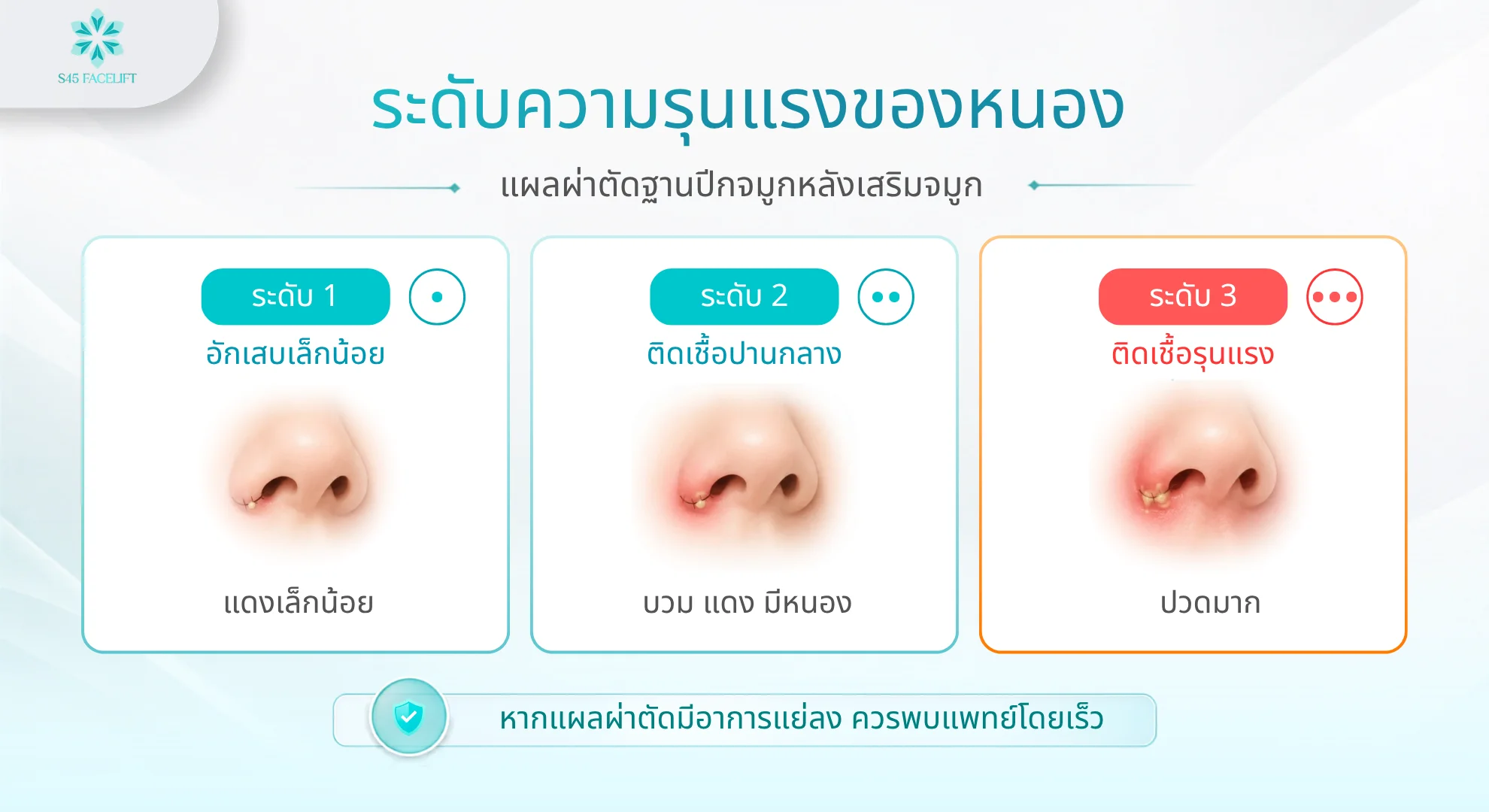
Not every case of pus in an alar base reduction wound is equally serious. Grading the severity helps you assess your own situation more accurately and understand how each level should be managed.
Severity is assessed from several factors, such as the amount of pus, the size of the inflamed area, how far the symptoms have spread and your general symptoms. Care also differs by level.
However, these levels are only a basic guide. An accurate diagnosis needs a direct examination by a doctor. Do not use this information as a reason to delay seeing a doctor.
Level 1, Mild Inflammation
At the early level, there may be a little pus at the edge of the wound, slight redness, mild pain and no fever. Symptoms usually stay around the alar base reduction wound and do not spread much into the surrounding skin.
Care at this level follows your doctor’s advice, such as cleaning the wound step by step and using the medicine your doctor prescribes correctly. Symptoms may gradually improve within 5 to 7 days, but the time can vary from person to person.
Level 2, Moderate Infection
At this level, pus may be more obvious, with redness and swelling around the wound, throbbing pain or a mild fever. Some people may have inflammation around the alar base reduction wound spreading about 1cm to 2cm, which needs to be assessed by a doctor.
The doctor may consider further care, such as cleaning the wound at the clinic or using suitable medicine. Recovery at this level may take about 7 to 14 days, and some people may be at risk of a visible scar or a raised alar base reduction scar.
Level 3, Severe Infection
If a lot of pus is coming out, the wound has opened, redness and swelling are spreading beyond the original wound, or you have a high fever, severe tiredness or severe pain, see a doctor as soon as possible, because this may be a sign of an infection that needs close care.
In this case, the doctor may consider specific care, such as cleaning the wound, giving suitable medicine or planning further wound care based on your actual symptoms. Recovery may take several weeks, and there is a higher chance of a raised scar or keloid than at the other levels.
How Long an Alar Base Reduction Wound Takes to Heal
Understanding the healing timeline of an alar base reduction wound in a normal case helps you compare it with your own wound and tell whether what you see is part of the normal process.
How long an alar base reduction wound takes to heal depends on several factors, such as the technique the surgeon uses, how much tissue is removed, your general health and, most importantly, your aftercare.
In cases without complications, recovery follows a standard timeline. If your wound is healing much more slowly or quickly than this timeline, consult a doctor to have it checked.
Normal Timeline of an Alar Base Reduction Wound
- Days 1 to 3: the wound is swollen, red and tight, with some clear fluid leaking and mild pain. This is normal.
- Days 4 to 7: the swelling starts to go down, there is less fluid, and the wound dries and forms a scab.
- Days 7 to 14: stitches are removed (for external wounds) and internal wounds start to heal.
- Days 14 to 30: the wound is fully closed, the redness starts to fade, and there may be a slightly raised mark.
- Months 1 to 3: the scar gradually becomes smoother and lighter.
- Months 3 to 6: the scar flattens and blends in with the surrounding skin.
Healing Time When There Is Pus
If you have a level 1 or 2 infection and get prompt care, healing takes about 1 to 2 weeks longer than usual. At level 3, it may take as long as 1 to 2 months for the wound to heal fully.
When Healing Is Unusually Slow
- The external wound still has fluid after 7 days.
- The wound has still not formed a scab after 10 days.
- The stitches cannot be removed at the planned appointment because the wound has not healed.
- The wound opens or comes apart after the stitches have been removed.
Read more about looking after yourself after surgery in How to reduce swelling after rhinoplasty
Other Types of Abnormal Alar Base Reduction Wounds
As well as wounds with pus, other types of abnormal wounds can happen after alar base reduction. Each type has different causes and ways of managing it. Knowing how to tell them apart helps you explain the problem to your doctor more precisely.
Sometimes a wound problem starts as one type and develops into another. For example, a wound that does not dry may become soft and broken down, and eventually develop pus.
Noticing and responding promptly to even small abnormal signs helps stop the problem from spreading.
An Alar Base Reduction Wound That Does Not Dry
Clear fluid keeps leaking without stopping, usually because of trapped moisture and incorrect care. Clean the wound gently with saline 2 times a day, pat it dry every time and keep it away from water. If it has still not dried after 7 days, see a doctor promptly.
An Alar Base Reduction Wound That Does Not Close
The edges of the wound come apart and the gap is clearly visible. This may be caused by moving your face too much, stitches that are too tight, or stitches coming out too early. In this case, the doctor may need to stitch it again or use another way to close the wound. Never try to deal with it yourself.
A Soft, Broken-Down Alar Base Reduction Wound
The wound is swollen, red and moist, with fluid or pus leaking, and the surrounding skin looks soft and broken down. This is a sign of an early to moderate infection. See a doctor to get antibiotic medicine and have the wound cleaned properly.
A Split Alar Base Reduction Wound
Part of the stitch line comes apart and you may see a split in the wound. This may be a sign of infection or of too much tension on the wound. It usually needs to be stitched again to prevent a wide scar.
A Raised Alar Base Reduction Scar
A raised scar in the early period after stitch removal (1 to 3 months) is a normal part of collagen production. If it stays within the edges of the wound and gradually flattens, it is called a hypertrophic scar. If it grows beyond the edges of the wound and does not flatten, it may be a keloid, which needs specific care
A Wound on the Nasal Septum
In some cases where alar base reduction is done together with rhinoplasty, there may be a wound on the nasal septum. It usually improves gradually if you keep it clean as your doctor advises and do not pick your nose or blow it hard.
First Aid for an Alar Base Reduction Wound
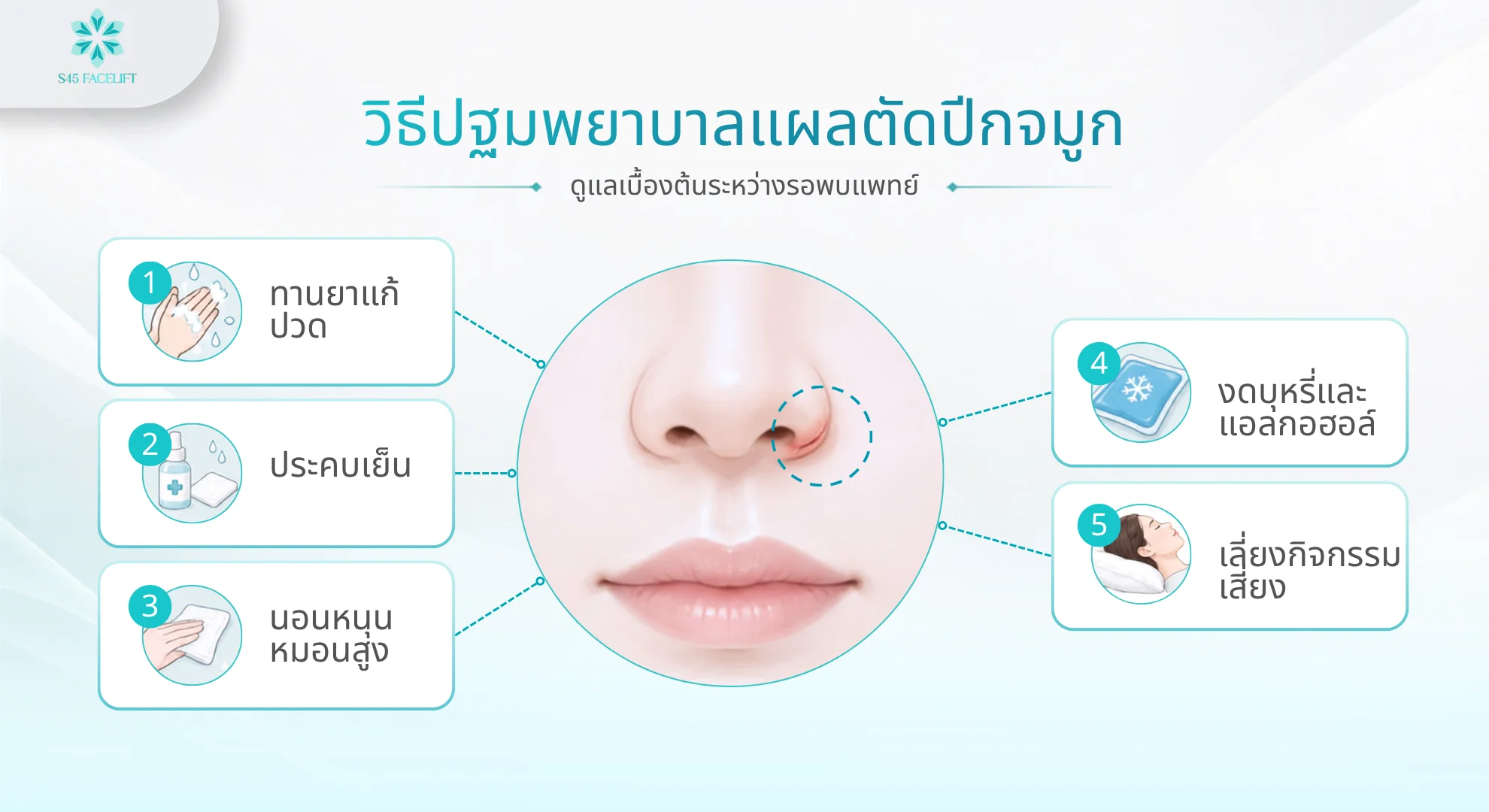
If you find pus in the wound and are waiting to see a doctor, correct first aid helps stop the symptoms from getting worse. What you do during this time affects how quickly the wound heals and the chance of scarring.
These steps are basic care you can do yourself and do not replace seeing a doctor, but they help to “buy time” and reduce the spread of the infection.
Before any step, wash your hands well with soap for at least 30 seconds, or use alcohol hand gel.
Step 1, Clean the Wound Gently
Use sterile cotton wool soaked in saline (normal saline 0.9%) and gently wipe around the wound in circles from the inside outwards, without rubbing hard. If there is dried pus stuck to the wound, do not try to pick it off. Let it soften and come away on its own.
Step 2, Pat It Dry
Use sterile gauze or a new cotton bud to pat the wound dry. Do not use ordinary cloths from home because they may carry bacteria. Repeat until the wound is completely dry.
Step 3, Contact the Clinic That Did Your Surgery
Even at night or on a holiday, send a photo of the wound to the clinic on LINE. The clinic can use the photo for an initial check and tell you whether to come in straight away or wait until opening hours.
Step 4, Reduce Swelling and Pain
Place a cold compress around the wound (without touching the wound directly) for 10 to 15 minutes at a time. You can take ordinary painkillers such as paracetamol, but do not take aspirin because it may make you bleed more easily.
Step 5, Sleep With Your Head Raised
Sleep on your back with 2 to 3 pillows so your head is higher than your heart. This helps reduce the build-up of blood and fluid around the nose, and reduces swelling and the build-up of pus.
What to Prepare Before Seeing a Doctor
- A list of all the medicines you take
- Your history of drug and food allergies
- Daily photos of the wound so far (so the doctor can see the changes)
- Notes on your symptoms, such as how high your fever is and how bad the pain is
How to Clean an Alar Base Reduction Wound Correctly
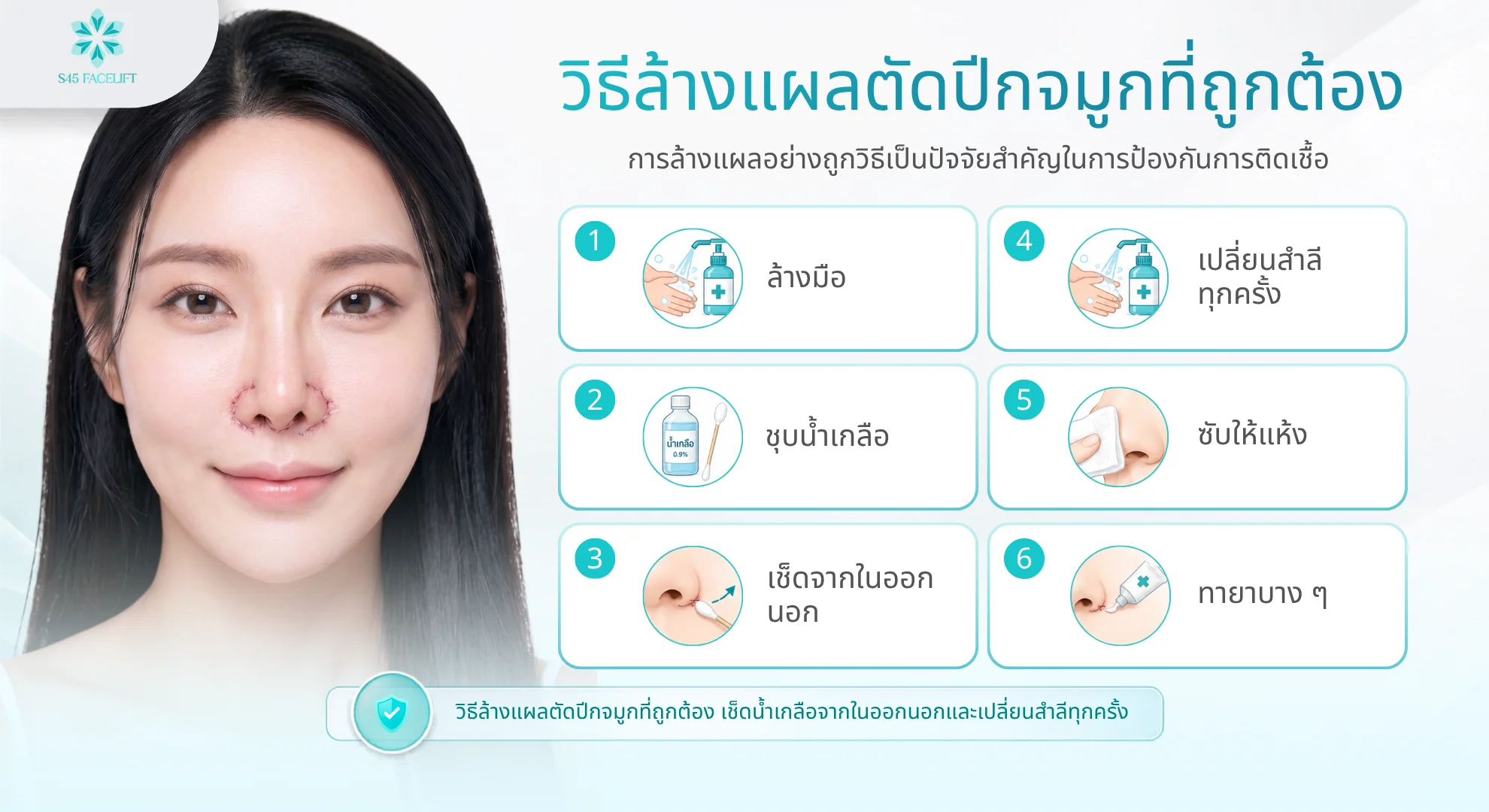
Cleaning the wound correctly is the most important way to prevent infection, and it is the first thing you need to get right when you go home from the clinic.
Although your doctor will give advice for your individual case, the basic principles of correct wound cleaning are the same for everyone. Following the steps strictly can help prevent more than 90% of infections.
Equipment you need: sterile saline (normal saline), sterile cotton buds, sterile gauze, the ointment your doctor prescribed and hand soap.
Steps for Cleaning the Wound Correctly
- Wash your hands with soap for at least 30 seconds and dry them with a clean towel.
- Open the sterile equipment carefully and do not let the cotton wool or gauze touch anything else.
- Pour saline onto a cotton bud until it is just damp, not too much.
- Wipe gently from the inside of the wound outwards in circles, without going back and forth.
- Change the cotton bud every time you wipe and never reuse the same one.
- Pat dry with sterile gauze.
- Apply the ointment your doctor prescribed in a thin layer.
- Throw away used items in a sealed bag.
How Often to Clean the Wound
Clean the wound 2 to 3 times a day, in the morning after you wake up, around midday and before bed, during the first 7 days, which are the most important. After that, gradually reduce how often you clean it as your doctor advises.
What Not to Do When Cleaning the Wound
- Do not apply 70% alcohol directly to the wound, because it damages new cells.
- Do not use povidone-iodine (Betadine) that is too strong, because it irritates the wound and slows healing.
- Do not clean the wound with tap water, even if it looks clean.
- Do not use soap or toothpaste on the wound.
Things You Must Never Do When a Wound Has Pus
When people find pus in a wound, many rush to deal with it in ways they have heard from friends or read on the internet, but some of these actions can make the situation much worse.
Surgeons stress these rules to every patient because, although they may sound like common sense, people often do these things without thinking in the heat of the moment.
The recommended approach is to let the surgeon who did your operation manage it. These are the things you must never do:
1. Do Not Squeeze or Press the Pus Out
Squeezing spreads the infection into the surrounding skin and may push bacteria into the blood vessels, with a risk of a bloodstream infection (sepsis), which can be life-threatening. Pus must only be drained by a doctor in a sterile room.
2. Do Not Pick the Scabs or Pull the Stitches
Even if a scab is annoying or starting to come off, do not pick it, because the wound underneath is still healing. Stitches that look like they are about to come out may still be holding the wound together. If there is a problem, let the doctor remove them.
3. Do Not Apply Alcohol or Strong Povidone-Iodine
70% alcohol and strong povidone-iodine damage the new cells that are forming, which slows healing and can leave a bigger scar. They can only be used to clean the skin around the wound, not inside the wound itself.
4. Do Not Buy Antibiotics to Take on Your Own
Each type of antibiotic works on different bacteria. Taking the wrong type may not work and can lead to antibiotic resistance. Importantly, taking medicine at the wrong dose or for the wrong length of time makes it harder for the doctor to treat you later.
5. Do Not Use Herbal Remedies or Household Items
Turmeric powder, coconut oil, aloe vera and gotu kola leaves may have some properties, but once a wound is infected they are not suitable to use and may carry microorganisms that make the infection worse.
6. Do Not Leave It
If you can clearly see pus, do not wait more than 24 hours to see how it goes. In some cases infection develops very quickly, and the longer you wait, the harder it is to treat.
When to Get Urgent Medical Help
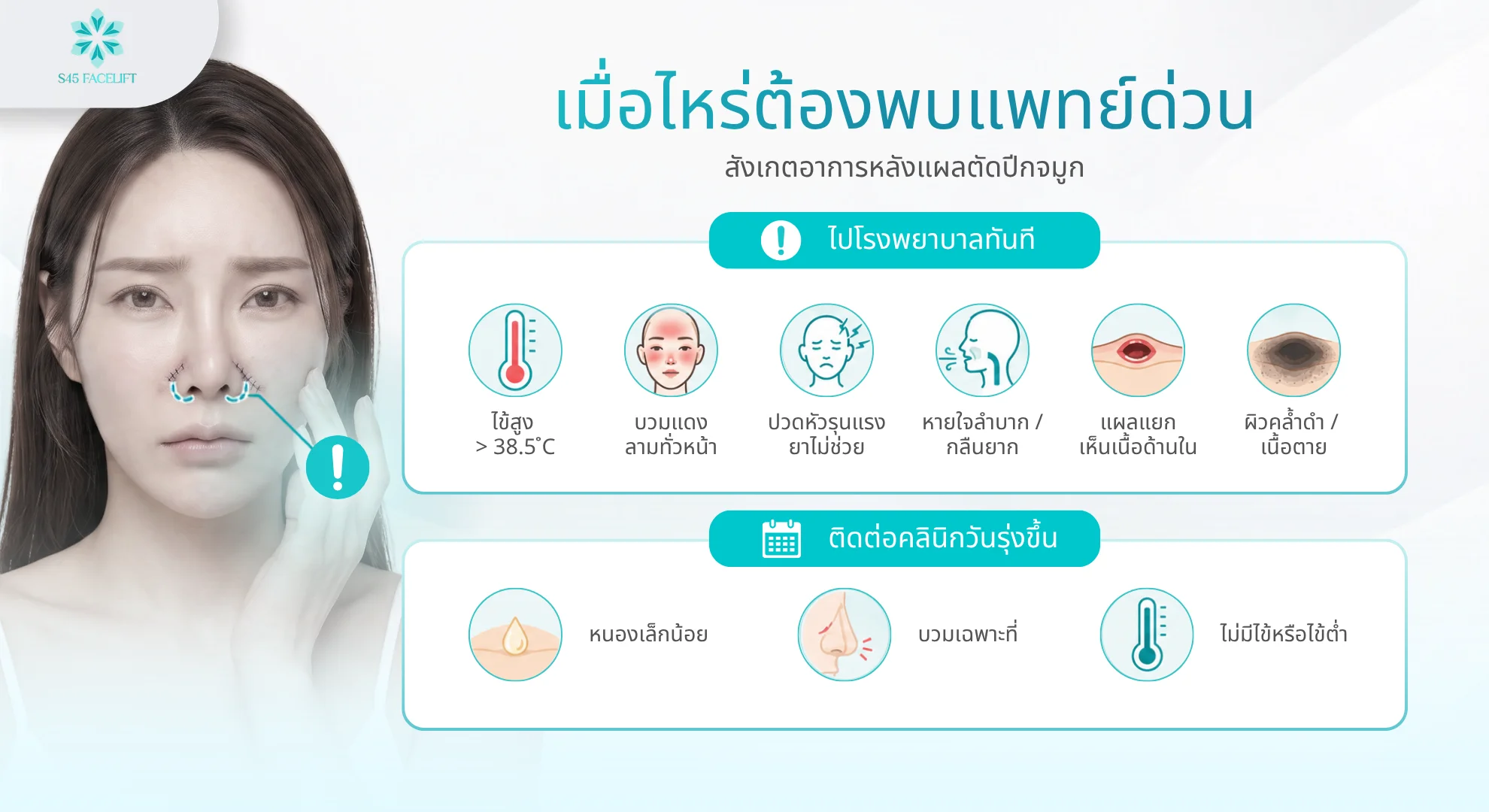
Many people are unsure whether to see a doctor straight away or wait until opening hours. Some symptoms can wait, while others mean you need to go to hospital straight away. Telling them apart correctly helps you get the right care.
In general, if you have symptoms of a level 1 or 2 infection and no high fever, you can contact the clinic that did your surgery to book an appointment for the next day. But if you have level 3 symptoms or any of the following danger signs, go to a hospital emergency room straight away.
Every clinic that meets proper standards should have an emergency contact channel available 24 hours a day. Before choosing a clinic for surgery, ask about its aftercare system from the start.
Signs You Need to Go to Hospital Straight Away
- A high fever above 38.5°C that does not come down with paracetamol
- Swelling and redness spreading across the face, not just on the nose
- Very severe pain that painkillers do not help
- Nausea, vomiting or feeling very weak
- Difficulty breathing or swallowing
- The wound clearly opening so you can see the tissue inside
- Large amounts of pus coming out continuously
- The skin around the wound turning black or showing patches of dead tissue
Symptoms Where You Can Contact the Clinic the Next Day
- A little pus with redness only around the wound
- Pain that is getting worse but can still be controlled with painkillers
- No fever, or a fever below 38°C
- Swelling only around the wound that is not spreading
Information to Tell Your Doctor
- The date of your surgery and the technique used
- When the symptoms started
- What the pus looks like, including its colour, smell and amount
- All the medicines you are currently taking
- Any long-term conditions (especially diabetes)
- How you have been caring for the wound
Read more about complications after nose surgery in the ASPS guidance at ASPS – Rhinoplasty Recovery
Caring for Pus in an Alar Base Reduction Wound at Each Level
How pus in an alar base reduction wound is treated depends on its severity, and an accurate assessment needs a direct examination by a doctor. This section explains the care at each level so you understand what to expect.
At every level, care has 3 main parts: getting rid of the infection, cleaning the wound and helping the skin recover. How intensive each part is depends on the severity.
Costs of care vary between clinics. Most clinics that performed the surgery take responsibility for treating common complications at no extra charge. This is something to check before choosing a clinic.
Care at Level 1 (Mild Inflammation)
At this level, the wound may have a little pus, slight redness, mild pain and no fever. The doctor may advise cleaning the wound with saline step by step and using a topical ointment, such as mupirocin or fusidic acid, at the doctor’s discretion.
In some cases antibiotic tablets may not yet be needed if the symptoms stay at the edge of the wound and have not spread. However, go to your follow-up appointment within 3 to 5 days, or sooner if the wound has more pus, more swelling or more pain.
Care at Level 2 (Moderate Infection)
At this level, pus may be more obvious, with redness and swelling around the wound, throbbing pain or a mild fever. The doctor may consider prescribing antibiotic tablets, such as amoxicillin with clavulanate or cephalexin, together with a topical ointment where suitable.
Some people may need to go back to the clinic several times to have the wound cleaned, especially if pus is building up or the wound is starting to open slightly. The doctor will decide whether to open the wound to drain the pus, and will usually arrange close follow-up every 2 to 3 days depending on how severe the wound is.
Care at Level 3 (Severe Infection)
If there is a lot of pus in the alar base reduction wound, the wound has opened, redness and swelling are spreading, or you have a high fever, tiredness or unusually severe pain, see a doctor as soon as possible, because you may need closer care than ordinary wound dressing.
The doctor may consider antibiotic injections, cleaning the wound in a medical facility or further care based on the actual condition of the wound. If alar base reduction was done together with rhinoplasty and the infection is suspected to have spread to the silicone implant, the doctor will carefully assess the right care for your individual case.
Care at the severe level may take about 2 to 4 weeks, or longer in some cases, depending on how you respond to treatment, the original condition of the wound and continued care after seeing the doctor.
If Corrective Surgery Is Needed
If the infection is severe enough that the silicone implant has to be removed, wait until the wound has fully healed, for at least 3 to 6 months, before having rhinoplasty again. Read more at revision rhinoplasty
Preventing Scars and Keloids After Treatment
Once the infected wound has healed, the next thing many people worry about is scarring, because wounds that have been infected tend to leave more of a mark than wounds that heal normally. Care during this period is therefore important for how the scar turns out.
An alar base reduction wound that has been severely inflamed may leave 3 types of scar: a normal scar, a raised scar (hypertrophic scar) and a keloid. Each type is managed differently.
The key period for scar care is the first 1 to 6 months after the wound closes, because the collagen is still settling into place. Treatment during this period usually works more effectively than treatment once the scar is old.
Care in the First 1 to 3 Months
- Apply silicone gel or silicone sheets to the scar for 22 to 24 hours a day.
- Apply sunscreen with SPF 50+ every day to prevent the scar from darkening.
- Massage the scar gently (from 1 month onwards) to help the collagen settle evenly.
- Avoid pulling on or pressing the scar.
Care at 3 to 6 Months
- Follow-up with your doctor every 1 to 2 months
- Steroid injections if the scar starts to become unusually raised
- Laser treatment for the scar where needed
Managing Keloids
If the scar becomes a keloid (raised beyond the edges of the wound and not flattening), it needs specific care, such as steroid injections into the scar, pressure therapy dressings, or surgery combined with radiotherapy. People with a family history of keloids have a higher risk than others.
Foods That Help Wounds Heal and Reduce Scarring
- Good-quality protein: eggs, fish, chicken, tofu
- Vitamin C: oranges, guava, kiwi fruit
- Vitamin E: avocado, nuts
- Zinc: meat, pumpkin seeds
Read more about what to eat after surgery at What to eat after rhinoplasty
How to Prevent Pus in an Alar Base Reduction Wound
It is always easier to prevent a problem than to fix it, especially an infection that could affect the shape and appearance of your nose in the long term. Looking after yourself correctly in the first 1 to 2 weeks after surgery is the key.
According to data from clinics that meet proper standards, more than 90% of the infections that happen can be prevented by following the doctor’s advice. The rest are caused by factors within the body that are hard to control.
Prevention covers 4 main areas, from choosing a clinic to everyday care.
Area 1, Choosing the Right Clinic From the Start
Choose a medical facility properly licensed by the Department of Health Service Support (DHSS), where a doctor assesses you and plans the procedure, and where there is a clear aftercare system, such as follow-up appointments, wound care steps and a way to get in touch if something is not right.
Area 2, Wound Care in the First 7 Days
In the first 7 days, clean the wound following the steps your doctor or the clinic staff recommend, such as wiping the wound with saline, changing the gauze on schedule and applying the ointment your doctor prescribed. Wash your hands every time before touching the wound, and avoid picking, scratching or pressing the wound unnecessarily.
Area 3, Things to Avoid
Keep the wound away from water for the first 7 to 10 days, or as your doctor advises. Also avoid heavy exercise, strong facial movements, make-up around the nose, smoking and alcohol, because these may interfere with wound healing.
Area 4, Looking After Your General Health
Get enough rest, drink a suitable amount of water and eat healthy food, such as protein, vegetables and fruit, to support wound healing. If you notice unusual scabbing on your alar base reduction wound, a raised scar, increasing redness and swelling, or the start of pus, see a doctor to have it assessed.
What to Check at Follow-Up Appointments
Go to every follow-up appointment your doctor arranges. Do not skip one even if you feel the wound is fine, because the doctor may see early signs of a problem that you cannot see.
Consultation for Alar Base Reduction Wounds at S45 Clinic
Pus in an alar base reduction wound is a problem that needs care from an experienced doctor who understands nose surgery wounds in detail. S45 Clinic is a plastic surgery clinic focused on the nose, with an aftercare system that covers complications from an early stage, under our promise “Because every beautiful result comes from care”
Our Surgeons and Their Training
Our doctors are otolaryngologists (ear, nose and throat surgeons) with subspecialty training in facial plastic and reconstructive surgery who focus on nose cases, and complications of surgical wounds are assessed and managed by an experienced doctor. Read more at rhinoplasty
Aftercare With a Quick Response
S45 Clinic has an aftercare team that follows up with every patient from the first day after surgery, with a LINE Official Account where you can send photos of your wound and ask for advice straight away. In an emergency, our team will reply quickly and arrange an appointment with a doctor as soon as possible, to help stop complications getting worse.
How We Manage Cases With Complications
If an infection develops, we follow a structured care protocol, from assessing the severity, prescribing suitable antibiotics and cleaning the wound in a sterile room through to preventing scars and keloids. Every step is carried out by our surgeons.
FAQ About Pus in an Alar Base Reduction Wound
Is Pus in My Alar Base Reduction Wound Dangerous?
The risk ranges from mild to severe. At the mild level (level 1), it is not usually dangerous and can be managed with ointment and cleaning. At the severe level (level 3), it may be serious enough to need hospital care. The important thing is to act early, before it becomes more serious.
What Causes Pus After Alar Base Reduction?
The 5 main causes are the wound getting wet in the first 7 days, incorrect wound cleaning, touching or picking the wound with unwashed hands, low immunity and contamination during surgery. The most common causes are the wound getting wet and incorrect care, which can be prevented.
What Should I Do If the Stitches in My Nose Have Pus?
First, stay calm and follow the correct first aid steps. Clean the wound gently with saline, pat it dry and contact the clinic that did your surgery straight away. Do not squeeze the pus, pick the scabs, apply alcohol or buy antibiotics to take on your own. Send photos so the clinic can make an initial assessment of how severe it is.
How Many Days Does an Inflamed Alar Base Reduction Wound Take to Heal?
With prompt care, level 1 heals in 5 to 7 days, level 2 in 7 to 14 days, and level 3 in 2 to 4 weeks or longer. However, “the wound healing” is not the same as “the scar healing”, which takes 3 to 6 months to fade and smooth out.
How Many Days Does a Surgical Wound With Pus Take to Heal?
It depends on the severity and the care. In a typical case treated with suitable antibiotics, the infection clears within 7 to 14 days, but the healed wound may need several more weeks to fully recover. Choosing a clinic with a good aftercare system can help this process go more smoothly.
What Are the Symptoms of an Infected Nose?
The main symptoms are a wound that is redder, more swollen and hotter than usual, throbbing pain, yellow or green pus leaking out, a bad smell from the wound and possibly a mild fever. At the severe stage, symptoms spread beyond the wound, with a high fever and tiredness. If you get these symptoms, consult a doctor straight away.
How Do I Care for a Wound Inside My Nose That Has Pus?
A wound inside the nose that has pus is a little harder to care for than an external wound, because it is in a closed, moist area. The doctor usually prescribes antibiotic tablets together with specific nasal drops or a nasal spray, and advises you to avoid blowing or picking your nose. In severe cases, the wound may need to be cleaned at the clinic. Do not use cotton buds to clean inside your nostrils yourself.
Is It Normal for My Alar Base Reduction Wound to Scab?
Yes, it is normal and a good sign that the wound is healing. The scab will gradually come off on its own within 7 to 14 days. Never pick the scab, because it can make the scar bigger. If the scab smells or turns greenish yellow, it may mean there is an infection under the scab, so consult a doctor.
Will a Raised Alar Base Reduction Scar Flatten on Its Own?
In a typical case (hypertrophic scar), a scar that is raised in the first 1 to 3 months gradually flattens within 6 to 12 months with silicone gel and sunscreen. But if it grows beyond the edges of the wound and does not flatten, it may be a keloid, which needs specific care. An accurate assessment needs an examination by a doctor.
What Can I Apply to a Wound on My Nasal Septum?
If there is a wound on the nasal septum (for example from alar base reduction done together with rhinoplasty), use only the medicine your doctor prescribes, such as a thin layer of antiseptic ointment or antiseptic gel. Do not apply coconut oil, herbal remedies or general sprays, because they may interfere with healing. If the wound has not healed within 1 to 2 weeks, see a doctor.
What Should I Do If a Stitch Comes Out After Alar Base Reduction?
If a stitch comes out before 7 days, contact the clinic straight away, as it may need to be stitched again to stop the wound from opening. If it comes out after 7 days and the wound is fully closed, it is usually not a problem and you just need to care for the wound as normal. Do not pull out any remaining stitches yourself. Let the doctor remove them.
How Many Days Do I Need to Take Antibiotics For?
It depends on the type of medicine and how severe the infection is. A standard course is usually 7 to 10 days, and in some cases 14 days. The important thing is to finish the whole course even if you feel better, to prevent antibiotic resistance and the infection coming back. Never stop taking the medicine early.
Summary
Pus in an alar base reduction wound is a complication caused by a bacterial infection, which can happen in the first 3 to 7 days after surgery. The main symptoms are redness, swelling, heat, throbbing pain, thick yellow-green pus leaking out and possibly a fever. Severity is divided into 3 levels, from mild inflammation that can be treated with an antiseptic ointment to a severe level where the pus needs to be drained.
The most important thing is to tell normal wound fluid apart from dangerous pus, and to avoid the things you must never do, such as squeezing the pus, picking the scabs, applying alcohol or taking antibiotics on your own. Correct first aid, together with contacting a doctor promptly, helps support the wound’s recovery.
If you are dealing with this problem, stay calm, follow the first aid steps and contact the clinic that did your surgery straight away. Acting early helps stop it from becoming more serious, and in most typical cases the wound heals well, although results depend on each person. It is also important to choose a clinic with a good aftercare system before surgery, so you can get prompt care if a problem does happen.
Because every nose structure…
is different
An otolaryngologist assesses every case before treatment and gives advice based on your actual concerns.
“Reveal the beauty within you”
Message us online
Surgery and medical procedures carry risks. Find out about them and consult a doctor before you decide. Results depend on each person.