Alarplasty in Bangkok 2026, How to Choose a Clinic, Techniques, Cost and Downsides to Know Before You Decide
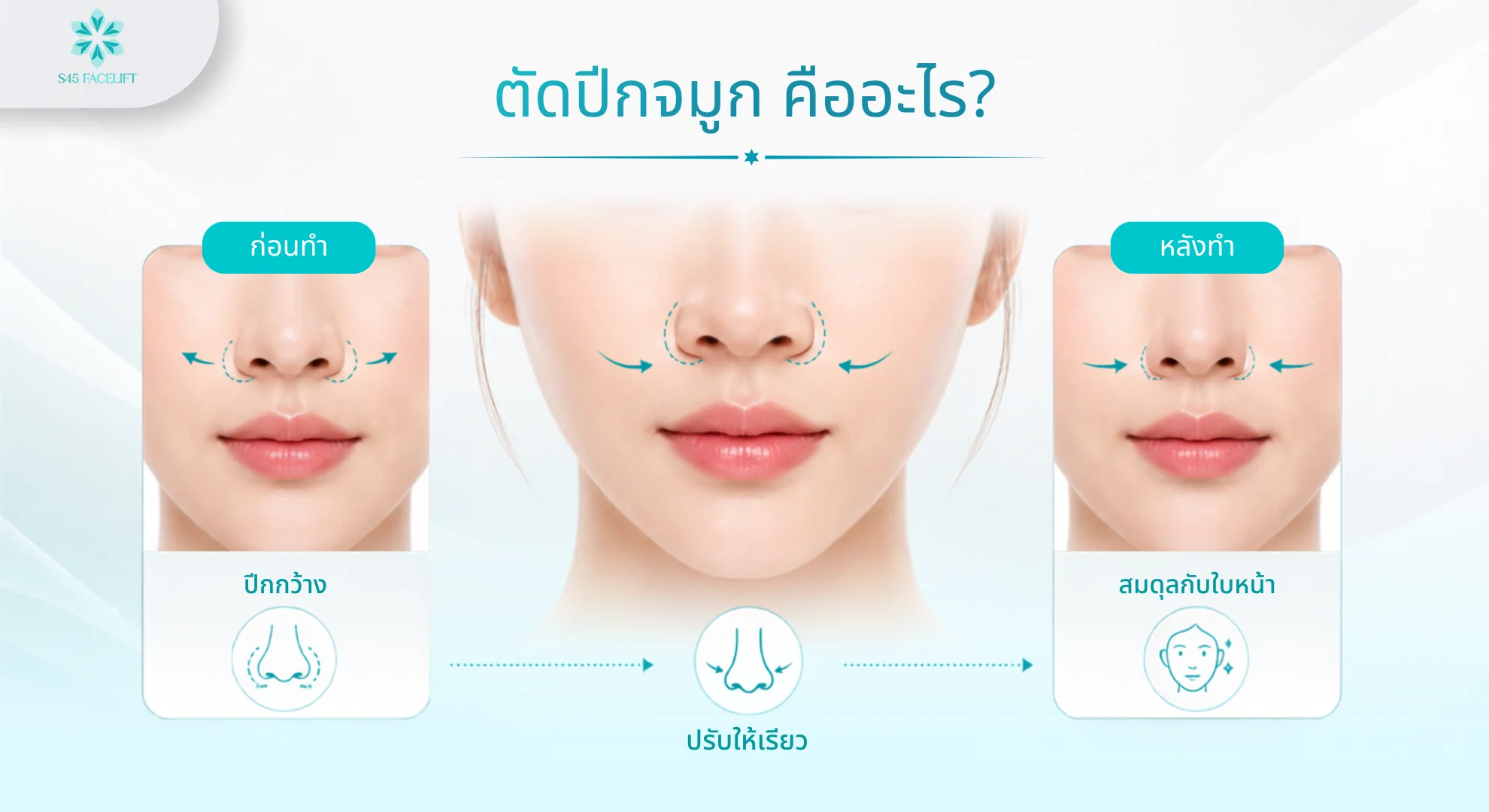
Many people with flared alae, wide nostrils or a wide nasal base have thought about alar base reduction to make the face look slimmer and more balanced. Before deciding, a question many people search for is ‘where to have alar base reduction’, because choosing the wrong clinic can affect the scar, the balance of the nose and your confidence in the long term.
Key points
- Alar base reduction (alarplasty) is a minor operation to reduce the width of the alae (the sides of the nostrils). There are 2 main techniques, an internal incision (the scar sits inside the nostril) and an external incision (a scar at the base of the alae), chosen according to each person’s concern.
- Which noses suit alar base reduction? Suitable cases include flared alae, wide nostrils, a wide nasal base, thick alae and alae that are out of balance with the bridge and tip.
- 6 criteria for choosing a clinic: the doctor’s specialty qualifications, a clinic licence from the Department of Health Service Support, operating theatre standards, real review cases, transparent pricing and an aftercare system.
- The cost of alar base reduction depends on the technique, the complexity of the case and the clinic’s standards. An unusually low price carries risks to quality and safety.
- Downsides to know: there is a chance of keloid scarring, especially if you have a history of keloids, and reducing the alae out of proportion can make the nostrils too small or change the character of your face.
- Having alar base reduction and rhinoplasty at the same time is a common option because it reduces the overall cost and recovery time, but the overall shape needs to be planned in detail beforehand.
This article covers what you need to know before deciding, from what alar base reduction is and its techniques, which noses it suits and does not suit, the factors that affect the cost, downsides and risks, 6 criteria for choosing a clinic and a checklist of questions to ask the doctor, through to wound care after surgery, so you can make a fully informed decision.
In This Article
What Is Alar Base Reduction
Alar base reduction, or alarplasty, is a minor surgical procedure that reduces the size of the alae (nasal ala, the sides of the nostrils) so that the nose looks slimmer and more in balance with the face. It is a procedure often requested by people of Asian descent, who commonly have a wide nasal base and flared alae as part of their inherited facial structure.
Although it is called ‘cutting’, it is in fact a careful ‘reduction and reshaping’ of the alae rather than a drastic removal. The doctor measures and designs the new alae to fit your existing bridge, tip and nasal base, so that the result is in proportion with your face.
In Thailand, alar base reduction is done both on its own and together with rhinoplasty, because the width of the alae also affects the overall shape of the nose, not only the height of the bridge.
Background of Alar Base Reduction
This procedure developed from techniques used by facial plastic surgeons to correct flared alae and wide nostrils in people of Asian descent. Today there are several variations designed to reduce scarring and give results in proportion with the face.
Why Many People Choose Alar Base Reduction
Flared alae or a wide nasal base can make the face look wider and less slim. However much the bridge is raised, the overall look of the nose may still seem unbalanced if the alae are out of shape. Alar base reduction adjusts the proportions of the alae directly, which can improve the overall proportions of the face.
Read more about correcting the shape of the alae in alar base reduction without rhinoplasty
Which Noses Suit Alar Base Reduction
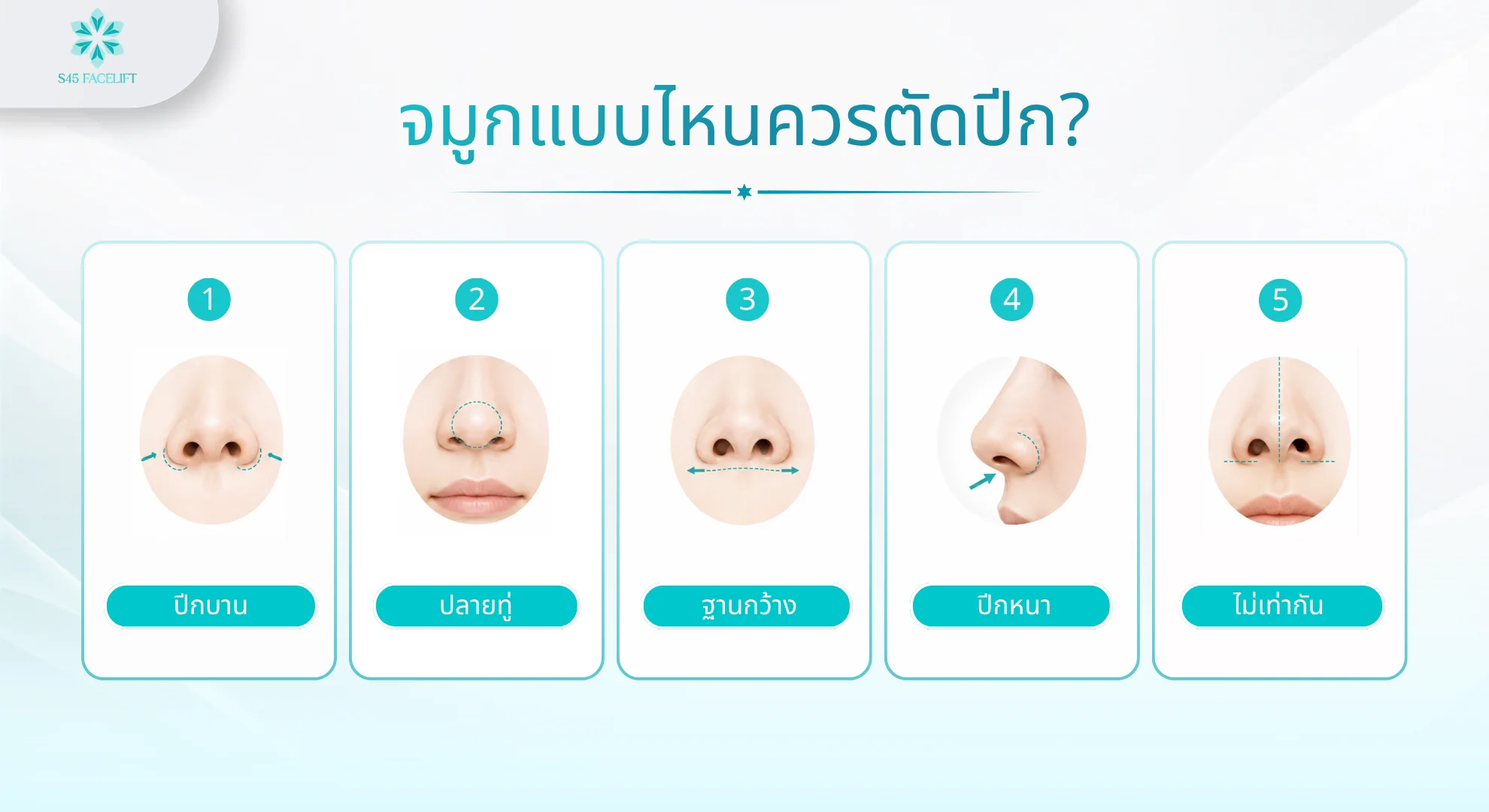
One of the questions people often search for is ‘which noses suit alar base reduction’, because not every case benefits from it. In some cases rhinoplasty alone is enough, while in others alar base reduction is really needed for a balanced result.
An accurate assessment needs an examination by a doctor, because the shape of the alae seen from the outside can involve several factors, including the bone structure, the soft tissue and the skin in that area.
However, some nose types often clearly benefit from alar base reduction. Compare your nose to see which of these features apply to you.
1. Flared Alae and Wide Nostrils
This is a suitable and common case. Seen from the front, the alae spread out to the sides beyond the proportions of the face, which makes the nose look large with a wide base. Alar base reduction can reduce the width and help the face look slimmer.
2. Flared, Blunt Nasal Tip
Where the nasal tip spreads out to the sides and looks blunt, alar base reduction combined with tip reshaping can help the tip look slimmer and more defined. Read more about correcting a flared nasal tip in how to fix a flared nasal tip
3. Wide Nasal Base Out of Balance With the Bridge
If your nose still looks large after the bridge has been raised, this is often because the wide nasal base is out of balance with the higher bridge. Alar base reduction adjusts the proportions so that the bridge and base match, which can make the nose look smaller and slimmer overall.
4. Thick, Fleshy Alae
In some cases the alae do not spread out much but are thick, which makes the nose look large. Alar base reduction in this case focuses on removing tissue from the alae so that they become thinner and the nose looks slimmer. Cases with thin alae may use a different technique. Read more in thin alae
5. Uneven Alae
Asymmetrical alae are something many people notice in front-facing photos. Alar base reduction in this case adjusts the size of both sides to match, helping the face look more balanced.
Who Is and Is Not Suitable for Alar Base Reduction
Besides the shape of the nose, other factors affect who is or is not suitable for alar base reduction, especially your general health and past medical treatment.
Before deciding, assess yourself first before your consultation, so that you can share important information and plan properly. Not giving complete information may affect your care and the long-term result.
An experienced doctor assesses the suitability of your existing nose, your general health and your expectations before advising whether alar base reduction is right for you.
People Who May Be Suitable for Alar Base Reduction
- aged 25 or over, when the facial and nasal structure is fully developed
- flared alae, wide nostrils or a wide nasal base that affects facial proportions
- in good general health, with no serious medical condition that rules out surgery
- realistic expectations of the result
- ready to follow the wound care advice after surgery
People Who Need Careful Consideration
- people with a history of keloid scars, because the scar at the base of the alae may become a lasting raised scar
- people who are pregnant or breastfeeding, who are advised to postpone surgery
- people with a bleeding disorder, who need an assessment with the doctor first
- people taking medicines that affect blood clotting, such as aspirin, who need to stop them before surgery as the doctor advises
- people with a chronic skin condition on the nose, which needs to be treated until it clears first
If Your Alae Are Only Slightly Flared
If the alae are only slightly flared, alar base reduction may not be needed. Rhinoplasty to raise the bridge and lift the tip may help the overall look become balanced without further surgery. A consultation with a doctor before deciding is therefore very important, because unnecessary alar base reduction can make the nostrils too small and change the character of your face.
Why Alar Base Reduction Is Not Advised in Some Cases
‘Why is alar base reduction not advised’ is one of the questions people often search for, because many worry about results that may not meet their expectations. Understanding why it is ‘not advised’ in some cases helps you decide carefully.
Alar base reduction is not a bad procedure, but it has limitations and does not suit everyone, so an assessment beforehand is very important. People who have it when it does not suit them may get results that do not meet their expectations and need correction later.
The main reasons alar base reduction is not advised in some cases are:
1. The Alae Are Not Really Flared
Many people think their alae are flared when the real issue is a flat bridge or an undefined tip. When the bridge and tip lack projection, the alae can seem flared too. In this case rhinoplasty may be more suitable, without alar base reduction.
2. The Nostrils May Become Too Small
Removing too much from the alae makes the nostrils narrow and small, which affects both appearance and breathing in the long term. A doctor with limited experience may remove more than necessary.
3. Risk of Keloid Scarring
The scar at the base of the alae with the external incision technique can become a keloid in some people, especially those with a history of keloids. In this case the doctor may suggest considering the internal incision technique instead, or postponing surgery.
4. Losing the Character of Your Face
The alae are part of the character of your face. Removing too much can make your face look so different that people around you say “you do not look the same”. A design that fits you is therefore more important than reducing more than necessary.
5. The Change Is Lasting and Hard to Reverse
Alar base reduction removes tissue, so the change is lasting. If too much is removed, making the nostrils larger again is difficult and complex, unlike rhinoplasty, where a silicone implant can be removed.
Advice: If you are not sure whether to have alar base reduction, consult an experienced doctor with specialty training at 1 to 2 clinics or more to get a range of opinions before deciding. Taking a few more weeks to decide is more careful than deciding too quickly and regretting it later.
Alar Base Reduction Techniques, Internal and External Incisions
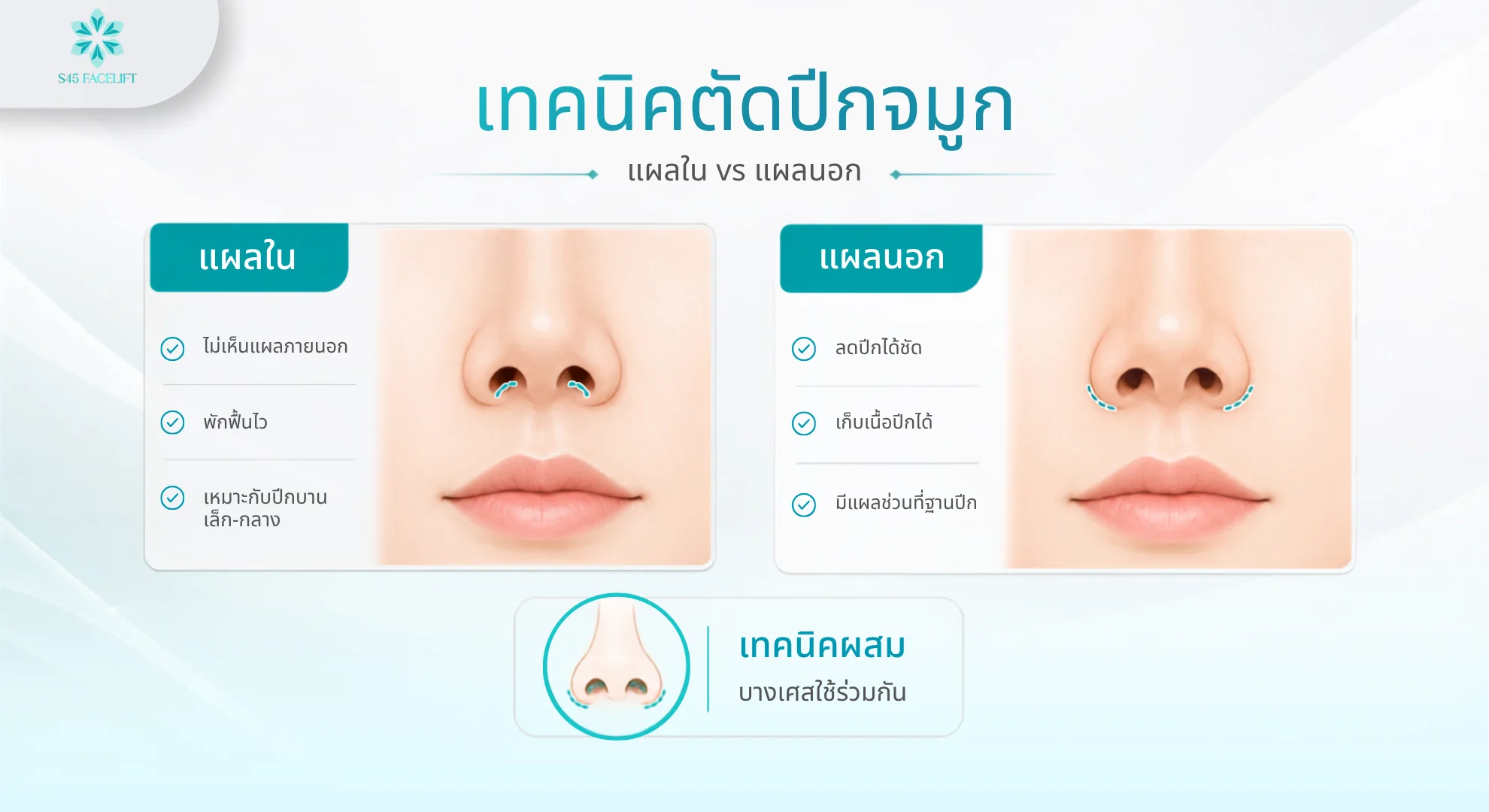
Alar base reduction has 2 main techniques based on where the incision is made, the internal incision and the external incision. Each has different advantages and limitations and suits different cases.
Choosing the right technique affects the result, the chance of scarring and your appearance in the long term. An experienced doctor assesses your case and recommends a technique that suits your structure.
Where the alae are slightly to moderately flared, the internal incision technique may be used as the main approach. Where the alae are very flared, or both the flare and the thickness of the alae need reducing, the external incision or a combination of both may be more suitable.
1. Internal Incision Technique (Internal Alarplasty)
The incision is made inside the nostril, so the scar cannot be seen from the outside. It suits cases where the main aim is to reduce the width of the nostrils, because the doctor sutures the base of the alae inwards to make the nostrils smaller. Its advantages and limitations are:
Advantages:
- the scar is not on the outside of the nose
- a lower chance of keloid scarring
- usually a shorter recovery
Limitations:
- a limited reduction in how flared the alae are
- not suitable for very thick or very flared alae
- some partial return of the original shape is possible in the long term
2. External Incision Technique (External Alarplasty)
The incision is made at the base of the alae, in the crease where the nostril meets the cheek, so the scar sits in the shadow of that crease. This technique can remove excess alar tissue and suits cases where the alae are very flared or thick tissue needs reducing.
Advantages:
- can reduce the flare and size of the alae more noticeably
- results intended to last in the long term
- the new nostril shape can be designed precisely
Limitations:
- a scar at the base of the alae (placed in the crease at the nostril base)
- a higher chance of keloid scarring than the internal incision
- depends on the doctor’s suturing skill
3. Combined Technique
In complex cases, the doctor may use both internal and external incisions together to correct both the width of the nostrils and the flare of the alae in one operation. This technique requires precision and experience from the doctor.
Good Wound Suturing Technique
Whatever the technique, the quality of the scar depends on the doctor’s suturing skill. Good suturing helps the scar lie smooth, without pulling, and fade over time. An experienced doctor uses fine sutures and careful stitching to help make the scar less noticeable.
Can Alar Base Reduction and Rhinoplasty Be Done Together
A common question is ‘can I have alar base reduction together with rhinoplasty’. The answer is yes, and it is a common option for people who want to change the shape of the whole nose, because the surgeon can plan all parts of the nose together rather than separately.
Having both together has advantages and limitations. The main advantages are saving recovery time and overall cost. The main limitation is that the overall shape needs careful planning, because changing it later is complex.
The doctor plans both procedures together so that the reduced alae and the augmented nose match each other. A good assessment from the start helps give a balanced result.
Advantages of Having Both Together
- saves recovery time, with one recovery period of 7 to 14 days instead of two
- saves cost, as anaesthesia and other fees are lower when both are done together
- the overall shape is designed from the start, which helps the parts of the nose fit together
- the shape is planned at the same time, with fewer recovery periods and less cumulative risk
Limitations to Know
- the shape needs planning in advance, because once the alae have been reduced this cannot be undone
- more swelling and bruising, because there are wounds in 2 areas that need more careful care
- a higher cost per operation paid in one sum, even though it costs less than having them separately
- cumulative risk, as more procedures in one operation mean a higher risk during surgery
When to Have Them Separately
In some cases the doctor may suggest having them separately, for example if it is your first rhinoplasty and you are not sure whether you also want alar base reduction. Waiting 6 months for the rhinoplasty result to settle before assessing may make it clearer whether alar base reduction is really needed. Read more about rhinoplasty (nose surgery)
Alar Base Reduction Cost and the Factors That Affect It
Alar base reduction cost is a question people often search for about this procedure, because it directly affects the decision. Before comparing prices, understand the factors that affect the cost and what the quotation should include.
Prices for alar base reduction range from a few thousand baht to several tens of thousands of baht. The differences reflect the quality of service, the doctor’s skill and the clinic’s standards. Choosing on low price alone may not be worth it in the long term if the scar needs correcting later.
Before paying, consider both the cost per operation and the risks that follow, because alar base reduction removes tissue for good and is hard to correct later.
Factors That Affect the Cost of Alar Base Reduction
- technique used: internal incision < external incision < combined technique
- case complexity: slightly flared alae < moderately flared alae < very thick or asymmetrical alae
- the doctor’s qualifications and experience: doctors with specialty training charge more than general practitioners
- clinic standards: a standard operating theatre, an anaesthetist team and a care system
- on its own or with rhinoplasty: having it with rhinoplasty costs more, but less than having the two procedures separately
- aftercare: clinics with an ongoing follow-up system have higher costs
What to Check in the Quotation
Ask for a quotation that clearly states whether it includes the anaesthetist fee, medicines after surgery, stitch removal and follow-up. A transparent clinic lists every item in the quotation from the start and does not add charges later. Other items to check include:
- the silicone implant (if combined with rhinoplasty)
- cartilage (if your own cartilage is used)
- anaesthesia and operating theatre fees
- medicines after surgery
- follow-up fees
How Much Does Alar Base Reduction Cost
The answer to ‘how much does alar base reduction cost’ depends on the factors above. Large price differences between clinics reflect differences in quality and service. The typical market price is usually in the tens of thousands of baht, but an accurate price needs a facial assessment and a discussion with the doctor. Contact the clinic on LINE to ask for a quotation for your case.
Beware of Unusually Low Prices
Take extra care if a clinic offers a price far below the market, because it may reflect an inexperienced doctor, an operating theatre that does not meet standards or no aftercare system. Saving a few thousand baht may not be worth the risk of scarring, nostrils out of proportion and the cost of correction later.
Alar Base Reduction Downsides and Risks to Know
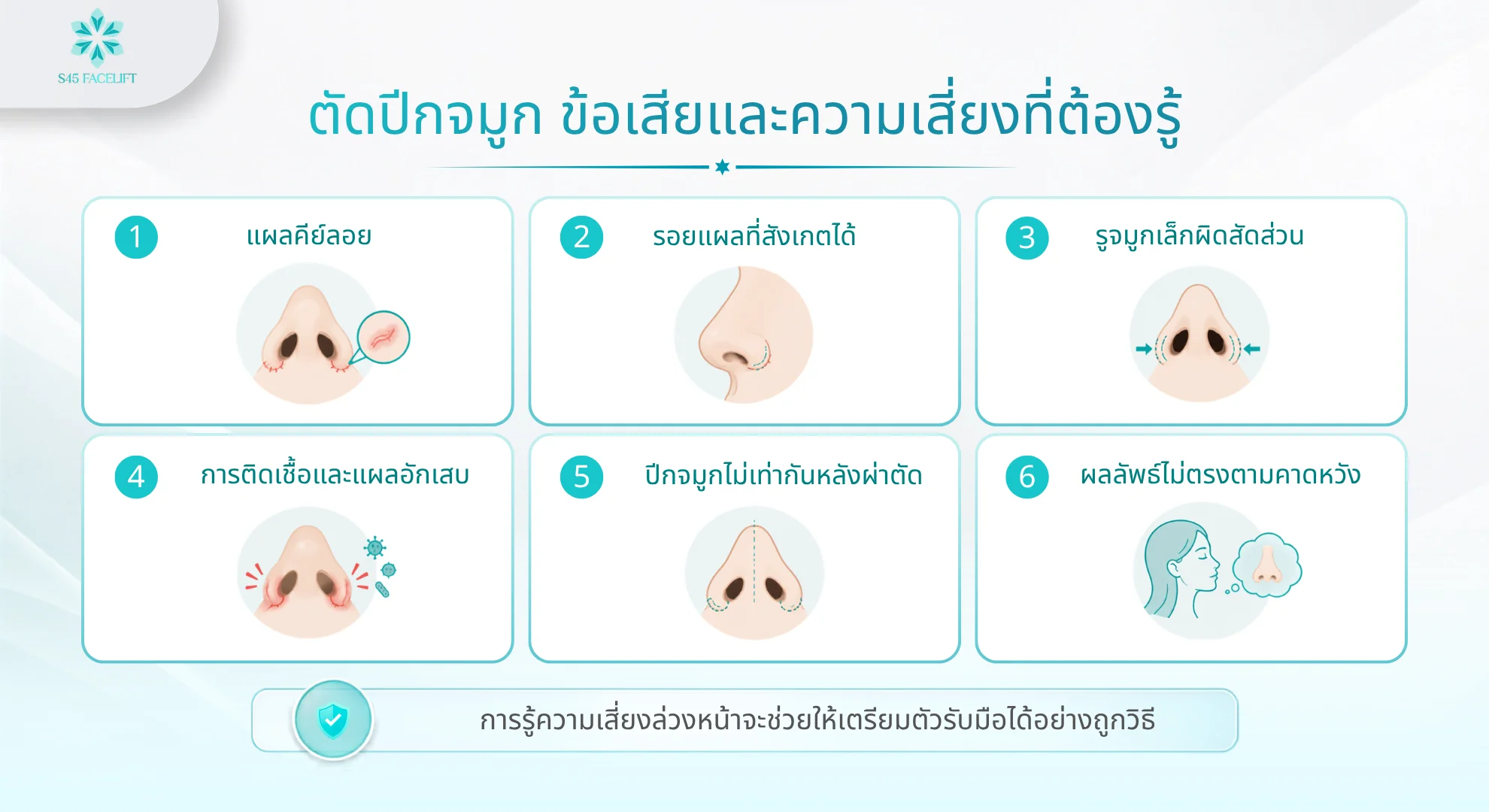
Although alar base reduction is a minor procedure with a lower risk than rhinoplasty, it still has downsides and risks to understand before deciding. Knowing the risks in advance helps you set suitable expectations and prepare.
Some risks happen soon after surgery, such as wound inflammation, while others appear in the long term, such as keloid scars. Following the doctor’s advice closely can lower these risks.
Especially if you are deciding now, the following downsides and risks can give you a complete picture.
1. Keloid or Raised Scars
This is a common risk of the external incision technique, especially in people with a history of keloids. Good wound care and attending follow-up appointments can lower the risk.
2. Noticeable Scars
Even with careful suturing, in some people the scar at the base of the alae may be noticeable up close, especially in the first 3 to 6 months while the scar has not fully faded.
3. Nostrils Too Small for Your Proportions
If the doctor removes too much from the alae, the nostrils may become too small for your proportions and the face may look unbalanced. This is very difficult to correct because tissue needs to be rebuilt.
4. Infection and Wound Inflammation
This is a general risk of any surgery, which happens when the environment is not clean enough or the wound is not cared for well. Choosing a clinic that meets standards and following the doctor’s advice help lower the risk.
5. Uneven Alae After Surgery
Even with careful measurement and design, in some cases the alae may look uneven after surgery. This can be due to uneven swelling in the early period, or because the alae were already asymmetrical.
6. Results That Do Not Meet Expectations
The result may not match what you imagined, especially if you expect an unrealistically large change. Discussing things in detail with the doctor before surgery and looking at real review cases help set expectations in line with reality.
Read more about surgical wound care to international standards at Cleveland Clinic – Surgical Incision Care
Where to Have Alar Base Reduction, 6 Criteria for Choosing a Clinic

Now to the key question, ‘where to have alar base reduction’. Choosing a clinic is a decision that affects both the result and your appearance in the long term. Although alar base reduction is a minor procedure, it requires precision and skill.
Many people choose a clinic mainly from social media reviews or price, but other factors matter just as much, such as the doctor’s qualifications, the clinic licence and operating theatre standards.
Paying a little more for a clinic that meets standards is wiser than saving money and needing scar correction later. There are 6 main criteria for choosing where to have alar base reduction:
1. The Doctor’s Qualifications and Experience
This is a key factor in choosing a clinic. Check that the doctor is:
- certified in otolaryngology (ear, nose and throat), or
- trained in the subspecialty of facial plastic and reconstructive surgery
- experienced in nose surgery and alar base reduction in particular
Read more about our doctors and their qualifications
2. A Valid Clinic Licence
Always check the clinic licence on the website of the Department of Health Service Support (DHSS) first. A properly registered clinic has a licence number you can check, and a doctor in charge who is registered with the Medical Council of Thailand.
3. Operating Theatre Standards
Although alar base reduction on its own is done under local anaesthetic, the operating theatre still needs standards of cleanliness, sterilisation and ready-to-use equipment. If it is done together with rhinoplasty under general anaesthetic, the operating theatre needs to be of hospital standard with an anaesthetist team.
4. A Range of Real Review Cases
Look at the clinic’s real review cases, focusing on:
- reviews of alar base reduction cases specifically, not only rhinoplasty cases
- reviews covering a range of face types, not only cases with striking results
- long-term reviews 3 to 6 months after surgery to see settled results
- real reviews with clear case details, not stock images
5. Transparent Pricing
A trustworthy clinic gives a detailed quotation and does not add charges later. The price should cover the surgery, medicines, follow-up and stitch removal.
6. A Complete Aftercare System
Good aftercare is more than 1 follow-up appointment. It covers:
- check-ups 1 week, 1 month, 3 months and 6 months after surgery
- an emergency contact system if you have unusual symptoms
- advice on wound care and preventing keloid scars
- a policy for care if the result is not as agreed (subject to each clinic’s terms)
Checklist of Questions to Ask the Doctor Before Surgery
Before deciding to have alar base reduction, preparing questions for the doctor on the day of your consultation is important, because it helps you get complete information and decide based on facts, not feelings alone.
A good doctor is happy to answer every question in detail and directly. If the doctor does not want to answer or gives vague answers, that is a warning sign to consider.
Here is a checklist of questions to prepare for your consultation:
Questions About Technique and Results
- Which technique does the surgeon recommend for my case, and why?
- Where will the scar be, and how noticeable will it be once fully healed?
- What will the actual result look like, and how closely can it match my reference photos?
- Is there a chance the alae will flare again?
- If the result does not meet my expectations, what is the clinic’s correction policy?
Questions About Safety
- What risks could occur?
- About how many alar base reduction cases has the surgeon done?
- Have any cases not turned out as expected, and how were they corrected?
- What standards do the operating theatre and team meet?
- What type of anaesthetic will be used, and is there an anaesthetist team?
Questions About Preparation and Aftercare
- How do I prepare before surgery?
- How many days off work will I need?
- What wound care do I need in the first 7 days?
- How many follow-up appointments are there, and how far apart are they?
- If I have problems after surgery, how can I contact the doctor who operated?
Questions About Cost
- What does the quoted price include?
- Are there any additional costs that may come up later?
- If a minor correction is needed, is there an extra cost?
- What payment options are there?
Warning Signs to Look Out for During a Consultation
During a consultation, some signs suggest that a clinic or doctor may not be right for you. Noticing these signs and walking away from a clinic you do not trust is wiser than regretting it after surgery.
A good doctor takes time to assess you and answer your questions in detail, does not pressure you to decide and does not play down the risks.
Look out for the following signs during your consultation.
Warning Signs to Watch For
- pressure to decide on the day of the consultation, for example “this offer is for today only, pay the deposit now”
- promising a 100% guaranteed result, when in reality no procedure can promise a fixed result without conditions
- not explaining the risks, or making them seem smaller than they are
- no clinic licence or doctor qualifications that can be checked
- prices far below the market with no reason given
- no real review cases, or review cases that look like stock images
- refusing to answer detailed questions, or giving vague answers
- an operating theatre and premises that are not clean and tidy
- no mention of aftercare, or no follow-up system
Signs That a Clinic Is Trustworthy
On the other hand, a trustworthy clinic shows these features:
- the doctor takes time to assess your face and nose in detail
- explains the technique to be used and why it was chosen
- shows real review cases similar to yours
- answers every question directly, including limitations and risks
- gives you time to think before deciding
- provides a detailed and transparent quotation
- openly shows the clinic licence and the doctor’s qualifications
Preparing for Alar Base Reduction and Caring for the Wound Afterwards
Preparation before surgery and wound care afterwards directly affect the result and the chance of scarring. However skilled the doctor, if you do not look after yourself properly, the result may not be as expected.
Before the procedure, there are medicines, food and your physical condition to consider. Care afterwards is divided into the first 7 days, which are an important period, and 1 to 3 months after surgery, when the scar gradually fades.
Following the right steps helps the wound heal smoothly and can noticeably lower the chance of keloid scars.
Preparing for Alar Base Reduction
Good preparation starts at least 1 to 2 weeks before surgery:
- stop medicines that increase bleeding, such as aspirin, ibuprofen and vitamin E, for at least 7 days
- stop alcohol and smoking for at least 1 week before surgery, because they affect wound healing
- tell the doctor about any medical conditions, regular medicines and allergies
- tell the doctor if you or your family have a history of keloid scars
- get enough sleep and eat healthy food to support your immune system
- clean your facial skin before going into the operating theatre
Wound Care in the First 7 Days
The first 7 days are an important period for wound healing:
- apply cold compresses for the first 24 to 48 hours to reduce swelling and bruising
- clean the wound as the doctor advises, rinsing with saline and patting it dry
- apply antiseptic ointment as the doctor prescribes
- do not touch, press or massage the wound area at all
- sleep with your head raised on pillows and avoid bending your head down for long periods
- take your medicines exactly as the doctor prescribes
- have your stitches removed as scheduled (usually 5 to 7 days after surgery)
Wound Care 1 to 3 Months After Surgery
After the stitches are removed, the scar gradually fades, but it still needs ongoing care to help prevent keloid scars:
- apply sunscreen with SPF 50+ every day when you go out in the sun
- avoid strong sunlight for the first 3 months
- apply silicone gel or silicone sheets as the doctor advises to help prevent keloid scars
- do not pick off scabs yourself, let them fall off on their own
- avoid strenuous exercise and any sport where the nose could be knocked for 1 to 2 months
- take vitamins that support wound healing, such as vitamin C, as the doctor advises
Important Things to Avoid
Do not pick or wipe the wound with anything sharp, and do not wear glasses that press on the nose during the first week. Most importantly, if you have unusual symptoms such as severe pain, redness, heat and swelling, pus or a fever, contact the clinic straight away.
Why Choose S45 Clinic for Alar Base Reduction
Alar base reduction needs careful facial assessment and skilled suturing for a smooth scar. S45 Clinic is a plastic surgery clinic focused on the nose that plans every case individually, under our promise ‘Because all beauty comes from care’.
Doctors With Specialty Training
Our doctors are trained in otolaryngology (ear, nose and throat) and the subspecialty of facial plastic and reconstructive surgery. They focus on nose and alar base reduction cases and assess your face to plan a technique that suits your case.
Internal and External Incision Techniques to Suit Each Case
S45 Clinic chooses the technique that suits each case rather than using one technique for every case. The doctor assesses whether to use an internal incision, an external incision or a combined technique, based on how flared the alae are, the thickness of the tissue and your goals. Read more in alar base reduction without rhinoplasty
Operating Theatre Standards and Ongoing Aftercare
Our operating theatre meets standards, with a 1:1 anaesthetist team for cases combined with rhinoplasty under general anaesthetic, and an aftercare system that follows up for 3 to 6 months after surgery, with detailed advice on wound care and preventing keloid scars. We look after you from assessment through to recovery.
Frequently Asked Questions About Alar Base Reduction
Where Should I Have Alar Base Reduction, and How Do I Choose?
Choose using 6 main criteria: a doctor with specialty training, a valid clinic licence from the DHSS, operating theatre standards, a range of real review cases, transparent pricing and a complete aftercare system. Price is not the only factor to consider, because clinic standards and the doctor’s skill directly affect the long-term result.
How Much Does Alar Base Reduction Cost?
Prices vary by clinic, technique, case complexity and the doctor’s qualifications. The typical market price is usually in the tens of thousands of baht, and when combined with rhinoplasty the price is given as a package. An accurate estimate needs an in-person facial assessment. Ask the clinic for a quotation for your case, and be wary of clinics offering unusually low prices.
Which Noses Suit Alar Base Reduction?
Suitable features are flared alae, wide nostrils, a wide nasal base out of balance with the bridge, thick fleshy alae and uneven alae. However, an accurate assessment needs an examination by an experienced doctor, because some cases that look like flared alae are actually due to a flat bridge or an undefined tip, which can be corrected with rhinoplasty without alar base reduction.
Why Is Alar Base Reduction Not Advised in Some Cases?
The main reasons are that the alae may not really be flared, with the issue being a flat bridge, or that there is a risk of keloid scarring, especially in people with a history of keloids. Removing too much makes the nostrils too small for your proportions and changes the character of your face, and the change is lasting and hard to reverse. Before deciding, consult an experienced doctor at 1 to 2 clinics or more.
What Are the Downsides of Alar Base Reduction?
Downsides and risks to know include keloid scars, especially with the external incision, a scar that may be noticeable up close, nostrils too small for your proportions if too much is removed, a risk of infection and results that do not meet expectations. Choosing an experienced doctor and caring for the wound as advised help lower these risks.
Internal or External Incision, Which Should I Choose?
It depends on each person’s case. The internal incision suits cases where the main aim is to reduce nostril width. The scar cannot be seen from the outside, but the reduction in flare is limited. The external incision suits very flared alae or thick alar tissue. It gives a more noticeable reduction but leaves a scar at the base of the alae. An experienced doctor assesses your case and recommends the technique that suits you.
Can I Have Alar Base Reduction Together With Rhinoplasty?
Yes. It is a common option for people who want to change the shape of the whole nose. The advantages are saving recovery time and cost, and the doctor designs the overall shape together from the start, with fewer recovery periods. The shape needs detailed planning in advance.
How Long Is the Recovery After Alar Base Reduction?
Swelling and bruising are most noticeable in the first 3 to 7 days. You can usually return to work after the stitches are removed (about 5 to 7 days). In the first month the wound dries and the scabs fall off, from month 1 to 3 the scar gradually fades, and by month 6 the scar usually fades to close to your normal skin, depending on each person. Following the wound care advice directly affects how quickly and smoothly the scar heals.
Is There a Chance of Keloid Scarring After Alar Base Reduction?
Yes, especially in people with a history of keloids. The external incision has a higher risk than the internal incision. Ways to lower the risk include choosing a doctor skilled in suturing, caring for the wound as advised, avoiding the sun for the first 3 months and applying silicone gel as the doctor advises. If you have a history of keloids, tell the doctor before surgery.
Has Anything Changed for Alar Base Reduction In 2026?
In 2026, technology and techniques for alar base reduction continue to develop, especially finer suturing techniques and suture materials that help reduce scarring more than in the past. However, the key factor is still the skill and experience of the doctor, not technology alone.
Summary
Alar base reduction is a minor surgical procedure that reduces the flare of the alae, helping the face look slimmer and more balanced. There are 2 main techniques, internal and external incisions, chosen according to how flared the alae are and how thick the tissue is. Suitable cases are people with flared alae, wide nostrils or a wide nasal base out of balance with the bridge.
The question of where to have alar base reduction can be answered with 6 criteria: a doctor with specialty training, a clinic licence, operating theatre standards, real review cases, transparent pricing and a complete aftercare system. Alar base reduction cost depends on the technique, the complexity and the quality of the clinic, and an unusually low price carries risks to quality and safety.
The downsides to know are the chance of keloid scars, over-reduction that makes the nostrils too small for your proportions, and losing the character of your face if the design does not suit you. Preparing a checklist of questions for the doctor and watching for warning signs during the consultation help you make a decision you can feel confident about in the long term.
Because every nose structure…
is different
An otolaryngologist with subspecialty training in facial plastic and reconstructive surgery assesses every case before treatment and gives advice based on your actual concerns.
“Reveal the beauty within you”
Message us online
Surgery and medical procedures carry risks. Find out about them and consult a doctor before you decide. Results depend on each person.