Nose Tip Settling After Rhinoplasty, Will the Tip Get Smaller? A Day-by-Day Timeline and How to Help It Settle

After rhinoplasty, many people ask the same questions in the first few months: “Will the nose tip get smaller as it settles?”, “Will the shape turn out as I hoped?” and “How long will it take?” Feeling impatient and worried at this stage is normal, because a swollen nose can look bigger than planned in the early weeks.
Key points
- Nose settling is the process in which your body forms tissue around the silicone implant after rhinoplasty. The tissue tightens around the implant, so the nose looks more defined and settles into shape.
- Will the tip get smaller? Yes, it usually does, especially if your tip was not very large to begin with, because the swollen tissue goes down and tightens around the implant, so the tip looks slimmer. How much depends on each person.
- How many months does settling take? You may start to see changes from week 2, the shape becomes clearer in months 3 to 6, and it fully settles in months 6 to 12.
- How can I tell my nose has settled? The nose looks narrower, the bridge is more defined, the tip is slimmer, and the nose feels firm to the touch rather than soft as it did at first.
- Normal symptoms: tightness, mild swelling and itching at the wound are a normal part of settling.
- Symptoms that are not normal: severe pain, swelling that is red and hot, a dark red tip or thinning skin. See a doctor straight away.
- How to help your nose settle: avoid knocks to the nose, get enough protein and vitamin C, avoid alcohol and smoking, and attend your follow-up appointments.
This article covers nose settling in full, from what it is and how it works, to a detailed day-by-day timeline, signs that your nose has settled, how to tell normal from abnormal symptoms, what to do if only one side settles, how to help your nose settle, and what to do if you are unhappy with the shape after it settles, so you can wait for your result with confidence and realistic expectations.
In This Article
What Is Nose Settling?
Nose settling is the process in which your body forms a thin layer of tissue (a capsule) around the silicone implant used in rhinoplasty. About 2 to 4 weeks after surgery, this tissue gradually tightens around the implant, so the nose looks more defined and starts to settle into the shape the surgeon planned.
In the early period after surgery, the nose looks large and swollen because the tissue around the implant has not yet tightened. Many people worry that their nose will be too big, but this is only a transition stage before settling takes place.
Settling is the body’s own response to a ‘foreign object’ placed inside it, in this case the silicone implant. The body forms a capsule around the implant to separate it from the surrounding tissue. This is normal and is needed to reach the final shape.
How Settling Works
- First week: the body starts to form a thin capsule around the implant
- Weeks 2 to 4: the capsule thickens and starts to tighten
- Months 1 to 3: the capsule clearly tightens around the implant and the shape starts to settle
- Months 3 to 6: settling becomes stable and the shape is clearly defined
- Months 6 to 12: the final result, with a slimmer tip and a defined bridge
Why Settling Matters
Without settling, the nose can look like a rod and the implant may move. Settling holds the implant in place and lets the skin of the nose lie closely over the implant, so the nose blends with your face and takes the shape the surgeon planned.
See more about rhinoplasty to understand the procedure in detail.
Why Does the Nose Need to Settle?
Many people wonder why a nose that has just been operated on does not show the final shape straight away when they leave the clinic. The answer lies in the body’s own process, which needs time to ‘adjust’ to the implant.
Whenever something foreign enters the body, the immune system responds by forming tissue around it to separate it from normal tissue. In rhinoplasty, this response is actually helpful, because it holds the implant in the position where the surgeon placed it.
How long it takes to settle fully depends on several factors, including the original structure of your nose, your skin, how much augmentation was done and how carefully you follow your aftercare.
Factors That Affect How Long Settling Takes
- Original nasal tissue: thick tissue settles more slowly, thin tissue settles sooner
- Amount of augmentation: more augmentation takes longer, moderate augmentation settles sooner
- Technique: closed rhinoplasty settles sooner, open rhinoplasty takes longer
- Age: younger people tend to heal sooner
- General health: good health helps the nose settle sooner
- Self-care: following your surgeon’s advice helps the nose settle sooner
Why Patience Matters
Many people are impatient to see the result, but settling is the body’s own process and cannot be sped up much. Being patient in the first 3 to 6 months matters for the final result. A hard knock to the nose during this time could make the tissue tighten in the wrong direction and change the planned shape.
Will the Nose Tip Get Smaller as It Settles?
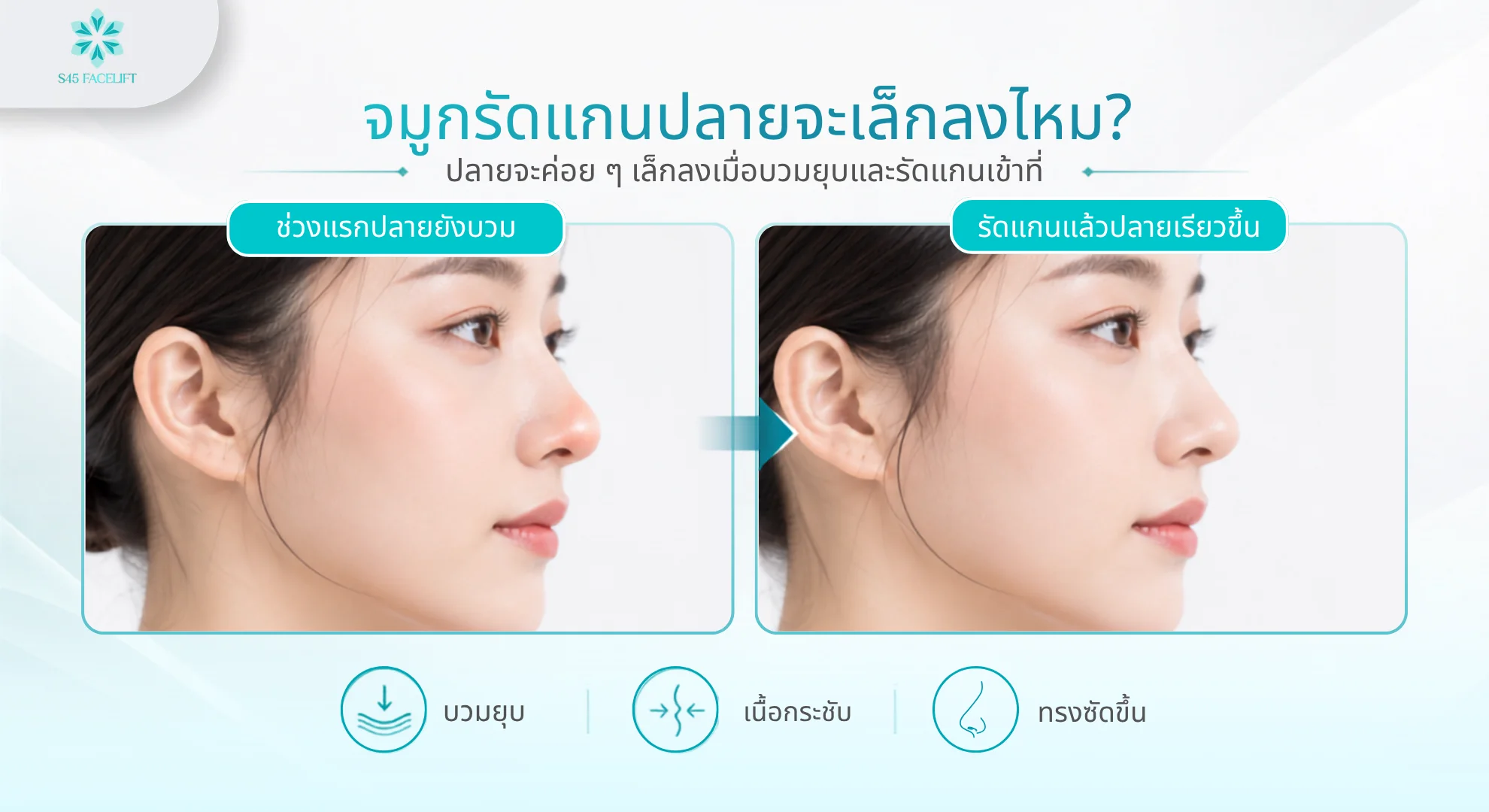
Will the nose tip get smaller as it settles? This is a question people search for often after rhinoplasty, because a swollen tip can look large and blunt at first, and people worry the shape will not match their reference photo. The short answer is yes, it gets smaller, but how much depends on several factors.
A tip that looks large in the first few months is partly caused by swollen tissue and partly by a capsule that has not yet tightened. Once the swelling goes down and the capsule tightens, the tip looks slimmer and smaller on its own.
However, how much smaller it gets depends on the original tip and the technique used. If the original tip was large or had thick tissue, a silicone implant alone may make the tip only slightly smaller.
Cases Where the Tip Gets Clearly Smaller
- An original tip that was not very large: the change is clearly visible
- Open rhinoplasty with cartilage: the tip is slimmer and more projected
- Cases where the tip was also reshaped: the tip is slimmer and more defined, as designed
- People with thin nasal tissue: the nose settles sooner and the slimmer tip is clearly visible
Cases Where the Tip Gets Only a Little Smaller
- An original tip that was large with thick tissue: only a small reduction, and extra tip reshaping is needed
- Silicone implant augmentation without tip reshaping: the tip gets only slightly smaller
- People with thick nasal tissue: the nose settles more slowly and the tip gets only a little smaller
How Much Smaller You Can Expect It to Be
In general, once the nose has settled, the tip is about 20% to 40% smaller than on the day you leave the operating room, although this varies from person to person. Where the original tip was not very large, it can sometimes look smaller than before surgery. If the original tip is very large, a silicone implant alone may not be enough, and tip reshaping techniques may need to be considered. See more techniques at thin nasal tissue and a more projected tip
Will the Nose Look Higher After It Settles?
One question many people ask is “Will the bridge get higher once the nose settles?” The answer is no. The bridge does not actually get higher from settling, but it “looks higher” because the surrounding tissue goes down and tightens, making the bridge the surgeon built more defined.
This confusion happens because people feel their nose looks better and higher after settling than when they first left the operating room. In fact, the height of the implant has not changed. The swelling around it has simply gone down, making the shape clearer.
Understanding this helps you keep realistic expectations. The height of your nose depends on the size and shape of the implant the surgeon chose on the day of surgery. It does not increase over time.
What Changes as the Nose Settles
- The nose looks narrower and more defined
- The bridge is more defined (because the tissue around it goes down)
- The tip is slimmer and more defined
- The skin of the nose lies closely over the implant
What Does Not Change
- The height of the implant (it does not increase)
- The basic shape the surgeon designed
- The length of the nose
Special Cases Where the Nose “Looks Much Higher”
Where the original nasal tissue was thick and there was a lot of swelling after surgery, the change after settling can look very noticeable, so it feels as if the nose has “become much higher”. In fact the implant has not changed. The overall look is different because the tissue around it has gone down and tightened.
How Many Months Does Settling Take? A Day-by-Day Timeline
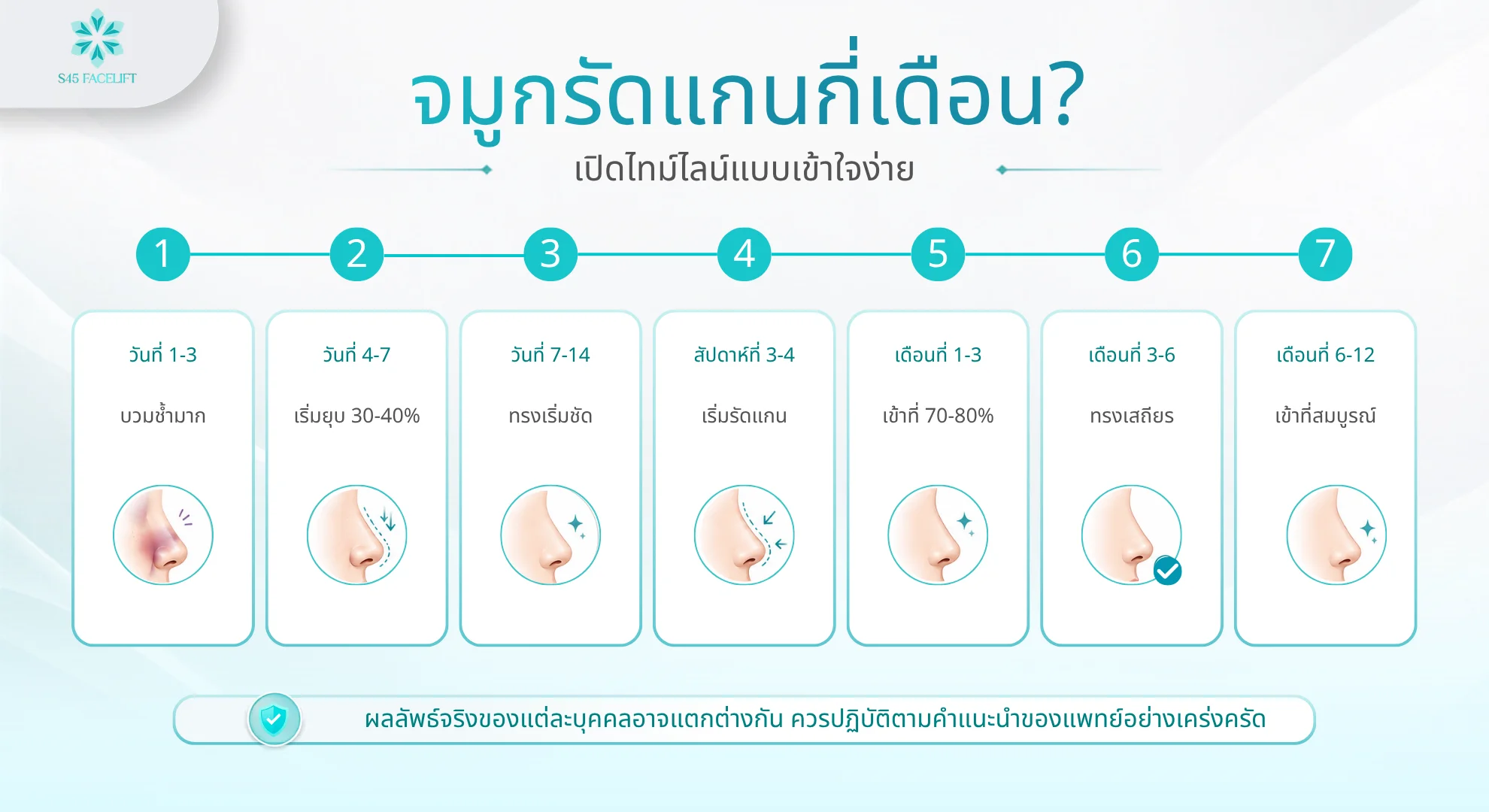
How many months does settling take? This is a common question, because many people want to know an exact timeframe so they know what to expect. There is no single exact answer, because ‘fully settled’ can mean different stages.
Understanding each stage of the timeline helps you know what to expect each week, so you are not alarmed when your nose does not yet look the way you expected in the first few months.
Your own timeline may be a little faster or slower than shown here, depending on your nasal tissue, your health and how carefully you follow your aftercare.
Days 1 to 3, Peak Swelling
The nose is at its most swollen and bruised, and looks larger than the planned shape because the tissue has not yet gone down and the capsule has not formed. Many people are alarmed at this stage because the nose feels unusually large. This is normal and usually not a cause for concern.
Days 4 to 7, Swelling Starts to Go Down
Swelling and bruising go down by 30% to 40%, and you can start to see the rough shape, but the tip and bridge still look large because the capsule is only starting to form.
Days 7 to 14, Splint Removed and the Shape Starts to Form
The nasal splint is removed during this period. Swelling goes down to about 50% to 60% and the shape becomes clearer, but the nose still looks larger and more swollen than the final result. Around days 10 to 14, the capsule starts to form around the implant.
Weeks 3 to 4, Settling Begins
This is when ‘settling’ becomes noticeable. The capsule around the implant thickens and starts to tighten. The tip starts to look slimmer and the bridge more defined. You may notice your nose changing every day.
Months 1 to 3, the Shape Starts to Settle
In months 2 to 3, the nose reaches about 70% to 80% of its final shape. The tip is clearly smaller and the bridge is more defined. Many people start to feel happier with the shape at this point and feel their nose looks “as they hoped”.
Months 3 to 6, Settling Is Complete
The nose reaches about 95% of its final shape. The capsule is stable and does not change much. The tip and bridge take their final form, and this is when many people consider the nose “fully settled”.
Months 6 to 12, the Final Result
The shape reaches 100%. Small details, such as the smoothness of the skin over the nose and the softness of the tip, finish adjusting during this period. The final result should be assessed at 6 to 12 months, not in the first few months.
How Can I Tell My Nose Has Settled?
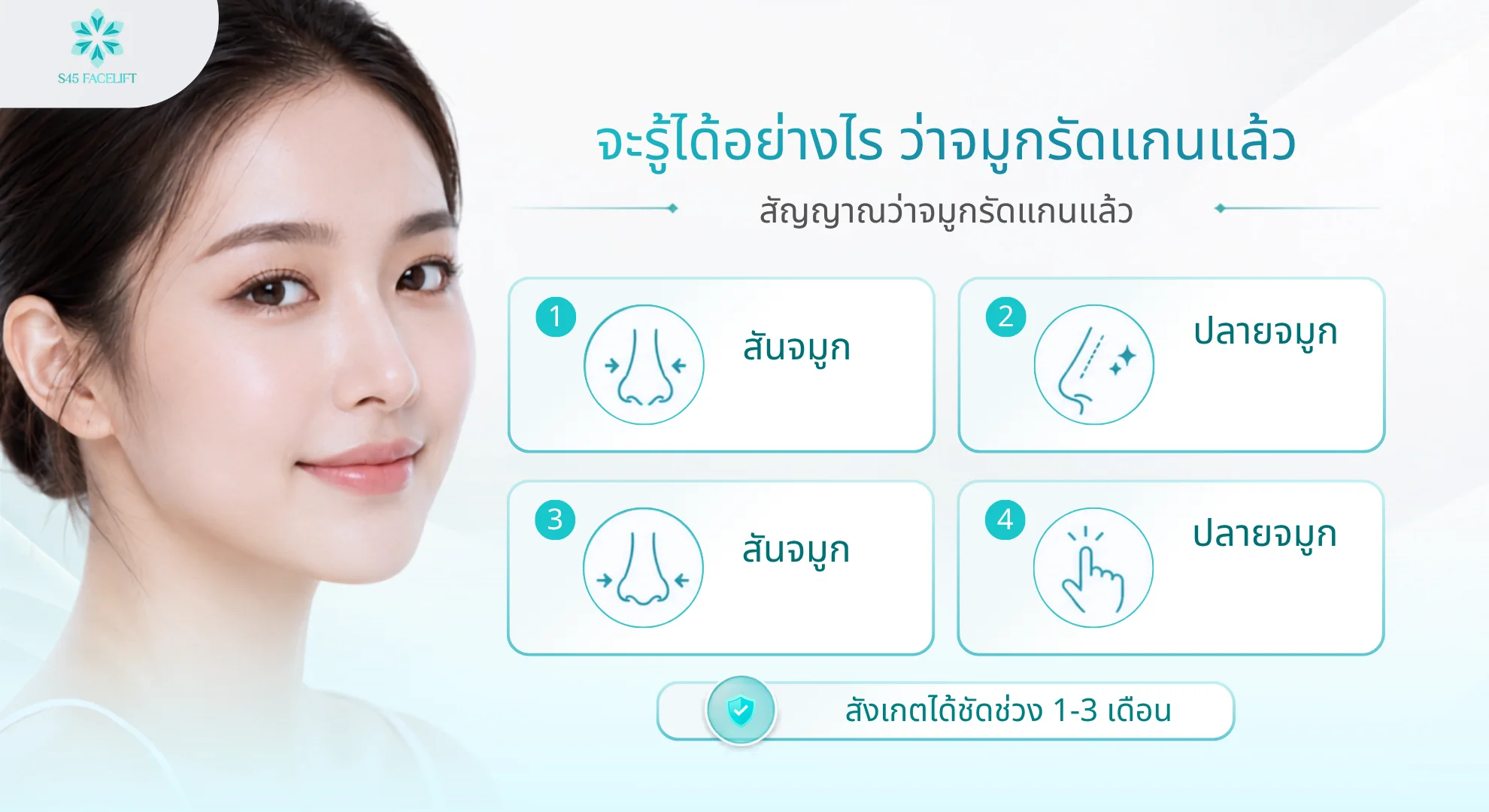
One of the most searched questions is “How can I tell my nose has settled?” Many people are unsure what to look for once the process is complete. Knowing the signs helps you tell whether the shape has settled yet.
In general, signs of settling become clear in months 1 to 3 and can be confirmed in months 3 to 6 after surgery. You can notice changes in both how your nose looks and how it feels.
Check whether these signs match your nose.
Signs You Can See
- The nose looks narrower than on the first day
- The bridge is more defined and sharper
- The tip is slimmer and smaller
- The skin lies closely over the implant and the nose does not look like a rod
- Swelling and bruising have almost gone
Signs You Can Feel
- The nose feels firm and tight, not soft
- The implant no longer moves, because the capsule holds it in place
- Some tightness over the bridge and tip is normal
- It does not hurt when you touch it lightly
Signs That the Wound Has Healed
- The wound inside the nostril or at the base of the columella (the strip of skin between the nostrils) has fully healed
- The area around the wound is not swollen or red
- The scar has faded close to your normal skin colour
When Is Settling Considered Complete?
Medically, the nose is considered settled when its shape has not changed for 1 to 2 months in a row. This is usually around month 6 after surgery. However, small details continue to adjust in months 6 to 12.
Does Settling Hurt and How Does It Feel?
The questions “Does settling hurt?” and “How does it feel?” reflect the worries of many people waiting for their result. Each stage of settling feels different, and understanding this helps you tell whether what you feel is normal.
In general, settling is not very painful, but you will have tightness, itching and some odd sensations in the nose at different stages. Knowing which feelings are normal helps reduce worry.
However, if you have symptoms that are “not normal”, such as severe pain or swelling that is red and hot, see a doctor straight away.
How It Feels at Each Stage
Weeks 1 to 2
- Tightness and a blocked feeling in the nose
- Mild pain that is eased by painkillers
- A heavy feeling over the bridge and tip
- Itching around the wound (do not scratch)
Weeks 3 to 4
- A tight, squeezing feeling, which is a sign of settling
- Much less pain
- Some people feel slight numbness at the tip
- The tip may feel harder than usual
Months 1 to 3
- The tightness gradually eases
- You can touch your nose, but do not press hard yet
- Sensation starts to return to normal
- The pain has gone
Months 3 to 6
- The nose feels like part of your face
- It feels normal to the touch
- The odd sensations have gone
Normal Symptoms That Are Not a Cause for Concern
- Frequent tightness and itching in the first month
- A heavy feeling in the nose in the early period
- Slight numbness at the tip for 1 to 3 months
- Dry, peeling skin on the nose
- A firm feeling over the bridge
Symptoms That Need a Doctor Straight Away
- Unusually severe pain that painkillers do not help
- Swelling that is red and hot and getting worse instead of better
- A dark red tip or black spots
- Skin so thin that the implant shows through
- Pus or a bad smell from the wound
- A fever of 38°C or higher
See more about a moist, itchy wound after rhinoplasty if you have unusual itching.
Still Sore 1 Month After Rhinoplasty? When the Tightness Goes
The question “Is it normal to still be sore 1 month after rhinoplasty?” worries many people, because they expect to have recovered after a month. In fact, some tightness and mild discomfort in the first month is still normal.
The time it takes for “tightness” to go is different from the time it takes for “pain” to go. Normal pain goes in the first week, but tightness can last up to 2 to 3 months, because the capsule is forming and tightening around the implant.
Understanding the difference between “pain” and “tightness” helps you keep realistic expectations and know whether your symptoms are within the normal range.
How Long the Tightness Lasts
- Weeks 1 to 2: very tight, and the nose feels hard and uncomfortable to touch
- Weeks 3 to 4: tightness goes down by 30% to 40% and the nose starts to move more freely
- Months 1 to 2: tightness goes down by 60% to 70% and the nose feels close to normal
- Months 2 to 3: only slight tightness remains, felt only when you touch it lightly
- Months 3 to 6: the tightness has almost gone and the nose feels like part of your face
Why It May Still Hurt in Month 1
In a typical case, real pain should go within the first week. If you still feel real “pain” in month 1, it may be a sign of:
- infection (usually with redness, swelling and fever)
- the implant pressing on a nerve
- other complications
In this case, see a doctor for a check-up. Do not wait for it to go away on its own.
How “Tightness” and “Pain” Differ
- Tightness: a firm feeling with mild discomfort that does not hurt, needs no medicine and eases over time
- Pain: pain that needs painkillers and may disturb your sleep. Pain that continues after month 1 is not normal
Ways to Ease Tightness Sooner
- Gentle massage as your surgeon advises (starting after month 1)
- Apply the moisturising cream your surgeon provides
- Get enough vitamins and protein
- Get enough sleep
- Do not wear glasses that press on the bridge in the early period
See full aftercare advice at how to reduce swelling after rhinoplasty
How to care for yourself to help your nose settle
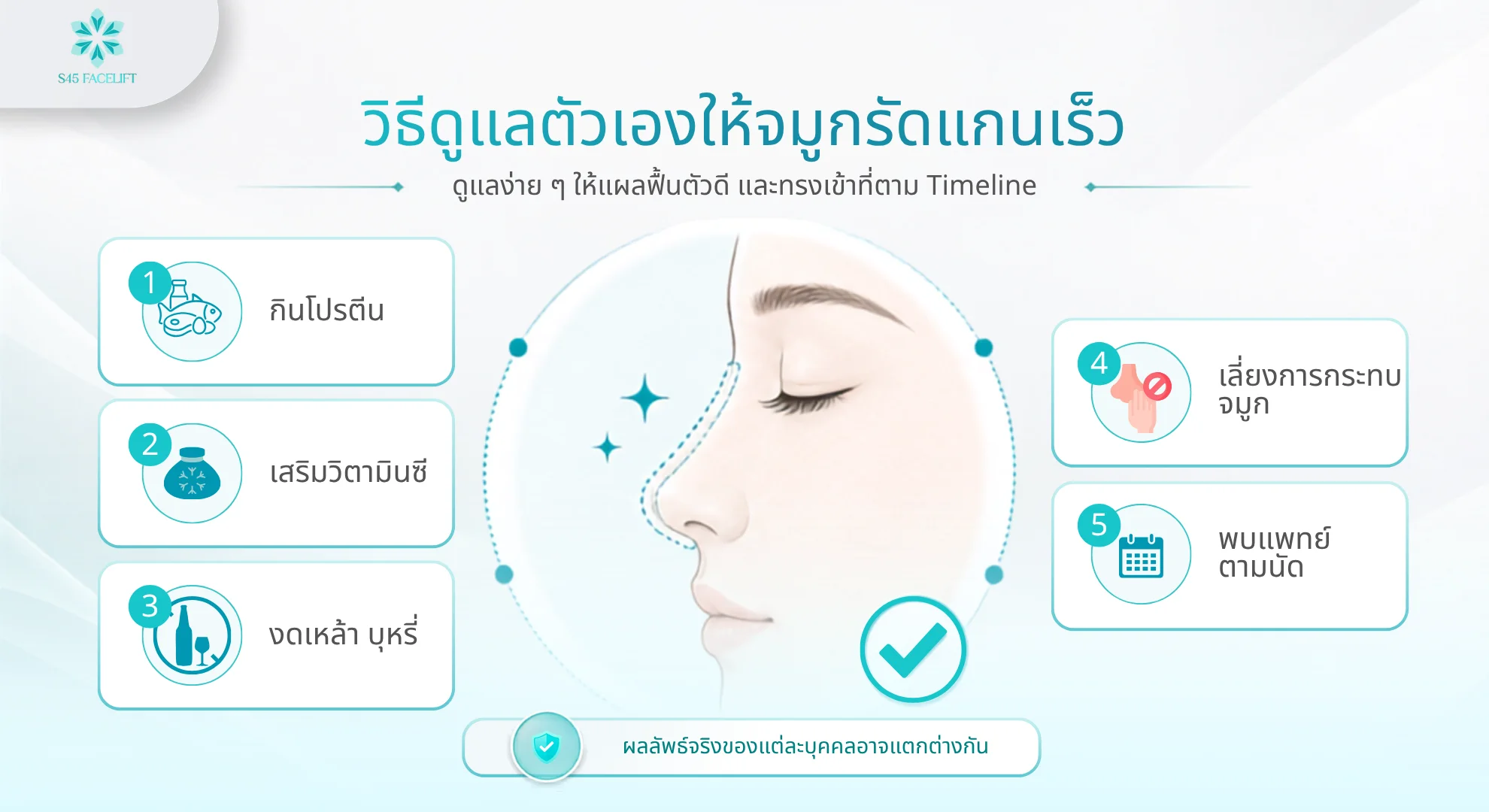
Many people ask whether there is a “way to make the nose settle faster”. Good care helps, but the timing still follows your body’s own process, and settling cannot be sped up to happen within 1 week. Good care helps your nose settle “normally” and “well” along the usual timeline.
Caring for your nose so it settles well covers several areas, including diet, rest, avoiding risky activities and attending your follow-up appointments. Each one matters as much as the others, and together they affect the result.
Following these steps helps settling go smoothly, lowers the chance of complications and helps the final shape match what the surgeon designed.
1. Avoid Knocks to the Nose
- Do not press, massage or touch your nose firmly in the first month
- Sleep on your back with your head raised on pillows, and do not sleep on your front
- Avoid sports that could knock your nose
- Do not blow your nose hard in the first 2 weeks
- Take care when applying make-up and do not rub your nose
2. Eat Foods That Support Healing
- Protein, such as fish, eggs and chicken, helps build tissue
- Vitamin C, such as oranges, guava and broccoli, helps the body make collagen
- Zinc, such as pumpkin seeds and nuts, helps wounds heal
- Water: drink 1.5 to 2 litres a day
3. Avoid Things That Slow Healing
- All types of alcohol, for at least 1 month
- Smoking, including second-hand smoke, for at least 1 month
- Pickled or fermented foods and very strongly flavoured food
- Large amounts of caffeine
- Medicines that make you bleed more easily, such as aspirin
4. Attend Every Follow-Up Appointment
- 1 week: stitches removed and wound checked
- 1 month: settling assessed
- 3 months: shape checked
- 6 months: final result assessed
5. Massage and Care as Advised
After month 1, your surgeon may advise you to massage your nose gently in a set direction. Massaging correctly helps the capsule tighten evenly and helps stop it tightening in the wrong direction. Do not massage your nose without advice.
6. Avoid Heat and Sun
- No saunas or very hot water for 1 month
- Apply SPF 50+ sunscreen every day when you go out in the sun
- Avoid strong midday sun
- Use a face mask or an umbrella
Is It Normal for Only One Side to Settle?
One side settling first is something many people worry about when they notice one side of the nose looks narrower and settles into shape faster than the other. The question is, “Is this normal?”
The answer is that “it can be normal in the early stages”, because the body forms the capsule at different rates on each side. In months 1 to 2, a difference between the two sides is common and usually evens out in months 3 to 6.
However, if the difference is still clear after month 6, or you have other symptoms, it may be a sign of a complication that needs a doctor.
Differences That Are Normal
- Uneven swelling on the two sides in the first month
- One side settling into shape faster than the other in months 1 to 3
- Different levels of tightness and itching on each side
- A slightly tilted tip in the early period
Differences That Are Not Normal
- Clearly one-sided settling after month 6
- The implant has visibly shifted to one side
- Pain on one side
- Redness and swelling on one side only
- Nostrils that are unusually different in size
Causes of One-Sided Settling
- Often sleeping on the same side
- Often touching one side of the nose
- The implant shifting after a knock
- Uneven capsule formation (varies from person to person)
Treatment for Cases That Are Not Normal
If one-sided settling is found to be abnormal after month 6, your surgeon may recommend:
- targeted massage to adjust how the capsule tightens
- a local steroid injection where the capsule has tightened too much
- revision surgery where the implant has clearly shifted
See how rhinoplasty is planned for each person at thin nasal tissue, which helps lower the chance of uneven settling.
Unhappy With the Shape After Settling, What Can I Do?
One of the biggest worries is “What can I do if I am unhappy with my nose after it settles?” This feeling can have several causes, including expectations that do not match reality, a result that genuinely did not turn out well, or abnormal settling.
Before deciding how to correct it, first work out why you are disappointed with the shape, because each problem needs a different solution. In some cases the shape settles after waiting until month 6, while in others revision surgery is needed.
Before making any decision, it is important to consult the surgeon who did your operation, or to get a second opinion from an independent doctor.
Problem 1, a Drooping Tip
- Causes: not enough tip tissue, the implant pressing on the tip, or the capsule tightening in the wrong direction
- Treatment: wait until 6 months and then assess. If the tip clearly droops, revision surgery with cartilage may be needed
Problem 2, a Tilted Shape
- Causes: the implant has shifted, sleeping on one side for long periods, or the original structure was not straight
- Treatment: change your sleeping position. Where the nose is clearly tilted, surgery to reposition the implant is needed
Problem 3, a Rod-Like Nose That Does Not Blend In
- Causes: an implant of the wrong size, thin nasal tissue, or poor settling
- Treatment: in some cases the shape softens after 6 months. If it still looks like a rod, the implant needs replacing
Problem 4, Uneven Nostrils
- Causes: an asymmetric original nasal base, or uneven settling
- Treatment: where the difference is small, wait until 6 months. If the difference is clear, alar base reduction or base reshaping may be needed
Problem 5, a Shape That Does Not Match the Reference Photo
- Causes: unrealistic expectations, a reference photo that does not suit your face, or miscommunication with the surgeon
- Treatment: consult your surgeon to assess whether your current shape suits your face. Sometimes a shape that “does not match the reference” actually suits your face more
When to Consider Revision Surgery
- The shape has not changed after 6 months
- A structural problem that has not improved with time
- It affects your confidence in daily life
- Your surgeon advises that revision surgery is more suitable than waiting
Can a Round, Large Nose Tip Be Corrected After Settling?
The question “How can a round, large nose tip be corrected?” is a common one, especially among people who have had rhinoplasty but whose tip still looks large after settling. The answer is yes, it can be corrected, but the cause needs to be assessed first.
A round, large tip after settling can have several causes, including the original structure of the tip, thick tissue and the technique used. Working out the cause helps choose the right correction.
Where the nose has settled (after 6 months) and the tip is still round and large, there are several options.
Causes of a Round, Large Tip After Settling
- A lot of original tip tissue: the main factor, and a silicone implant alone can reduce it only a little
- No tip reshaping at the first surgery: the focus was on the bridge only
- Thick tip skin: makes the tip look large even after settling
- Flared alae (the sides of the nostrils): make the tip look larger too
Possible Corrections
1. Tip surgery (tip plasty): used where the original tip is large. The surgeon reshapes the tip cartilage and stitches it into shape. The result is long-term and the change can be clearly visible.
2. Your own cartilage: ear cartilage or cartilage from the septum is placed at the tip to build its shape, helping the tip look slimmer and more defined.
3. Alar base reduction: where the tip looks large because the alae flare, alar base reduction helps the nose look slimmer overall.
4. Implant replacement: where the original silicone implant does not suit the nasal structure, replacing it with one that has a more pointed tip can help.
Advice for Making a Decision
Before revision surgery, consult an experienced surgeon to assess whether the tip is truly round and large or whether other factors are involved. The surgeon will recommend a technique that suits your case and your budget.
Why Choose Rhinoplasty at S45 Clinic
Rhinoplasty that settles well into the planned shape depends on the surgeon’s skill in choosing the silicone implant, placing it and shaping the tip to suit your facial structure from day one. S45 Clinic plans every case for each person, under our promise “Because every kind of beauty comes from care”.
Our Surgeons and Their Training
Our surgeons are otolaryngologists with sub-specialty training in facial plastic and reconstructive surgery, who focus on nose cases. They assess your face and design a shape that is planned to settle well and match your expectations.
Techniques Planned for Even Settling
S45 Clinic chooses the silicone implant and technique to suit each case, from closed rhinoplasty in straightforward cases to open rib rhinoplasty in cases that need strong, durable support. Shaping the tip and base on the day of surgery is planned to work with long-term settling, lowering the chance of the tissue tightening in the wrong direction or a result that does not match expectations.
Continuous Aftercare for 6 Months
- Follow-up appointments at 1 week, 1 month, 3 months and 6 months
- Settling assessed at every visit, with advice for your case
- Contact our team on LINE if you notice anything that concerns you
- Massage and care advice to help even settling, with attentive care until the shape has settled
FAQ About Nose Settling
Will the Nose Tip Get Smaller as It Settles?
Yes. On average, once the nose has settled, the tip is about 20% to 40% smaller than on the day you leave the operating room. How much smaller depends on the original tip and the technique used. Where the original tip was not very large and open rhinoplasty with cartilage was used, the tip can become clearly slimmer and smaller.
How Many Months Does It Take for the Nose to Settle?
The nose starts to settle in months 1 to 3 (70% to 80%), settles fully in months 3 to 6 (95%), and reaches its final result in months 6 to 12 (100%). The result should be assessed at 6 to 12 months, not in the first few months when the shape can still change.
Will the Nose Look Higher After It Settles?
The bridge does not actually get higher from settling, but it “looks higher” because the surrounding tissue goes down and tightens, making the bridge the surgeon built more defined. The height of the implant does not change. The overall look is simply more settled.
How Can I Tell My Nose Has Settled?
Look for signs you can see and feel. The nose looks narrower, the bridge is more defined and sharper, the tip is slimmer, the skin lies closely over the implant, the nose feels firm rather than soft, and the implant no longer moves. These signs usually become clear in months 1 to 3 and can be confirmed in months 3 to 6.
Does Settling Hurt?
It is not usually very painful, but you will often have tightness and itching in the first month. Real pain should go within the first week, while tightness can last up to 2 to 3 months. If you still feel real pain in month 1, it may be a sign of a complication, so see a doctor for a check-up.
Is It Normal to Still Be Sore 1 Month After Rhinoplasty?
Real pain should go within the first week. If you still feel real “pain” in month 1, not just “tightness”, it may not be normal. Try to tell the feelings apart. “Tightness” is a firm feeling with mild discomfort that needs no medicine, while “pain” needs painkillers. If it is real pain, see a doctor to find the cause.
How Many Days After Rhinoplasty Does the Tightness Go?
Tightness eases gradually over time. It is very tight in weeks 1 to 2, goes down by 30% to 40% in weeks 3 to 4, goes down by 60% to 70% in months 1 to 2, and has almost gone in months 3 to 6. By month 6, most people feel their nose is back to normal.
Can I Make My Nose Settle Faster?
Some care can help your nose settle normally and well along the usual timeline, such as avoiding knocks to the nose, eating food with protein and vitamin C, avoiding alcohol and smoking, attending follow-up appointments and massaging as advised. However, settling cannot be sped up to happen within 1 week, because it is the body’s own process.
Is It Normal for Only One Side to Settle?
In months 1 to 2, a difference between the two sides is normal, because the body forms the capsule at different rates on each side. It usually evens out in months 3 to 6. If the difference is still clear after month 6, or you have other symptoms such as pain or redness and swelling on one side, see a doctor.
Unhappy With the Shape After Settling, What Can I Do?
It depends on the cause and timing. If it has not been 6 months yet, wait for the nose to settle before assessing it. If it has been 6 months and you are still unhappy, consult a surgeon to identify the problem (a drooping tip, a tilted shape, a rod-like look and so on). The surgeon will advise whether to keep waiting, have revision surgery or have an additional procedure. Choosing an experienced surgeon who treats revision cases matters.
Summary
Nose settling is the body’s own process of forming a capsule of tissue around the silicone implant, so the nose looks more defined and settles into shape. It happens in stages. Changes start to show in weeks 2 to 4, the shape starts to settle in months 1 to 3, settling is complete in months 3 to 6, and the final result is reached in months 6 to 12.
As for the question will the nose tip get smaller as it settles, the answer is yes, by about 20% to 40% compared with the first day. The bridge “looks higher” because the surrounding tissue goes down, not because the height of the silicone implant changes. Tightness and itching in the first month are normal, but if you have severe pain, swelling that is red and hot, or skin so thin the implant shows through, see a doctor straight away.
You can help your nose settle well by avoiding knocks to the nose, eating foods that support healing, avoiding alcohol and smoking, attending follow-up appointments and massaging as advised. If the shape does not match your expectations after settling, wait until 6 months before deciding on a correction, because the shape can still change during this time.
See more medical information on recovery and healing after rhinoplasty at Cleveland Clinic, Rhinoplasty
Because every nose structure…
is different
An otolaryngologist with subspecialty training in facial plastic and reconstructive surgery assesses every case before treatment and gives advice based on your actual concerns.
“Reveal the beauty within you”
Message us online
Surgery and medical procedures carry risks. Find out about them and consult a doctor before you decide. Results depend on each person.