Crooked Columella After Rhinoplasty and Why the Nose Does Not Line Up With the Philtrum

The ‘nasal axis’ and the ‘philtrum’ show how balanced the face is, and you can see this both before rhinoplasty and after it. If the nose and the philtrum do not form a straight line, the face may be asymmetrical. You can look at and check this balance if you are worried.
What Is the Nasal Axis?
The nasal axis is an imaginary midline that divides the nose into 2 equal halves, running from the root of the nose to the tip when seen from the front. A straight nasal axis is:
- in line with the central axis of the face (through the point between the eyebrows, the nasal tip, the philtrum and the chin)
- dividing the nose into 2 symmetrical halves, left and right
- not tilted to either side when seen from several angles
What Is the Philtrum?
The philtrum is formed by 2 vertical ridges between the nose and the upper lip, with a deep groove between them. The philtrum is:
- beginning at the base of the nose (just below the nostrils)
- ending at the peak of the upper lip (Cupid’s bow)
- dividing the lower face into 2 halves
- an important reference point for facial balance
The Facial Midline That Shows How Balanced the Face Is

- the midpoint between the eyebrows (glabella)
- the root of the nose (nasion)
- the nasal bridge (nasal dorsum)
- the nasal tip
- the middle of the philtrum
- the middle of the upper lip (Cupid’s bow peak)
- the middle of the lower lip
- the middle of the chin (pogonion)
If the nasal bridge and the philtrum are not in line after rhinoplasty, the nasal axis looks tilted.

Why the Nasal Axis Tilts and the Philtrum Is Not in Line After Rhinoplasty
1. Facial Structure That Has Been Asymmetrical Since Childhood
In reality, nobody’s face is completely symmetrical. The eyes are often not level, with one higher than the other, one cheekbone is often higher, and one side of the jaw is wider. The philtrum may also already tilt to one side.
If rhinoplasty makes the nose and the nasal axis straight, but the philtrum still tilts, the face can still look asymmetrical. Possible causes include:
- a deviated or bent septum, as the nose can tilt with the septum
- a tilted facial skeleton, so the philtrum and the nose are not in line
- an uneven jaw, which makes the lower face tilt and pulls the philtrum with it
- uneven nasal cavities, which make the nose structure tilted or twisted from the inside
2. The Implant Is Not Placed on the Midline
- the midline is measured wrongly because of the surgeon’s error, such as using the original nasal tip (which may already be tilted) instead of the philtrum, not taking a front-facing photo before surgery to find the true midline, or judging by eye without precise measuring tools
- the pocket for the implant is prepared unevenly, with more tissue lifted on one side than the other, so the space for the implant is not the same width on each side, and the base supporting it is not made firm enough
- the implant is not fixed firmly, so it moves easily, especially in the first 1 to 3 months, because it was not stitched in place or not held securely, leaving the implant ‘floating’ too freely in the pocket
- an unsuitable implant, such as a ready-made silicone implant that does not fit the nose structure, or material that is too rigid to follow the structure
3. Pull From Tissue or Scar Tissue
- scar tissue contracting and pulling the implant to one side, as thicker scar tissue on one side pulls the nose so it tilts, or a keloid scar twisting it
- uneven swelling, where one side swells more than the other, especially in the first month, which can push the implant to one side as the swelling goes down unevenly
- sleeping position, such as always sleeping on one side, which may make the implant slowly tilt towards that side, and gravity may pull the implant down unevenly, and with a less experienced surgeon the implant may end up uneven
4. Complications From Surgery
- the implant moving because it is the wrong size or was not carved to fit the nose structure
- infection affecting one side more than the other, causing swelling, tissue damage and scar tissue from inflammation that pulls the nose so it tilts
5. Problems With the Nose Structure
- a curved septum
- asymmetrical cartilage at the nasal tip
- an unbalanced facial skeleton
How to Correct a Tilted Nasal Axis
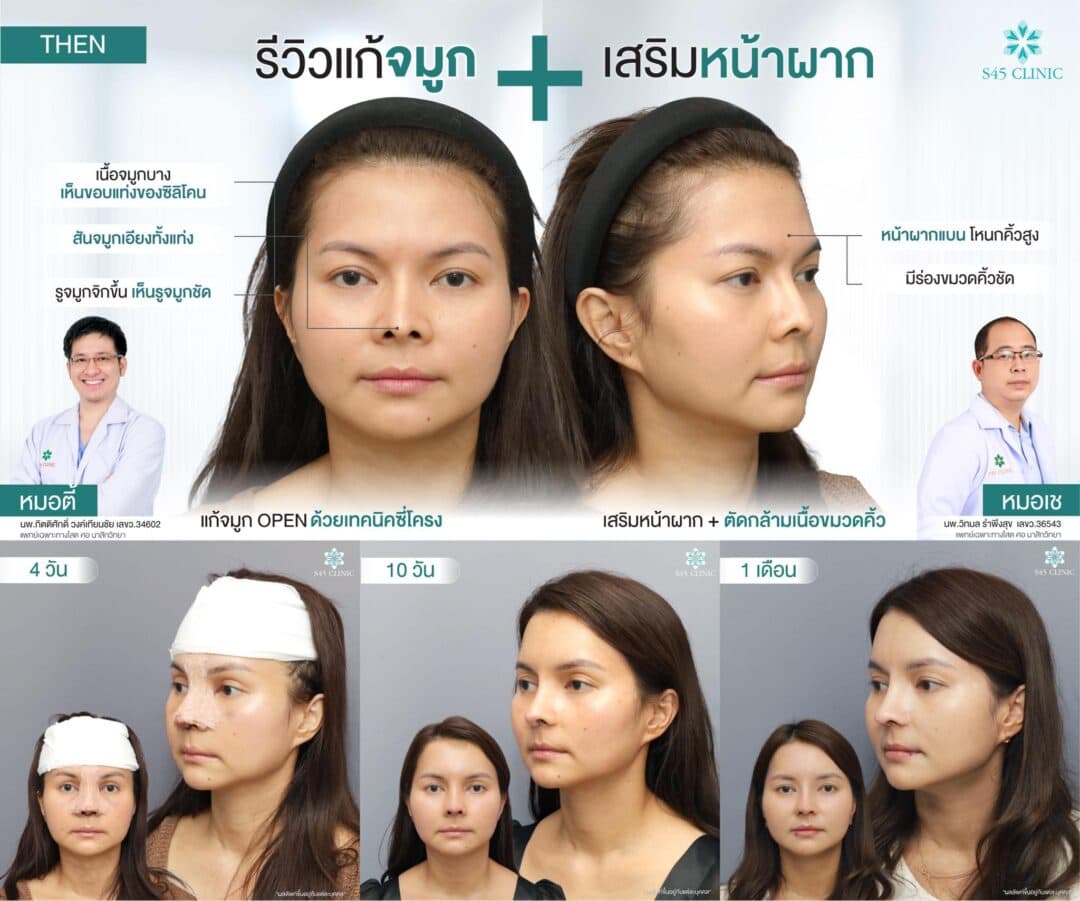
The surgeon diagnoses and assesses how much the nose tilts to choose a technique to correct the nose structure that suits each case. This may include treatment without surgery, or surgery to correct the nose structure if the surgeon thinks it is needed.
If you want rhinoplasty anyway, open rhinoplasty is a suitable way to correct this, as it lets the surgeon see the nose structure clearly, design a nose shape with definition and make it symmetrical with the face.
Frequently Asked Questions
If My Nose Tilts Slightly, Do I Need Revision Rhinoplasty Straight Away?
There is no need to rush. Monitor it for at least 6 to 12 months, but have a consultation with a doctor straight away if the tilt is clear and getting worse, if you have difficulty breathing, or if you have pain, swelling, redness or pus.
If My Philtrum Tilts From a Childhood Accident, Should My Nose Be Made Straight or Follow the Tilt?
The surgeon assesses each case by how severe the problem is. For example, if the philtrum tilts slightly, by less than 3mm, rhinoplasty may be able to make the nose straight along the midline, and a straight nose helps balance the face. If the philtrum tilts clearly, by more than 3mm, the surgeon may consider making the nose follow the philtrum slightly so that it blends with the face, because a completely straight nose may look unusual. See a doctor for a detailed assessment and diagnosis.
What Should I Do If My Nose Is Still Tilted After Revision Rhinoplasty?
Do not rush into repeated surgery. Wait 12 months between each operation. During this time, consider choosing a surgeon with direct experience in revision rhinoplasty.
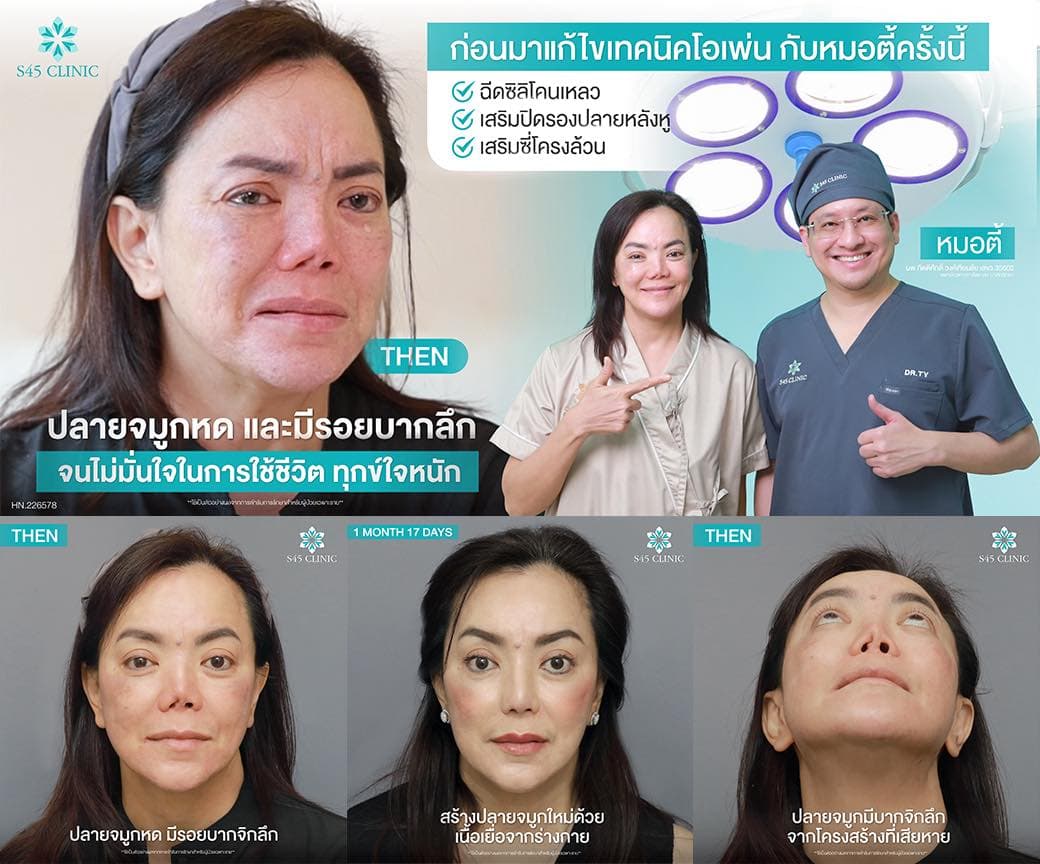
S45 Clinic provides revision rhinoplasty, including complex cases.
How Long Does It Take to See the Final Result After Revision?
- within 1 month, swelling goes down by 30% to 40% and you can see the rough shape
- within 3 months, swelling goes down by 60% to 70% and the result is clearer
- within 6 months, swelling goes down by 80% to 90%, the nose shape is clearer and there is very little chance of it changing
- within 12 to 18 months, the swelling has gone, the nose shape is clear and it hardly changes
If It Is Not Corrected, Will the Nose Tilt More and More?
It depends on several factors. For example, if the tilt is caused by rhinoplasty, it may get worse without revision rhinoplasty. But if it has been there since childhood because of your original facial structure, there is very little chance of it getting worse.
Note: Repeat nose surgery, which many people know as ‘nose reshaping’, is surgery for people who have had nose surgery before and need a further assessment by a surgeon. The approach to care depends on the original problem, the nose structure and the surgeon’s judgement in each case.