Where to Get a Brow Lift? Techniques, Prices and 5 Criteria for Choosing a Brow Lift Surgeon

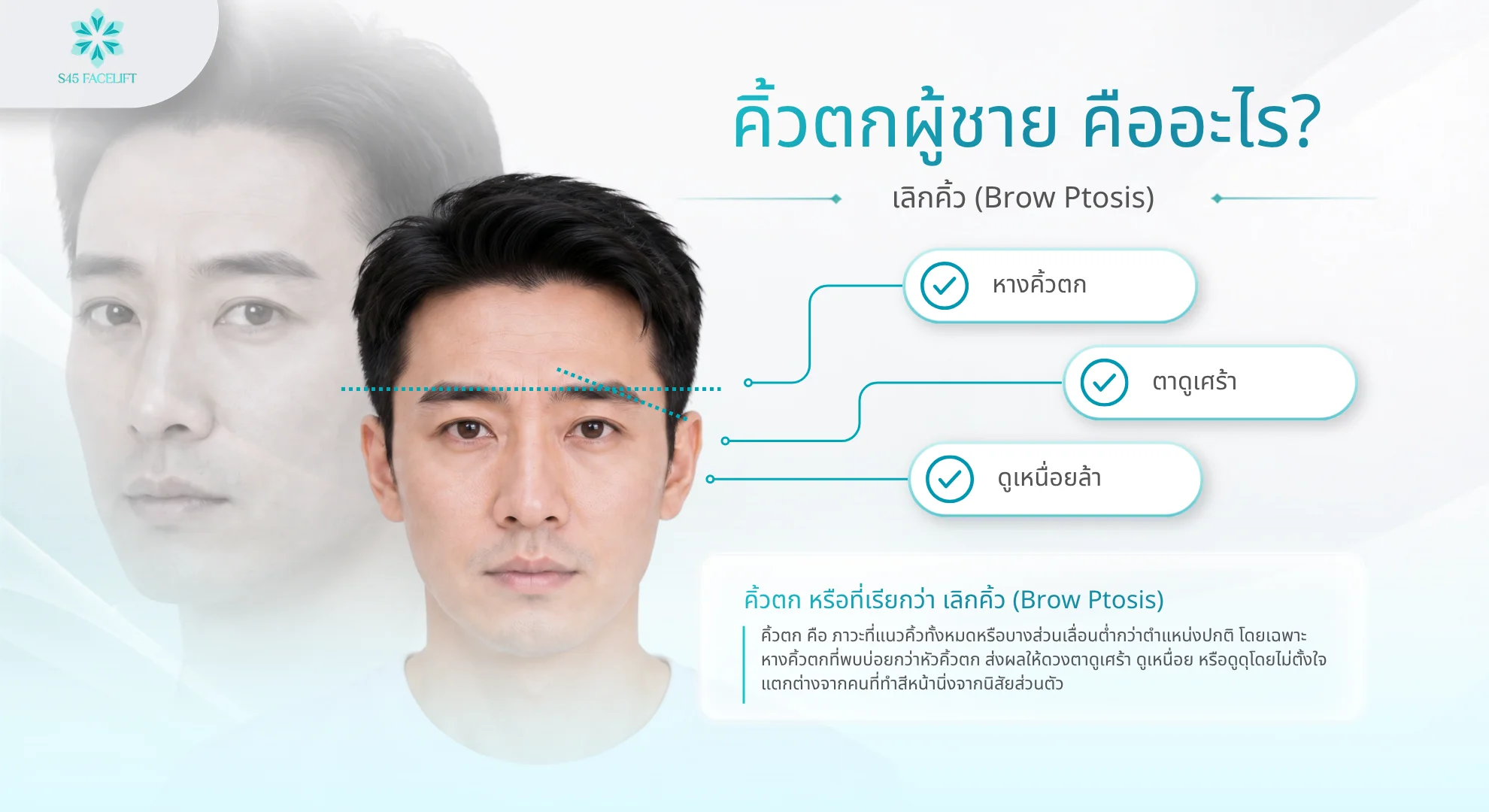
The question of where to get a brow lift often comes up after people start to notice that their face looks tired, sad or older than they feel, even when they are not angry or worn out, and brows that have drooped over time turn out to be the main cause. Drooping brows (brow ptosis) can be caused by age, genetics and repeated facial expressions, which is why interest in brow lift procedures keeps growing.
Key points
- A brow lift is a procedure that moves drooping brows back up to a suitable position, which can help the face look fresher and more youthful and soften a face that looks sad, stern or older without meaning to.
- There are 4 main techniques, endoscopic brow lift, direct brow lift, temporal lift and pretrichial brow lift. They differ in wound size, incision position and the cases they suit.
- Endoscopic brow lift with Endotine is a technique commonly used today, because the small incisions are hidden in the hairline rather than on the face.
- How long does an endoscopic brow lift last? In general, results last about 5 to 10 years or longer, depending on age, genetics and how you look after yourself after the procedure.
- Where to get a brow lift depends on 5 main criteria, the surgeon’s qualifications, the technique used, operating theatre standards, clear pricing and the aftercare system.
- The price of brow lift surgery varies with the technique, the complexity of the case and the materials used. Your face always needs to be assessed in person first.
This article brings together what drooping brows are, the 4 brow lift techniques, the difference between an endoscopic brow lift and double eyelid surgery, recovery time and brow lift surgery prices, through to the 5 key criteria that help answer the question of where to get a brow lift for your case.
In This Article
What Are Drooping Brows and How Do They Affect the Face?
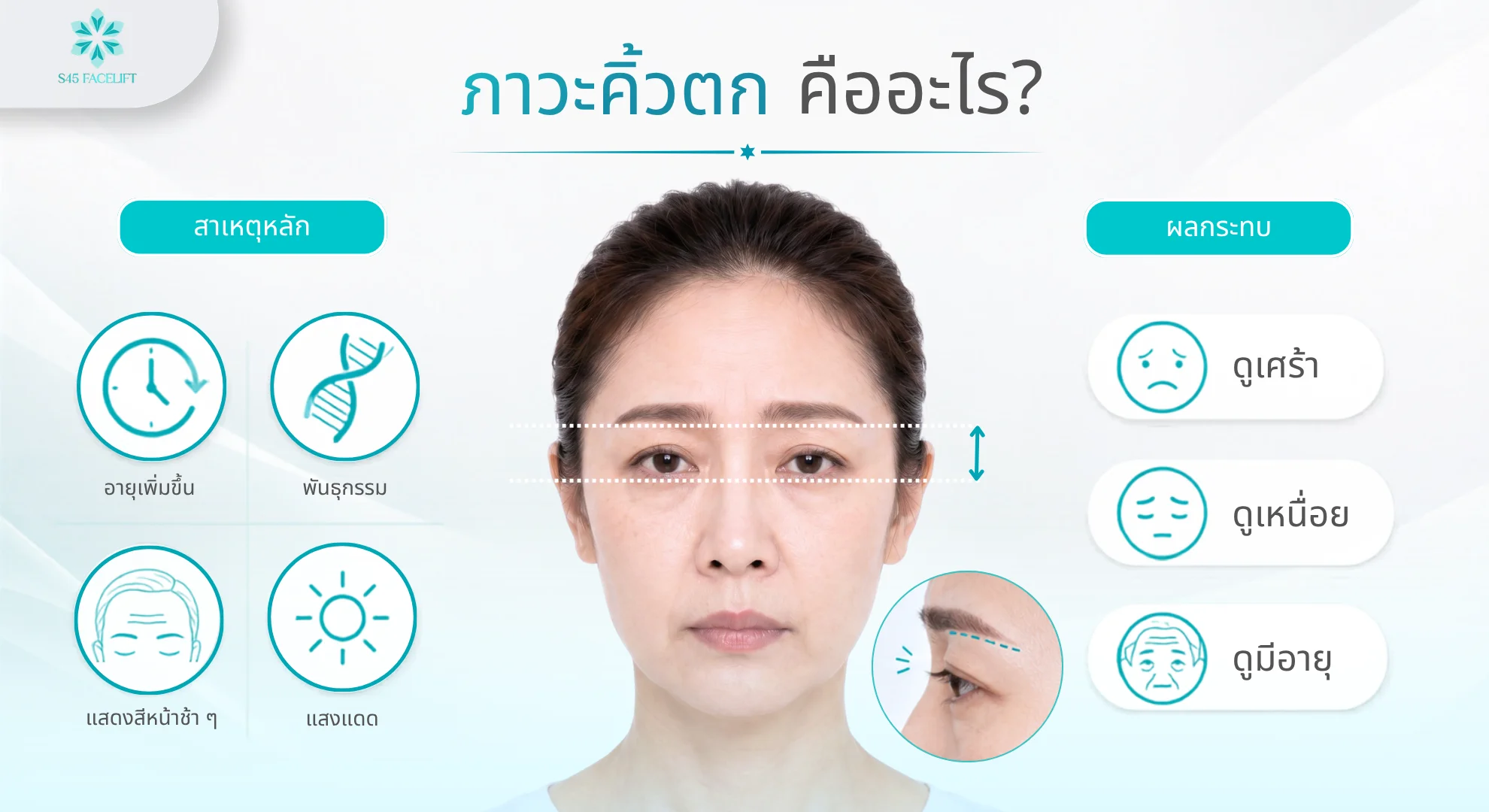
Drooping brows, or brow ptosis, is when the skin and muscles around the brows sag below a suitable position. This narrows the space between the brows and the upper eyelids, and the face as a whole can look sad, tired or stern, even when the person does not feel that way. Understanding the cause of drooping brows is important, because it affects which brow lift technique suits your case. The main causes fall into 4 groups.
1. Getting Older
As you get older, the collagen and elastin in your skin break down and the skin becomes less elastic. The skin and muscles of the forehead and brows start to sag with gravity. This is a common cause and is difficult to avoid.
2. Genetics
Some people have a genetic tendency to get drooping brows from a young age. The structure of the eye socket bones, the thickness of the facial muscles and the elasticity of the skin can all be inherited, so some people see signs of drooping brows while they are still young.
3. Repeated Facial Expressions
Frowning, raising the brows or making other expressions that use the muscles in this area often and regularly can make the muscles lose their tone sooner, especially in people with high stress or who work at a screen for long periods.
4. Too Much Sun Exposure
UV rays damage the collagen and elastin in the skin, so the facial skin loses elasticity. Most people who spend long periods outdoors without sun protection get drooping brows sooner than usual.
Signs That It May Be Time for a Brow Lift
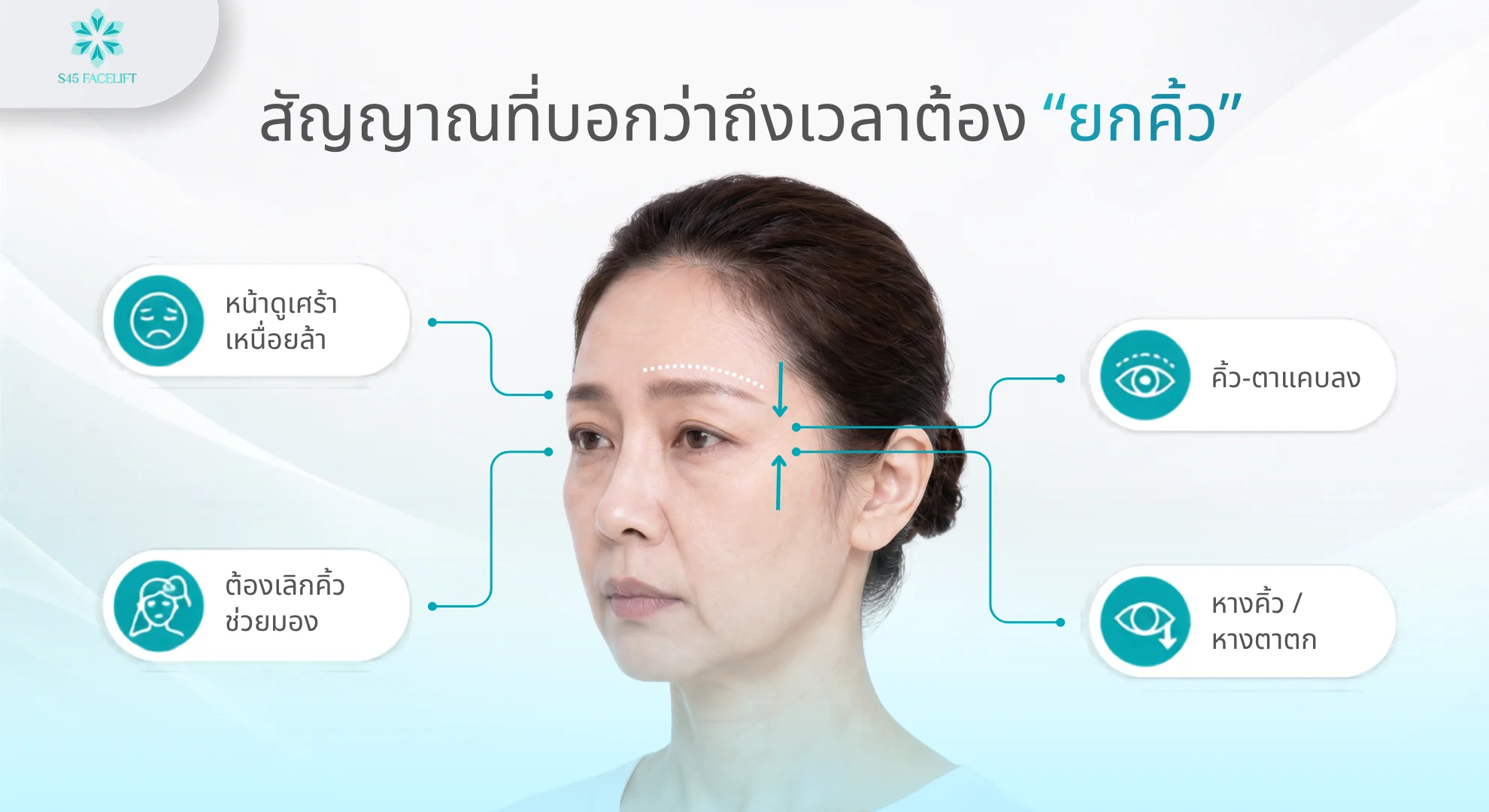
Before deciding where to get a brow lift, the first question to answer is “do you have signs of drooping brows that are worth correcting?”, because not everyone who feels they look older actually has drooping brows. A basic self-check can help you have a more useful discussion with the surgeon.
1. Your Face Looks Sad, Stern or Tired Without Meaning To
If people around you often ask “are you angry?” or “are you unwell?” when you feel fine, it may be a sign that the position of your brows makes your face send a message that does not match how you really feel.
2. The Space Between the Brows and Eyes Is Unusually Narrow
When the skin of the forehead sags, the space between the brows and the upper eyelids narrows, so the eyes look half-closed even when you open them as wide as you can.
3. You Feel You Need to Raise Your Brows to See More Clearly
When the brows droop a lot, the sagging skin may block the upper part of your vision, so you raise your brows or tilt your head up without realising, to widen your field of view. If you have this symptom, consult a doctor soon.
4. Drooping Brow Tails or Downturned Outer Eye Corners
Drooping brow tails make the face look sterner and less friendly. Some people have a drooping brow tail in only one area while the rest of the brow stays in a normal position, which needs a specific technique to correct.
How Many Brow Lift Techniques Are There, and How Do They Differ?
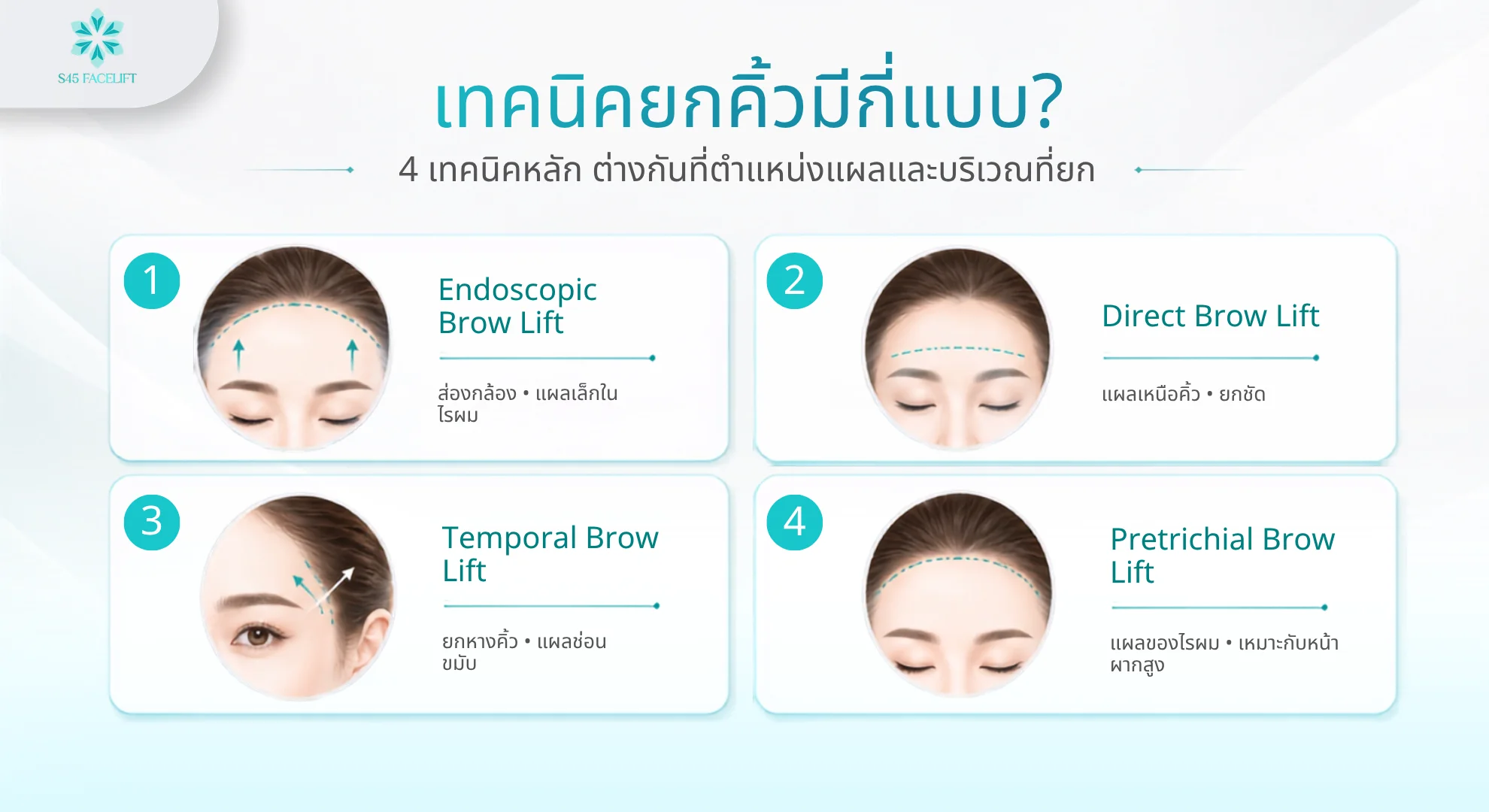
There is more than one brow lift technique, and the differences between them affect wound size, recovery time, how long the result lasts and which cases they suit. The surgeon assesses several factors before choosing a technique, including how much the brows droop, where the problem is, how thick and dense the skin is, and your goals. There are currently 4 main techniques.
1. Endoscopic Brow Lift
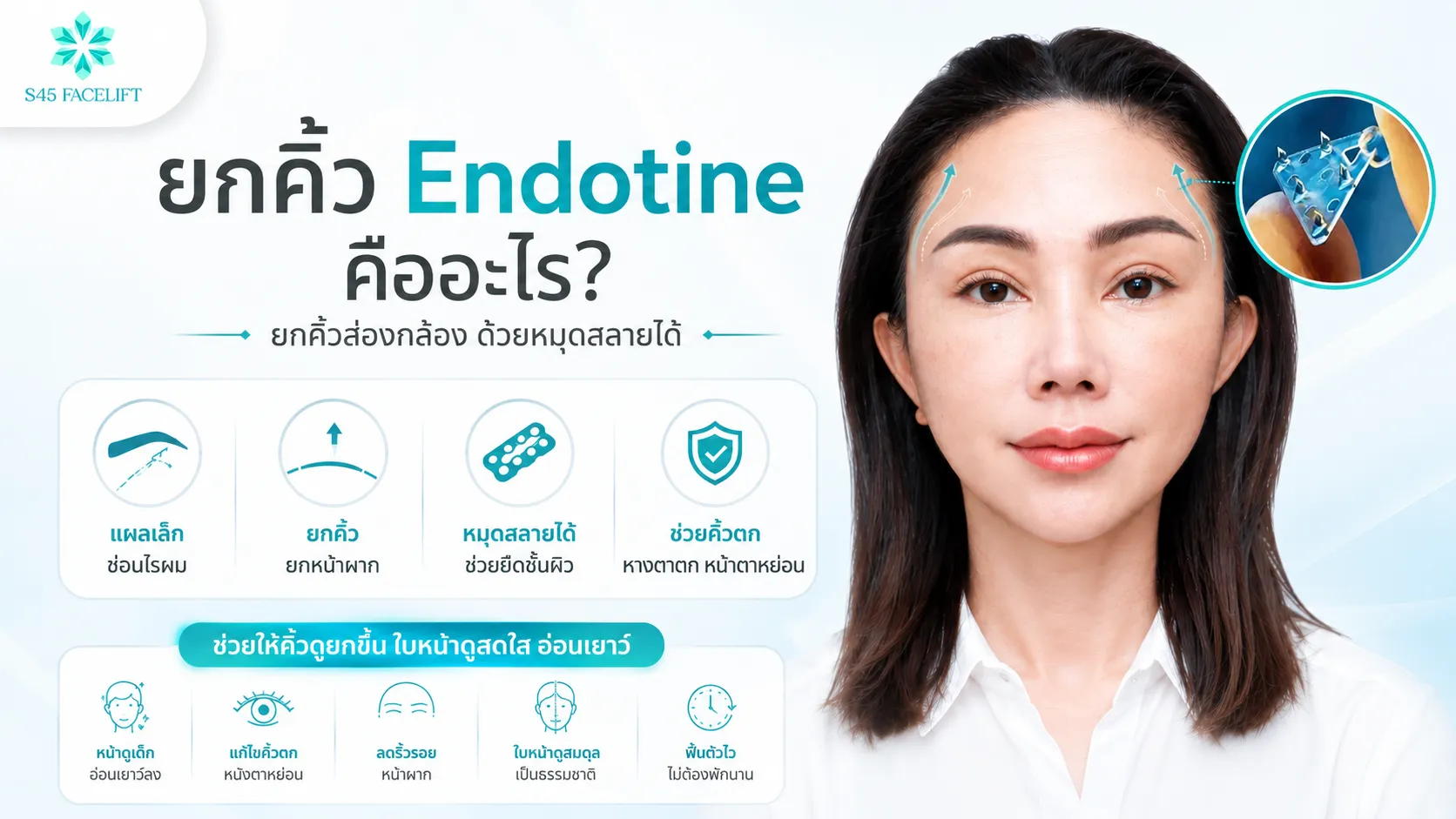
A technique commonly used today. Surgery is done through small incisions of about 2cm to 3cm hidden in the hairline. The surgeon uses a very small camera (endoscope) to lift and tighten the tissue and move the brows up to a suitable position, then holds the new position with Endotine, a device that dissolves on its own. The incisions are in the hairline rather than on the face. It suits mild to moderate brow drooping.
2. Direct Brow Lift
Excess skin is removed directly from just above the brows, which gives a clear result that can be adjusted as needed. It suits severe brow drooping in older adults who need a more direct correction. The main downside is a visible line scar above the brows, so it is less often chosen by people who are concerned about scarring.
3. Temporal Lift (Lateral Brow Lift)
Only the brow tails are lifted, through an incision at the temples with the scar hidden in the hair. It suits cases where only the brow tail droops. The limitations are that it cannot treat drooping of the whole brow, and the scar cannot always be fully hidden.
4. Pretrichial Brow Lift
A long incision is made along the hairline. It suits people with a high forehead who want to lower the forehead at the same time as lifting the brows. It is rarely used today because it leaves a long scar that may be clearly visible.
| Technique | Suits | Scar | How commonly used today |
|---|---|---|---|
| Endoscopic brow lift (endo) | Mild to moderate brow drooping | Small, hidden in the hairline | Commonly used |
| Direct Brow Lift | Severe brow drooping, older adults | Visible above the brows | Low |
| Temporal Lift | Drooping brow tail in one area only | Partly hidden | Moderate |
| Pretrichial | High forehead + drooping brows | Long, may be visible | Low |
What Is an Endoscopic Brow Lift, and Why Is It Commonly Used?
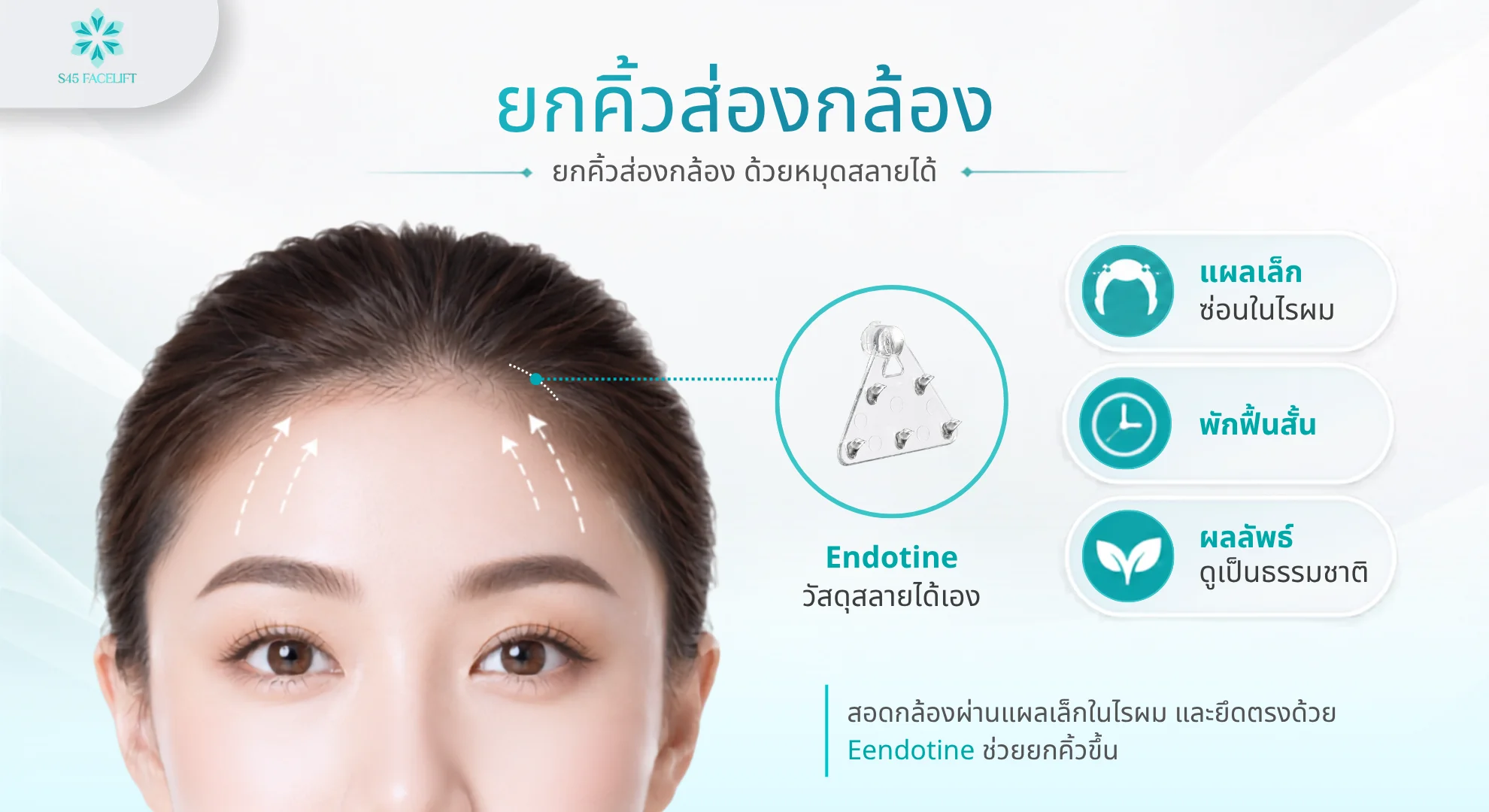
An endoscopic brow lift is a technique that uses a very small camera passed through small incisions hidden in the hairline. The surgeon can see the structures under the skin clearly, lift and tighten the skin and muscles, and adjust the brow position precisely without removing a large amount of skin. A key part is Endotine, a medical fixation device that holds the new position of the tissue under the skin and the brows after lifting. It is designed to be absorbed by the body over about 6 to 12 months, without leaving foreign material behind. See more in why Endotine matters for a brow lift
1. Incisions Placed in the Hairline, Not on the Face
All the incisions are hidden in the hairline, so they are usually hard to see from the outside after surgery. This suits people who want to treat drooping brows but are very concerned about scars.
2. Recovery Is Usually Shorter Than With Other Techniques
Because the incisions are small and less skin is removed, recovery is usually shorter than with a typical open technique. Most swelling goes down in the first week.
3. Results Planned to Suit Your Face
Lifting with a camera lets the surgeon plan a brow position that suits each person’s facial proportions in detail, and Endotine holds the new structure firmly in place, so the result is planned to suit your face. See the technique details in endoscopic brow lift technique at S45 Clinic
How Does an Endoscopic Brow Lift (Small Incisions) Differ From a Traditional Brow Lift?

An endoscopic brow lift differs from traditional surgery in that the incisions are clearly smaller, which can help reduce side effects after surgery. Comparing the 2 methods helps you see the difference in value more clearly.
| Comparison | Brow lift with a camera (endoscopic brow lift) | Traditional brow lift (classic brow lift) |
|---|---|---|
| Size and type of incision | Small incisions of about 2cm to 3cm, hidden along the hairline | A long incision across the top of the head from one ear to the other |
| Hair loss | Very little hair loss around the incisions | A chance of a wide scar and permanent hair loss along the incision line |
| Recovery time | Back to your usual routine within 7 to 14 days | Several weeks, because the surgical wound is larger |
| Numbness of the scalp | Uncommon, and usually returns to normal gradually | A higher chance of long-lasting numbness of the scalp |
Passing a high-magnification camera under the skin lets the surgeon see the internal structures in detail, which helps avoid important nerves and can help reduce swelling and bruising after surgery compared with the traditional method.
Where Are the Endoscopic Brow Lift Incisions?
An endoscopic brow lift hides the incisions in the scalp behind the hairline, so the scars are hard to see from the outside when looking at the face straight on.
Each incision is about 2cm to 3cm long, and there are usually 3 to 5 small incisions, depending on your skin and how much it sags. The surgeon closes the incisions with special stitches or specific materials that help reduce tension on the skin.
Hiding the incisions under the hairline can help reduce worry about scarring after surgery. Once the wounds have fully healed and your hair grows back, the scars are covered and become hard to notice, so you can go about your daily life and style your hair as usual after the stitches are removed within 10 to 14 days.
What Is Endotine, and Does Everyone Need It?
Endotine is a specific medical device used to hold the skin and muscles of the forehead in their lifted position. It is made from a bioabsorbable material that the body breaks down over about 6 to 12 months, without leaving residue. It uses small fixation points to spread the pulling force evenly instead of relying on stitches alone, which helps reduce tension on the surgical wound.
Not everyone who wants to reshape their brows needs this device, because people with only slight sagging can have the skin held in place with standard stitches instead. The surgeon considers the thickness of your skin and the slope of your forehead bone when planning surgery. Assessing how elastic your skin actually is, is an important step in deciding whether this device is needed for firmer fixation.
Brow Lift Compared With Double Eyelid Surgery, How Do They Differ?
A common confusion for people considering a brow lift is telling the difference between a “brow lift” and “double eyelid surgery” or “droopy eyelid correction”, because the problems can look similar from the outside, but the real causes and treatments are completely different. The key is whether the problem comes from the position of the brows or from the eyelids.
| Comparison | Endoscopic brow lift | Double eyelid surgery / droopy eyelid correction |
|---|---|---|
| Area treated | The position of drooping brows | Upper eyelids / excess eyelid skin |
| Result | Brows raised, eyes more open, a fresher-looking face | A clearer eyelid crease, eyes that look larger |
| Suits | Brows lower than the bony rim of the eye socket | Thick eyelids with no crease / sagging eyelid skin |
| Incision position | Hairline, hard to see from the outside | On the eyelid or under the brow |
If the problem is that the brows sag below the bony rim of the eye socket, a brow lift is what is needed. If the problem is thick upper eyelids or eyelids with no crease, double eyelid surgery is what is needed. If both areas have a problem, the surgeon may recommend doing both together. A detailed assessment needs an examination by the surgeon in person, because everyone’s structure is different.
Who Is a Brow Lift Suitable for, and Who Is It Not Suitable For?
A brow lift does not suit everyone who wants their face to look younger. The surgeon assesses your facial proportions, skin condition, health history and goals before you decide together whether it is suitable and which technique to use.
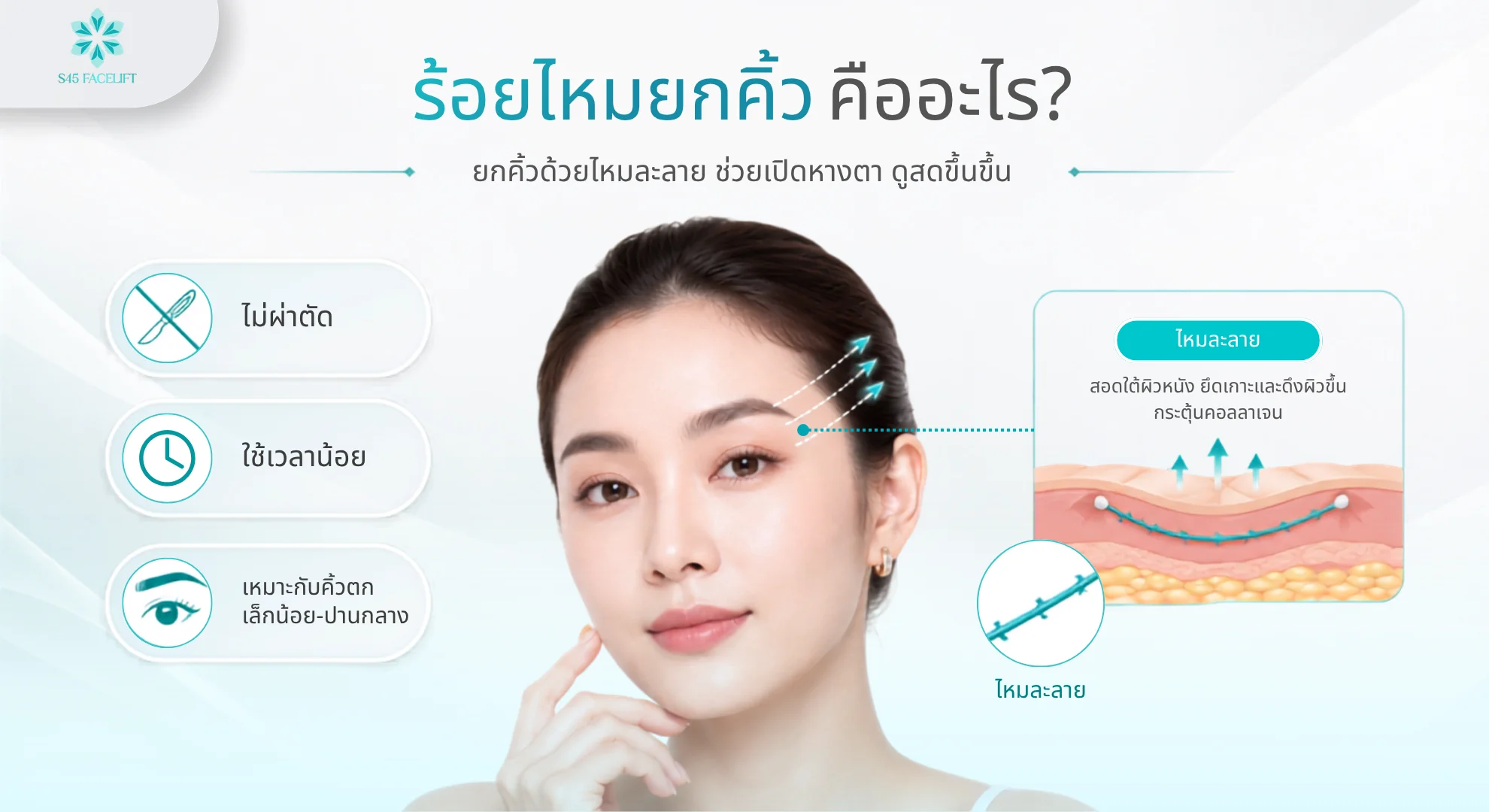
People who suit an endoscopic brow lift include those whose brows sag below the bony rim of the eye socket, who have an unusually narrow space between the brows and eyes, who have drooping brow tails that make the face look stern, who have forehead lines from raising the brows to compensate, or who want a fresher, more youthful look. People with only slight brow drooping may consider non-surgical options first, such as botulinum toxin injections to lift the brows or a thread lift for the brows
Factors that need careful consideration before surgery include some long-term conditions, taking blood-thinning medicines, a history of allergy to anaesthetic drugs, or skin with scar tissue from previous procedures. Tell the doctor about all of these in detail. Importantly, the Department of Health Service Support (DHSS) sets a minimum age of 25 for plastic surgery procedures.
How Long Does an Endoscopic Brow Lift Last?
A common question is “how long will the result last, and is the surgery worth the investment?”. The answer depends on several factors at once. In general, results from an endoscopic brow lift with Endotine can last about 5 to 10 years or longer, depending on age, skin condition and aftercare.
After a brow lift, the normal ageing of the skin continues, but more slowly than before, because the structures have been repositioned. Caring for your skin regularly, using sunscreen and avoiding habits that speed up collagen loss can help the result last longer. Results depend on each person.
How to Prepare for a Brow Lift
Good preparation before brow lift surgery helps lower the chance of complications and makes recovery after surgery go much more smoothly. The surgeon will book an appointment to assess your facial proportions and take your health history before planning surgery. Giving complete information at this stage directly affects your recovery and the result.
2 To 4 Weeks Before Surgery
The doctor may advise you to stop some medicines, such as blood thinners, aspirin or vitamin E, as suits your case. Stop smoking and drinking alcohol as well, to support wound healing after surgery.
1 Week Before Surgery
Stop some supplements and herbal products that may affect blood clotting, as the doctor advises. Prepare a comfortable place to recover for the first 1 to 2 weeks, and arrange for someone to take you home after surgery, because you may not be fit to drive yourself after the procedure.
On the Day of Surgery
Stop eating and drinking at the time the doctor tells you. Wear little or no make-up on your face, and wear a top that is easy to take off without pulling it over your head. Arrive at the clinic before your appointment time, and tell the care team straight away if you feel unwell, such as having a fever or an allergic reaction to medicine.
Looking After Yourself After a Brow Lift
Looking after yourself after a brow lift directly affects the long-term result. Even when the surgeon has planned the technique carefully, if you do not follow the advice after surgery, the result may not turn out as planned. Recovery is divided into 4 stages.
Days 1 to 7, the Most Swelling
In the first 1 to 7 days after brow lift surgery, you get swelling and bruising around the brows and forehead, and some people feel tightness along the hairline. Sleep with your head raised on pillows, use cold compresses in the first 48 hours, and avoid bending your head down, straining your face or heavy effort, to help reduce strain on the surgical area.
Days 7 to 14, Adjusting
The swelling gradually goes down, and many people can go back to work or their daily routine as appropriate. However, still take care not to knock your forehead and brows, and avoid hard exercise, because the tissue under the skin is still recovering.
Months 1 to 3, the Shape Settles
The swelling goes down further and the brow shape gradually settles. The doctor may book follow-up appointments to check how the wounds and the tissue under the skin are healing and how the brow shape is changing. During this time, keep looking after yourself as the doctor advises.
Months 3 to 6, a Clearer Result
Months 3 to 6 are when the tissue under the skin continues to settle. If Endotine was used, the device gradually changes as the body processes it, and the brow shape gradually suits the face more. How things change depends on your facial proportions, the technique used and how each person recovers.
Important Aftercare After a Brow Lift
Avoid hard exercise and contact sports for about 4 weeks. Avoid massaging, pressing or rubbing the forehead and brows for about 1 month. Do not drink alcohol or smoke in the first 2 weeks. Use sunscreen once the wounds have healed, as advised, and attend every follow-up appointment so the doctor can keep checking your recovery.
How Much Does a Brow Lift Cost, and What Affects the Price?
“How much does brow lift surgery cost?” is one of the questions people often ask, and the answer is not the same figure for everyone, because the price of an endoscopic brow lift varies with several factors. A good price comparison is not about looking at the number alone, but at what you get for that price. Be careful of unusually cheap brow lift offers, because they may reflect lower material quality, less surgeon experience or operating theatre standards below the norm. Ask for a price for your case in endoscopic brow lift with Endotine price
Factors That Affect the Price
The price of a brow lift, an endoscopic brow lift or brow lift surgery depends on several factors, such as the technique used. An endoscopic brow lift involves more surgical detail than a direct brow lift, so the cost may differ. Other factors include the Endotine device chosen, the size and type of the device, and the complexity of the case, such as cases that need treatment of both the brows and the outer corners of the eyes. The price also relates to the surgeon’s experience, the anaesthetist team, operating theatre standards, equipment and the aftercare system.
What to Check in the Quotation
Ask for a quotation that states clearly whether it includes the anaesthetist’s fee, medication after surgery, stitch removal, wound dressing and follow-up fees. Some clinics quote a low price but add miscellaneous charges later.
What Makes a Brow Lift Price Good Value?
A good-value brow lift price is not measured by the lowest figure, but by a price that includes the surgery, equipment and all medication, with nothing charged extra later. Judging value therefore means looking at complete care, from the initial health check and a general anaesthetic given by an anaesthetist, through to wound care and close follow-up after surgery in the first 14 days (you can compare with the price range structure for endoscopic brow lift).
Brow Lift Surgery Costs to Ask About Clearly to Avoid Going Over Budget
Asking for the full cost of brow lift surgery with everything included helps you avoid going over budget because of hidden charges that were not stated in advance. Key items to check clearly before agreeing to surgery include:
- the anaesthetist’s fee and the standard operating theatre fee
- the cost of specific devices used to hold the skin in place
- the cost of medicines and medical supplies to look after yourself at home
- the cost of blood tests and health checks to prepare for surgery
Some clinics charge laboratory tests or other medical services separately from the main price. Comparing the net price that includes care after surgery helps you decide where to get a brow lift. For transparency, the clinic should tell you the full total you will pay before your surgery is booked.
How Does Care After Surgery Affect Value?
Care after surgery is an important factor in the value of brow lift surgery, because correct wound care helps lower the chance of side effects and helps the wounds heal step by step. Choosing a clinic with a continuous follow-up system means you get correct advice on looking after yourself and less worry during recovery. Items to ask about clearly include:
- appointments to clean the wounds and remove stitches as scheduled, and whether they are included in the package
- care to reduce swelling after surgery, as assessed by the doctor
- how to contact the clinic if you have unusual symptoms
- a check of the brow position and eyelid crease by the surgeon who performed the operation within 30 days after surgery
Where to Get a Brow Lift, 5 Criteria for Choosing the Right Clinic
The question of where to get a brow lift cannot be answered with a clinic name alone, because what is right for someone else may not suit your case. Choosing the right clinic means looking at several aspects at once, not just price or popular reviews. As well as the general standard (a DHSS licence), there are 5 specific criteria that help answer this question.
1. The Surgeon’s Qualifications and Field of Training
The surgeon who performs an endoscopic brow lift should be trained in facial plastic and reconstructive surgery (facial plastic surgery), rather than a general practitioner. Check the surgeon’s experience and training, their medical licence number, and the subspecialty certified by the Medical Council of Thailand.
2. The Technique and Materials Used
Ask directly which technique is used, whether the Endotine devices used are approved for medical use, and how many cases similar to yours the surgeon has treated. How openly these questions are answered tells you a lot about the clinic’s standards.
3. Operating Theatre Standards and the Anaesthetist Team
An endoscopic brow lift must be done in an operating theatre that meets required standards, with an air filtration system, complete equipment, and an anaesthetist team providing one-to-one care in cases that need a general anaesthetic. Do not accept surgery in a room that does not meet these standards.
4. Clear Pricing and What Is Included in the Package
A good clinic gives you a clear and complete quotation with no hidden costs. Ask about everything from the anaesthetist’s fee and medication after surgery to stitch removal and follow-up fees.
5. Aftercare and Follow-Up System
Because the result of an endoscopic brow lift settles over 3 to 6 months, a good clinic must have a system of regular follow-up appointments, not just finish once surgery is done. An aftercare system helps spot problems early.
How to Read Brow Lift Reviews Without Being Misled by Edited Photos
To spot brow lift review photos that have been edited, look at the position of the outer eye corners and the folds around the eyes, which should move up in line with the brows. It should not be only the brows floating higher while the skin around the eyes stays unusually smooth and tight with no depth. If a photo has been squeezed or stretched to mislead, the proportions of the ears and the hair at the temples will look distorted straight away.
To check whether review photos are genuine before deciding on surgery, look at 3 key points:
- Check that the brow hairs lie at an upward angle following the pull of the surgery, not pointing straight up in an unusual way.
- Check that the shadows and light on the cheekbones and eye sockets have balanced depth on both sides.
- Look for video clips that show facial expressions, so you can see clearly how the muscles around the eyes move after surgery to lift the forehead.
Photos or video clips are only basic information for learning. Results vary from person to person according to facial structure and skin condition, so an assessment by a doctor is the step that gives you information closest to your own situation.
Why Choose S45 Clinic for a Brow Lift
An endoscopic brow lift with Endotine needs both skill in planning a brow position that suits each person’s face and the right operating theatre standards. S45 Clinic provides endoscopic brow lifts performed by surgeons with experience in facial surgery, planning the brow position for each person rather than using a ready-made template, under our promise “Because every kind of beauty comes from care”.
Surgeons With Experience in Facial Surgery
Our surgeons have experience in otolaryngology and in the subspecialty of facial plastic and reconstructive surgery. They assess your facial features and how much your brows droop, and plan the Endotine position to suit your face.
Endoscopic Brow Lift Technique With Endotine
S45 Clinic uses the endoscopic brow lift technique with Endotine devices to hold the new brow position firmly. The Endotine position is planned to suit each person’s bone structure and the tissue under the skin. See more details in why choose Endotine at S45 Clinic
Operating Theatre Standards and Aftercare
Our operating theatre meets required standards, with an anaesthetist team providing one-to-one care in cases that need a general anaesthetic, and an aftercare system that follows up for 3 to 6 months after surgery, to check that the new brow position settles as planned and to spot problems early.
FAQ, Common Questions About Brow Lifts
Where Should I Get a Brow Lift, and What Should I Mainly Consider?
Where to get a brow lift depends on 5 main areas considered together, the surgeon’s qualifications and field of training, the technique and materials used, operating theatre standards and the anaesthetist team, clear pricing, and an aftercare system with continuous follow-up. Choosing on low price alone may lead to a result that needs revision, which costs much more.
How Much Does Brow Lift Surgery Cost?
The price of brow lift surgery varies with the technique, the Endotine device used, the complexity of the case, the surgeon and the clinic’s standards. Your face always needs to be assessed in person first. Chat with us on LINE to ask for a quotation for your case. Be careful of clinics that quote unusually low prices, because this may reflect lower standards.
How Long Does an Endoscopic Brow Lift Last?
In general, results from an endoscopic brow lift with Endotine last about 5 to 10 years or longer, depending on age, genetics, skin care and sun protection. People who have it at a younger age usually get results that last longer.
Will I Have Swelling or Scars After an Endoscopic Brow Lift?
After surgery you get swelling and bruising in the first 3 to 7 days, which gradually goes down, and most people go back to work after the first week. All the incisions are hidden in the hairline rather than on the face, so they are usually hard to see.
How Is a Brow Lift Different From Double Eyelid Surgery?
A brow lift adjusts the position of brows that have drooped low, increasing the space between the brows and eyes so the eyes look more open and the face looks fresher. Double eyelid surgery creates an eyelid crease directly on the eyelid. They are completely different procedures, and some cases may need both together for a complete result.
Is a Brow Lift Risky?
A brow lift is a surgical procedure with risks, like any type of surgery. However, the chance of complications is lower when it is done by a surgeon with experience in facial surgery, at a clinic that meets required standards. Always research and consult a surgeon before you decide.
Who Is Suitable for an Endoscopic Brow Lift?
It suits people whose brows sag below the bony rim of the eye socket, who have drooping brow tails that make the face look stern, who have an unusually narrow space between the brows and eyes, or who want a fresher, more youthful look. The minimum age is 25, as set by the DHSS. A detailed assessment needs an examination by a surgeon in person.
Summary
A brow lift is a procedure for people who want to treat drooping brows or a face that looks sad or older without meaning to. Of the 4 techniques available, endoscopic brow lift with Endotine is a commonly chosen option, because the small incisions are hidden in the hairline.
There is no single answer to where to get a brow lift that suits everyone, because it depends on your facial features, how much your brows droop and your goals. Before deciding, consider the surgeon’s qualifications, the technique used, operating theatre standards, clear pricing and the aftercare system together, not just price or popular reviews.
The key is a brow lift that suits you. It is not about copying someone else’s result exactly, but a brow position that the surgeon plans to suit your own facial features. Choosing an experienced surgeon and a clinic that meets all required standards, within DHSS standards throughout the process, is key to a result that meets your expectations, although results depend on each person.
Because every face shape…
is different
An otolaryngologist with subspecialty training in facial plastic and reconstructive surgery assesses every case before treatment and gives advice based on your actual concerns.
“Reveal the beauty within you”
Message us online
Surgery and medical procedures carry risks. Find out about them and consult a doctor before you decide. Results depend on each person.