What Causes Lateral Brow Ptosis? Non-Surgical and Surgical Treatment Options

Many people notice that the tails of their eyebrows seem to have dropped, or that their face looks sadder without meaning to. They start to worry and search for what causes a drooping brow tail and how it can be treated. Some also wonder what it means according to traditional beliefs.
Key points
- Lateral brow ptosis is when the tail of the eyebrow sits lower than usual, which can make the face look sadder, more tired or sleepier than it really is.
- The main causes are ageing and sagging skin, along with how the muscles work, genetics and habits in using the forehead muscles.
- In traditional beliefs about facial features, a drooping brow tail is read as a bad sign, but these beliefs have no medical evidence behind them and should not be the main reason for any decision.
- Non-surgical options, such as a botulinum toxin brow lift, thread lifts and filler injections, can make some improvement and the results are temporary.
- Surgical options, such as brow lift surgery, suit cases where the brow has clearly dropped or where there is also droopy upper eyelid skin, and the results last longer.
- The choice of treatment depends on the cause and severity for each person, so have a doctor assess you before you decide.
This article explains, simply and plainly, what drooping brows look like and what causes them, how they affect the face, what traditional beliefs say, treatment with and without surgery, how the options compare and how to look after yourself, to help you understand the condition and choose an approach that suits you with confidence.
In This Article
What Is Lateral Brow Ptosis?

Lateral brow ptosis (a drooping brow tail) is when the tail of the eyebrow sits lower than its usual position. In general, a well-placed brow sits a little above the upper rim of the eye socket. If the whole brow, or only its tail, sits lower than this, it is called a drooping brow. This can affect the head of the brow, the tail of the brow or the whole brow.
Drooping brows are found in both women and men, and drooping brows in men also occur. Some people have had them since birth because of the proportions of their face, while for others they gradually become more noticeable with age. The term people with droopy eyebrows refers to people whose brows sit lower than usual, to the point that it affects how the face looks.
If you are wondering what the medical term is, drooping brows are usually called eyebrow ptosis or brow ptosis, which means the brow or the tail of the brow has dropped lower than usual.
What Causes Lateral Brow Ptosis?

A common question is what causes a drooping brow tail, or drooping brows in general. In most cases, several factors work together.
- Ageing and sagging skin is a common cause. As collagen and skin elasticity decrease, the tissue around the forehead and brows starts to sag.
- How the muscles work If the muscles that pull the brows up and the muscles that pull them down are out of balance, the brow tail may be pulled down.
- Genetics and facial proportions Some people have a brow or eye socket position that makes the brow tail look low from a young age.
- Habits in using the facial muscles such as raising the eyebrows often or frowning regularly, which may affect the muscles around the brows over time.
Many people also ask what raising the eyebrows means. Raising the eyebrows is lifting them with the forehead muscles, which is a normal movement. But if you use your forehead muscles to hold your brows up all the time to make up for sagging brows or eyelids, it may be linked to tiredness in the muscles of that area.
How Drooping Brows Affect the Face
Drooping brows are not a serious health problem, but they can affect how you look and how confident you feel, because the position of the brows shapes the emotion the face shows.
A drooping brow tail can make the face look sad, worn out, sleepy or less fresh than it really is. In some people, a drooping brow tail together with droopy upper eyelid skin can make the eyes look smaller or tired. This is why many people look for ways to bring the brow tail back to a position that looks fresher.
On the other hand, a brow tail that points up slightly can make the face look brighter and more lively. Adjusting the position of the brow tail is therefore about a balance that suits the whole face, not about lifting it too high.
What Traditional Beliefs Say About a Drooping Brow Tail
Because many people wonder what a drooping brow tail means in traditional belief, this section explains the belief as it is commonly described, as background information only.
In traditional Chinese beliefs about facial features, a drooping brow tail is read in a rather negative way, for example as a sign of obstacles or a lack of support from others. However, this is a cultural belief, not a medical fact, and different schools interpret it in different ways.
Importantly, these beliefs have no medical evidence behind them and should not be the main reason to worry or to rush into a procedure. Any decision to adjust your brows should come mainly from your own wishes about your appearance and confidence, with a doctor assessing your actual condition, rather than from belief alone.
How Can Lateral Brow Ptosis Be Treated?
If you want to know what to do about a drooping brow tail, the main approaches fall into 2 groups: treatment without surgery and treatment with surgery.
The first group is treatment without surgery, such as a botulinum toxin brow lift, a thread lift and filler injections, which can adjust the brow position to some degree and give temporary results. The second group is surgery, such as brow lift surgery, which suits cases where the brow has clearly dropped or where there is also droopy upper eyelid skin, and gives longer-lasting results.
There is also make-up and brow pencil, which can disguise the problem and change the brow shape visually, with temporary results. The choice depends on the cause, the severity and what each person wants. The next section explains each option in detail.
Treating Drooping Brows Without Surgery

If you want to treat drooping brows but do not want surgery yet, there are several non-surgical procedures that can adjust the brow position to some degree. Each works in a different way and has different limits.
Botulinum Toxin Brow Lift
Botulinum toxin injections for a brow lift work by relaxing the muscles that pull the brows down, so the muscles that lift the brows have more effect and the brow tail looks slightly lifted. This suits mild drooping that is linked to how the muscles work. The results are temporary and the injections need to be repeated from time to time. The treatment should be done by a doctor who can assess the muscle positions properly.
Thread Lift for the Brows
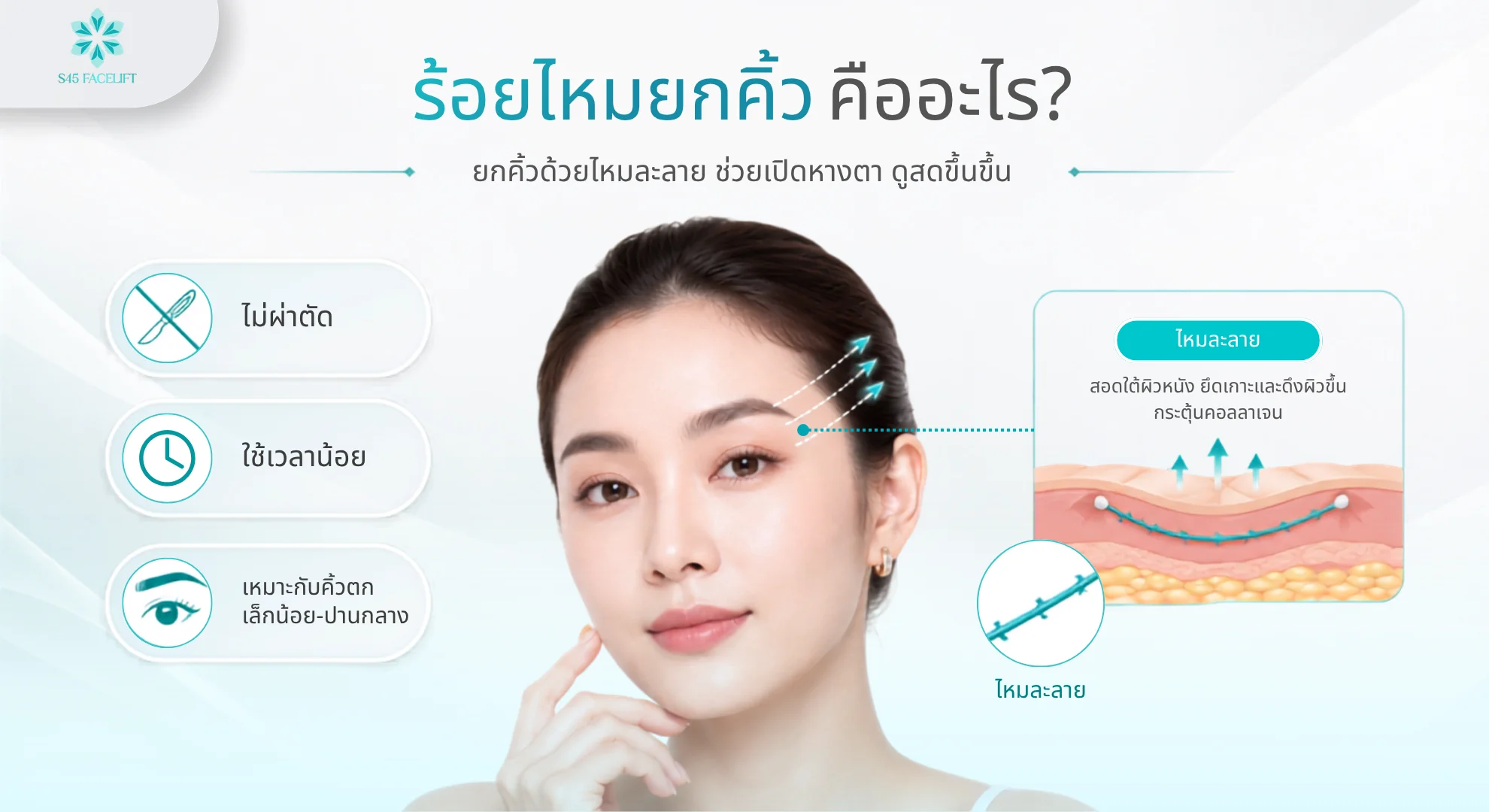
A thread lift lifts and tightens the tissue around the brow tail and temples, so the brow tail looks lifted. It suits drooping brows caused by mild to moderate skin sagging. The results are temporary because the threads gradually dissolve, and it has limits in cases with a lot of sagging.
Filler Injections to the Temples and Around the Eye Sockets
Filler injections to hollow temples or hollow areas around the eye sockets can make the area around the brows look fuller and make the brow tail look lifted. The results are also temporary, and the treatment should be done by an experienced doctor because the area around the eyes needs particular care.
Using Make-Up and Brow Pencil to Disguise Drooping Brows
Drawing and shaping the brows so the tail looks lifted can change your look visually. You can do it yourself and the risk is low, but the effect only lasts while you wear make-up and it does not change the actual position of the brows.
Treating Drooping Brows With Surgery (Brow Lift)
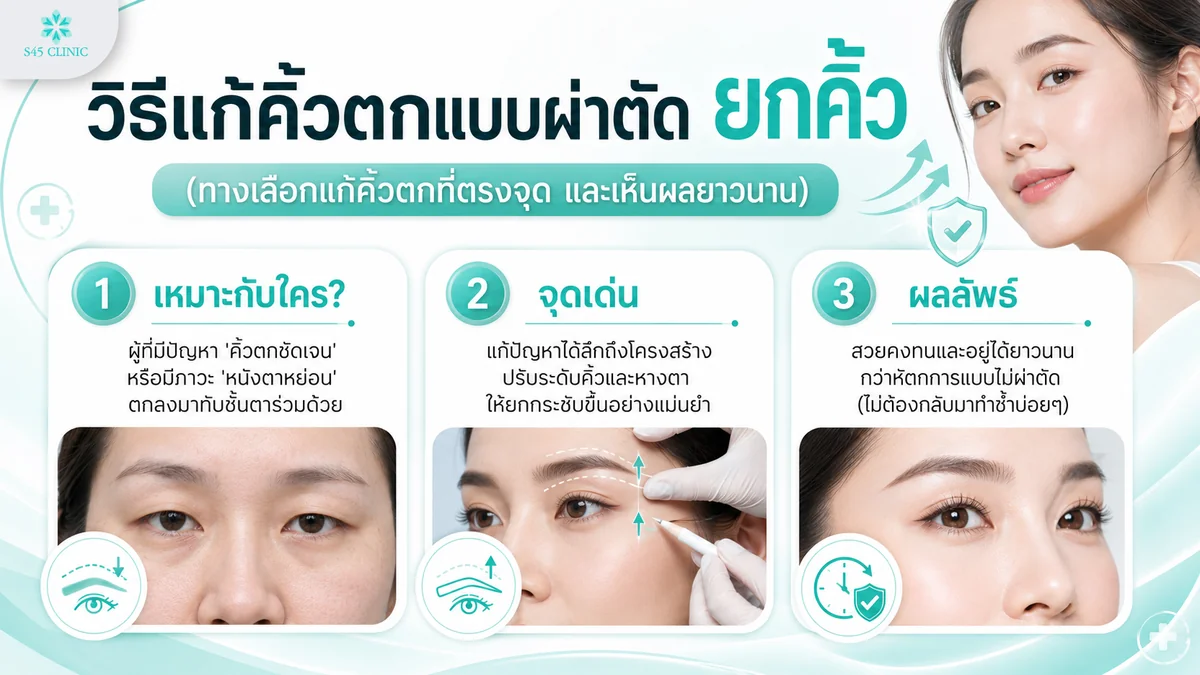
Where the brows have clearly dropped or there is also droopy upper eyelid skin, brow lift surgery treats the problem directly and gives longer-lasting results than non-surgical methods.
Who Brow Lift Surgery Suits
Brow lift surgery suits people whose brows or brow tails have clearly dropped, people who also have droopy upper eyelid skin that blocks their vision or makes them look tired, and people who have tried non-surgical treatment and found it did not meet their needs. A doctor needs to assess whether it is suitable for you.
Endoscopic Brow Lift
One technique commonly used today is the endoscopic brow lift. This is surgery that lifts and tightens the skin and muscles of the forehead and brows back to a suitable position. It can help with drooping brows, drooping outer corners of the eyes and forehead lines. The surgeon inserts an endoscope (a thin camera) through small incisions of about 1cm to 2cm hidden along the hairline. The camera magnifies the structures inside so they can be seen clearly, which helps the surgeon adjust the brow position precisely and lowers the chance of affecting the nerves.
The main advantage is that the incisions are hidden along the hairline, so the scars are not on the face. Swelling and bruising are usually mild, and most people can return to daily activities after about 3 to 5 days, depending on each person. The brow position is adjusted to suit your face. See the service details at endoscopic brow lift.
3 Types of Brow Lift Fixation Material, Chosen by Skin Condition and Age
As well as the technique, the material used affects how firm the lift is and how long the result lasts. The doctor assesses and chooses the material to suit each person.
- Suture A non-dissolvable material that suits mild to moderate sagging and focuses on lifting specific points.
- Endofict A dissolvable material shaped like a pin with small barbs, which helps spread the lifting force over a wider area.
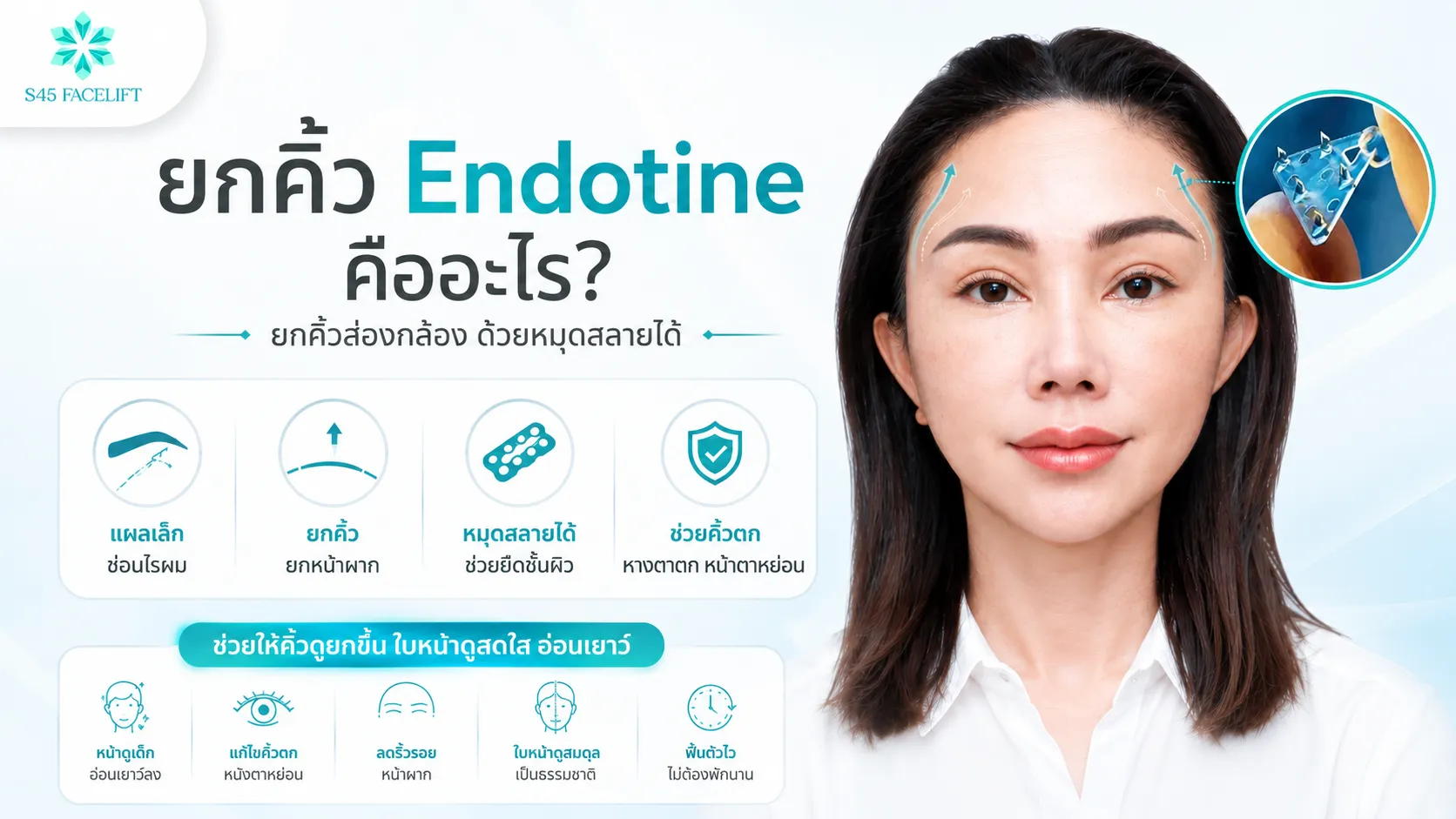
- Endotine A dissolvable device that suits many skin types, especially thick skin. It helps hold the tissue and spread the lifting force over a wide area, and dissolves on its own in about 6 to 12 months.
How long the result lasts varies with the material, skin condition and aftercare of each person, so have a doctor assess you before choosing.
Can Be Combined With Other Procedures, Such as Lifting the Outer Corners of the Eyes
An advantage of the endoscopic technique is that other procedures can be done through the same incisions in the hairline, so no extra incisions are needed and you only need 1 general anaesthetic. Examples include lifting the outer corners of the eyes (a ‘foxy eyes’ lift), which lifts drooping outer eye corners and brow tails for a more lifted look and directly addresses a drooping brow tail, or cutting the frown muscles to reduce lines between the brows. Whether this is suitable depends on the doctor’s assessment. For an international perspective, see ASPS Forehead Lift.
Comparing the Treatments for Drooping Brows

To give an overview, the table below summarises the differences between the options. Which one is suitable depends on the cause and severity for each person.
| Method | Surgery? | How long it lasts | Suits |
|---|---|---|---|
| Make-up and brow pencil | No | Temporary | Changing your look from time to time |
| Botulinum toxin brow lift | No | Temporary | Mild drooping caused by the muscles |
| Thread lift for the brows | No | Temporary | Mild to moderate skin sagging |
| Filler injections to the temples or around the eye sockets | No | Temporary | Hollow area around the brows that does not look full |
| Brow lift surgery | Surgery | Long term | Clearly drooping brows, or with droopy upper eyelid skin |
Which Option Suits Whom
Choosing a treatment should start with understanding the cause and severity of the drooping. If the drooping is mild and linked to the muscles, botulinum toxin injections may help. If there is early, mild skin sagging, a thread lift or filler injections may be an option. For cases where the brows have clearly dropped or there is also droopy upper eyelid skin, brow lift surgery meets the need more closely.
In many cases, the doctor may consider combining several methods to get a result that suits your face. Having a doctor assess your actual condition therefore helps you choose a more suitable approach than deciding from general information alone.
Does Treating Drooping Brows Hurt, and Is It Risky?
Many people worry whether treating drooping brows hurts and whether it is risky. On pain, procedures such as botulinum toxin injections or filler injections use a local anaesthetic or anaesthetic cream, so most people feel only mild discomfort during the treatment. Brow lift surgery is done under local anaesthetic or general anaesthetic depending on the technique, so pain is controlled during the operation. Afterwards you may have some tightness or swelling, which is normal for the procedure.
On risk, every procedure has its own risks, such as swelling and bruising, or a result that has not yet settled in the early period. Most of these can be managed by choosing a clinic that meets proper standards and having the procedure done by an experienced doctor. To lower the risks, choose a properly licensed medical facility and have a consultation with a doctor for an assessment before every procedure.
How to Look After Yourself and Slow Down Drooping Brows
You cannot completely stop the sagging that comes with age, but looking after yourself may help slow it down and care for the skin around the brows to some degree. This includes:
- keeping the skin moisturised and protecting it from the sun, because sunlight is a factor that speeds up skin sagging
- getting enough rest and looking after your overall health
- avoiding frowning or raising your eyebrows hard as a habit when there is no need
- if droopy upper eyelid skin makes you raise your eyebrows often to compensate, having a consultation with a doctor to assess the underlying cause
Looking after yourself helps overall skin health, but it does not clearly lift brows that have already dropped. If you want a clearly visible result, you will usually need to consider a medical procedure.
Common Misunderstandings About Drooping Brows
There are several beliefs about drooping brows that are worth understanding as they really are.
- Drooping brows can be fixed with facial exercises alone Exercises may help muscle tone a little, but they do not clearly lift brows that have sagged with age.
- A drooping brow tail really does show your fortune This is a cultural belief with no medical evidence behind it.
- Botulinum toxin injections lift the brows as much as surgery In fact, botulinum toxin injections help in mild cases, while cases with clear sagging usually need surgery to be considered.
- Every treatment lasts equally long after 1 session Each method lasts a different length of time. Non-surgical methods give temporary results, while surgery gives longer-lasting results, although these can still change with age.
Why Consult S45 Clinic About Drooping Brows
Experienced Doctors in Brow and Forehead Lift
Our doctors experienced in brow and forehead lift surgery assess the cause of the drooping, whether it comes from the muscles, sagging skin or the underlying structure, and then plan a brow shape that suits your face, whether you prefer a soft look or a sharper, more lifted look, aiming for a result in balance with your features. See the service details at endoscopic brow lift.
Endoscopic Technique With Small Incisions Hidden in the Hairline
S45 Clinic uses an endoscopic technique with small incisions of about 1cm to 2cm hidden along the hairline, so the scars are not on the face, and uses materials such as Endotine to lift the brows to a position that suits each person.
Care by an Anaesthetist and Operating Theatre Standards
When a general anaesthetic is used, an anaesthetist looks after you one-to-one, with equipment and medicines ready for emergencies to lower the risks during surgery, and there is a follow-up system after the procedure. The clinic is in central Bangkok on Sukhumvit 33, easy to reach and close to BTS Phrom Phong station.
FAQs About Lateral Brow Ptosis
What Causes Lateral Brow Ptosis?
It is mostly caused by ageing and sagging skin, along with how the muscles work, genetics and habits in using the forehead muscles.
What Do Traditional Beliefs About Facial Features Say Drooping Brows Mean?
In traditional beliefs about facial features, a drooping brow tail is read in a rather negative way, but this is a cultural belief with no medical evidence behind it, so it should not be the main reason for any decision.
How Should I Shape My Brows to Make a Drooping Brow Tail Look Better?
Drawing and shaping the brows so the tail looks lifted can disguise the drooping visually, but the effect is temporary. If you want a clearer and longer-lasting result, have a consultation with a doctor about the procedures available.
Can a Drooping Brow Tail Be Treated Without Surgery?
Yes, to some degree, for example with a botulinum toxin brow lift, a thread lift or filler injections, which give temporary results and suit mild drooping. Cases with clear drooping usually need surgery to be considered.
Can Drooping Brows in Men Be Treated?
Yes, in the same way as in women. The method is chosen according to the cause and severity, from non-surgical treatment to brow lift surgery, and a doctor should assess you first.
What Is the Medical Term for Drooping Brows?
They are usually called eyebrow ptosis or brow ptosis, which means the brow or the tail of the brow has dropped lower than usual.
Summary
Lateral brow ptosis is when the tail of the eyebrow sits lower than usual, making the face look sadder or more tired than it really is. The main causes are ageing and sagging skin, along with how the muscles work, genetics and habits in using the facial muscles. Beliefs about reading facial features are cultural and have no medical evidence behind them, so they should not be the main reason for any decision.
Treatment options include non-surgical methods such as a botulinum toxin brow lift, thread lifts and filler injections, which give temporary results, and brow lift surgery, which suits cases where the brows have clearly dropped or there is also droopy upper eyelid skin, and gives longer-lasting results. The choice should depend on the cause and severity for each person.
Most importantly, have an experienced doctor assess your actual condition before you decide, so you can choose a suitable approach and a result that suits your face. Results depend on each person.
Because every face shape…
is different
An otolaryngologist with subspecialty training in facial plastic and reconstructive surgery assesses every case before treatment and gives advice based on your actual concerns.
“Reveal the beauty within you”
Message us online
Surgery and medical procedures carry risks. Find out about them and consult a doctor before you decide. Results depend on each person.