Types of Brow Lift and Facelift With the Endoscopic Technique, and How the Materials Differ

What Is Brow Ptosis? Signs That Make the Face Look Older
Brow ptosis (drooping brows) is when the brows sit lower than usual. In general, a suitable brow position is about 1.5cm to 2cm above the edge of the eye socket.
If the brows drop, whether at the inner end, at the tail or unevenly, the face can look less fresh, the eyes can look sad and the face can look stern without meaning to.
Brow ptosis is also often seen together with drooping outer eye corners and sagging upper eyelids, which can make the eyelid crease look narrower and the eyes look tired. Many people think double eyelid surgery alone can fix this, but when the main cause is a lowered brow position, an endoscopic brow lift and facelift with Endotine may give a more balanced result. If you have drooping brows or drooping outer eye corners, you can book a consultation with a surgeon at S45 Clinic, who will assess the problem in detail case by case and plan care that fits your goals and your facial structure.
What Is Endoscopic Brow Lift and Facelift Surgery?
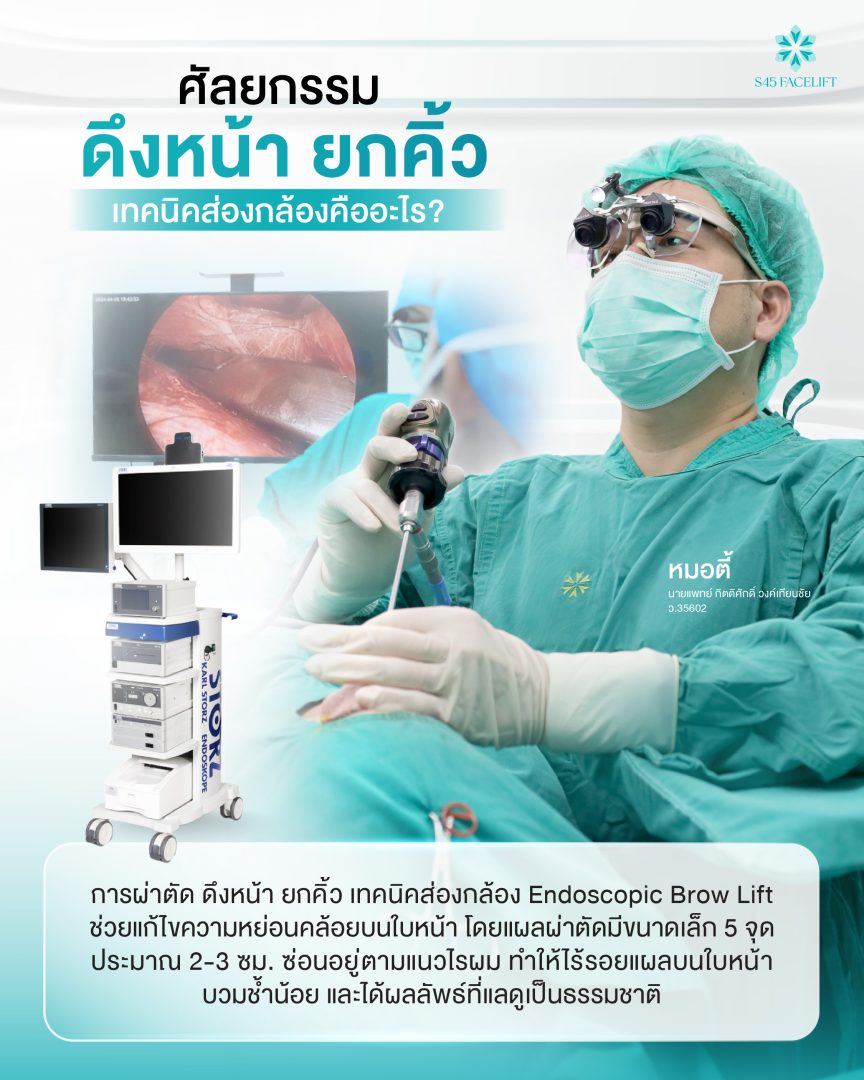
Endoscopic brow lift and facelift surgery lifts the skin and muscles of the forehead and brows, also known as an upper facelift, to move them to a more suitable position. It helps the face look fresher and reduces drooping brows, drooping outer eye corners and forehead lines.
The surgeon inserts an endoscope (a thin camera) through small incisions in the hairline to magnify the internal structures, so the details can be seen more clearly on a screen, which makes the surgery more precise. An endoscopic brow lift and facelift is therefore another option to reposition the brows and lift the face so its proportions and overall look appear more youthful.
Types of Endoscopic Brow Lift and Facelift, and How the Materials Differ
In a brow lift and facelift with the endoscopic technique, apart from the surgical technique itself, another factor that affects the result is the ‘material used to hold the lift’, which affects how firmly the tissue is held, how long the result lasts and how well it suits each person’s skin.
In general, an endoscopic brow lift and facelift can use 3 types of material. The surgeon assesses your facial structure, the degree of sagging and your goals to choose the most suitable approach for each case.

- Suture (non-absorbable medical material): a material for the facelift and brow lift suited to people aged 25 to 35 with mild to moderate sagging. It holds specific points well, with results that can last 5 to 8 years, depending on each person.
- Endofict (absorbable medical material): a material for the facelift and brow lift suited to people aged 30 to 45. It is a small anchor with tiny prongs that holds and spreads the lifting force over a wide area and helps stretch skin and muscle well. Results can last 5 to 10 years.
- Endotine (absorbable medical material): suitable for all skin types, especially thick skin, for people aged 35 to 65. Endotine is a device designed for medical use to hold the skin and spread the lifting force over a wide area. The material absorbs on its own within 6 to 12 months, and results can last 10 to 15 years.
Why Choose an Endoscopic Brow Lift?
An endoscopic brow lift and facelift helps lift the brows and makes the face look more balanced. Its key features are:

- Long-term results
Results of an endoscopic brow lift and facelift can last 10 to 15 years, depending on several factors, such as your health and how carefully you follow aftercare advice.
- Small incisions
The incisions are only 1.5cm to 2cm long and are hidden in the hairline.
- No overnight hospital stay
You can usually go home straight after the procedure without staying in hospital. Recovery time depends on each person.
- A result that suits your face
It helps bring the brows to a suitable position so the face looks fresher, and you can still make facial expressions as usual.
An endoscopic brow lift and facelift is therefore one option for people who want to reposition their brows to suit their face. The choice of treatment should be made after an assessment by a surgeon, to lower risks and meet each person’s goals.
Brow Lift vs Thread Lift, How Do They Differ?
An endoscopic brow lift and facelift and a thread lift both help lift the face and correct drooping brows, but they differ in how they are done, the degree of change and how long the result lasts. The right choice depends on each person’s problem and goals.
Endoscopic Brow Lift and Facelift
This lifts the skin and muscles of the forehead and brows to address the problem in a suitable way:
- results can last 10 to 15 years
- lifts both the brows and the forehead, helping to lift the face so it looks fresher
- helps reduce sagging upper eyelids
- better proportion between the eyelid crease and the brows
- small incisions hidden in the hairline
Thread Lift
A procedure that lifts the skin without surgery, but it has limits to consider:
- results last about 8 to 12 months
- suited to lifting at the skin level
- needs repeat sessions to maintain the result
- not suitable for people with clearly sagging upper eyelids or drooping outer eye corners
- may cause irritation or inflammation in some cases
- in some cases, may cause scar tissue or uneven skin
If you want to address sagging upper eyelids and drooping outer eye corners and lift the face, an endoscopic brow lift and facelift with Endotine is one option, with results intended to last in the long term.
Summary
Drooping brows, drooping outer eye corners and sagging upper eyelids are among the main reasons the face looks less fresh and older. They can be addressed with an endoscopic brow lift and facelift, which repositions the brows to a suitable level, with the advantage of small incisions hidden along the hairline. If you have drooping brows, drooping outer eye corners or sagging upper eyelids and are looking for options, you can book a consultation at S45 Clinic for an assessment and a treatment plan that suits you.
Ask us for more information