What to Know Before Breast Augmentation About Methods, Size and Recovery

Example image used in advertising. Not a real patient.
Key points
- Breast augmentation can be done in 3 ways: with silicone implants, with your own fat, or as a hybrid that uses both. The right method depends on your existing breast tissue, the fat in your body and the size you want.
- The implant can be placed above the muscle, under the muscle or with the dual plane technique, and the incision can be in 1 of 3 places: the armpit, the crease under the breast or the edge of the areola.
- Choose the implant size in cc from the width of your breast base and the thickness of your skin, not just the cup size.
- Sharp pain usually eases within 1 to 5 days, according to ASPS, but you need to wear a support bra throughout the first month and avoid lifting anything heavier than 3kg for about 4 to 6 weeks.
- Breast implants are not expected to last for the rest of your life, so keep having follow-up checks as your doctor advises.
Small breasts, breasts of different sizes or breasts that have lost volume after breastfeeding are reasons many people start looking into breast augmentation. But once you start searching, you find implants and fat transfer, several implant positions and many implant sizes. Each option affects the shape, the scar and recovery differently. If you choose without understanding the differences, you may end up with a size that does not suit your proportions.
In this article, S45 Clinic covers what to know before surgery, from the methods and types of implant to implant position, incision sites and choosing a size, through to recovery and the risks. Use it to help you decide and to prepare questions before your consultation with a doctor.
In This Article
What Is Breast Augmentation?
Breast augmentation is surgery to increase the size or change the shape of the breasts, using silicone implants or fat taken from another part of your body to add volume. The medical term is augmentation mammaplasty. The American Society of Plastic Surgeons (ASPS) says it can be used to make the breasts fuller and more projected, to improve the balance between the bust and hips, and to restore volume lost after weight loss or pregnancy.
This surgery is different from a breast lift. Breast augmentation adds volume, while a breast lift (mastopexy) removes excess skin and raises the position of the nipple. Some people with very saggy breasts need both operations together, because an implant on its own does not raise a nipple that has dropped.
Who Is Breast Augmentation Suitable For?
Breast augmentation is suitable for people who are in good health, have no medical conditions that make anaesthesia risky, and want to change the size or shape of their breasts for themselves. For example, your breasts may be small compared with your body, different sizes, or smaller after breastfeeding or weight loss.
Your doctor assesses your age and physical readiness individually at your consultation. Your doctor will also ask about your expectations. If you know what shape you want and accept that the result depends on your existing breast tissue, you can discuss a size with your doctor that is closer to what you want.
Who Should Wait or Have Tests Before Breast Augmentation?
In some cases, it is better to postpone surgery or have tests first to check that your body is ready. Your doctor will assess this from your history and test results. Tell your doctor at your consultation if any of these apply to you:
- You can feel a lump in your breast. The cause should be checked and treated first.
- You have a long-term condition such as high blood pressure, diabetes or heart disease, because the surgery is done under a general anaesthetic with an anaesthetist looking after you.
- You take medicines or vitamins regularly, especially medicines that affect blood clotting.
- You smoke. Smoking affects how the wound heals, and you need to stop before surgery.
- Your surgery date falls during your period. The date should be moved.
What Are the Methods of Breast Augmentation?
There are 3 methods of breast augmentation: with silicone implants, with your own fat, and hybrid breast augmentation, which combines implants and fat. Each method differs in the size it can achieve, how long the result lasts and the recovery. Your doctor will recommend a method based on your existing breast tissue, the amount of fat in your body and the size you want.
Breast Augmentation With Silicone Implants
Breast augmentation with silicone implants places an implant filled with gel or saline under the breast tissue or under the muscle. This method controls the size more precisely than the others, because you choose the volume in cc before surgery, and the size does not shrink over time the way fat does. It suits people who want a noticeable increase in size, or who do not have enough excess fat to remove and use.
Implants stay in your body for a long time, so you need regular follow-up checks, and if a complication happens you will need surgery to replace them in the future. There is more about how long implants last in the section on implant lifespan below.
Breast Augmentation With Your Own Fat
Breast augmentation with your own fat (fat transfer to the breasts) uses liposuction to take fat from the thighs, waist or abdomen. The fat is spun to separate out the fat cells, which are then injected into the breasts. One advantage is that there is no foreign material in your body, and the breasts feel like your own tissue.
The limitation is that your body absorbs some of the injected fat, so the breasts gradually become smaller over time. To keep the same size, you need more fat injections later. This method suits people who want a small increase in size or to reshape certain areas, and it needs enough fat in the areas where liposuction is done. Some very slim people do not have enough fat for this method.
Hybrid Breast Augmentation
Hybrid breast augmentation places an implant and injects your own fat during the same operation. A smaller implant provides the base volume, and fat fills the areas the implant does not reach. A study published in Aesthetic Surgery Journal in 2021 planned the amount of fat in advance so that a smaller implant could give a shape close to that of a larger one.
This method is often considered for people with thin skin or so little breast tissue that the implant edges may show. But surgery takes longer because liposuction is also needed, clinics still do this technique in different ways, and most study results come from small groups of patients.
How Breast Implants Differ in Filling, Surface and Shape
Breast implants differ in 3 ways: what they are filled with, the surface of the shell and the shape. All of these affect how the implant feels, how it moves and some risks. The table below summarises information from ASPS and the US Food and Drug Administration (FDA).
| What Differs | Option | Features |
|---|---|---|
| Filling | Saline | If the shell leaks, the implant deflates and your body absorbs the saline. |
| Silicone gel | Feels close to breast tissue. If it leaks, the implant does not deflate, so you need an ultrasound or MRI to check. | |
| Form-stable gel | The gel is thicker and firmer and keeps its shape even if the shell tears, but it needs a slightly longer incision. | |
| Surface of the shell | Smooth | Soft and moves within the pocket. In people with thin skin, rippling may show. |
| Textured | Tissue grips the surface, so it moves less, but BIA-ALCL is more common with this type of surface. | |
| Shape | Round | Makes the breasts look fuller. The shape stays the same if the implant rotates. |
| Teardrop | The lower part projects more than the upper part. If it rotates out of position, you may need more surgery. |
As well as these 3 differences, implants come in different profiles (how far they project). ASPS says a high-profile implant makes the front of the breast project further. Implants with the same base width but a different profile have different volumes.
Where Can a Breast Implant Be Placed?
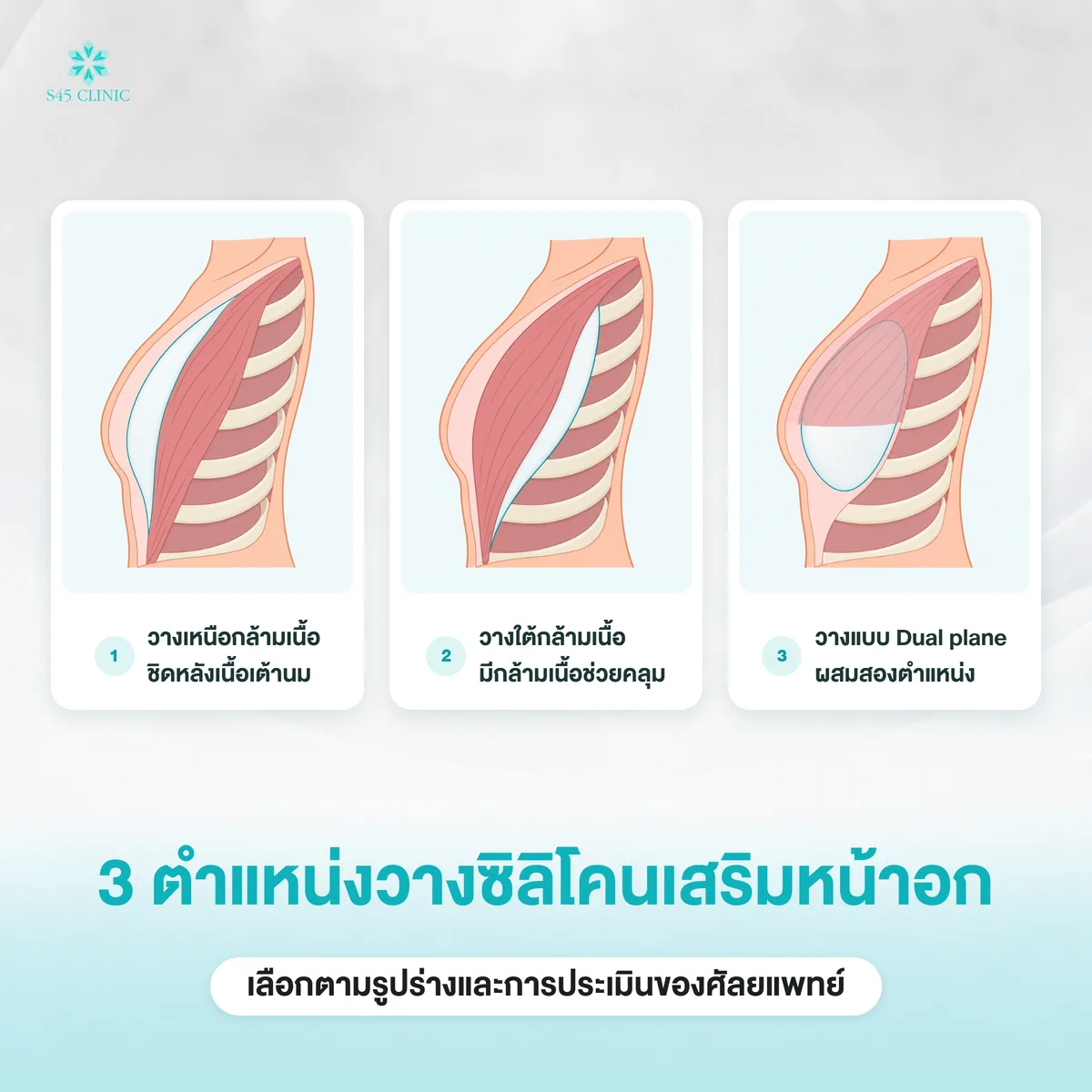
A breast implant can be placed in 3 positions: above the muscle, under the muscle, or with the dual plane technique, which combines both positions. ASPS says the choice depends on the type of implant, how much bigger you want to go, your body shape and your surgeon’s assessment.
Placement Above the Muscle
Placement above the muscle puts the implant directly behind the breast tissue, in front of the chest muscle. The medical term is subglandular. The surgery does not involve separating the chest muscle, and the implant sits against the breast tissue. Doctors consider this position for people whose breast tissue is thick enough to cover the implant.
The limitation is for people with little breast tissue or thin skin. The implant edges and rippling are easier to see or feel, because only the skin and a thin layer of breast tissue cover them. Your doctor will assess the thickness of your tissue before choosing this position.
Placement Under the Muscle
Placement under the muscle puts the implant behind the chest muscle (subpectoral placement), so an extra layer of muscle helps cover the implant. The edges and rippling show less, especially in people with thin skin or little breast tissue, which is why many surgeons recommend this position for them.
A downside to know about is that the surgery involves separating the tissue under the chest muscle. Some surgeons write that the first few days may be more sore than with placement above the muscle, but this is still surgeons’ opinion more than research evidence. If you play sport or lift weights regularly, tell your doctor at your consultation so this can be taken into account when choosing the position.
Dual Plane Placement
The dual plane technique places the upper part of the implant behind the chest muscle and the lower part behind the breast tissue. The lower attachment of the muscle along the crease under the breast is released, but not the attachment along the breastbone. John Tebbetts first described this technique in Plastic and Reconstructive Surgery in 2001.
The aim is to give the upper part of the breast muscle cover, as with placement under the muscle, while the lower half of the implant sits against the breast tissue. This adjusts the relationship between the implant and the tissue to suit each breast type. The original paper included 468 patients who had surgery with this technique between 1992 and 1998, and reported that it can be used in a wide range of breast types.
Breast Augmentation Incision Sites
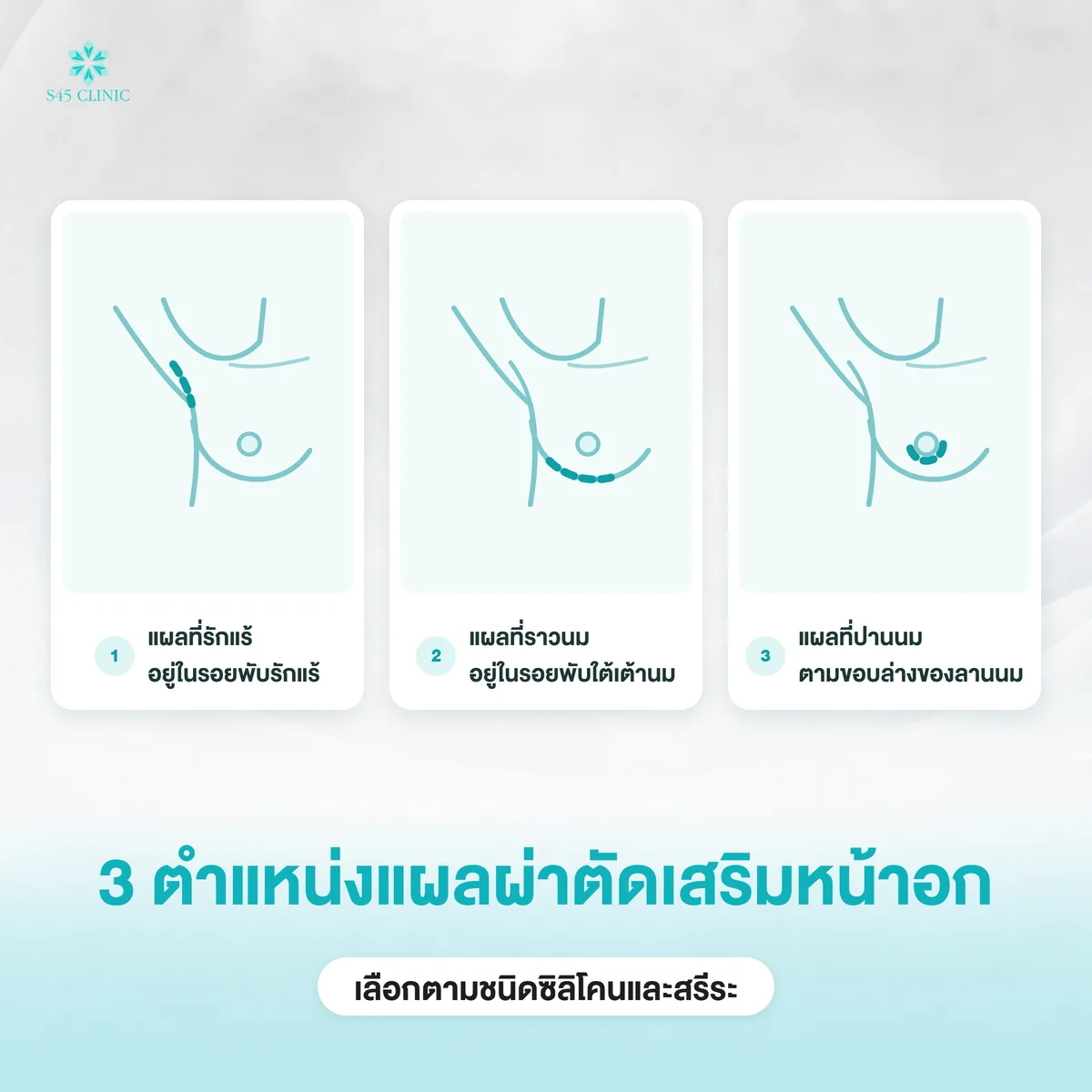
A breast augmentation incision can be in 3 places: the armpit, the crease under the breast or the edge of the areola. ASPS says the choice depends on the type of implant, the size you want, your anatomy and your surgeon’s preference. Every site is placed where it is hard to see, and scars fade over time, but how a scar looks still depends on your genes, exposure to nicotine and infection.
Armpit Incision
The armpit incision (transaxillary incision) is in the crease of the armpit. The advantage is that the scar is in the armpit, not on the breast. When your arm is by your side, the scar is hidden in the crease, so it is an option for people who do not want any mark on the chest.
Bear in mind that the incision is a long way from where the implant sits, and ASPS says form-stable implants need a slightly longer incision than other types. Your doctor will consider whether the type and size you choose can go through this incision. If you often wear sleeveless tops, ask your doctor how deep in the crease the scar will be, and whether the same incision can be reopened if you need surgery again in the future.
Inframammary Incision
The inframammary incision is in the crease under the breast, called the inframammary fold. When you stand up straight, the breast tissue covers the scar, and the incision is right next to the pocket where the implant sits.
This incision does not go through the areola, and the scar sits under the breast, not on the front. If your breasts are so small that you have almost no crease under them, ask your doctor at your consultation where the scar line will be after surgery, and whether the same incision can be used if you need surgery again in the future.
Areola Incision
The areola incision (periareolar incision) runs along the lower edge of the areola (the darker skin around the nipple), where the skin colour changes. Once it heals, the scar sits on the line where the 2 skin colours meet. This is harder to see than a scar on skin that is one even colour.
The limitation is that the size of the areola limits the length of the incision, because the incision follows its edge. Your doctor will check whether the type and size of implant you choose can go through this incision. If you plan to breastfeed in the future, ask your doctor about the incision site too, because the FDA says breast augmentation can affect breastfeeding, although it does not break this down by incision site.
What Is the Funnel Technique in Breast Augmentation?
The funnel technique places the implant into the pocket through a sterile plastic funnel (sterile insertion funnel) instead of pushing it in by hand. The doctor loads the implant into the funnel, then squeezes it so the implant slides through the incision. The implant surface therefore barely touches your skin or the doctor’s hands.
A systematic review published in Plastic and Reconstructive Surgery Global Open in 2022 included 6 studies and found that the funnel helped reduce incision length, operating time and the rate of capsular contracture (scar tissue tightening around the implant). However, most of the studies looked back at past cases, and there are no randomised controlled trials yet. Another study comparing 100 patients found an average incision length of 35.5mm with the funnel and 46.2mm when the implant was inserted by hand. S45 Clinic uses a funnel to insert implants in breast augmentation.
What Size of Breast Implant Suits Your Body?
There is no single breast implant size that suits everyone, because it depends on the width of your existing breast base, the thickness of your skin and breast tissue, and the width of your chest and shoulders. The same cc can give different results in 2 people with different frames.
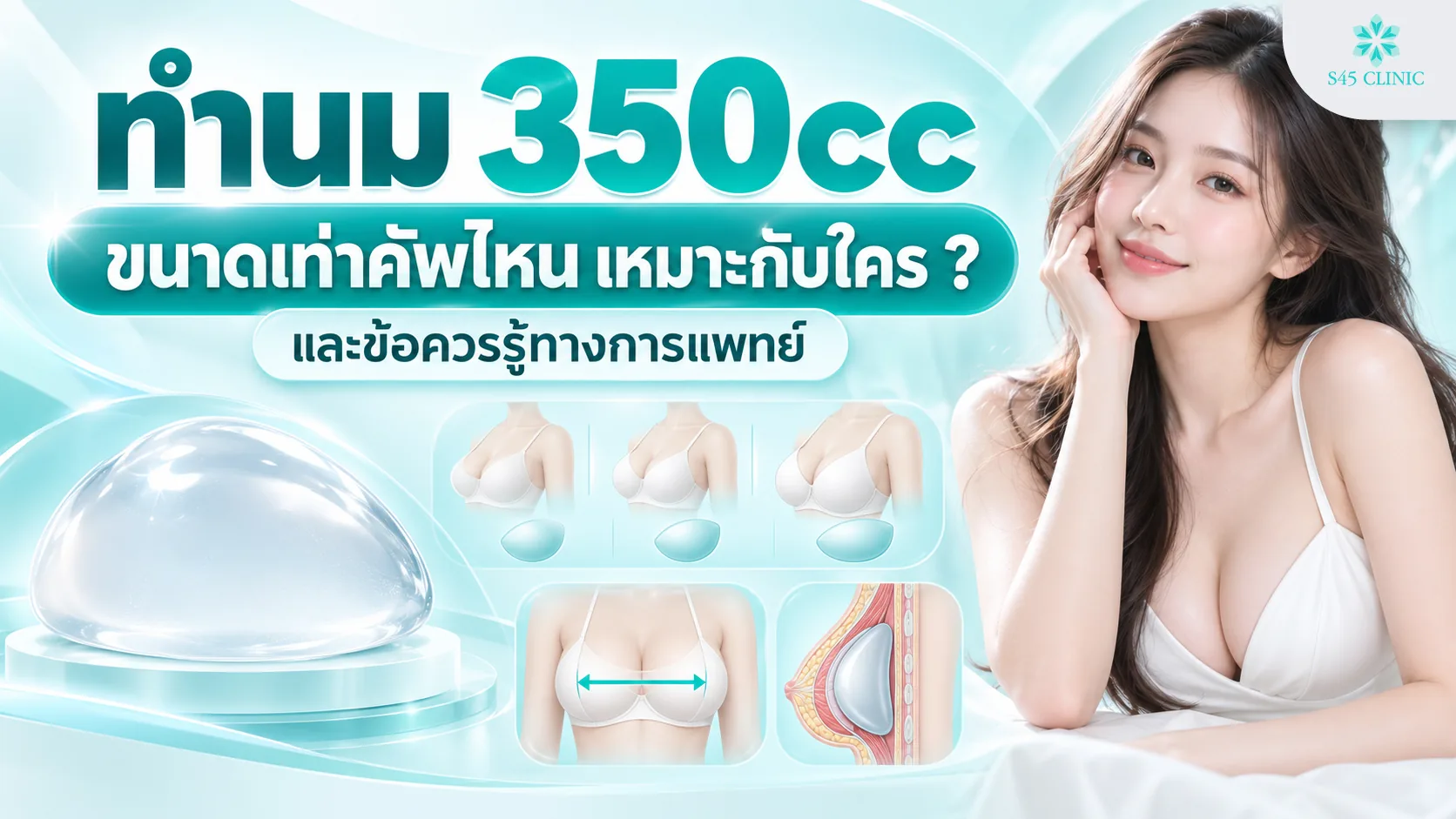
A common rough guide is that a 350cc implant adds about 2 cup sizes, but this is only an estimate, because cup sizes vary between bra brands. A petite person with a 300cc implant can look bigger than a broad-shouldered person who has breast augmentation with a 400cc implant.
At your consultation, your doctor usually measures your breast base, the distance from the nipple to the crease under the breast and the thickness of your skin. Trying implant sizers in a bra also helps you see the proportions before surgery. Telling your doctor what breast shape you want and what clothes you often wear helps you choose a size closer to what you want than asking for a number in cc.
Breast Augmentation Steps From Consultation to Surgery
Breast augmentation starts with a consultation and examination and continues through to the day of surgery and going home. The usual steps are:
- At your consultation, you describe your concerns and the shape you want. Your doctor examines your breasts, takes measurements and explains the suitable methods.
- You choose the type, size, implant position and incision site with your doctor, and try implant sizers.
- You have a physical examination and blood tests before surgery to check that you are ready for a general anaesthetic.
- On the day of surgery, an anaesthetist gives you a general anaesthetic. The doctor makes the incision, creates the pocket and places the implant in the planned position.
- The wound is closed by stitching the tissue layers, then the skin is closed with stitches, skin glue or tape.
- You rest while your recovery is monitored after surgery, and you receive medicines and a follow-up appointment before going home.
S45 Clinic uses the Seamless technique (closing the wound with medical skin glue), so you do not need to come back to have stitches removed.
How to Prepare for Breast Augmentation
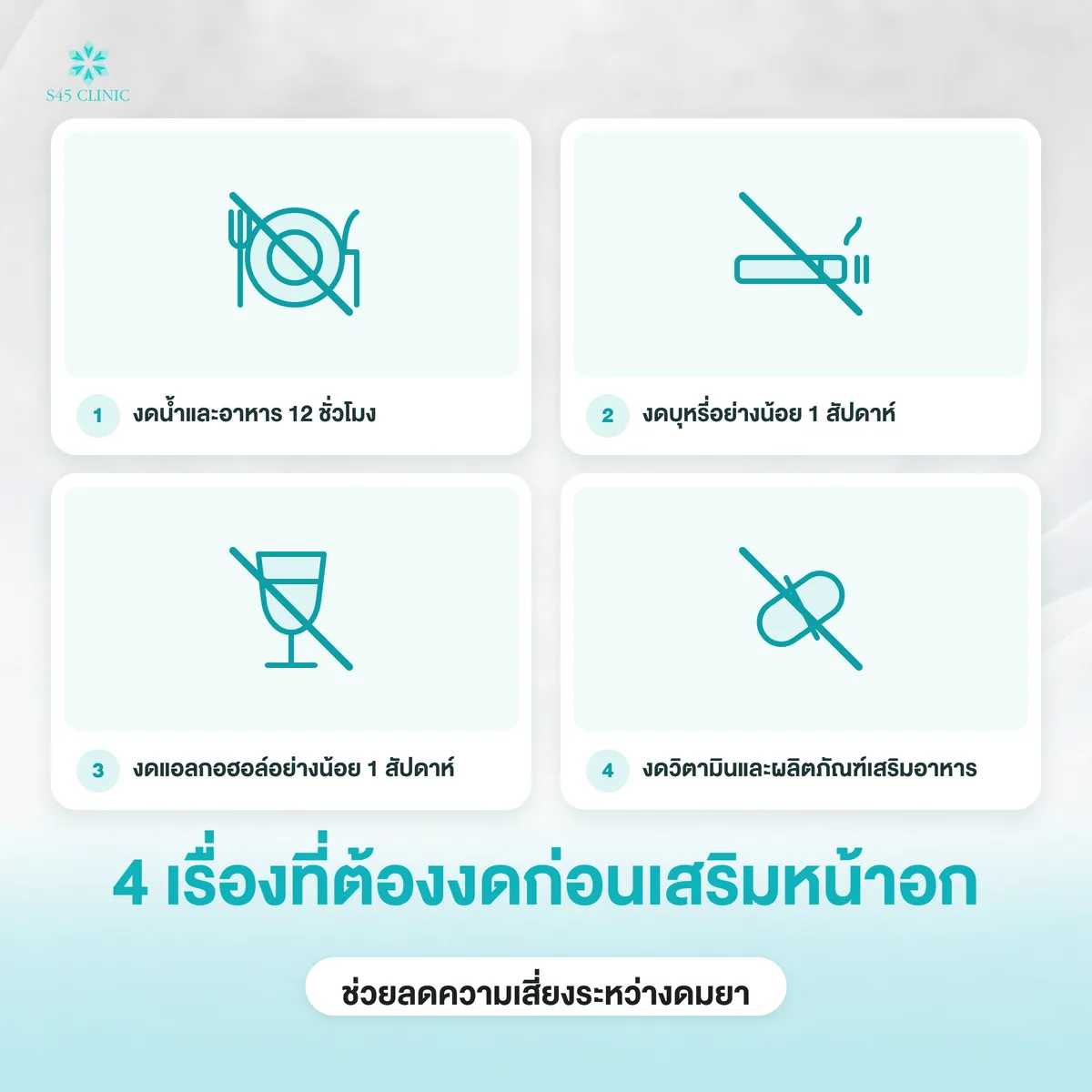
Preparing for breast augmentation helps lower the risks during anaesthesia and helps the wound heal normally. The first 6 points are what S45 Clinic recommends, and the last 2 are about getting ready to go home:
- Have the tests your doctor asks for, and tell your doctor about all your medical conditions and any drug allergies.
- Do not eat or drink for 12 hours before surgery.
- Stop drinking alcohol and smoking at least 1 week before surgery.
- Stop taking vitamins and dietary supplements.
- Tell your doctor about medicines you take regularly, so they can advise whether to stop or continue them.
- Avoid booking surgery during your period.
- Have clothes that button at the front ready, because raising your arms is difficult at first.
- Ask a family member or friend to take you home, because you must not drive after a general anaesthetic.
Does Breast Augmentation Hurt?
There is pain after breast augmentation, and it gradually eases over time. ASPS says sharp pain usually eases within 1 to 5 days. After that, you may have soreness and swelling that can last for several weeks. You are given a general anaesthetic, so you are asleep during the operation.
How much pain you feel depends on the implant position, the size and how sensitive you are to pain. ASPS says your doctor may prescribe painkillers, and antibiotics to prevent infection. Take them on time. The same source says a support garment or support bra helps reduce swelling. If the pain gets worse instead of better, or one breast is more swollen and firmer than the other, contact your doctor straight away.
More on pain: Is Breast Augmentation Painful? What It Feels Like and How to Look After Yourself
How Long Is Recovery After Breast Augmentation?
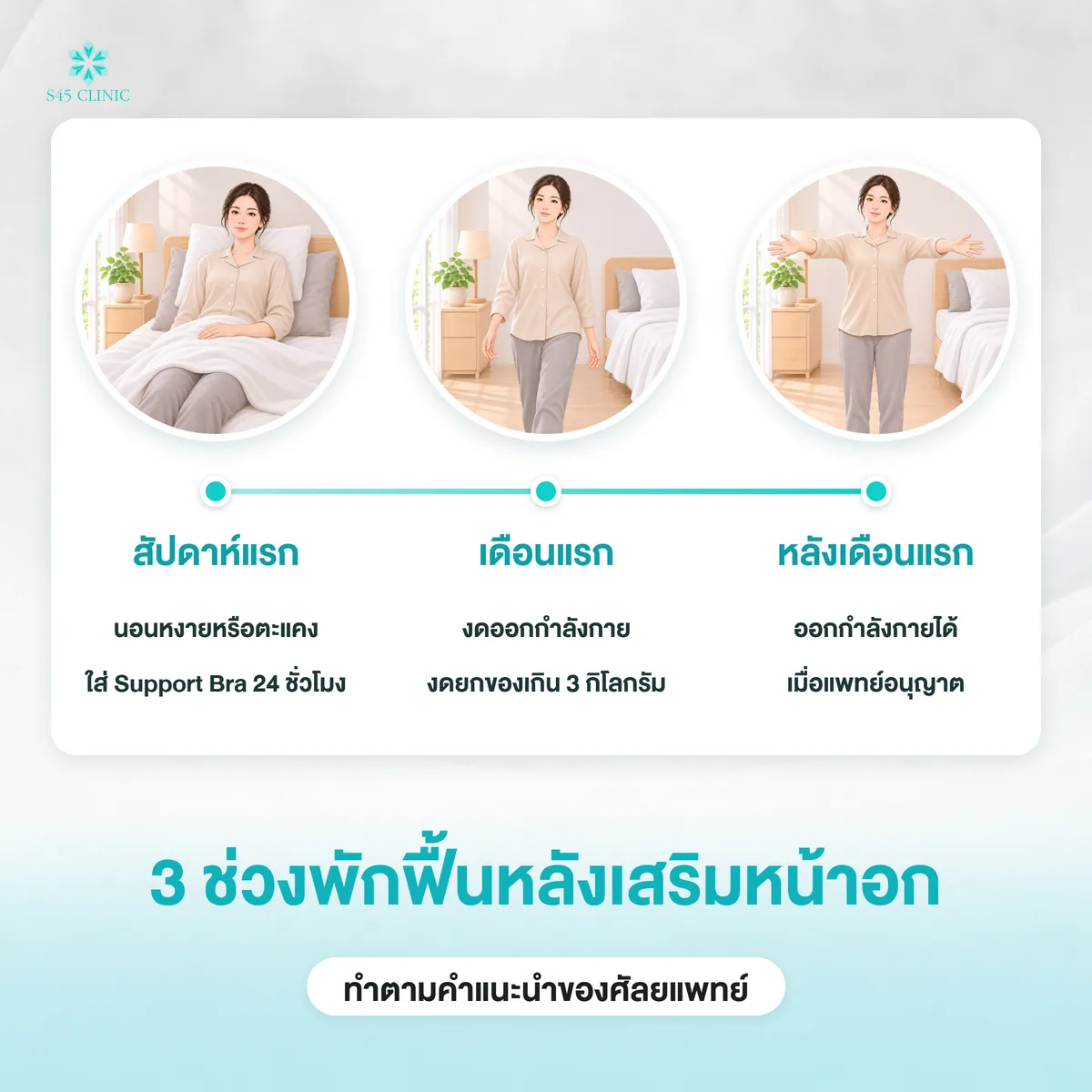
Recovery after breast augmentation takes at least 7 days before you go back to light daily activities, but it takes your body about a month before you can return to your usual exercise. Each stage has different things to do and avoid.
The First Week After Breast Augmentation
In the first week, you will still have swelling and soreness. Sleep on your back or side, avoid sleeping on your front, and wear a support bra 24 hours a day as your doctor advises. ASPS says blood can collect around the implant in the first few days, so rest as much as you can until your doctor says you can do more.
Avoid raising your arms above your head, reaching for things on high shelves and lifting heavy things. You can do light activities at home as your doctor advises. With a wound closed using the Seamless technique, you can shower and do not need to wait for stitches to be removed. During this time, take your medicines on time and check for discharge from the wound, redness and swelling, or a high temperature.
The First Month After Breast Augmentation
Throughout the first month, you still need to wear a support bra 24 hours a day. Avoid lifting anything heavier than 3kg, such as a bucket of water, a basket of wet laundry or a young child, for about 4 to 6 weeks, or until your doctor examines you and says you can.
Other things to avoid during this time are exercise for at least 1 month, underwired bras, and alcohol for at least 2 weeks. S45 Clinic recommends massaging your breasts regularly to help the implants settle. Massage using the method and timing your doctor shows you at your appointment.
After the First Month
After the first month, when you can go back to exercise depends on your check-up at your appointment. ASPS recommends returning to exercise and activities as your surgeon advises, not on a date you set yourself. For exercises that use the chest muscles a lot, such as press-ups or lifting weights, ask your doctor about each one separately.
Scars gradually fade over time, as ASPS says, and the swelling and soreness that can last for several weeks will keep easing. Go to every follow-up appointment, even if you have no problems, so your doctor can check the implant position and how soft your breasts feel.
Recovery stages: How Long Is Breast Augmentation Recovery? Recovery Stages and Aftercare
Disadvantages and Risks of Breast Augmentation
Breast augmentation has the same risks as any surgery, plus risks that come from the implant itself. The FDA lists about 30 complications that happen in 1 in 100 patients or more. Complications to know about before you decide include:
- capsular contracture: the tissue your body forms around the implant tightens until the breast feels hard, and severe cases may need more surgery
- implant rupture or leak: a saline implant deflates visibly, while a gel implant can leak without symptoms and needs an MRI or ultrasound to check
- infection, and blood collecting around the implant (haematoma) in the early period after surgery
- the implant moving out of position, or the 2 breasts looking different
- changes in nipple sensation, and long-term breast pain in some people
- BIA-ALCL (breast implant-associated anaplastic large cell lymphoma): a type of lymphoma that develops around the implant and is more common with textured implants
- breast implant illness: a group of symptoms that patients report, such as tiredness, joint pain or difficulty concentrating, and the FDA says its cause is not well understood
The FDA also says breast augmentation may affect breastfeeding, and there is no guarantee that the appearance of your breasts will be what you want. Talk to your doctor about the risks that apply to your body before the day of surgery.
Precautions: Breast Augmentation Risks and What to Know Before You Decide
How Long Do Breast Implants Last?
Breast implants do not need to be replaced after a fixed number of years, but the FDA says breast implants are not expected to last for the rest of your life, and the longer you have them, the higher the chance of complications. The FDA advises anyone deciding to have breast augmentation to expect further surgery in the future.
Implants are replaced because of symptoms, not on a schedule. Reasons for further surgery include capsular contracture that makes the breast hard, a leaking implant, an implant moving, or the breast shape changing with age, weight and pregnancy. Some people choose to replace their implants because they want a different size.
A gel implant can leak without symptoms. The FDA says MRI is the main way to check for this type of leak, and ultrasound can be used instead in people with no symptoms. Ask your doctor on the day of surgery which method to use for follow-up checks and how often, and keep a record of the implant model and size to use for future checks.
How Much Does Breast Augmentation Cost?
The cost of breast augmentation is not based only on the size in cc. It includes several costs, from the consultation to follow-up appointments, so prices vary widely between medical facilities and between cases. The main factors that affect the cost are:
- method: implants, your own fat or hybrid, and hybrid breast augmentation adds the cost of liposuction
- type and model of implant: the filling, surface, shape and size
- implant position and complexity: revision surgery or surgery combined with a breast lift takes longer
- anaesthetist and operating room fees: including how long you need to stay for monitoring
- tests before surgery: such as blood tests and a physical examination
- items after surgery: such as a support bra and medicines
- follow-up appointments: how many are included in the price
When you compare prices, ask for a quote that lists these items separately, because a lower price sometimes leaves some items out.
Check the cost: What Affects 400cc Breast Augmentation Cost? Key Facts and How to Prepare
How to Choose a Breast Augmentation Clinic
When choosing a breast augmentation clinic, look at the doctor’s qualifications, the standards of the medical facility and the care after surgery, rather than just the price or reviews. Criteria you can check for yourself include:
- check the doctor: search for the name and medical licence number of the doctor who will operate in the Medical Council of Thailand’s checking system
- check the medical facility licence: the facility where the surgery takes place must display its licence on site
- ask about the anaesthetist: whether an anaesthetist looks after the anaesthesia throughout the operation
- ask for implant information: the implant brand, model name, size and approval documents for the implant that will be used
- ask about care after surgery: how many follow-up appointments there are and how to get in touch if you have problems
- see whether the doctor explains the risks: the doctor should explain both the benefits and the risks, and should not rush you to decide at your consultation
Clinic criteria: Breast Augmentation in Bangkok, Where to Have It and Why Consider S45 Clinic
Summary
Before breast augmentation, start by knowing whether your concern is size, unevenness or sagging, because each suits a different method. Then prepare questions about implant position, incision site and a size that fits your actual breast base to ask your doctor, and plan for at least 7 days of recovery and the things to avoid throughout the first month.
If you are not sure which method suits you, having a doctor assess your case before any treatment helps you get advice based on your actual concerns. Book a consultation with S45 Clinic using the contact options below before you decide.
Because every body…
is different
Doctors at S45 Clinic assess every case before treatment and give advice based on your actual concerns.
“Reveal the beauty within you”
Message us online
Surgery and medical procedures carry risks. Find out about them and consult a doctor before you decide. Results depend on each person.