Tummy Still Bulging After Birth? Diastasis Recti, a Cause Many Mothers Do Not Know About
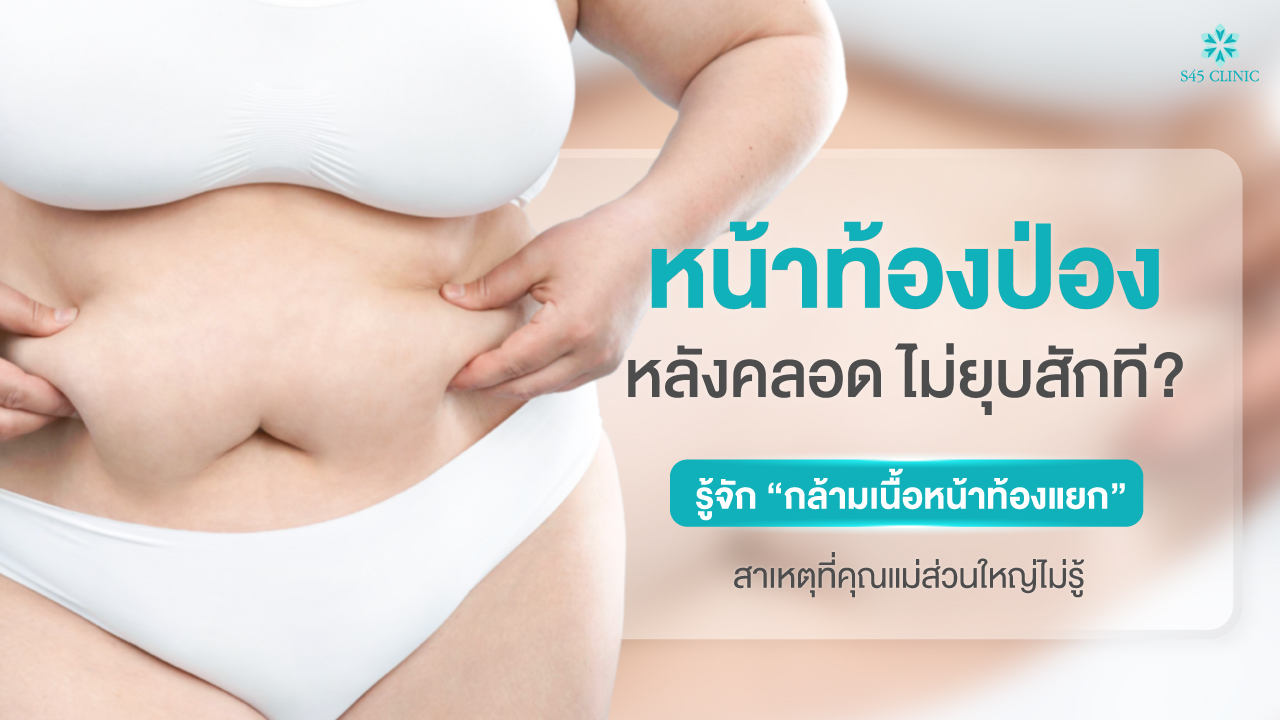
You have had your baby, so why has your tummy still not gone down? You exercise, watch what you eat and do everything you can to look after yourself, but your tummy still bulges, sticks out or looks like a ‘mummy tummy’, just as before.
In fact, this problem may not be caused by fat alone. It may be a sign of diastasis recti (separated abdominal muscles), an important reason why many people find their tummy does not go down however much they try to lose belly fat.
This article helps you check what is causing your tummy to bulge after giving birth, explains how to check yourself, and describes ways to treat a tummy after birth, from basic self-care to medical treatment options.
What Causes a Bulging Tummy After Birth?
A tummy that bulges after birth is a common problem for many mothers. Even after giving birth, the tummy may not go down or may look like a ‘mummy tummy‘. This is not caused by fat alone but by several factors together. There are 4 main causes.
1. The womb has not fully shrunk back
After birth, the womb takes about 6 to 8 weeks to return to its usual size. During this time your tummy may still look bulging and loose, which is normal in the early stage.
2. Diastasis recti
This is an important cause that many people overlook. When the abdominal muscles are stretched, a gap forms in the middle and the tummy bulges out. This is why many people try several methods but see no change, because “they are not treating the actual cause”.
3. Fat built up after birth
Especially while breastfeeding, the body needs more energy. If you eat more than you need, fat may build up around your tummy, making the bulge more noticeable.
4. Hormones and stress
Stress and a lack of rest raise the hormone cortisol, which makes the body store fat more easily and stops the metabolism from working as well as it could.
What Is Diastasis Recti?
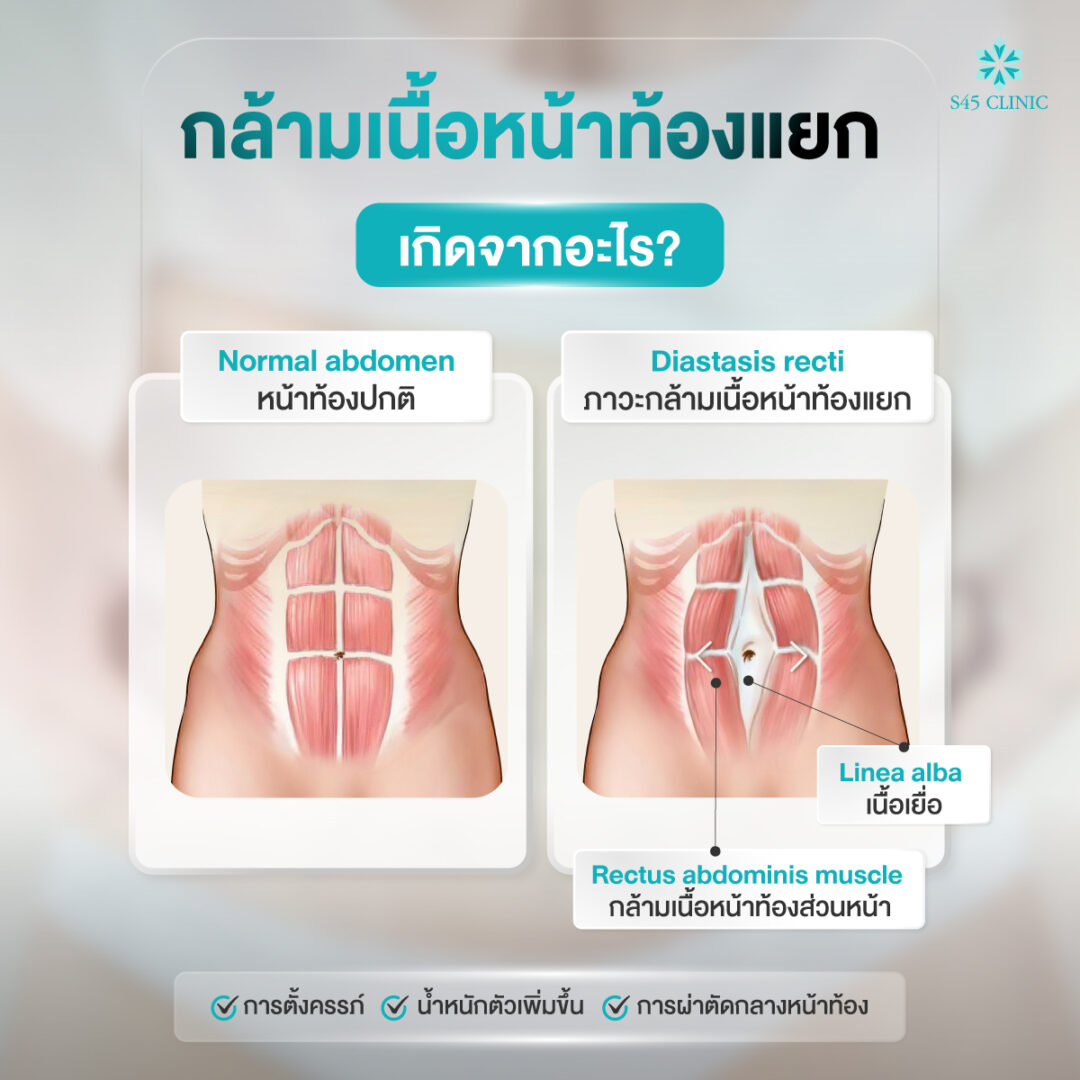
Diastasis recti is when the abdominal muscles (rectus abdominis) are stretched and pulled apart, caused by the pressure inside the abdomen during pregnancy.
Normally, the muscles are held together by tissue called the linea alba. But when it is stretched too much, a “gap” forms between the muscles, so the tummy bulges even if you do not have much fat.
This is why many people try ways to treat a tummy after birth without success, because the problem lies in “the muscle structure”.
In general, a gap wider than 2cm is considered diastasis recti, and a gap wider than 4cm to 5cm often needs medical treatment to be considered, such as a tummy tuck, to help bring the separated muscles back together.
Degrees of Diastasis Recti
- less than 2cm: mild (can recover)
- 2cm to 4cm: moderate (should get care from a healthcare professional)
- more than 4cm: severe (the surgeon may consider treatment such as surgery)
Common symptoms include:
- a bulging tummy that looks like a ‘mummy tummy’
- a tummy that is not firm
- back pain or weak core muscles
- a tummy that does not go down even with exercise
What Causes Diastasis Recti?
Many people look for ways to treat their tummy after birth but see no change. This may be because “the problem is not fat” but a muscle structure that has separated. The main causes are usually:
Pregnancy
- the tummy expands to make room for the baby, so the muscles are stretched
- several pregnancies increase the risk
- a large baby or a twin pregnancy
- being pregnant when you are older than 35
This makes the tummy less firm and causes “a bulging tummy after birth”. In some people, the muscles cannot come back together on their own.
Gaining and losing weight quickly (the yo-yo effect)
Other factors that upset the structure of the tummy include:
- gaining weight quickly, which raises the pressure inside the abdomen
- losing weight quickly, so the skin and muscles cannot shrink back in time
- weight that goes up and down often, so the tissue loses its elasticity
- fat that builds up and is lost in cycles, which makes the skin sag more easily
How to Check Yourself for Diastasis Recti in 1 Minute
If you think your tummy is bulging, or you have tried to lose belly fat without seeing any change, it may be caused by diastasis recti. You can do a basic check yourself at home:
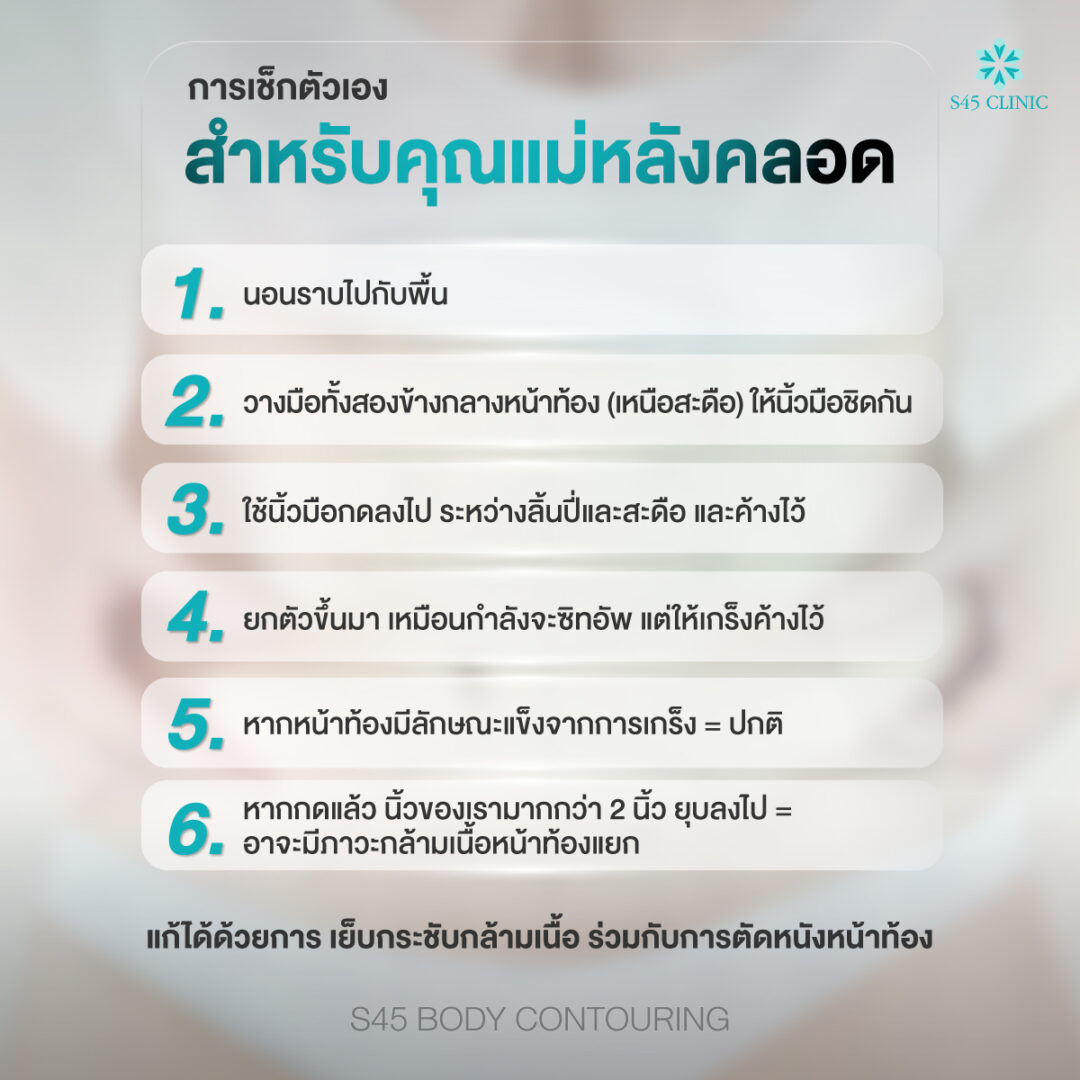
- Lie on your back on the floor, bend both knees and put your feet flat on the floor.
- Place your fingertips (about 2 fingers) in the middle of your tummy, just above your belly button.
- Slowly lift your head and shoulders a little (as if gently tightening your tummy).
- Feel the area of your tummy under your fingers.
How to read the result
- normal: your tummy feels firm and pushes your fingers back
- not normal: your fingers feel as if they “sink into a groove”, or there is a gap
If the gap is wider than 2 fingers, it may be a sign of diastasis recti.
Things to know
- this is only a basic check, not a diagnosis
- if your tummy bulges, is not firm or does not go down,
see a doctor to plan a suitable way to treat your tummy after birth and to assess which treatment you need, such as muscle rehabilitation or a tummy tuck.
Tummy Tuck With the Surgeons at S45 Clinic
A tummy tuck is not only about removing excess skin. It also needs “correcting the structure from the inside”, especially for a tummy that bulges after birth with diastasis recti.
At S45 Clinic, treatment is planned for each person, and the surgeon assesses every case in detail to plan a result that suits each person’s body.
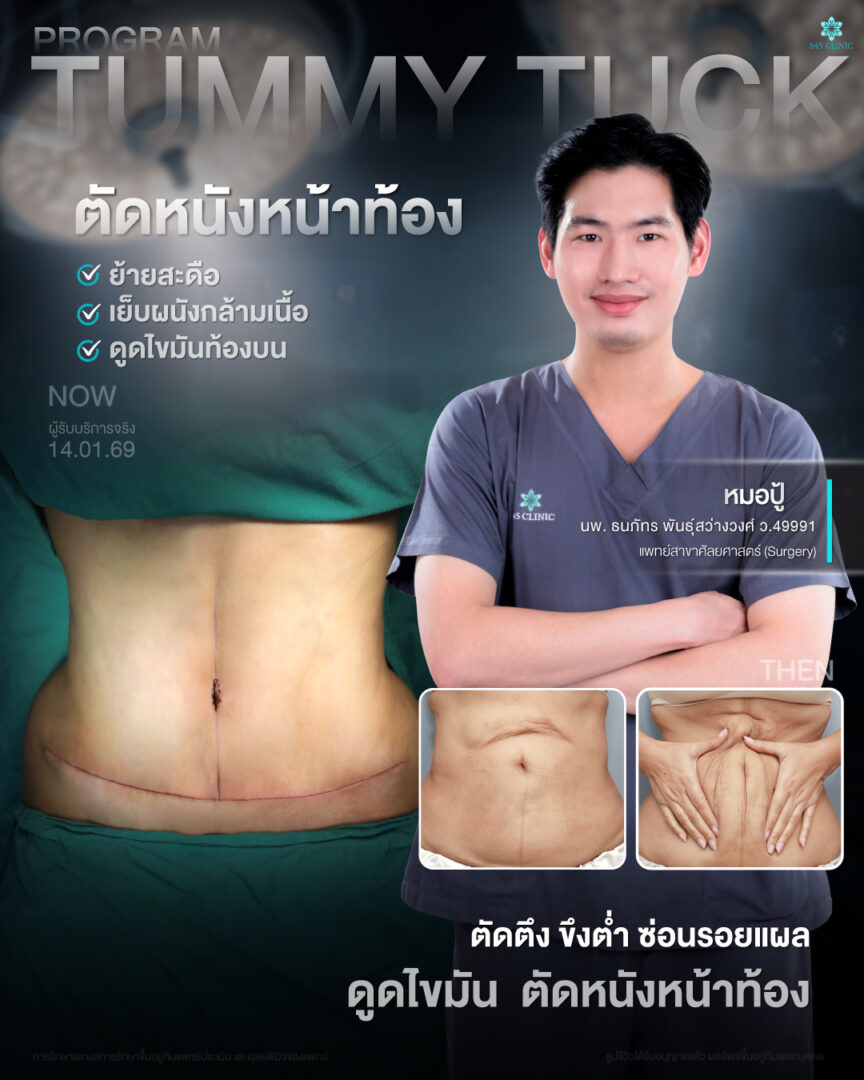
What S45 Clinic offers:
- a detailed assessment of the problem (muscle, fat and skin)
- muscle repair from the inside (rectus repair), which addresses the cause of the bulging tummy directly
- a technique that hides the incision, with fine stitching to keep the scar as discreet as possible and no stitches to remove
- a recovery of about 2 to 3 days for many people before going back to daily activities, depending on each person
- ongoing care, with follow-up for 1 year
A tummy that bulges after birth is not always about fat. In many cases it is linked to diastasis recti. The choice of treatment should depend on “the degree of the problem”:
- mild: exercise
- moderate: physiotherapy
- severe: surgery
If you are not sure which degree applies to you, have an assessment with a doctor to find out in detail whether the cause is built-up fat or diastasis recti, so you can plan a suitable way to treat your tummy after birth.