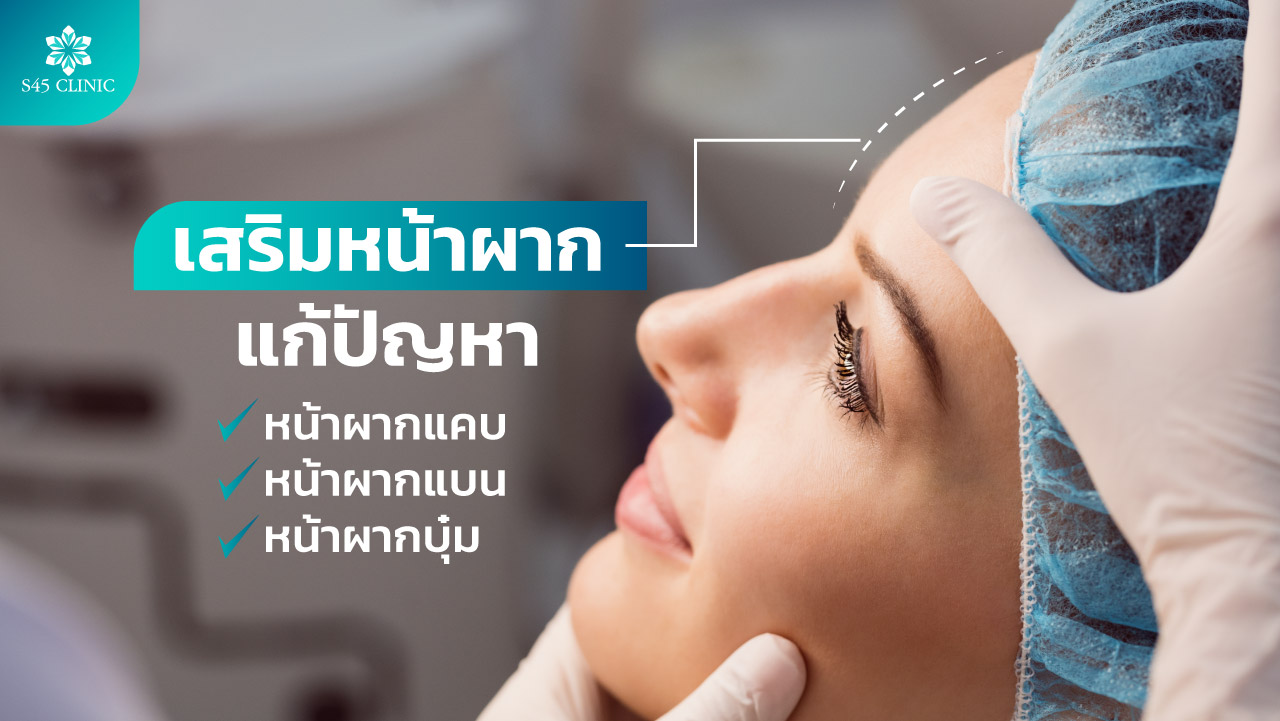
Flat Forehead and Wavy Forehead, How Can They Be Corrected?

A flat or wavy forehead may come from the shape of the skull, which can be inherited, and from other causes. If it does not affect your daily life or cause pain in the forehead area, it is not considered a health problem. However, a flat or wavy forehead can make some people feel less confident, make the face look flat, and in some people make the face look older than their real age.

A narrow forehead, deep creases or dents generally have no effect on your health or daily life. The only issue is that the face may lack the depth of the Golden Ratio, a standard of facial proportion used as a reference for beauty.
A flat, wavy or poorly rounded forehead comes from the facial bones sinking and from muscle and fat reducing with age, which can happen to anyone. This is why medical techniques can be used to reshape the forehead so that it looks firmer and curves to suit the face, to help you feel more confident. However, what looks attractive is different for each person.
- A sunken forehead from ageing, when the bone and fat sink and leave a hollow above the eyebrows, which can make the face look older than its age
- A flat forehead, when the skull is not well rounded, which may also come from the bone, skin, muscle and fat reducing with age
- Lines and deep creases on the forehead, caused by cells reducing with age

Forehead Shape and Personality in Traditional Beliefs
- Wide forehead: said to be intelligent, quick-thinking and good with people
- Narrow forehead: said to be independent and to enjoy time alone
- Straight forehead: said to be open-minded, reasonable and often successful in business
- Curved forehead: said to be positive, sincere and not good at lying
- M-shaped forehead: said to be creative, romantic and honest
- High forehead: said to be reasonable, good with people and self-confident
- Wavy forehead: said to be stubborn and to like having their own space

Correcting a Flat or Wavy Forehead With Silicone Forehead Augmentation
A flat forehead that does not curve to suit the face can be corrected with silicone forehead augmentation, using an implant custom-made to suit your face. The surgeon chooses the technique that suits you.
1. 4D CT FIT With 3D Images From a CT Scan

2. Casting Mold, a Plaster Cast of the Skull Used to Make the Silicone Implant

Differences Between Forehead Augmentation With Silicone and With Filler Injections
| Silicone forehead augmentation | Forehead augmentation with filler injections |
|---|---|
| Lasts a long time | Filler injections usually last about 1 year after injection (with a registered product) |
| Needs surgery with an incision in the scalp | Filled with hyaluronic acid and injected under the membrane that covers the bone |
| Low chance of the implant shifting, as the silicone sits under the membrane that covers the bone so the forehead shape is less affected by weight gain or loss | Results can be seen from 7 to 14 days after the procedure |
| Can reduce fine lines | No incision or surgery needed, and usually no recovery period After the injection, the forehead is swollen for 7 to 14 days |
| You can choose how full the forehead is | Looks softer than silicone augmentation |
| Correcting it later needs surgery to replace the silicone implant | Can be dissolved with an injection if you want it corrected |
| Choose an experienced doctor | Avoid sleeping on your front or side for 1 to 2 weeks after the procedure |
Forehead augmentation at S45 Clinic, with a consultation with the surgeon and the option to send photos first

How to Prepare for Forehead Augmentation
- Tell the surgeon about any health conditions, drug allergies and supplements, including any medicines, herbal remedies and vitamins you take regularly. If you have a condition such as high blood pressure or diabetes, it must be well controlled before surgery.
- If you have a blood disorder, heart disease, lung disease, cancer or an endocrine disorder, you must have a consultation with the surgeon before the procedure.
- Tell the surgeon if you smoke, drink alcohol or use herbal remedies.
- Give the surgeon full details of any previous surgery, including implants and any liquid injections, to help with diagnosis and further treatment.
- Tell the surgeon the date of your last period.
- Tell the surgeon if any blood relative has had problems with a general anaesthetic.
- If you have ever had an allergic reaction to a local or general anaesthetic, tell the surgeon.
- Do not eat or drink for at least 6 to 8 hours before surgery.
- Stop medicines and supplements that affect the blood, such as vitamin C, vitamin E, aspirin, fish oil and ginkgo products, because they affect blood clotting and can cause more bleeding during surgery. Stop them at least 2 weeks before surgery.
- Avoid alcohol for at least 48 hours before surgery, and avoid drinks that contain caffeine.
- On the day of surgery, wear loose, comfortable clothes that are easy to take off, such as a top with buttons at the front, and have a shower. Do not wear make-up, contact lenses, nail polish or false nails.
- Stop skin products that speed up skin cell turnover, such as tretinoin (Retin-A), retinols, retinoids, glycolic acid and all anti-ageing creams or topical products, for about 3 days before surgery.
- Avoid skin treatments, scrubs, exfoliation, shaving and hair removal for about 3 days before your procedure.
- Talk clearly with the surgeon about the result you want, the surgical technique, example forehead shapes and the size you would like, so the plan matches what you want.
- If you have not been able to follow these steps, tell the surgeon before your surgery.

A flat or wavy forehead can make the face look stern and hard rather than soft. Forehead augmentation with a silicone implant in a size that suits your face can help, with an assessment and a discussion of what you want before surgery, guided by experienced surgeons at S45 Clinic, who pay attention to every detail