Ski Slope Nose, 5 Main Types, Who They Suit, Techniques and Prices For 2026
If you are considering rhinoplasty in 2026, the ski slope nose is a shape requested by both women and men, because it gives a look with dimension that blends with the face and can suit Asian facial structure, rather than a straight classic bridge or a sharp, high bridge.
Key points
- Ski slope nose: a nose shape with a bridge that slopes gently down from the radix and a tip that projects slightly upwards in a small triangle. It is a frequently requested shape that blends with the face and suits Asian facial features.
- 5 main sub-types: soft (gentle lines), teardrop (rounded tip), upturned (clearly lifted tip), Barbie (sharp pointed tip) and slim (thin, narrow bridge)
- Suits: round faces in particular (the projected tip helps the face look longer), oval faces, and long faces that need more dimension
- Men can have it: a sharper projected tip with more angular lines is chosen, rather than the soft curves often chosen by women
- Possible with thin nasal tissue: your own cartilage supports the tip to create the projection with less strain on the skin
- Techniques: open rhinoplasty suits a ski slope nose that needs precise shaping, and closed rhinoplasty suits more straightforward cases
- Price: depends on the technique and materials, in a range of THB 30,000 to over THB 200,000
However, the term ‘ski slope nose’ covers several sub-types with different looks and suitability. If you want this shape but do not say which sub-type, the result may not match what you expect. This article covers everything from the definition of the 5 sub-types and how they differ, to choosing by face shape, whether men can have it, how the slim and defined styles differ, cases with thin nasal tissue, the techniques used, prices and traditional beliefs about nose shape, to help you make an informed decision.
In This Article
What Is a Ski Slope Nose, and Its Key Features
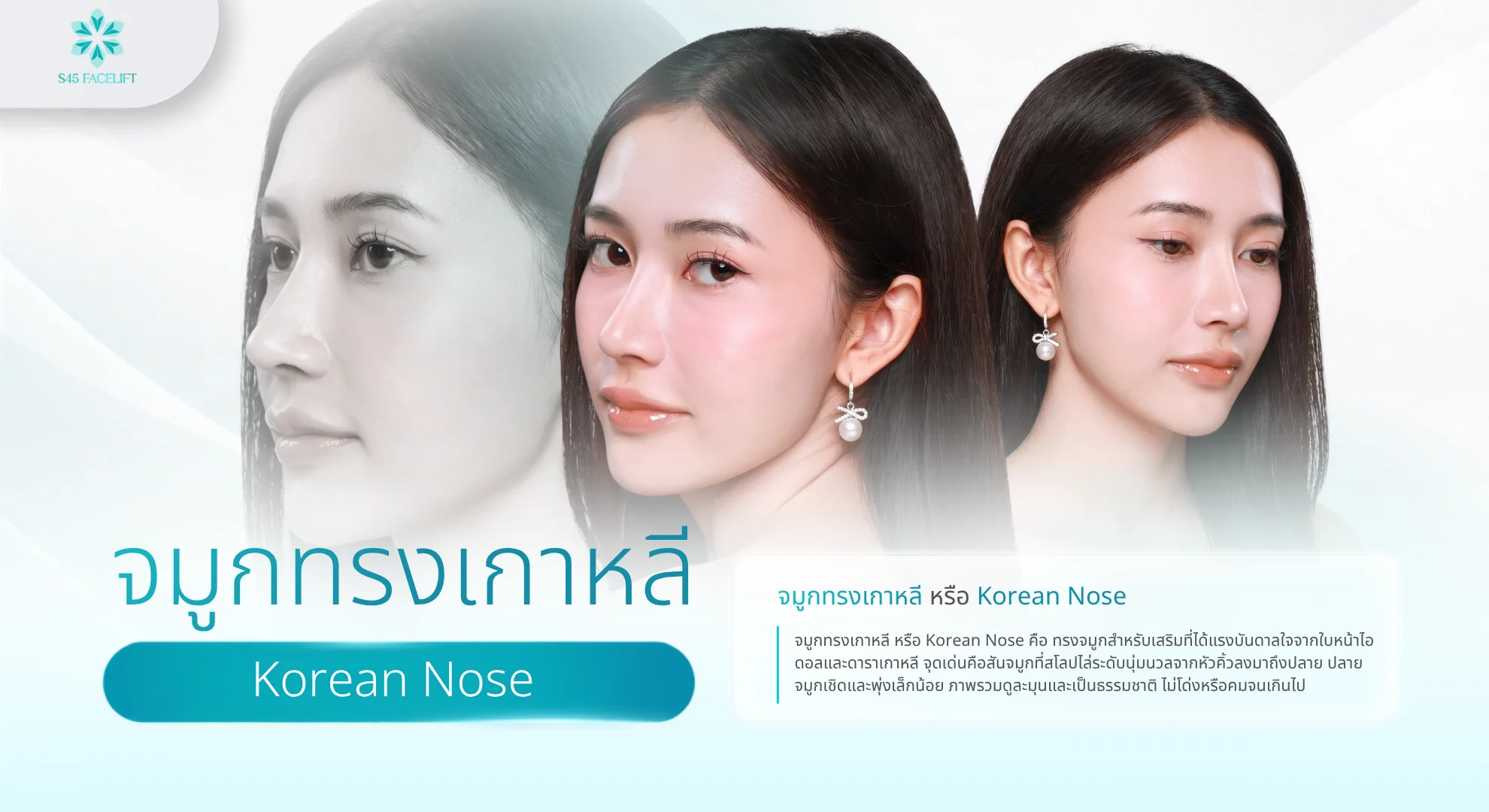
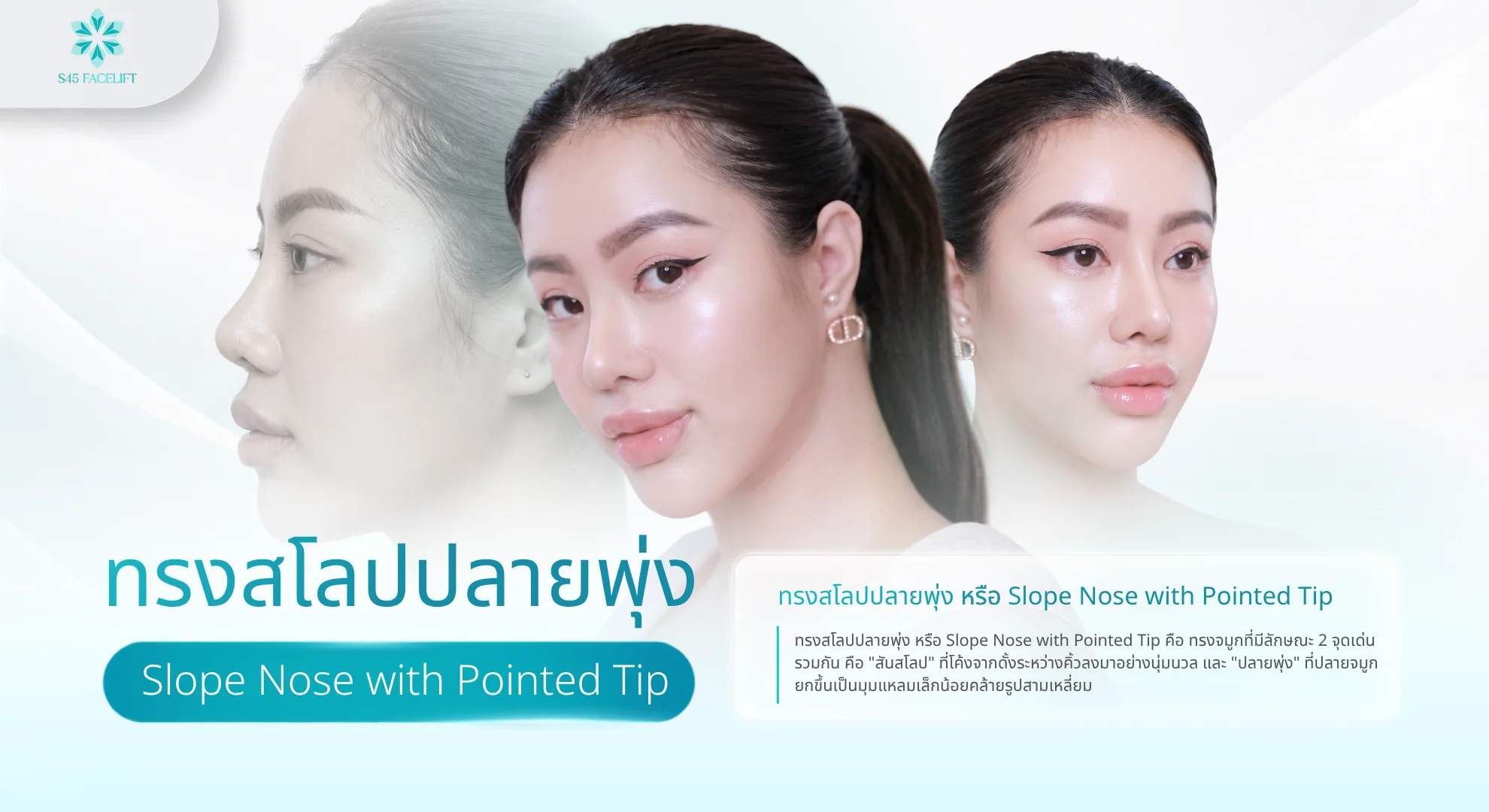
A ski slope nose, or slope nose with a pointed tip, combines 2 key features: a “sloping bridge” that curves gently down from the radix between the eyebrows, and a “projected tip” that lifts slightly into a pointed angle, like a small triangle.
This shape is often requested by people in Asia because it blends with the face, suits Thai and other Asian facial structures well, and is not tied to short-term trends. In 2026, it is still a shape that many people ask surgeons for.
These key features set the ski slope nose apart from a straight classic bridge or a sharp bridge with angular lines.
Key Features of the Ski Slope Nose
- Sloping bridge: not straight like a classic bridge, but curving gently from the radix to the tip
- Prominent projected tip: the tip lifts into a small triangle and looks sharp
- Understated: blends in with the rest of the face
- Suits Asian facial structure: works with your existing facial proportions rather than against them
- A soft or sharp look: can be adjusted to what you want
Why the Ski Slope Nose Is Often Requested
- Works with many face shapes: round, oval and long faces
- A classic shape: still requested in 2026 and not tied to short-term trends
- A result in proportion with the face: the aim is a shape that blends in and does not draw attention
- Silicone or cartilage can be used: depending on your budget
- Suits people of Asian descent: works with the nasal structure common in Thai, Chinese, Korean and Japanese people
Who Created This Shape
No single person ‘invented’ the ski slope nose. It developed from the observation that a straight, classic bridge often seen in Western faces did not always suit Asian facial structure. Surgeons in Korea and Japan began adapting their techniques to create a curved bridge with a slightly projected tip. The result was a shape that blended more closely with the face, and it later became widely requested in Thailand.
Read more about comparing different nose shapes in which nose shapes create a softer look
Where the Nasal Bridge Is and How It Relates to the Slope
Before understanding how a ski slope nose works, it helps to know where the “nasal bridge” is, because this is the area shaped into the slope. The nasal bridge is the raised midline of the nose running from the radix between the eyebrows down to the tip. It determines the shape and height of the nose.
In ski slope rhinoplasty, the surgeon places a silicone implant or cartilage along the bridge, designing it to slope down from the top with a slightly upturned tip. It combines several techniques.
Understanding the parts of the nose helps you explain what you want to the surgeon more precisely at your consultation.
Parts of the Nose
- Radix: the starting point of the nose between the eyebrows
- Bridge (dorsum): the midline of the nose from the radix to just above the tip
- Tip: the lowest part, just above the nostrils
- Alae: the sides of the nose around the nostrils
- Columella: the central strip between the nostrils
The Role of the Bridge in a Ski Slope Nose
- Sets the height and straightness of the nose
- Provides the base that makes the projected tip look balanced
- The ‘slope’ of the bridge is the defining feature of this shape
- The height of the bridge affects whether the shape looks soft or sharp
A Bridge That Suits a Ski Slope Nose
When designing the shape, the surgeon aims for a bridge with:
- Suitable height: not so high that it looks forced
- A gentle slope: not a straight line
- A gradual descent to the tip: so the projected tip looks balanced
- Suitable thinness: not too wide, so the nose looks slim
5 Sub-Types of the Ski Slope Nose
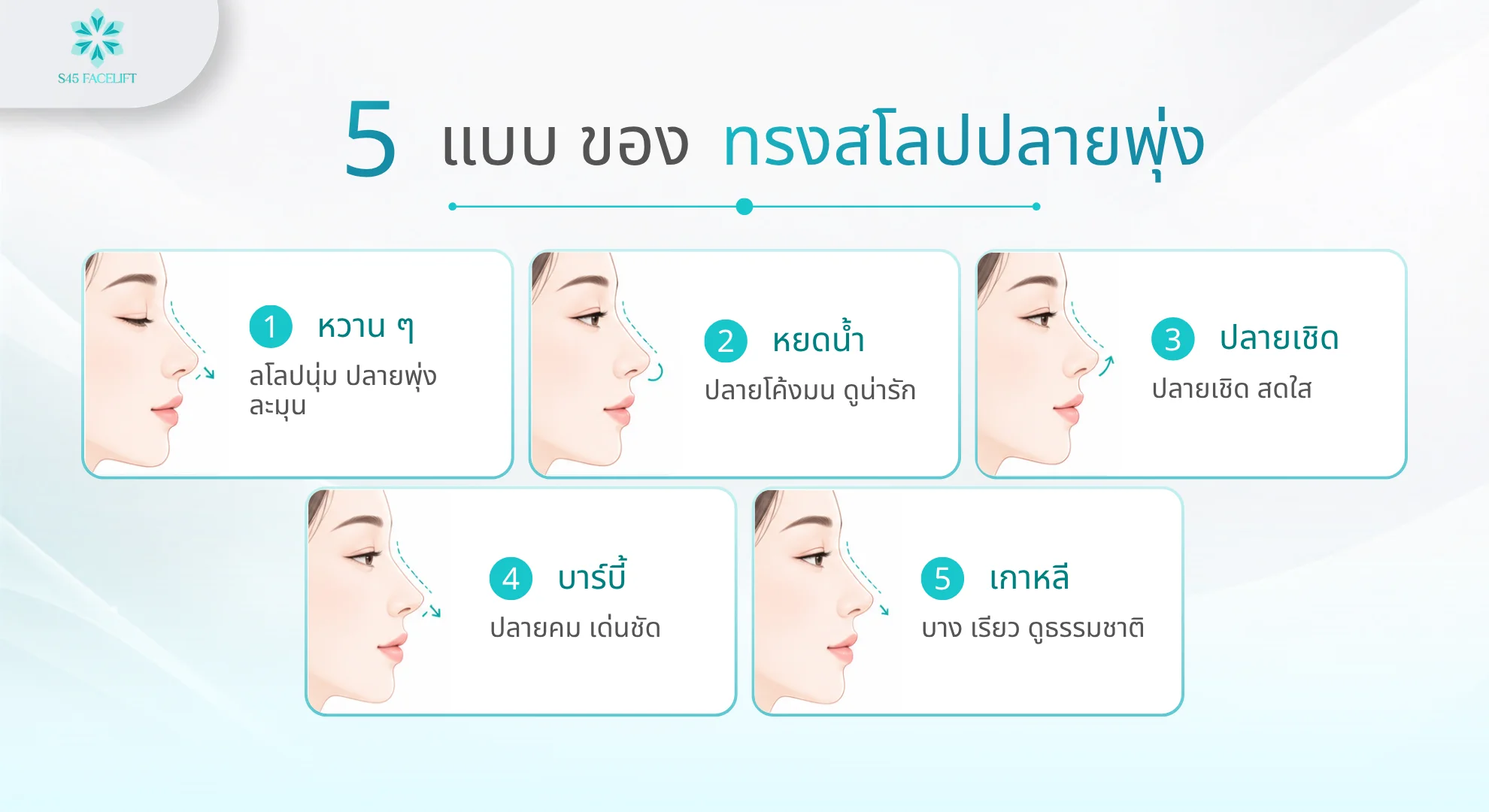
The ski slope nose has several sub-types with different looks and suitability. Knowing the 5 main sub-types helps you choose precisely the look you want, rather than just telling the surgeon “I want a ski slope nose”, which may lead to a result that does not match what you expect.
Each sub-type has its own features and suitability. Choose based on the look you want and your facial structure.
1. Soft Ski Slope Nose
- Shape: a gently curved bridge with a projected tip that is not very pointed
- Focus: soft lines with no angular corners
- Look: sweet and understated
- Suits: women who want a sweet look, with round or oval faces
- Highlight: suits a soft, understated look
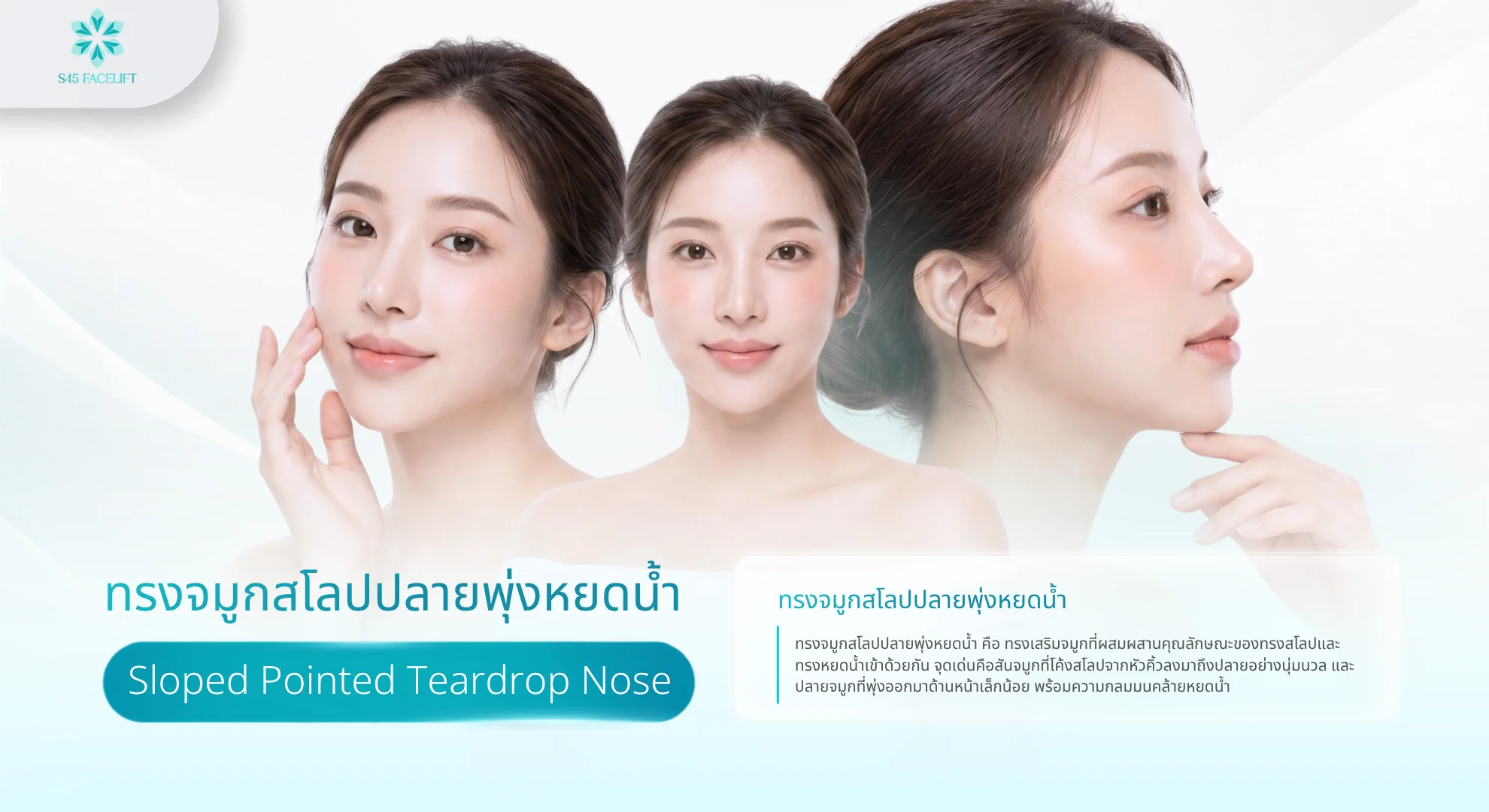
2. Teardrop Ski Slope Nose
- Shape: a sloping bridge with a rounded, teardrop-shaped tip
- Focus: the rounded curve of the tip
- Look: cute and fresh
- Suits: women who like a cute look without an overly pointed tip
- Highlight: a sweet look similar to other rounded tip shapes, but softer
3. Upturned Ski Slope Nose
- Shape: a sloping bridge with a clearly upturned tip
- Focus: a tip lifted to an angle of 90 to 100 degrees
- Look: fresh and youthful
- Suits: people with stern-looking faces who want a more youthful look, or people with long faces who want a cuter look
- Highlight: a cute, fresh look, but take care that the tip is not lifted so much that it looks forced
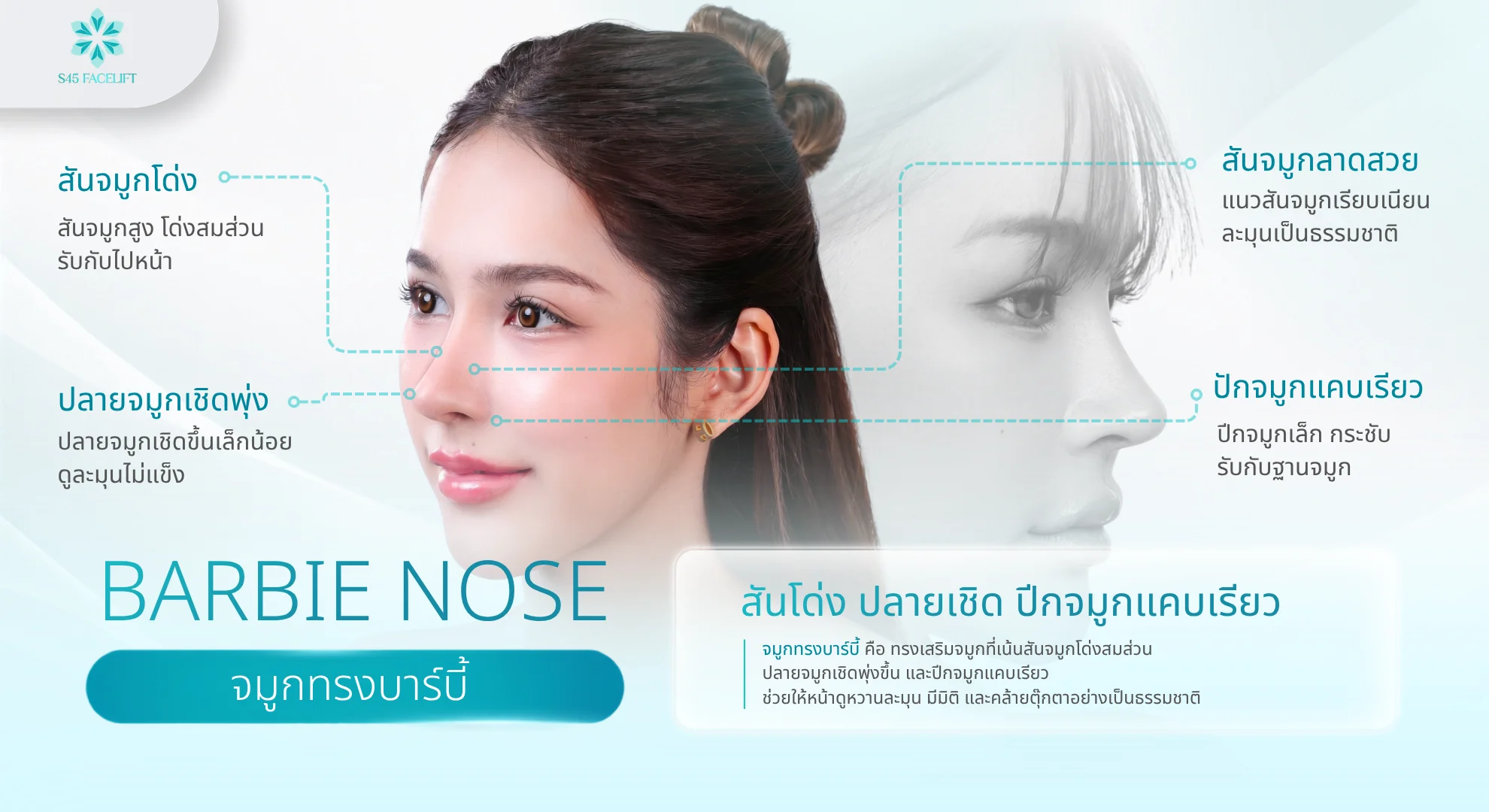
4. ‘Barbie’ Ski Slope Nose
- Shape: a sloping bridge with a sharp, pointed triangular tip
- Focus: a sharp tip, like a Barbie doll
- Look: sharp, bold and striking
- Suits: people who want a sharp look as their key feature, or oval faces that suit a sharp look
- Highlight: the most clearly pointed tip in this group
5. Slim Ski Slope Nose
- Shape: a thin, slender bridge with a narrow projected tip
- Focus: thinness and balance
- Look: refined and modern
- Suits: people who like a refined, slim look
- Highlight: mainly uses cartilage, for a shape that blends in closely with the face
Comparison Table of the 5 Sub-Types
| Sub-type | Look | Suits | Common technique |
| Soft | Gentle and sweet | Round or oval faces, women | Silicone implant with cartilage |
| Teardrop | Cute and fresh | People who like a cute look | Silicone implant with cartilage |
| Upturned | Youthful | Stern-looking or long faces | Silicone implant with cartilage |
| Barbie | Sharp and bold | Oval faces that like a sharp look | Open with cartilage |
| Slim | Refined | Any face shape, for people who like the slim look | Open with cartilage |
Read more about similar teardrop shapes in teardrop nose shapes for a more detailed comparison.
Ski Slope vs Upturned Tip vs Teardrop Tip

3 similar nose shapes that many people confuse are the ski slope nose, the upturned ski slope nose and the teardrop ski slope nose. Although all 3 include a ‘slope’, the tips are clearly different.
Knowing the differences helps you explain what you want to the surgeon precisely, because each shape uses different techniques and gives a different look.
The features of each shape are clearest when seen from the side (profile view).
Ski Slope Nose
- Tip direction: the tip points slightly forwards, like an arrow
- Tip angle: 95 to 105 degrees from the upper lip line
- Sharpness: moderate, not too pointed
- Look: understated, a classic shape
- Suits: almost any face, a versatile shape
Upturned Ski Slope Nose
- Tip direction: the tip turns upwards
- Tip angle: 100 to 110 degrees from the upper lip line
- Sharpness: soft
- Look: fresh, youthful and cute
- Suits: stern-looking or long faces that need a cuter look
Teardrop Ski Slope Nose
- Tip direction: the tip is rounded, like a small circle
- Tip angle: 90 to 100 degrees from the upper lip line
- Sharpness: not sharp, rounded
- Look: sweet and cute, with a soft, rounded tip
- Suits: women who like a sweet look
A Simple Way to Picture Them
- Projected tip: like an arrow
- Upturned tip: like a beak
- Teardrop tip: like a falling drop of water
Tips for Choosing
- If you want an understated look from every angle: choose the ski slope nose
- If you want a fresh, cute look: choose the upturned ski slope nose
- If you want a very sweet, cute look: choose the teardrop ski slope nose
Who a Ski Slope Nose Suits and Which Face Shapes
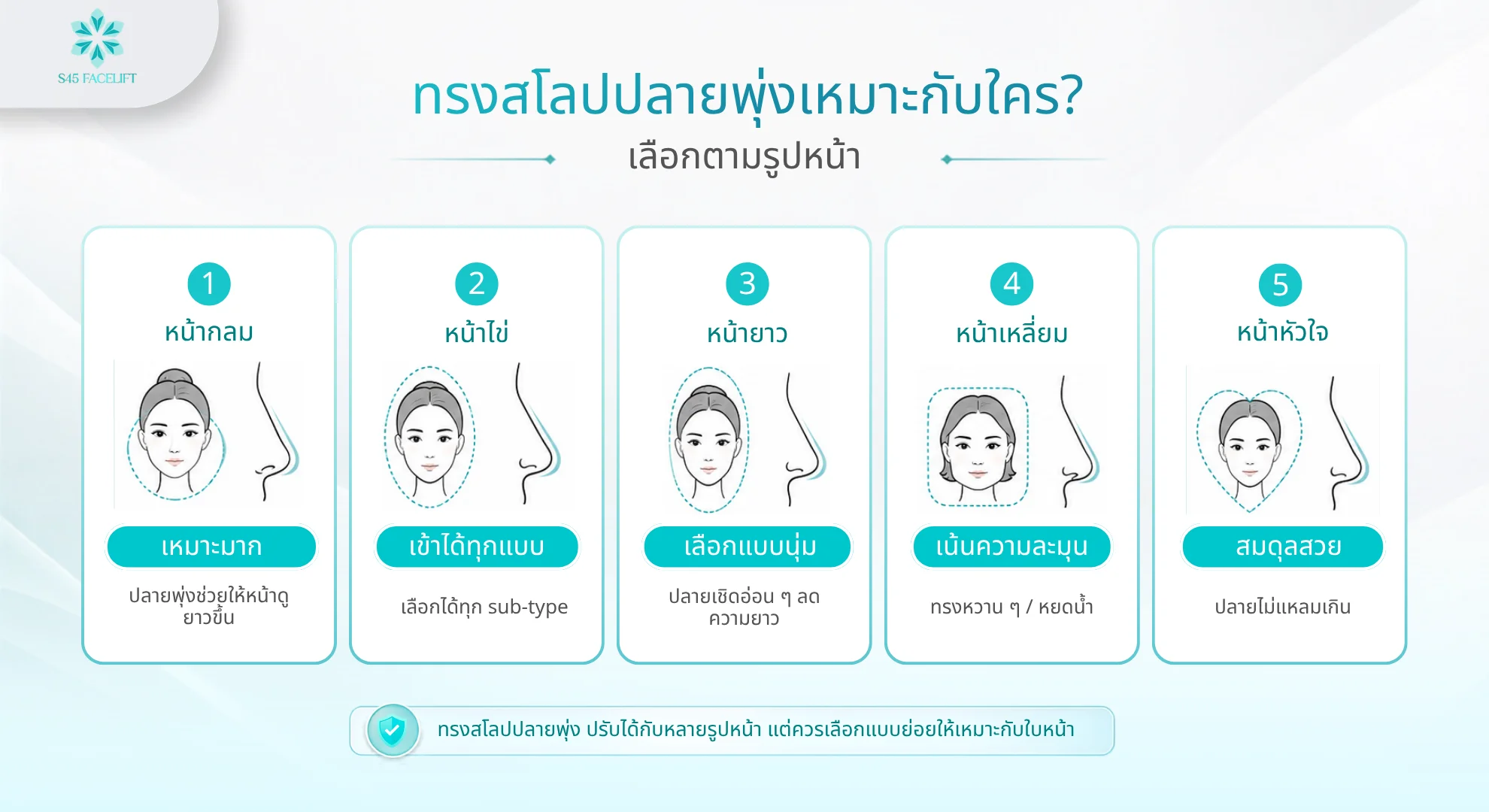
“Who does a ski slope nose suit?” is a question people often search for, because many want to be sure this shape suits their facial structure before deciding. The answer is that a ski slope nose suits almost every face shape. It is a versatile shape that can be adjusted to your facial structure.
However, choosing the right sub-type affects how attractive and balanced the result looks, and each face shape has sub-types that suit it particularly well. A consultation with an experienced surgeon helps assess your face and design a shape that suits it.
See which sub-type suits your face shape.
Round Face
- Concern: the face looks short and the cheeks stand out
- Suitable shapes: ski slope nose, upturned tip or Barbie pointed tip
- Effect: the projected tip helps the face look longer, which can reduce the roundness of the face
- Highlight: round faces are a particularly good match
Oval Face
- Strength: already balanced
- Suitable shapes: any sub-type
- Effect: adds dimension to the face
- Advice: choose the look you like, without worrying about balance
Long Face
- Concern: the face is already long
- Suitable shapes: upturned ski slope nose (reduces the look of length) or soft ski slope nose
- Effect: adds balance and reduces the look of length
- Advice: avoid a long tip that makes the face look longer
Square Face
- Concern: a square jaw that makes the face look hard
- Suitable shapes: soft ski slope nose or teardrop
- Effect: makes the face look softer and more balanced
- Advice: avoid a pointed tip that emphasises the angles
Heart-Shaped Face
- Features: a wide forehead and a pointed chin
- Suitable shapes: a standard ski slope nose
- Effect: emphasises balance in the middle of the face
- Advice: keep the tip from being too pointed, so it does not echo the pointed chin and look obviously altered
Ski Slope Nose for Round Faces, a Particularly Good Match
Of all face shapes, “round faces” are a particularly good match for a ski slope nose, because the projected tip helps the face look longer and reduces the roundness that is the main concern. People with round faces who choose this shape often see a clear change in the overall look of their face, although results depend on each person.
However, people with round faces still need to choose a sub-type that suits their particular features. Someone with a round face and a defined jaw may suit a different sub-type from someone with a round face and a soft jaw.
Understanding why round faces suit this shape, and how to choose the right sub-type, helps you make an informed decision.
Why Round Faces Suit a Ski Slope Nose
- The projected tip draws the eye upwards: the face looks longer
- Less focus on round cheeks: attention moves to the nose instead
- More dimension in the middle of the face: round faces often lack dimension
- A more balanced look: a round face benefits from a focal point in the middle
Sub-Types That Suit Round Faces
1. Upturned ski slope nose
- Highlight: the upturned tip clearly helps the face look longer
- Suits: very round faces
2. Barbie pointed tip
- Highlight: a sharp, prominent tip that draws the eye upwards
- Suits: round faces with a soft jaw that suit a sharp look
3. Soft ski slope nose
- Highlight: understated, does not look overdone
- Suits: slightly round faces
Tips for Round Faces
- Raise the bridge moderately: too high can look forced
- A prominent tip matters: it is the key point that lengthens the face
- Alar base reduction at the same time: if the alae flare, this can make the overall shape look slimmer
- Chin surgery may be combined: for very round faces, a longer chin can add balance
Ski Slope Nose for Men
Searches for “ski slope nose for men” show that many men are interested in rhinoplasty for this shape. The answer is yes, it can be done, but the sub-type and technique need to be adjusted to suit men specifically.
Men and women have different facial structures and want different looks. A shape that suits a woman may look forced on a man. A surgeon experienced in male rhinoplasty adjusts the shape to suit each person’s sex.
A ski slope nose for men differs in 4 to 5 ways.
Differences Between Men’s and Women’s Shapes
| Feature | Women | Men |
| Bridge height | Suitable height | Moderate height, not too high |
| Bridge width | Thin and slender | Wider and sharper |
| Curve | Gently curved | Less curved, straighter |
| Tip | Projected, soft or teardrop | Sharply projected, not soft |
| Tip angle | 95-105° | 90-95° |
Sub-Types That Suit Men
- Sharp ski slope nose: the tip points forwards and looks sharp and angular
- Straighter ski slope nose: a less curved bridge with a projected tip, for a masculine look
- Barbie sharp tip (adjusted to be sharper): for people who really want a sharp look
Sub-Types Men Should Avoid
- Soft ski slope nose: too sweet for men
- Upturned ski slope nose: can look too cute
- Teardrop ski slope nose: too rounded for men
Techniques Commonly Used for Men
- Open rhinoplasty with cartilage: high precision, and helps the tip keep its shape over the long term
- Flatter silicone implants than for women: because men often have thicker nasal skin
- Alar base reduction at the same time: if the alae flare, for a sharper shape
Slim Style vs Defined Style Ski Slope Nose
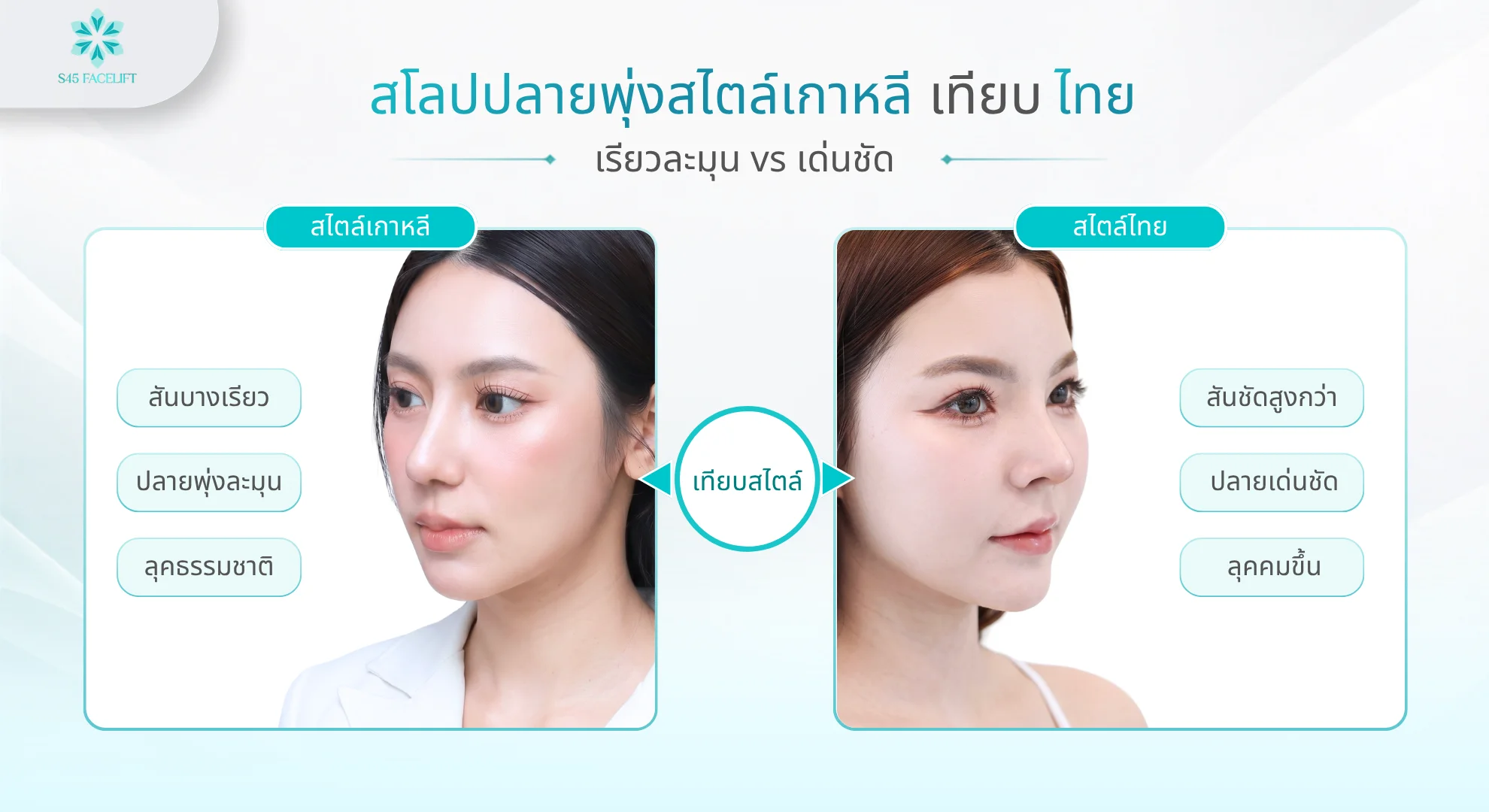
Searches for a “slim ski slope nose” reflect inspiration from entertainment trends. In reality, the slim and defined styles of ski slope nose have small differences that affect the overall look.
The slim style focuses on a thin, slender bridge and balance, while the defined style focuses on a prominent tip and a higher bridge. The choice depends on the look you want and your facial structure.
When talking to the surgeon, saying whether you want the “slim style” or the “defined style” helps them design a shape close to what you have in mind.
Slim Style
- Bridge: thin, slender and not very high
- Bridge height: 10% to 15% lower than the defined style
- Tip: a thin projection, not sharply pointed
- Overall look: refined and very understated
- Commonly used technique: open rhinoplasty with cartilage
- Suits: people who like a sweet, understated look
Defined Style
- Bridge: high and prominent, sharp or soft
- Bridge height: higher than the slim style
- Tip: clearly projected, pointed or rounded
- Overall look: striking, with a clearly prominent nose
- Commonly used technique: silicone implant with cartilage
- Suits: people who like a clearly prominent nose
Comparison Table
| Feature | Slim style | Defined style |
| Bridge height | Lower, smooth | High, prominent |
| Bridge thinness | Thin, slender | Wider |
| Tip | Thin projection | Prominent projection |
| Look | Sweet, understated | Striking |
| Technique | Open with cartilage | Silicone implant with cartilage |
| Suits | People who prefer an understated look | People who like a prominent nose |
Why the Slim Style Is Often Requested in Thailand
Between 2019 and 2026, entertainment trends in Asia led many people in Thailand to ask for a similar look, so the slim, understated style became widely requested. However, adapting the shape to Thai facial structure is important, because faces are not 100% alike.
Can You Have a Ski Slope Nose With Thin Nasal Tissue?
A major concern for many people is a “ski slope nose with thin nasal tissue“, and whether people with little nasal tissue can have this shape. The answer is yes, but the technique and materials need to be chosen carefully, rather than using a silicone implant alone as for people with thicker tissue.
The concern with thin nasal tissue is thin skin, which raises the chance of the implant showing through the skin and of tip extrusion over the long term. In these cases, using your own cartilage to support the tip is an option that suits the case.
Understanding the limitations and options helps you make an informed decision.
Signs of Thin Nasal Tissue
- Thin skin on the nose, with visible blood vessels
- A pointed nasal tip
- Narrow alae
- Small nostrils
- The bone is easy to feel when you touch the nose
Risks of an Unsuitable Augmentation
- A silicone implant that is too large: the skin may not be able to hold it, with a chance of the implant showing through
- No cartilage supporting the tip: a higher chance of tip extrusion over the long term
- The wrong shape: such as a Barbie pointed tip that strains the tissue
- A bridge raised too high: strains the existing nasal tissue
Techniques That Suit Thin Nasal Tissue
1. Open rhinoplasty with ear cartilage
- Ear cartilage is used to support the tip and shape the nose
- Lowers the chance of implant extrusion
- Blends in with the surrounding tissue
2. Open rib rhinoplasty (rib cartilage)
- Rib cartilage is used to rebuild the structure
- Very stable support
- Suits cases with very thin tissue
3. Silicone implant with cartilage tip support
- A small implant reduces the load of the silicone
- Cartilage helps lower the chance of extrusion
- Lower cost
Sub-Types That Suit Thin Nasal Tissue
- Soft ski slope nose: a gentle look that does not strain the tissue
- Slim ski slope nose: mainly uses cartilage
- Avoid: a Barbie pointed tip or a strongly upturned tip, which strain the tissue
Read about techniques for thin nasal tissue in thin nasal tissue and a projected tip, which covers assessment and treatment.
Open vs Closed Rhinoplasty, How They Differ
“How do open and closed rhinoplasty differ?” is a question people often search for, because these are the 2 main rhinoplasty techniques. Each has different advantages and limitations and suits different cases.
In ski slope rhinoplasty, the choice of technique affects how precise the shape is, the recovery and the complexity. An experienced surgeon assesses your case and recommends the right technique.
The differences between these 2 techniques matter for your decision.
Closed Rhinoplasty (Closed Technique)
- Incision: inside the nostrils only, with no external incision
- Surgeon’s view: limited, the structure cannot be fully seen
- Operating time: shorter, 1 to 1.5 hours
- Recovery: shorter, 7 to 10 days
- Precision: good in less complex cases
- Suits: simple bridge augmentation that does not need much tip work
Open Rhinoplasty (Open Technique)
- Incision: inside the nostrils plus a small incision at the base of the columella
- Surgeon’s view: the whole structure can be seen and adjusted in detail
- Operating time: longer, 1.5 to 3 hours
- Recovery: 10 to 14 days
- Precision: high, suits complex cases
- Suits: tip reshaping, cartilage grafts and complex cases
Which Technique Suits a Ski Slope Nose
It depends on the sub-type and the structure of your nose:
- Soft ski slope nose with enough tissue: closed rhinoplasty
- Slim ski slope nose: open rhinoplasty (using cartilage)
- Barbie pointed tip: open rhinoplasty (needs precision)
- Thin nasal tissue: open rhinoplasty (using cartilage for support)
- Revision cases: open rhinoplasty (the whole structure needs to be seen)
Tips for Choosing
- Have a consultation with an experienced surgeon: for an assessment based on your actual structure
- Look at real case reviews: for each technique
- Consider your budget: open rhinoplasty usually costs slightly more
- Think about recovery: if you can take only a little time off work, closed rhinoplasty may suit you better
Ski Slope Rhinoplasty Prices
“How much does a ski slope nose cost?” is an important factor in your decision. The price depends on the technique, materials, the complexity of the case and the clinic. In the Thai market in 2026, prices fall into 3 to 4 tiers.
A price that is much lower than usual may reflect differences in the materials or in the surgeon’s experience, while a price in the upper range may not always be needed if your case is not complex. Understanding price ranges helps you plan your budget and make an informed decision.
Ski slope rhinoplasty prices in the Thai market:
Budget Range, THB 30,000 to THB 60,000
- Technique: closed rhinoplasty
- Material: ready-made silicone implant
- Suits: standard cases with enough nasal tissue
- Caution: below THB 30,000, check the quality of the materials carefully
Mid Range, THB 60,000 to THB 120,000
- Technique: closed or open rhinoplasty
- Material: high-quality silicone implant with ear cartilage
- Suits: moderate cases with thin to average tissue
- Highlight: a commonly chosen price range
Upper Range, THB 120,000 to THB 200,000
- Technique: open rhinoplasty with your own cartilage
- Material: higher-grade silicone implant with septal or rib cartilage
- Suits: complex cases and very thin tissue
- Highlight: designed for a very stable result
Highest Range, Over THB 200,000
- Technique: open rib rhinoplasty
- Material: rib cartilage only
- Suits: revision cases and very complex cases
- Highlight: very stable support, suits difficult cases
Factors That Affect the Price
- Technique chosen: open rhinoplasty costs more than closed
- Materials used: cartilage costs more than silicone
- Complexity of the case: revision costs more than a first operation
- The surgeon’s skill and experience: an important factor
- Clinic standards: the operating room and the anaesthesia team
Tips for Comparing Prices
- Do not choose on price alone: check the quality
- Check what is included: whether the implant, the surgeon’s fee and room charges are included
- Check the aftercare: some clinics include 6 months of follow-up appointments
- Read detailed reviews: of real cases
Traditional Beliefs About the Ski Slope Nose
Apart from appearance, many people are also interested in cultural beliefs that link nose shape with personality. Under these traditional beliefs, the ski slope nose matches features seen as favourable in several ways.
The balance and softness of this shape match features that traditional beliefs regard as a favourable nose, so the ski slope nose is a shape that is both attractive and in line with these beliefs.
When designing the shape, considering these beliefs as well as appearance can help the result meet both of your priorities.
Features of the Ski Slope Nose Seen as Favourable in Traditional Belief
- Sloping bridge: believed to reflect gentleness and humility
- Prominent projected tip: a feature these beliefs see as favourable
- Balance: believed to reflect a stable life
- A bridge of suitable height: traditionally believed to reflect position and status
- Narrow, slim alae: a feature these beliefs see as favourable
Nose Features Seen as Unfavourable in Traditional Belief
In this belief, some nose features are seen as ‘unfavourable’. These are the shape changes a ski slope nose can make to them:
- A low or flat bridge → raising the bridge to a suitable height
- A drooping or overly pointed tip → reshaping it into a balanced projected tip
- Flared alae → alar base reduction to narrow them
- A crooked or tilted nose → augmentation to straighten it
Where These Beliefs and Facial Proportion Overlap
These beliefs and general standards of attractiveness share some common ground, namely ‘balance’ and ‘harmony’ of the face. Features seen as ‘favourable’ in these beliefs often match features considered attractive in terms of facial proportion. Rhinoplasty for appearance therefore often also matches features that these beliefs see as favourable.
Points to Consider
If these beliefs matter to you, you can tell the surgeon at your consultation that you would like the design to take them into account. An experienced surgeon can adjust the shape to balance appearance and these beliefs. However, the shape should be chosen mainly on facial proportion, with belief as a secondary factor.
Read more about rhinoplasty (nose surgery) to understand the overall process and options, or see Cleveland Clinic – Nonsurgical Rhinoplasty for comparative medical information.
Why Choose S45 Clinic for Rhinoplasty
A ski slope rhinoplasty result close to the look you want depends on a detailed assessment of your face, a shape designed for you and the surgeon’s skill. S45 Clinic is a plastic surgery clinic with a focus on the nose, guided by our promise “Because every kind of beauty comes from care”.
Our Surgeons
Our surgeons have training in otolaryngology and in the sub-field of facial plastic and reconstructive surgery. They treat ski slope noses of many different sub-types and assess your face to design a shape that suits your facial structure and the look you want.
A Range of Techniques, Adjusted to Each Case
S45 Clinic uses the technique that suits each case, from closed rhinoplasty for straightforward cases to open rib rhinoplasty for cases that need very stable support or have very thin nasal tissue. You can choose from a range of materials, including silicone implants, ear cartilage and rib cartilage. Our team looks after you from assessment through to recovery.
6 Months of Continuous Aftercare
- Follow-up appointments at 1 week, 1 month, 3 months and 6 months
- The shape and how the nose is settling are checked at every visit
- Our team is available on LINE to answer questions about your symptoms
- Care advice to help the shape look good and settle well
FAQ About the Ski Slope Nose
What Is a Ski Slope Nose?
A nose shape with a bridge that slopes gently down from the radix between the eyebrows and a tip that projects slightly upwards into a pointed angle, like a small triangle. It is a frequently requested shape that blends with the face and suits Asian facial structure well. It is a classic shape that is not tied to short-term trends.
Who Does a Ski Slope Nose Suit?
It suits almost every face shape, especially round faces (the projected tip helps the face look longer), oval faces (adds dimension), long faces (choose the upturned or soft sub-type) and square faces (choose the soft or teardrop sub-type for a softer look). Round faces are a particularly good match, because the projected tip helps reduce the look of roundness.
How Many Types of Ski Slope Nose Are There?
There are 5 main sub-types: soft (gentle lines), teardrop (rounded tip), upturned (clearly lifted tip), Barbie (sharp pointed tip) and slim (thin, narrow bridge). Each gives a different look and suits a different facial structure.
How Does a Ski Slope Nose Differ From an Upturned or Teardrop Tip?
The angle and shape of the tip differ. A ski slope nose points like an arrow (95° to 105°), an upturned ski slope nose turns upwards (100° to 110°), and a teardrop ski slope nose is rounded like a small circle (90° to 100°). The look and the face shapes each one suits are clearly different.
Can Men Have a Ski Slope Nose?
Yes, but the sub-type needs to be adjusted to suit men, with a sharp projected tip, a moderately high bridge and no soft curves. Avoid the soft, teardrop and upturned sub-types, which can look too cute. Open rhinoplasty with cartilage suits men who want precision.
Can I Have a Ski Slope Nose With Thin Nasal Tissue?
Yes, but the technique and materials need to be chosen carefully. Your own cartilage is used to support the tip and create the projection with less strain on the skin, rather than a silicone implant alone. Suitable techniques are open rhinoplasty with ear cartilage, or open rib rhinoplasty for very thin tissue. Avoid the Barbie pointed sub-type, which strains the tissue.
How Do the Slim and Defined Styles of Ski Slope Nose Differ?
The slim style focuses on a thin, slender bridge and balance, while the defined style focuses on a prominent tip and a higher bridge. The slim style mainly uses cartilage for a sweet, understated look, while the defined style often uses a silicone implant with cartilage for a clearly prominent nose. Both styles are used in Thailand, depending on the look you want.
How Much Does a Ski Slope Nose Cost?
Budget range THB 30,000 to THB 60,000 (closed rhinoplasty with a ready-made silicone implant), mid range THB 60,000 to THB 120,000 (closed or open rhinoplasty with a silicone implant and ear cartilage), upper range THB 120,000 to THB 200,000 (open rhinoplasty with your own cartilage) and highest range over THB 200,000 (open rib rhinoplasty). The price depends on the technique, materials and complexity.
How Do Open and Closed Rhinoplasty Differ?
Closed rhinoplasty is done through incisions inside the nostrils only, with no external incision. Recovery is shorter, around 7 to 10 days, and it suits less complex cases. Open rhinoplasty adds a small incision at the base of the columella, which lets the surgeon see the whole structure and adjust it in detail. Recovery takes 10 to 14 days, and it suits complex cases, tip reshaping or cartilage grafts.
Which Ski Slope Nose Should I Choose for a Round Face?
Round faces are a particularly good match. You can choose an upturned ski slope nose (clearly helps the face look longer), a Barbie pointed tip (draws the eye upwards) or a soft ski slope nose (understated), depending on the look you want. If your round face comes with flared alae, alar base reduction may be done at the same time to make the overall shape look slimmer.
Summary
A ski slope nose is a nose shape with a bridge that slopes down from the radix and a tip that projects into a slightly pointed angle. It is a frequently requested shape that blends with the face and suits Asian facial structure well. There are 5 main sub-types: soft, teardrop, upturned, Barbie and slim. Each gives a different look and suits a different facial structure.
This shape suits almost every face shape, especially round faces, where the projected tip helps the face look longer. Men can also have it, with the sub-type adjusted to suit them, and people with thin nasal tissue can have it using their own cartilage to support the tip. The techniques used are closed rhinoplasty (straightforward cases) and open rhinoplasty (complex cases or cases that need precision).
Prices in the Thai market in 2026 are THB 30,000 to over THB 200,000, depending on the technique and materials. Choosing an experienced surgeon who assesses your face and designs a shape for you is key to getting a result close to the look you want that continues to look good over the long term, although results depend on each person.
Because every nose structure…
is different
An otolaryngologist with subspecialty training in facial plastic and reconstructive surgery assesses every case before treatment and gives advice based on your actual concerns.
“Reveal the beauty within you”
Message us online
Surgery and medical procedures carry risks. Find out about them and consult a doctor before you decide. Results depend on each person.