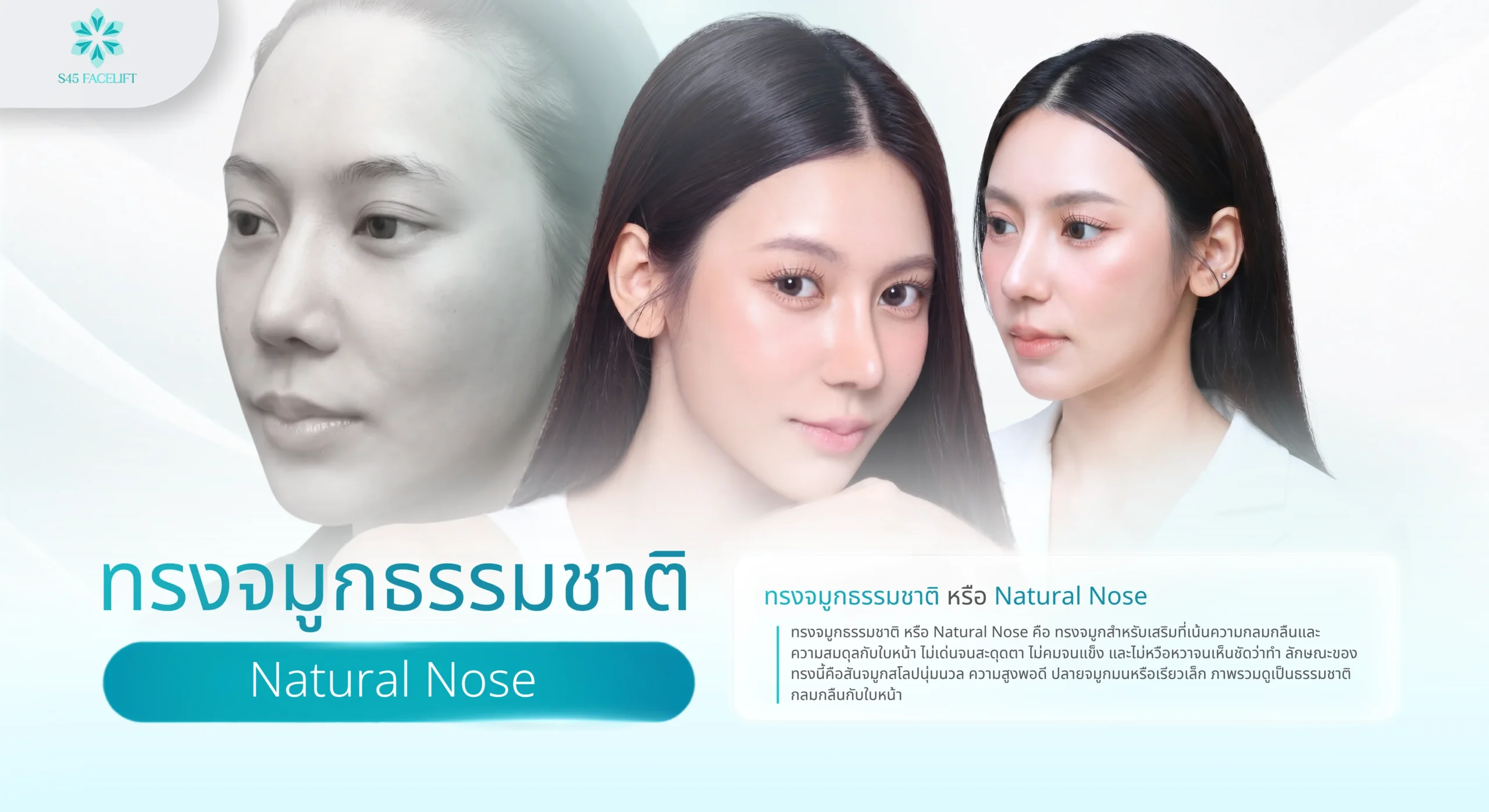
Sloped Nose With a Pointed Teardrop Tip, 5 Styles and How to Choose One for Your Face
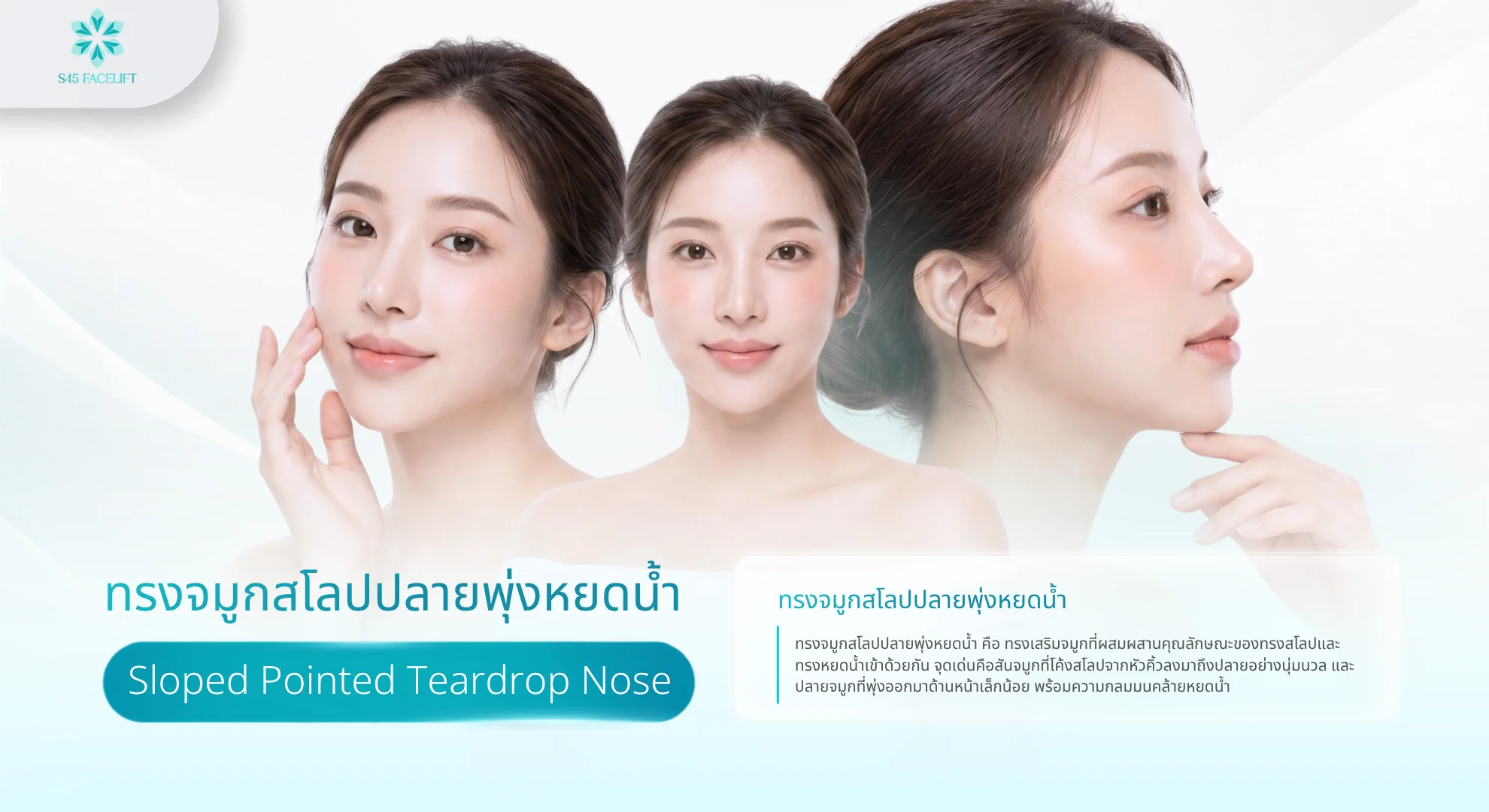
Among the rhinoplasty shapes people in Thailand continue to ask about, the ‘sloped pointed teardrop’ shape is one that can suit Asian faces well, because it gives a subtle look and keeps the soft, gentle character of the face.
In This Article
Key points
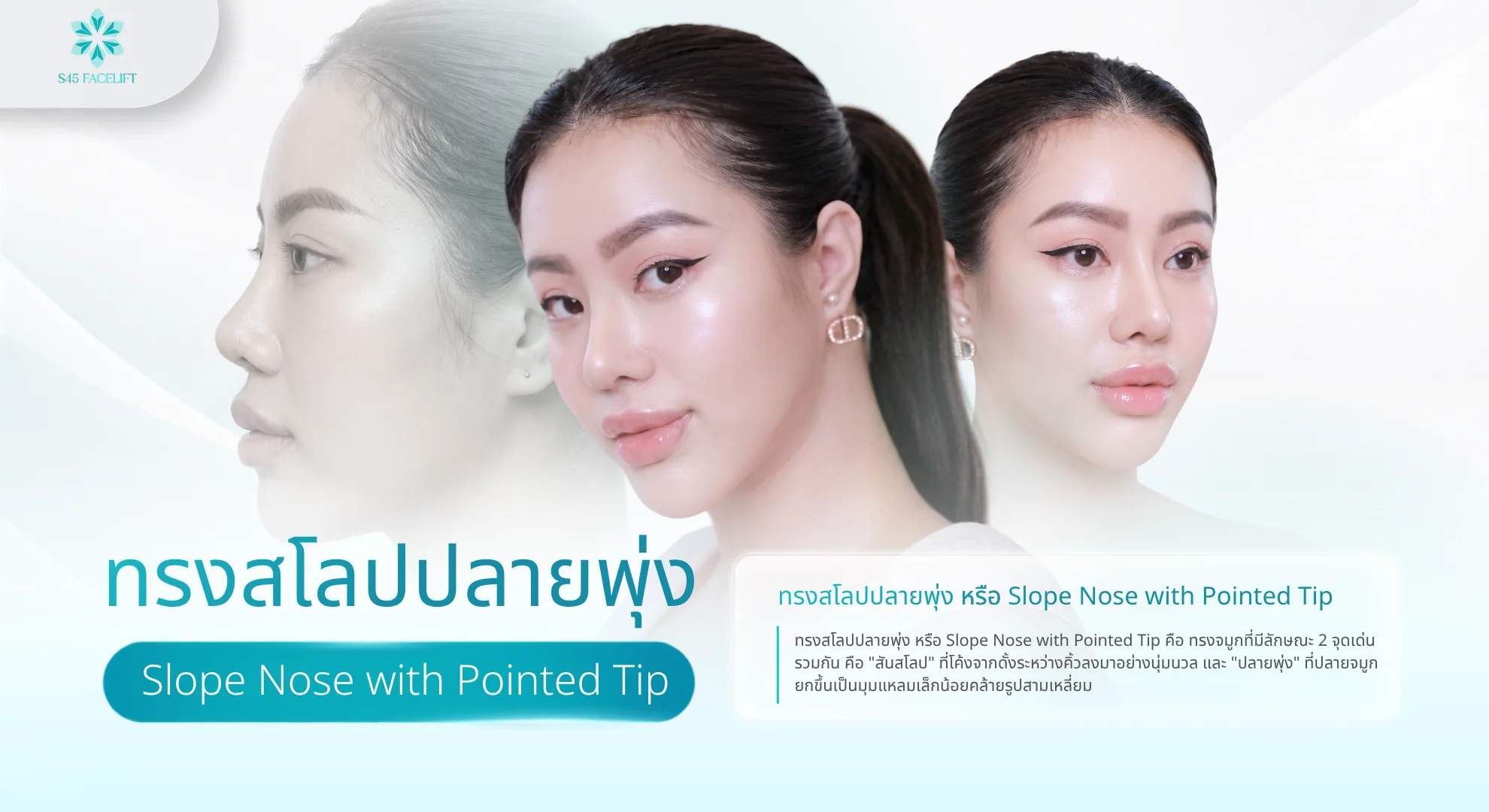
- The sloped pointed teardrop nose shape is a rhinoplasty shape with a bridge that slopes gently from between the eyebrows down to the tip, and a tip that projects slightly and is a little rounded, like a teardrop. It gives a soft, gentle look that blends in with the face.
- There are 5 common styles: a subtle sloped pointed teardrop, a sloped upturned tip, a sloped strongly upturned tip, a sloped teardrop tip with alar base reduction, and a higher, more defined sloped pointed teardrop.
- The sloped pointed-tip shape and the sloped teardrop-tip shape differ at the ‘tip’. A pointed tip is more upturned and sharper, while a teardrop tip is rounder and softer.
- It suits round, short and oval faces in particular, because a projecting tip can help the face look slimmer and longer, with clearer definition.
- It is possible with thin nasal tissue, but your own cartilage (ear cartilage, septum or rib cartilage) is needed to support the tip, to lower the chance of tip extrusion (the implant pushing through the skin) over the long term.
- A technique commonly used is open rhinoplasty, because the surgeon can see the whole structure and can shape the sloping bridge and the pointed teardrop tip precisely.
- Men can have this shape, but it is adjusted to have a sharper bridge and a less projecting tip than the version for women, to keep a more masculine look.
This article brings together information on the sloped pointed teardrop shape, from what it is, its key features and 5 common styles, to a comparison with the sloped pointed-tip and sloped upturned-tip shapes, choosing a shape to suit your face, the techniques used, managing thin nasal tissue, costs and how to choose a clinic that meets standards, so you can make an informed decision.
What Is the Sloped Pointed Teardrop Nose Shape
The sloped pointed teardrop nose shape is a rhinoplasty shape that combines features of a sloping shape and a teardrop shape. Its key features are a bridge that slopes gently from between the eyebrows down to the tip, and a tip that projects slightly forward and is rounded like a teardrop.
This shape suits people who want a face with more depth and definition while keeping its softness, without the nose standing out too much. It is a shape many Asian people ask about, particularly in Thailand, where facial and nasal structures often suit what this technique aims to achieve.
Importantly, this shape is not a single design. There are several variations that the surgeon adjusts to suit each person’s face, from a subtle version that focuses on softness to a more defined version, so the sloped pointed teardrop shape can suit a range of face shapes.
Where the Name ‘Sloped Pointed Teardrop’ Comes From
The name combines 2 features. ‘Sloped’ refers to a bridge that flows in a curved line rather than a straight, rigid one, and ‘pointed teardrop’ refers to a tip that projects and is rounded like a teardrop. The term is widely used in Thai plastic surgery to describe a shape that sits between softness and definition.
Why People Ask About the Sloped Pointed Teardrop Shape
People ask about this shape because it suits those who do not want an overly high nose or an unrealistically sharp tip, but want a nose that suits their face and gives a soft, gentle look with international flair. At a time when social media is part of daily life, a nose that looks good in photos from different angles is the main reason interest in this shape continues.
Key Features of the Sloped Pointed Teardrop Nose Shape
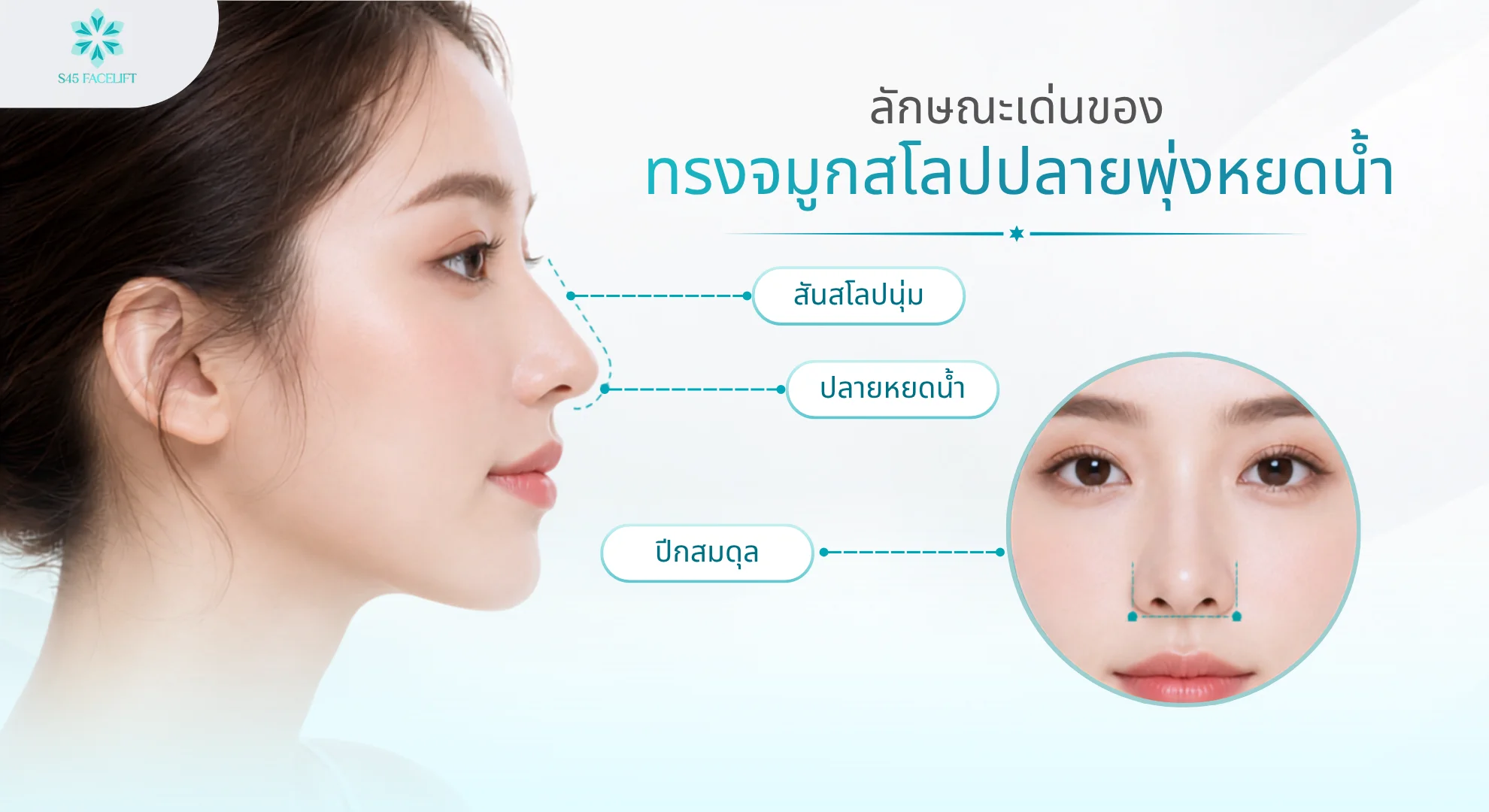
Before deciding on the sloped pointed teardrop shape, it helps to understand the features that make it different from other shapes, because each feature affects the overall look of your face in its own way.
The surgeon uses 3 main points to design the sloped pointed teardrop shape for each person. Together, these give a soft, gentle look that blends in with the face. The key is to assess the proportions of each point so they suit your existing facial structure.
If one of these points is missing, the result may not be the sloped pointed teardrop shape you expect. For example, a well-shaped sloping bridge with a tip that does not project, or a projecting tip with a straight bridge like an older shape, means the overall face will not match the reference photo.
A Gently Sloping Bridge
The bridge of this shape changes height gradually and continuously from between the eyebrows down to the tip, rather than being straight and rigid like a classic shape. The curve of the bridge suits the line of your forehead and eyebrows, which gives the side profile more depth and a softer look.
A Projecting Tip Rounded Like a Teardrop
The tip projects slightly forward and is rounded like a falling teardrop. This is the key feature that sets the sloped pointed teardrop shape apart from a standard sloped pointed-tip shape, where the tip is sharper and projects in a clear triangle.
Alae in Balance With the Bridge and Tip
The alae (the sides of the nose) in this shape are neither too wide nor too narrow, and need to suit the sloping bridge and teardrop tip. If your alae are very wide, the surgeon may recommend alar base reduction at the same time to balance the overall shape, particularly for the sloped teardrop tip with alar base reduction style.
5 Common Styles of the Sloped Pointed Teardrop Nose Shape
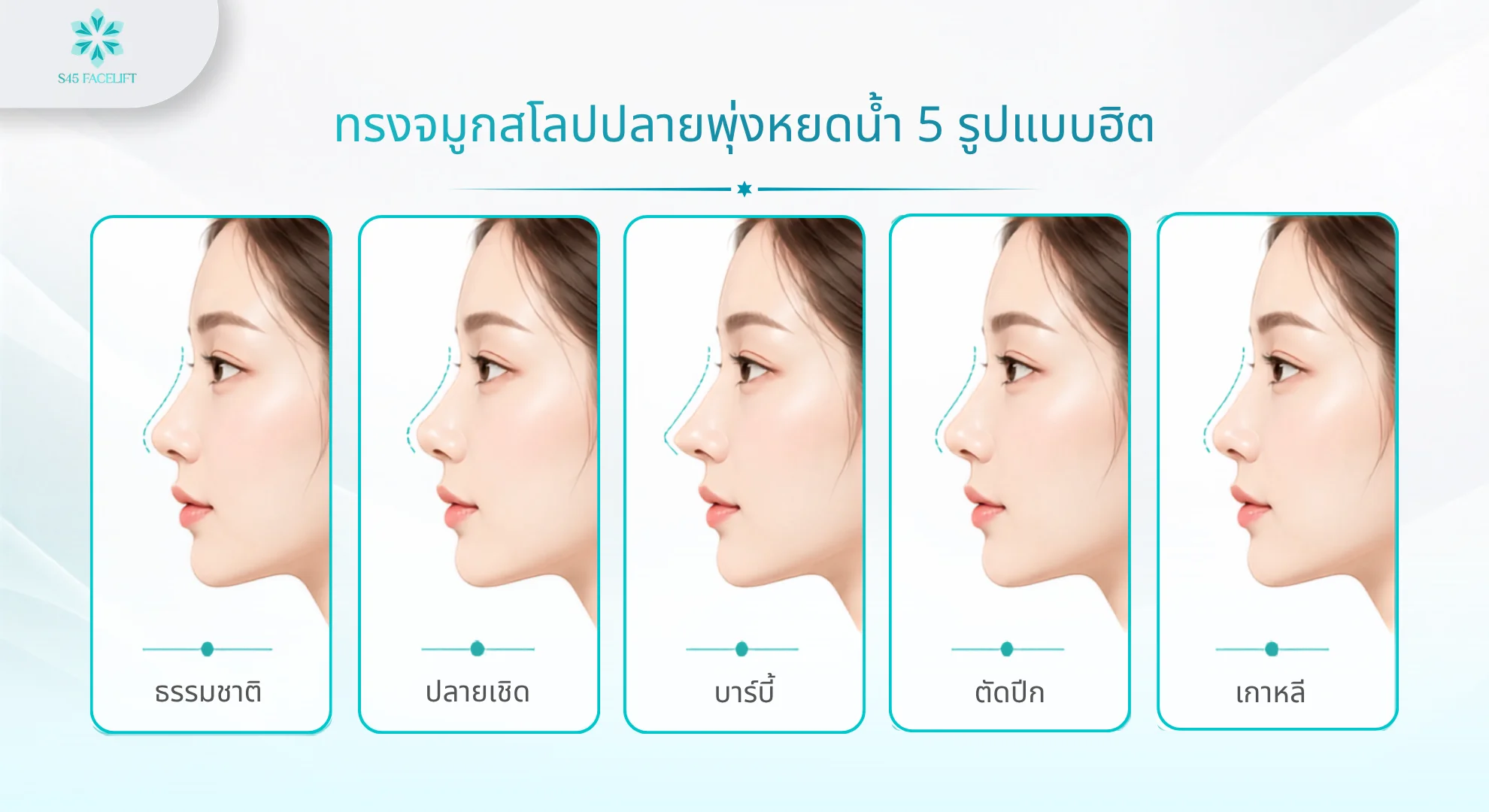
The sloped pointed teardrop shape is not a single design. It can be divided into several styles depending on the focus and the shape of the tip. Each style suits a different face and personality, and understanding the differences can help you explain what you want to the surgeon clearly.
In Thailand, there are 5 main styles people ask about. The surgeon recommends a style based on your existing nasal structure and your goals, and in some cases several features may be combined to create a shape for the individual.
Before choosing a style, have a consultation with a surgeon to assess your face, and look at review cases for each style. This can help you make a decision that better matches what you want. The 5 common styles are as follows.
1. Subtle Sloped Pointed Teardrop

This style focuses on softness and individuality, with a gently sloping bridge and a tip that projects and is rounded just enough, without standing out too much. It suits people who want a subtle look, and it is a version often chosen by working adults who want a look that is refined and blends in.
2. Sloped Upturned Tip

The tip turns up and projects more than usual, with a moderately sloping bridge. The overall look is fresh and youthful. It suits people who want a younger, more playful look, and it is a version often chosen by younger women. It is sometimes called the sloped upturned-tip nose shape.
3. Sloped Strongly Upturned Tip
This style combines a sloping bridge with a tip that is strongly upturned and clearly projecting. The bridge slopes gently but the tip is strongly upturned, which gives a look that balances softness and definition. It suits people who want a shape in between a soft sloping shape and a strongly upturned shape.
4. Sloped Teardrop Tip With Alar Base Reduction
For cases where the alae are wide and the nasal base is broad, the surgeon performs alar base reduction together with the sloped teardrop-tip shape, so the nose looks slimmer overall and suits the sloping bridge. It suits people with a bulbous nose or a wide nasal base.
5. Higher, More Defined Sloped Pointed Teardrop
This version has a higher, more defined sloping bridge than the subtle version, with a tip that projects and is rounded just enough, giving a soft, gentle look. It is a sloped pointed-tip shape that many people bring reference photos of when they have a consultation with a surgeon.
Sloped Pointed Tip vs Sloped Teardrop Tip vs Sloped Upturned Tip, How They Differ
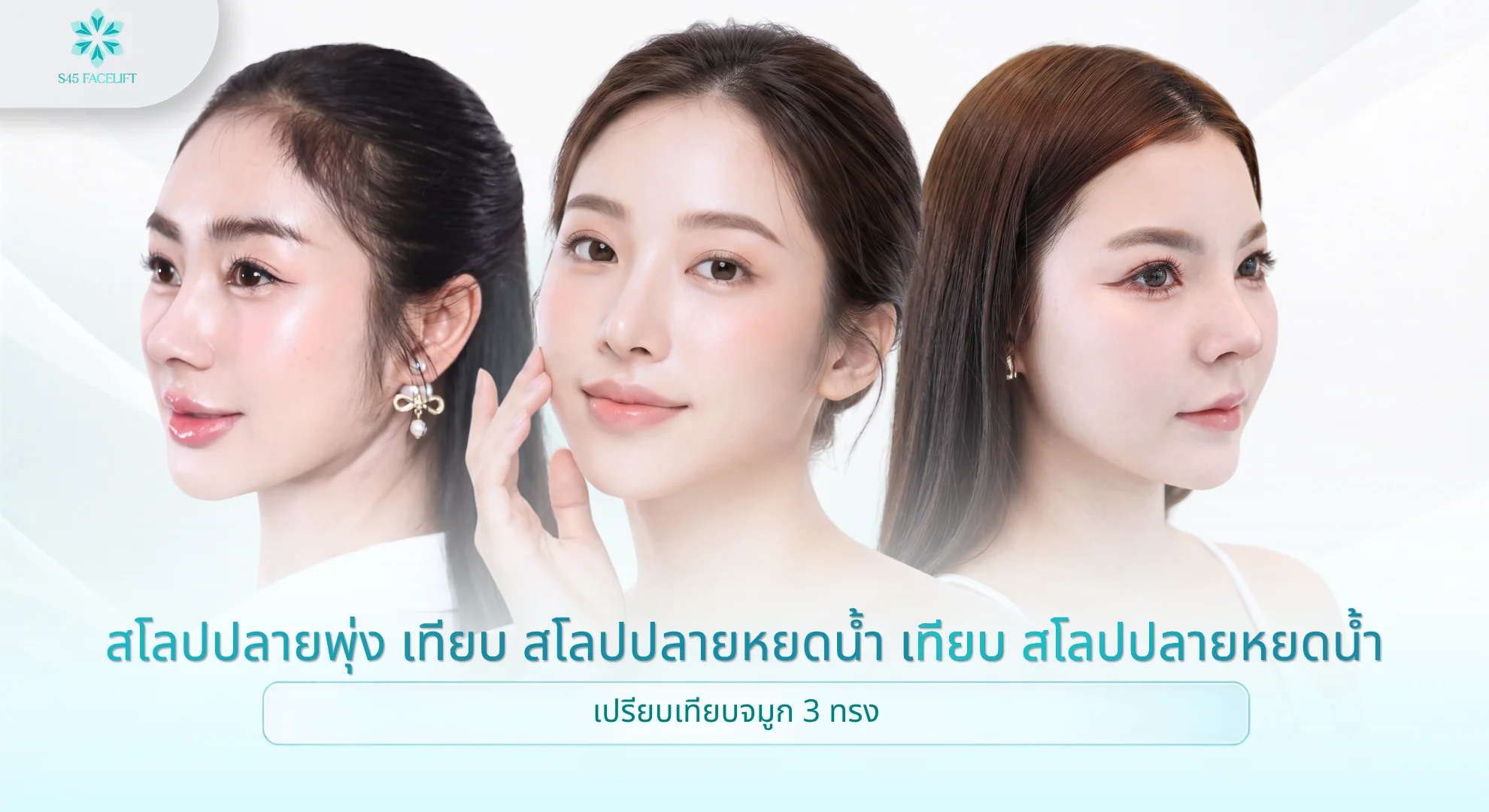
Many people wonder how the sloped pointed-tip, sloped teardrop-tip and sloped upturned-tip shapes differ, because at a glance they can look similar, which can cause confusion when talking to the surgeon or choosing a reference photo.
In fact, the 3 shapes differ clearly in the details of the ‘tip’, while the ‘bridge’ is similar, sloping gently to suit the face. Once you understand the differences, you can choose a shape that better matches your face and the look you want.
The main thing to look at is ‘the shape and angle of the tip’. A pointed tip forms a sharp triangle, a teardrop tip is rounded like a teardrop, and an upturned tip turns up more than both.
Sloped Pointed Tip vs Sloped Teardrop Tip
The sloped pointed-tip shape focuses on a tip that projects in a sharp triangle and turns up slightly, giving a sleek, sharp look. The sloped teardrop-tip shape has a tip rounded like a teardrop, giving a soft, gentle look that blends in with the face. People who like definition choose a pointed tip, and people who like softness choose a teardrop tip.
Sloped Pointed Tip vs Sloped Upturned Tip
Both shapes have an upturned tip, but the sloped pointed tip turns up less and projects in a triangle, while the sloped upturned tip turns up more clearly with a more open angle. The overall look of the sloped upturned-tip shape is therefore fresh and youthful, suiting people who want a girl-next-door look.
Comparison Table of the 3 Shapes
| Feature | Sloped pointed teardrop | Sloped pointed tip | Sloped upturned tip |
| Bridge height | Medium, gently sloping | Medium to high | Medium |
| Tip shape | Rounded like a teardrop | Sharp triangle | Clearly upturned |
| Overall look | Soft and gentle, subtle | Sharp and smooth, with depth | Fresh and youthful |
| Suits | People who like a subtle, soft look | People who like a defined look that is not harsh | People who like a cute, fresh look |
If you are interested in comparing several rhinoplasty shapes, read more in Which nose shape gives a softer look, and compare the triangular-tip and teardrop-tip shapes in Triangular-tip or teardrop-tip nose shape.
Which Face Shapes Suit the Sloped Pointed Teardrop Nose

One of the most common questions is ‘Which face shapes suit the sloped pointed teardrop nose?’ The answer is that this shape can be adjusted to suit almost any facial structure, but it tends to look most balanced on certain face shapes.
The surgeon considers the length of your face, the width of your forehead, cheeks and chin, and your existing nasal structure, to adjust the proportions of the shape to suit your face as a whole. Copying a shape exactly from a reference photo usually gives a result that does not match expectations, because every face has a different structure.
The general guidance for each face shape below can help you assess, before your consultation with a surgeon, whether the sloped pointed teardrop shape suits your face.
Round and Short Faces
These face shapes suit the sloped pointed teardrop shape well, because a projecting tip on a round face can help the face look slimmer and longer with clearer definition, softly reducing the roundness of the face. The surgeon may raise the bridge slightly to add depth to the face.
Oval and Heart-Shaped Faces
These face shapes are already well balanced. The sloped pointed teardrop shape suits them well and can make the face look more defined. They suit a sloping bridge and teardrop tip without much adjustment of proportions.
Long Faces
In this case, the surgeon is careful not to make the bridge too high and chooses the sloped teardrop-tip version with a rounded tip, rather than a version with a high bridge and a sharp tip that would make the face look even longer. A rounded tip can help the face look shorter and better proportioned.
Square Faces
The sloped pointed teardrop shape can help soften a square face, because the gently sloping bridge and rounded tip contrast with a sharp jawline, making the face look softer and more feminine overall.
Men vs Women
The version for women focuses on sweetness and softness, with a smoothly flowing sloping bridge and a clearly rounded tip. A teardrop-tip nose for men is adjusted to have a slightly sharper, higher bridge and a tip that projects in a soft triangle that is not too round, to keep a masculine look.
Advantages of the Sloped Pointed Teardrop Nose Shape
People ask about the sloped pointed teardrop shape not only because it is a trend, but because it suits people who want to look good in the age of social media. Understanding its advantages can help you decide whether this shape matches what you want.
Some advantages can be seen once the swelling goes down, such as a softer face, while others show over the long term, such as feeling more confident in photos and when meeting people.
Many people who previously had a classic straight-bridge shape and change to the sloped pointed teardrop shape feel that their face looks softer and closer to their original look. The main advantages are as follows.
1. A Subtle Look
The sloping bridge and teardrop-like rounded tip give one of the more subtle looks among common rhinoplasty shapes. The change can be subtle, which may suit people who prefer a result that does not draw attention to having had surgery.
2. A Soft, Gentle Look That Suits Asian Faces
This shape is designed with Asian faces in mind, which often have a round to oval face shape and fairly thick nasal tissue. A sloping bridge with a teardrop tip can therefore suit Thai and other Asian faces well and give the soft, gentle look many people want.
3. A Softer, Less Rigid Face
For people whose face looks stern or rigid, the sloped pointed teardrop shape can help the face look softer and friendlier overall, because the flowing bridge and rounded tip contrast with facial lines that may be too sharp.
4. A Range of Styles to Choose From
There are 5 styles to choose from to suit your face and personality, from a subtle version to a higher, more defined version, so the shape can be adjusted to what you want and to your personal style.
5. Suitable for Both Men and Women
Although it is more often chosen by women, this shape can be adjusted for men by making the bridge sharper and higher. The aim is a handsome East Asian look with international flair that keeps a masculine face.
Can You Have the Sloped Pointed Teardrop Shape With Thin Nasal Tissue
One of the most common questions is ‘If I have thin nasal tissue, can I have a sloped pointed tip?’ The answer is yes, but the technique needs planning to suit your existing tissue, because this shape needs enough tissue at the tip to create a clear projecting, teardrop-like rounded tip.
Forcing the shape with a silicone implant alone when there is not enough tissue can make the tip tight and thin, and raises the chance of the silicone implant pushing through the skin over the long term. This problem is not seen straight away, but may appear 1 to 3 years after surgery as a red tip, a thin tip, or the outline of the silicone implant showing through the skin.
The solution is to use your own cartilage to add tissue at the tip. Your body is less likely to reject it, and it can give more stable support than silicone alone. The surgeon assesses your nasal tissue and chooses a technique based on 3 main cases.
Case 1, Enough Nasal Tissue
Closed or mini open rhinoplasty is used to place a silicone implant and shape the tip into the sloped pointed teardrop shape. This is a straightforward case, recovery is usually shorter, and cartilage is not needed to support the tip. Results depend on each person.
Case 2, Slightly Thin Nasal Tissue
Open rhinoplasty is used with your own cartilage (autologous cartilage) from the ear or the septum, to add enough tissue at the tip to create a projecting, teardrop-like rounded tip. See more in Thin nasal tissue and a projecting tip
Case 3, Very Thin Nasal Tissue or a Very Flat Nasal Base
For cases where the tissue at the tip is very thin, or the nasal base is clearly flat, rib cartilage may also be needed to build a stable nasal structure intended to last over the long term. See examples of this type of case in Which nose shapes suit thin nasal tissue
Important An accurate assessment of your nasal tissue needs an in-person examination by a surgeon. It cannot be done from photos alone, because the actual amount of tissue and cartilage has to be checked by hand.
Techniques Used for Sloped Pointed Teardrop Rhinoplasty
The choice of rhinoplasty technique affects the result, the recovery time and the overall care. The sloped pointed teardrop shape involves detailed work on the sloping bridge and rounded tip, so it needs a precise technique.
Each technique has different advantages and limitations. Standard cases with enough tissue may use a closed technique, which usually has a shorter recovery, while cases that need major structural changes or extra tissue from cartilage need an open technique, which allows more precision.
The surgeon recommends a suitable technique after assessing your face and discussing your goals with you, and also considers recovery, budget and the complexity of your case.
1. Closed Rhinoplasty (Closed Technique)
Surgery is done through incisions inside the nostrils only, with no external incision. It suits cases with enough existing tissue that mainly need the bridge raised. The incisions are small and recovery is usually shorter, but the surgeon can see less of the structure than with an open technique. Creating a precise teardrop tip with this technique needs an experienced surgeon.
2. Mini Open Rhinoplasty
A small incision is made at the base of the columella, so the surgeon can see part of the structure. It suits cases that need precision in creating the projecting, rounded tip of this shape but do not need major structural changes. It sits between closed and open rhinoplasty.
3. Open Rhinoplasty (Open Technique)
Incisions are made inside the nostrils and at the base of the columella, so the surgeon can see the whole structure and shape it precisely. It is a commonly chosen option for the sloped pointed teardrop shape, because both the sloping bridge and the detailed rounded tip need to be created. Compare open and closed techniques in Open vs closed rhinoplasty
4. Open Rib Rhinoplasty
Rib cartilage is used to build the nasal structure. It suits cases that need long-term stability, a very flat nasal base, thin nasal tissue, or revision cases where a new sloped pointed teardrop shape needs to be created after a previous result the person was not happy with.
5. Filler Injections and Non-Surgical Options
If you are not ready for surgery, you can try filler injections to raise the bridge and preview a sloping shape first. However, filler injections can only change the tip to a limited extent and do not last long term. See a comparison of surgical and non-surgical rhinoplasty in Cleveland Clinic – Nonsurgical Rhinoplasty
Can You Change From Another Shape to the Sloped Pointed Teardrop Shape
Many people who previously had a classic straight-bridge shape or an older-style shape start to want to change to the sloped pointed teardrop shape for a softer look that blends in with the face. The questions are whether this is possible and how to prepare.
The answer depends on the current condition of your nose, how long ago you had the previous surgery and the technique used. If your nose is in good condition without much scar tissue, changing the shape is usually not difficult. But if there are existing problems, such as a droopy tip, a dropped tip or a tilted nose, the correction needs to be planned first.
Before deciding, have a consultation with an experienced surgeon to examine your nose and assess the risks, and look at review cases similar to your own.
If Your Existing Nose Is in Good Shape
If your existing nose has no problems and is in good condition, the shape can be changed with open rhinoplasty, removing the old silicone implant and placing a new one to create the sloped pointed teardrop design you want. Results can be similar to those of a first-time rhinoplasty.
If the Tip Is Droopy or Tilted
If you have a teardrop-shaped nose with a droopy tip from previous surgery, open rhinoplasty with cartilage grafting is needed to lift the tip and reshape it. This is a revision case that needs an experienced surgeon. Read more in Which noses need correcting
If There Are Existing Problems Such as Infection or Scar Tissue
If there are problems from previous surgery, such as a shifted silicone implant, a dropped tip, scar tissue or a shape you are not happy with, the existing problem needs to be corrected first before a new sloped pointed teardrop shape is created. This is a complex revision case.
How Long to Wait Before Revision
Wait at least 6 months for scar tissue and tissue from the previous surgery to settle before correction, so the surgeon can assess your nose accurately and to lower the risks of surgery.
Cost of Sloped Pointed Teardrop Rhinoplasty
How much a teardrop-tip nose costs is a common question among people who are deciding. Prices vary by clinic and technique, from the high tens of thousands of baht to hundreds of thousands of baht, depending on several factors. It helps to understand the factors that affect the price before comparing clinics.
An unusually low price may reflect the quality of the silicone implant, the surgeon’s experience or clinic standards that are lower than usual. For surgery that affects your face over the long term, saving too much may affect how satisfied you are in the long run.
However, a price above the usual range does not always mean higher quality. Compare mainly on the services included and the surgeon’s qualifications.
Factors That Affect the Price
- technique used, from lowest to highest cost: closed, mini open, open and open rib rhinoplasty
- implant material: silicone alone, silicone with ear cartilage, or rib cartilage
- type of silicone implant: an implant carved for your case, or an imported implant
- the surgeon: the surgeon’s experience and field of training
- clinic standards: licence, operating room and anaesthetist team
- additional procedures: alar base reduction, nasal base reshaping or rasping of a dorsal hump
What to Check in a Quotation
Ask for a quotation that clearly states whether it includes the anaesthetist’s fee, medicines after surgery, stitch removal and follow-up, to avoid extra costs later. A transparent clinic lists every item in the quotation from the start.
Be Careful of Unusually Low Prices
If a clinic offers a price far below the usual range, be careful. It may mean low-quality silicone implants, a surgeon with little experience, an operating room that does not meet standards, or no aftercare system. For surgery that affects your face over the long term, saving money in the wrong place may mean paying more for corrections in the future.
Where to Have Sloped Pointed Teardrop Rhinoplasty
Choosing a clinic is a very important decision. However good the shape you choose, if the surgeon lacks experience, the result may not be what you hoped for. The sloped pointed teardrop shape relies on detail in creating the bridge and tip, so choosing an experienced surgeon matters even more.
Apart from reviews on social media, there are factors not to overlook, particularly the surgeon’s qualifications, the standards of the premises and how transparent the clinic is.
Many people choose a clinic mainly on price, but for surgery that affects your face over the long term like this, consider the overall service rather than the price alone. The criteria to consider are as follows.
Criteria for Choosing a Clinic
- a valid clinic licence, always checked first on the website of the Department of Health Service Support
- operating room standards comparable to a hospital, with an anaesthetist team for cases under general anaesthetic
- transparent pricing, with a clear quotation and no extra charges added later
- a clear aftercare system, with follow-up for 3 to 6 months after surgery
- real review cases covering a range of face types and shape styles
Qualifications to Look for in a Surgeon
Look for a surgeon certified in otolaryngology with subspecialty training in facial plastic and reconstructive surgery who focuses on nose cases, rather than a general doctor who performs many types of surgery.
Operating Room Standards and Care
The operating room should meet standards comparable to a hospital, with an air filtration system and an anaesthetist providing one-to-one care for cases under general anaesthetic. See more information on standard rhinoplasty steps and recovery in Cleveland Clinic – Nonsurgical Rhinoplasty
Why Choose Sloped Pointed Teardrop Rhinoplasty at S45 Clinic
The sloped pointed teardrop shape needs detailed design of the bridge, the projecting tip and the alae so they suit each person’s face. S45 Clinic is a plastic surgery clinic that focuses on the nose and designs each shape for the individual rather than using a ready-made template, under our promise “Because every kind of beauty comes from care”
Our Surgeons
Our surgeons are certified in otolaryngology with subspecialty training in facial plastic and reconstructive surgery, focus on nose cases, and assess your face to design a sloped pointed teardrop shape that suits your facial proportions. See more in Rhinoplasty (Nose Surgery)
Open Rhinoplasty and Open Rib Rhinoplasty
S45 Clinic uses open rhinoplasty, which allows precision in creating the sloping bridge and teardrop-like rounded tip, and open rib rhinoplasty, which uses rib cartilage to build the nasal structure. This suits cases that need long-term stability, a flat nasal base, or thin nasal tissue that needs stable support at the tip.
Operating Room and Aftercare
In our operating room, an anaesthetist provides one-to-one care for cases under general anaesthetic, and our aftercare system follows up with you for 3 to 6 months after surgery to check that your result is settling as designed. See other nose shapes that our surgeons design to suit the face in Which nose shape gives a softer look
FAQs About the Sloped Pointed Teardrop Nose Shape
Which Face Shapes Suit the Sloped Pointed Teardrop Nose?
It suits many face shapes, particularly round and short faces, because a projecting tip can help the face look slimmer and longer with clearer definition. Oval and heart-shaped faces also suit it well because they fit a sloping bridge and teardrop tip. For long faces, a version with a lower bridge and a rounded tip is a better fit so the face does not look longer.
Is a Teardrop-Tip Nose a Good Choice, and Is It Worth the Investment?
A teardrop-tip nose suits people who want a soft, gentle look that blends in with the face. It can be worth it if you choose a clinic and surgeon that meet standards, because it is intended to give a long-term result so repeat surgery is less likely to be needed, although results depend on each person. An unusually low price may reflect lower quality and lead to paying for corrections in the future.
Sloped Pointed Tip vs Sloped Teardrop Tip, How Do They Differ?
Both shapes have a similar sloping bridge but differ at the tip. The sloped pointed tip is sharp and projects in a triangle, while the sloped teardrop tip is rounded like a teardrop. Overall, the sloped pointed tip looks sharp with clear depth, while the sloped teardrop tip looks soft and gentle and blends in with the face.
Who Suits a Sloped Pointed-Tip Nose?
It suits people who want a nose with depth that still looks soft and does not stand out too much, particularly people with a round or short face, or a face that looks flat and lacks depth. This shape can help the face look slimmer and longer and give the nose a balanced focal point. It suits both working adults and younger women who want a soft, gentle look.
How Much Does a Sloped Pointed Teardrop Nose Cost?
Prices vary by clinic, technique, implant material (silicone alone or silicone with cartilage), the complexity of your case and the surgeon. An accurate estimate needs an in-person assessment of your face. Message the clinic on LINE to ask for a quotation for your case, and be careful of clinics offering unusually low prices, because this may reflect insufficient quality and standards.
Can I Have a Sloped Pointed Tip With Thin Nasal Tissue?
Yes, but the tissue at the tip needs a careful assessment. If the tissue is very thin, your own cartilage (from the ear, the septum or the ribs) is needed to support the tip, to create a projecting, teardrop-like rounded tip and to lower the chance of tip extrusion over the long term. Forcing the shape with a silicone implant alone when there is not enough tissue raises the chance of problems in the future.
Can Men Have the Sloped Pointed Teardrop Shape?
Yes, but the proportions need to be adjusted to a version for men, with a bridge slightly sharper and higher than the version for women, and a tip that projects in a soft triangle that is not too round, to keep a masculine look. The aim is a handsome East Asian look with international flair that can look good in photos.
After Sloped Pointed Teardrop Rhinoplasty, How Many Months Does It Take to Settle?
In general, in the first 7 to 14 days about 60% to 70% of the swelling goes down and you can go back to work. In months 1 to 3 most of the swelling goes down and the shape is close to the final result, and in months 3 to 6 the scar tissue settles fully and the shape is clearly visible, with a softer tip. The full result is seen around 6 months after surgery. Timings depend on each person.
Summary
The sloped pointed teardrop nose shape is a rhinoplasty shape that can suit Asian faces well. Its key features are a gently sloping bridge and a projecting tip rounded like a teardrop, which give a soft, gentle look that blends in with the face. There are 5 styles to choose from to suit your face and personality: a subtle version, an upturned tip, a strongly upturned tip, a teardrop tip with alar base reduction, and a higher, more defined version.
This shape differs from the sloped pointed-tip and sloped upturned-tip shapes in the details of the tip shape. It suits a range of face shapes, particularly round, short and oval faces. Men can have it with a sharper adjustment, and people with thin nasal tissue can have it with their own cartilage supporting the tip for long-term stability.
The key point is that the sloped pointed teardrop shape that suits you is not a shape copied exactly from a reference photo, but a shape the surgeon designs to suit your face in particular. Choosing an experienced surgeon and a clinic that meets standards helps your result follow the plan.
Because every nose structure…
is different
An otolaryngologist with subspecialty training in facial plastic and reconstructive surgery assesses every case before treatment and gives advice based on your actual concerns.
“Reveal the beauty within you”
Message us online
Surgery and medical procedures carry risks. Find out about them and consult a doctor before you decide. Results depend on each person.