Brow Ptosis, What Causes It and How Can Drooping Brows Be Lifted?

Have people told you that you look “tired”, “sad” or “older than your age” even though you sleep enough and do not feel stressed? Part of this can come from brows that gradually drop over time, which can affect how your whole face looks and your everyday confidence more than you might think.
Key points
- Brow ptosis is when the brows sit lower than usual and press down on the eyelids, so the face looks tired, sad or older than your age.
- There are 3 common types: drooping inner brows, drooping outer brows and drooping on one side only (uneven brows).
- The main causes are age and skin laxity, genetics, weak forehead muscles, and botulinum toxin injections given in an unsuitable way.
- Treatment is either non-surgical (wrinkle-relaxing injections, thread lifts or energy-based skin tightening) or surgical, which gives longer-term results.
- An endoscopic brow lift with Endotine is a surgical option that helps lift the brows and support the tissue in a position that suits your face.
- Choosing a suitable method needs an assessment by an experienced doctor, because each type of drooping brow has different causes and treatments.
This article brings together information on what brow ptosis is and its types, what causes it and how drooping brows can be treated without and with surgery, along with how to prepare and look after yourself, to help you understand the problem and choose an approach that suits you with confidence.
In This Article
What Is Brow Ptosis?

Brow ptosis (eyebrow ptosis) is when the brows move lower than their usual position and press down on the eyelids, so the eyes look heavy and the whole face looks tired or sad, even when you do not feel that way. It is one of the common signs of facial sagging as you get older.
In most women, well-proportioned brows sit slightly above the bony rim of the eye socket and curve upwards towards the tail. In men, the brows sit lower and straighter. When the brows start to droop, these proportions change, so the space between the brows and the eyelids gets smaller and the eyes look heavy.
Brow ptosis is therefore not only about wrinkles but about the proportions of the face and how the facial muscles support the brows. Understanding this helps you choose care that suits the cause, because each type of drooping brow has a different cause and treatment.
How Is Brow Ptosis Different From a Droopy Upper Eyelid?
Brow ptosis and a droopy upper eyelid are often confused, because both make the eyes look heavy, but they happen in different places. With brow ptosis, the whole brow moves down and presses on the eyelid. With a droopy upper eyelid, the upper eyelid skin itself sags, which is linked to eyelid ptosis (weakness of the muscle that lifts the eyelid). Some people have both at the same time, so an assessment by a doctor is important to find the cause and plan the right treatment.
What Types of Drooping Brows Are There?
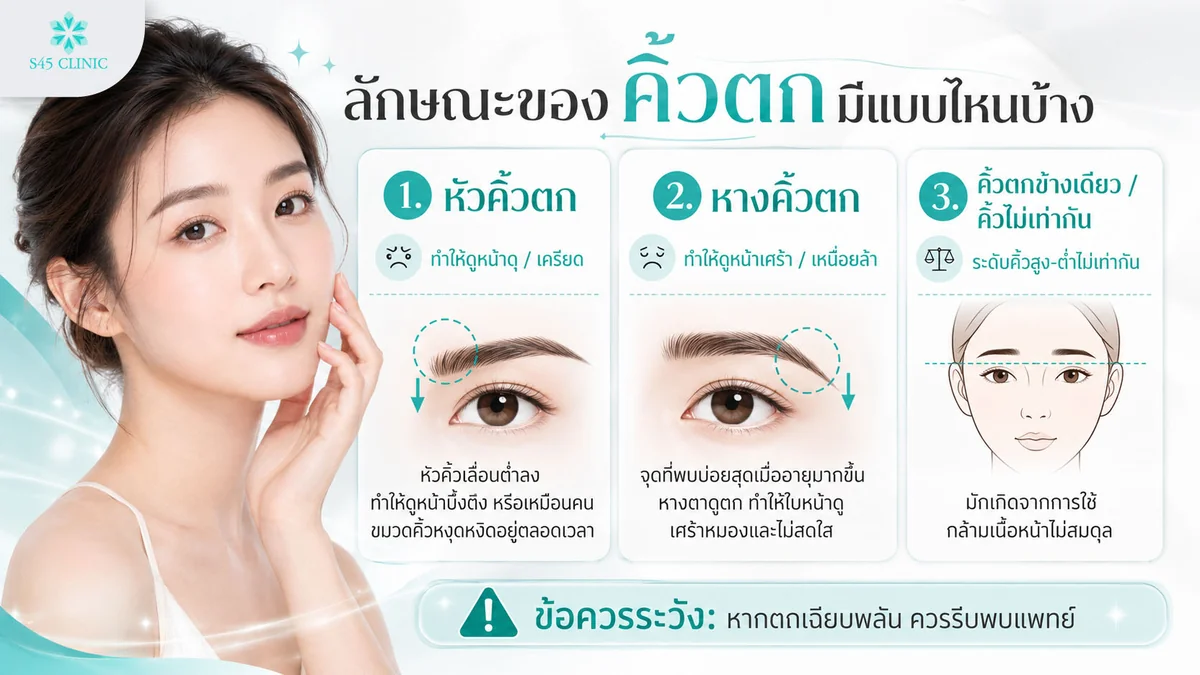
Before choosing a treatment, look at how your own brows droop, because where they droop affects your face and the treatment in different ways. There are 3 common types:
Drooping Inner Brows
When the inner ends of the brows (near the bridge of the nose) sit lower, you may look frowning or stressed all the time, even when relaxed, so people around you may think you are in a bad mood.
Drooping Outer Brows
When the tails of the brows (the outer ends) sit lower, the eyes look droopy and the face looks sad or tired. Drooping outer brows are common with age, and many people want to correct them so their eyes look brighter.
Drooping on One Side, or Uneven Brows
The 2 brows sit at different levels. This may come from using the facial muscles unevenly, or in some cases may be linked to how the muscles and nerves work. If one brow drops suddenly together with other symptoms, see a doctor for a consultation to find the cause.
What Causes Brow Ptosis?

Common questions are “what causes drooping brows?” and “why do some people’s brows drop earlier than others?”. The answer is that drooping brows come from several factors together, some hard to control and some preventable. Understanding the cause helps you choose treatment and prevention that fit it.
1. Age and Skin Laxity
As you get older, your skin makes less collagen and elastin, so it becomes less elastic. Together with gravity, this makes the tissue of the forehead and brows gradually sag and move lower.
2. Genetics and Facial Proportions From Birth
Some people inherit fairly low brows or weak forehead muscles, so they tend to have drooping brows from a young age.
3. Weak Forehead Muscles and Muscles Around the Eyes
The forehead muscle lifts the brows. When it becomes weaker or works unevenly, the brows get less support and move lower. In some cases, problems with the muscles around the eyes also play a part.
4. Effects of Botulinum Toxin Injections Given in an Unsuitable Way
Botulinum toxin injections in the forehead in an unsuitable position or dose may temporarily weaken the muscle that lifts the brows, so the brows look lower. The injections should be given by a doctor who assesses the injection points carefully.
5. Injury or Surgery Around the Eyes
Injury, accidents or surgery on the forehead and around the eyes may affect the muscles and nerves that control brow lifting, which can lead to drooping brows.
Outside factors such as sunlight and UV rays, which speed up skin ageing, can also make the forehead skin sag sooner. Using sunscreen regularly can help slow this down to some extent. Read more about the effects of sunlight on the skin from the American Academy of Dermatology.
What Do Drooping Brows Mean in Traditional Beliefs?
What drooping brows mean in traditional beliefs is a matter of personal views and cultural beliefs. It is not directly related to medicine or medical diagnosis.
In aesthetic care, what can actually be assessed is the proportion and balance of the face, such as a brow position that suits the eyes and facial structure, which can make the face look fresher and more balanced. If you want to change the position of your brows, base the decision mainly on your facial proportions and a doctor’s assessment rather than on beliefs alone.
Ways to Treat Drooping Brows, Non-Surgical and Surgical
Treatments for drooping brows today fall into 2 main groups (see an overview of all brow lift techniques): non-surgical treatments for small adjustments with little downtime, and surgery for longer-term results when the brows droop clearly. The choice depends on how much the brows droop, the cause and what each person wants to achieve.
Each group has different benefits and limits. Mildly drooping brows may be treated without surgery, while for clearly drooping brows or brows with sagging skin, surgery is usually considered for a clearer and longer-lasting result.
Comparison of Treatments for Drooping Brows
| Treatment group | How it works | Suitable for | Recovery time |
|---|---|---|---|
| Wrinkle-relaxing injections | Rebalance the muscles that pull the brows down | Mildly drooping brows or mildly drooping outer brows | Little downtime |
| Thread lift | Threads support the tissue and stimulate collagen | Mild to moderate drooping | Short recovery |
| Energy-based skin tightening | Stimulate collagen with HIFU/RF | Early to moderate sagging | Little downtime |
| Filler injections | Fill hollows and support the brow area | Drooping from loss of volume | Little downtime |
| Brow lift surgery | Lift and fix the brow position directly | Clearly drooping brows, wanting longer-term results | Longer recovery |
A Closer Look at Non-Surgical Treatments for Drooping Brows
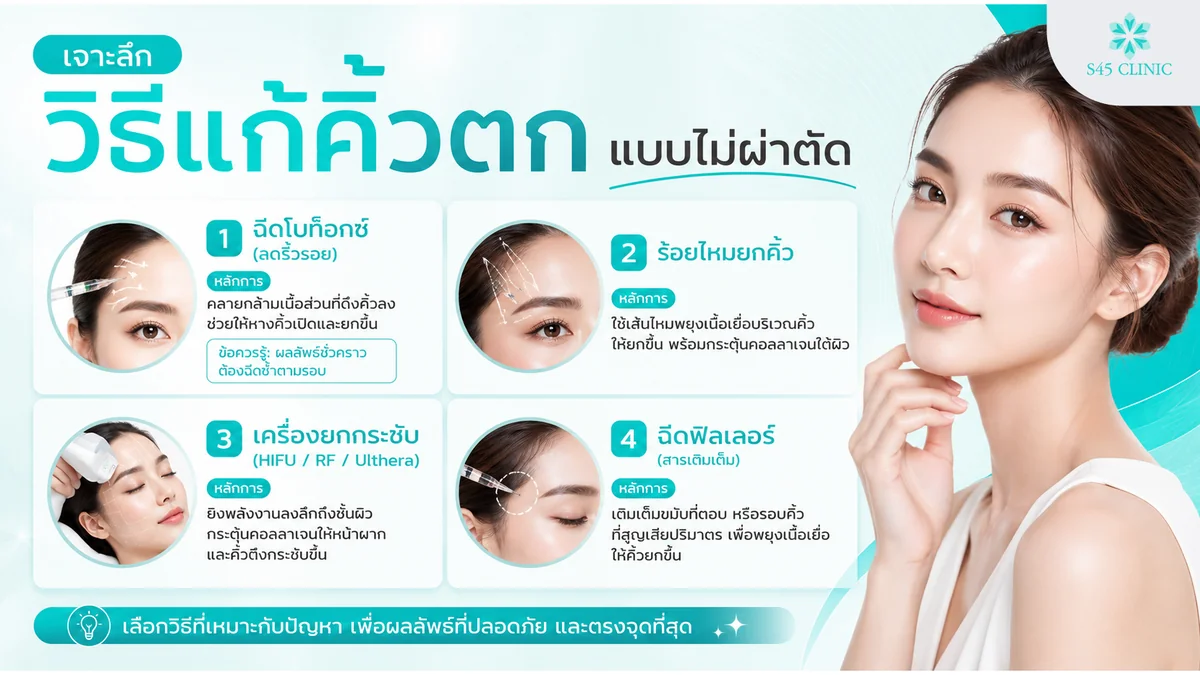
For mildly to moderately drooping brows, non-surgical treatments are an option with little downtime that can be adjusted to suit you. They must be carried out by an experienced doctor, using products or devices licensed by the Thai Food and Drug Administration.
Wrinkle-Relaxing Injections to Rebalance the Brows
Botulinum toxin injections in suitable positions help reduce the action of the muscles that pull the brows down, so the muscles that lift the brows work more strongly and the tails of the brows look slightly lifted. This suits mildly drooping brows. The effect is temporary and needs repeating at regular intervals.
Thread Lift for the Brows
A thread lift helps support the tissue around the brows and stimulates collagen. It suits mildly to moderately drooping brows when you want a gradual result, and the result depends on the type of thread and each person’s skin.
Energy-Based Skin Tightening
High-intensity focused ultrasound (HIFU) or radiofrequency (RF) helps stimulate collagen in the skin, so the forehead and brow area look firmer. It suits early to moderate sagging. See more about face contouring with the Ulthera SPT programme.
Filler Injections
Filler injections around the brows or temples help replace lost volume and support the brows so they look lifted. This suits brows that droop because of volume loss, and the injection points must be assessed carefully by a doctor.
Note: non-surgical treatments suit mildly drooping brows and give temporary results. If your brows droop clearly or you also have sagging skin, brow lift surgery gives a clearer and longer-lasting result.
Brow Lift Surgery Techniques for Drooping Brows
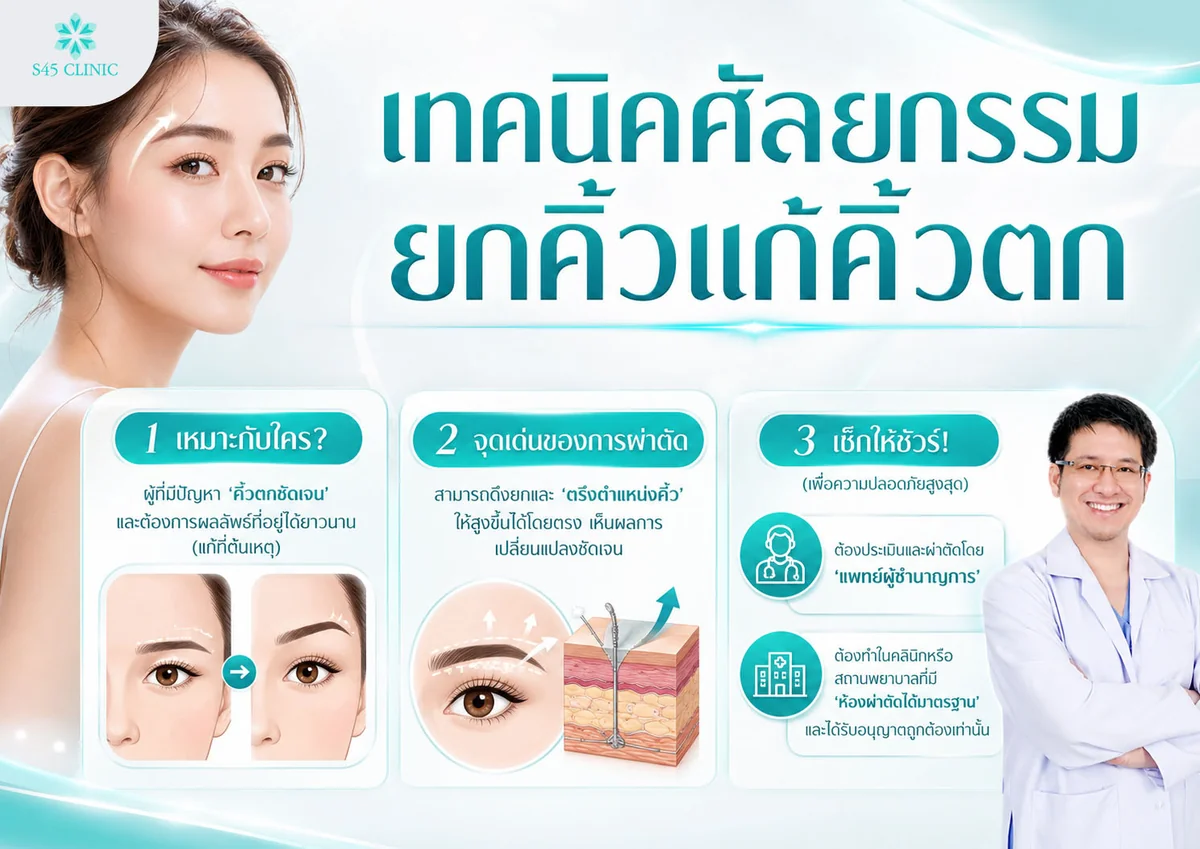
For clearly drooping brows when you want a longer-term result, brow lift surgery can lift and fix the brow position directly. It must be done in a healthcare facility licensed to have an operating room, after an assessment by an experienced doctor.
Endoscopic Brow Lift
An endoscopic brow lift uses small incisions along the hairline with a camera, so the surgeon can see and lift the forehead tissue in detail. It helps lift the whole brow into a position that suits your face, with scars hidden in the hairline. See the details of the endoscopic brow lift technique at S45 Clinic. Many people with drooping brows ask about this technique when they want a subtle result. See the details of endoscopic brow lift with frown line reduction.
Endoscopic Brow Lift With Endotine
Endotine is a device that helps fix and support the forehead tissue so the brows stay in their lifted position. The device gradually dissolves over time, and the tissue attaches in its new position. Using it with the endoscopic technique helps hold the brows firmly in their lifted position. Read more about facelift with Endotine.
Sub-Brow Lift
This surgery focuses on the tails of the brows and sagging upper eyelids, using an incision just below the brow. It suits people whose main problem is drooping outer brows and sagging upper eyelids.
Direct Brow Lift
This surgery lifts the brows through an incision directly above the brow. It suits some people, especially those with thick brows or very weak forehead muscles. Your doctor will consider whether it suits you individually, because the scar position differs from the endoscopic technique.
Is Drooping Brow Treatment Different for Men and Women?
Drooping brows happen in both women and men, but the aims of treatment differ according to the brow proportions that suit each sex. Most women want brows that curve upwards at the tail to look brighter, while most men want brows that sit lower and straighter, so the brows are not lifted too high.
So although the same technique can be used, your doctor designs the position and amount of lift to suit the facial proportions of each sex and each person, so the result suits you rather than lifting everyone to the same level.
How Much Does Brow Lift Surgery Cost?
The price of treating drooping brows varies widely with the method you choose, from non-surgical treatments that cost less each time but need repeating, to brow lift surgery that costs more but gives a longer-term result. See price guidance for endoscopic brow lift prices. It is worth understanding what affects the price before comparing clinics.
What Makes Prices Differ
The price depends on whether you choose a non-surgical treatment (injections, thread lift or energy-based treatment) or surgery, the technique and materials used, such as Endotine or the endoscopic technique, and how complex your case is, including how much the brows droop and any problems treated at the same time, such as droopy eyelids. It also depends on the doctor’s experience and the clinic’s standards, including its licence, operating room and care team.
What to Check Before Deciding
Ask the clinic directly for an assessment and a quote for your own case, and check clearly whether it includes the doctor’s fee, medicines after treatment and follow-up. Be careful with prices that are unusually low, because they may reflect the standards or materials used. Results and costs depend on each person.
Preparation and Aftercare
Good preparation and aftercare affect your result and recovery as much as the technique you choose. Follow your doctor’s advice strictly.
Before Treatment
- Tell your doctor about your health history and any medicines and supplements you take regularly.
- Stop medicines or supplements that affect blood clotting, as your doctor advises.
- Stop smoking and drinking alcohol before surgery for as long as your doctor tells you.
After Treatment
- Use cold compresses as advised to help reduce swelling and bruising at first.
- Avoid keeping your head bent down for long or straining during recovery.
- Take your medicines and attend your follow-up appointments as your doctor advises.
Swelling, bruising or tightness at first is common and gradually improves. If you have anything unusual, such as unusually severe pain or signs of inflammation, contact your doctor straight away for a consultation.
How to Choose a Clinic for Drooping Brows
Choosing a clinic matters as much as choosing a treatment, because it affects both your result and the chance of complications, especially for brow lift surgery, which needs careful design of the brow position. Some basic points to help you decide:
- a correctly licensed clinic, which you can always check first on the website of the Department of Health Service Support
- experienced doctors, with assessment and treatment by a doctor with training in this area
- operating room standards for surgical cases, with a suitable care team
- products and materials licensed by the Thai Food and Drug Administration
- clear pricing, with a written quote and clear conditions
Treating Drooping Brows at S45 Clinic
Drooping brows have different causes and features in each person, so good treatment starts with an individual assessment rather than using the same technique for everyone. S45 Clinic is a medical clinic providing facial aesthetic care, with a focus on designing a brow position that suits each person’s facial proportions, with care at every step.
Experienced Doctors
Your face is assessed and cared for by an experienced doctor, who designs a treatment for drooping brows that suits your facial proportions and the cause in your case, whether non-surgical or brow lift surgery. See all services at S45 Clinic services.
An Individual Assessment Before Every Treatment
Before treatment, your doctor assesses your brow position, facial proportions and the cause of the drooping, to design an approach that suits you, and explains the information so you understand it before you decide.
Common Questions About Brow Ptosis
How Can Drooping Brows Be Treated?
They can be treated without or with surgery. Non-surgical options, such as wrinkle-relaxing injections, thread lifts and energy-based skin tightening, suit mildly drooping brows. Surgical options, such as an endoscopic brow lift with Endotine, suit clearly drooping brows when you want a longer-term result. Book a consultation with a doctor to choose the method that suits your case.
Does Treating Drooping Brows Hurt?
How much you feel depends on the method. With non-surgical treatments you feel only a little. With surgery, local anaesthetic or other anaesthesia is used, and you may feel some tightness or mild pain during recovery, which your doctor will manage and give you medicine for as needed.
At What Age Can Drooping Brows Start?
They can start at a fairly young age in people who inherit low brows or have weak forehead muscles, but for most people they become more noticeable with age and as the skin sags.
Can Drooping Brows and Droopy Eyelids Be Treated at the Same Time?
Yes. In many cases, drooping brows and droopy eyelids happen together. Your doctor assesses where the main problem is and may plan to treat both areas at the same time for a balanced result.
How Long Does a Brow Lift Last?
It depends on the method. Non-surgical treatments give temporary results and need repeating at regular intervals, while brow lift surgery gives a longer-term result. Results depend on your skin and how you look after yourself.
Is Drooping Brow Treatment Different for Men and Women?
The principles are the same, but your doctor designs the level and position of the brows to suit the proportions of each sex. For men, the brows are kept lower and straighter so they suit a male face.
Summary
Brow ptosis is when the brows move lower and press down on the eyelids, so the face looks tired, sad or older than your age. There are 3 common types: drooping inner brows, drooping outer brows and drooping on one side. The main causes are age, genetics, weak forehead muscles and the effects of unsuitable injections.
Treatment is either non-surgical, which suits mildly drooping brows with little downtime, or surgical, which gives a longer-term result for clearly drooping brows. An endoscopic brow lift with Endotine is one approach that helps lift and support the brows in a position that suits your face.
Most importantly, each type of drooping brow has different causes and treatments, so choosing a suitable method should involve an assessment by an experienced doctor and a licensed clinic, for a result that suits your facial proportions.
Because every face shape…
is different
An otolaryngologist with subspecialty training in facial plastic and reconstructive surgery assesses every case before treatment and gives advice based on your actual concerns.
“Reveal the beauty within you”
Message us online
Surgery and medical procedures carry risks. Find out about them and consult a doctor before you decide. Results depend on each person.