What Is Face Lift Surgery? 4 Techniques, Benefits and Choosing a Clinic
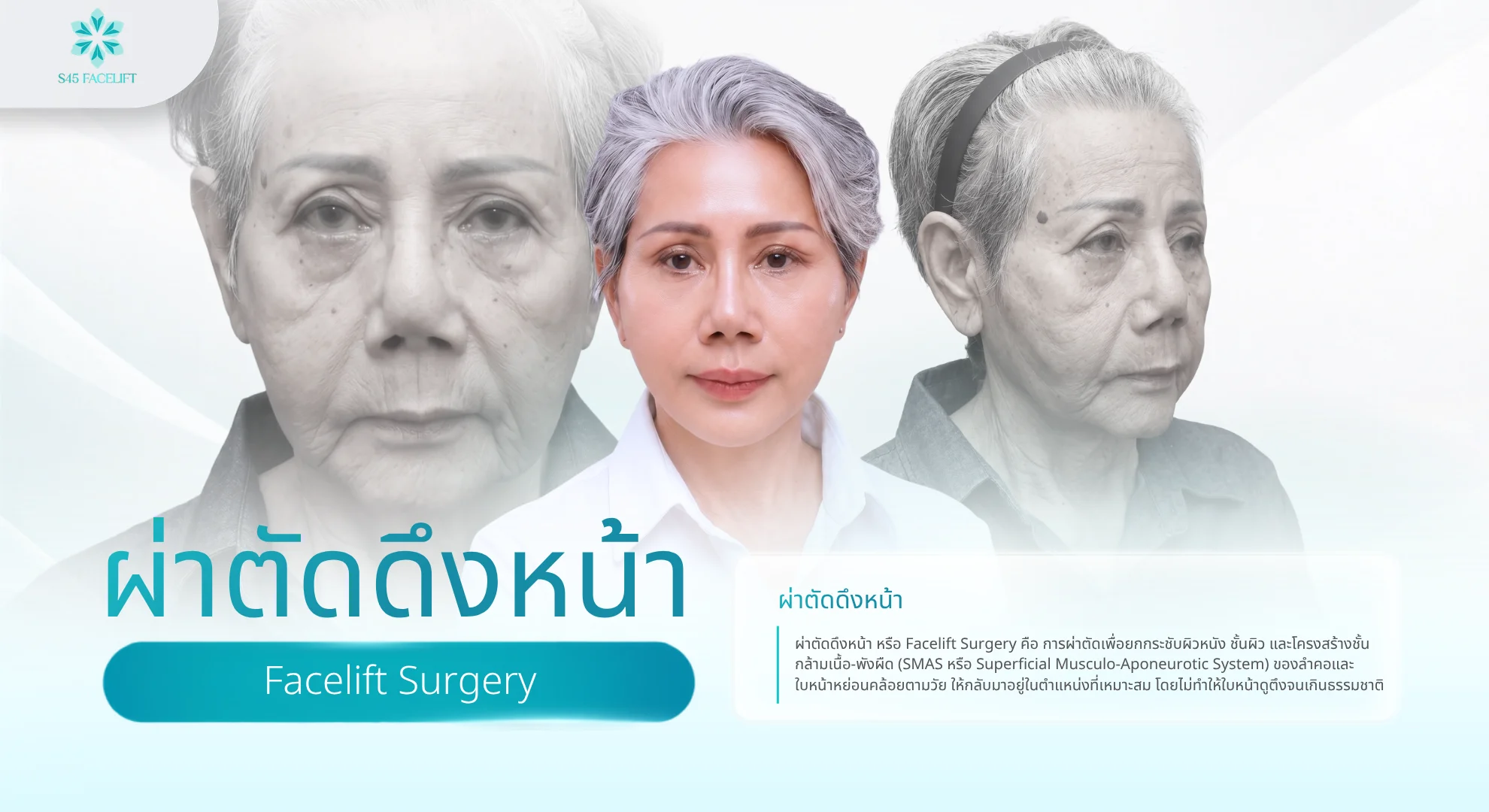
As you get older, the skin on your face starts to lose elasticity, which causes deep nasolabial folds, sagging cheeks, jowls and neck skin that is not as firm as before. Many people have tried non-surgical lifting treatments several times without getting the result they want. This is where facelift surgery can help lift the face, from the skin layers to the facial proportions.
Key points
- Face lift surgery is surgery to lift the skin of the face and neck and the deeper layers that sag with age, so they look firmer and suit your face.
- There are 4 main techniques: subcutaneous facelift, SMAS facelift, deep plane facelift and Endotine or endoscopic facelift. Each suits a different level of sagging.
- It suits people aged 40 or over with clear sagging, for whom non-surgical lifting treatments (such as HIFU, microfocused ultrasound and thread lifts) no longer give enough change.
- Points to consider include the recovery time, swelling and bruising at first, and results that depend on your existing facial structure and on how you look after yourself.
- Swelling after a facelift lasts about 2 to 4 weeks, and the result becomes clearer once the swelling goes down after the first month. Results last about 5 to 10 years, depending on the technique and aftercare.
- Choosing an experienced surgeon trained in facial plastic and reconstructive surgery, and a clinic with an operating theatre that meets recognised standards, is key to planning results that match realistic expectations.
This article brings together everything from what a facelift is and the concerns it can help with, the 4 main techniques, the benefits and the points to consider, to preparation and aftercare, recovery time, price and how to choose a clinic, so you can make an informed decision.
In This Article
What Is Face Lift Surgery?
Face lift surgery is surgery to lift the skin, the deeper skin layers and the muscle and connective tissue layer (SMAS, or superficial musculoaponeurotic system) of the neck and face that sag with age, and return them to a suitable position without making the face look overly tight. What makes it different from other lifting methods is that the surgeon can reach the deeper structures of the face directly. See more at ASPS Facelift (Rhytidectomy)
Areas That Facelift Surgery Can Lift
The surgeon can plan a full facelift or a partial facelift that lifts specific areas, depending on your skin and what you want. There are 4 main areas that can be lifted:
- forehead lift, which lifts sagging skin on the forehead and brows and reduces horizontal forehead lines
- upper face and temple lift, which lifts the temples and outer eye corners and helps the eyes look larger and brighter
- mid and lower facelift, for people with sagging cheeks, deep nasolabial folds, drooping mouth corners and jowls
- neck lift, which lifts the skin and muscles of the neck, reduces a double chin and gives the jawline and neck more definition
Understanding the SMAS Layer in Facelift Surgery
SMAS is the connective tissue layer just beneath the upper skin layer that links the skin to the facial muscles. With age, this layer loosens and pulls the skin down with it. Surgery that reaches the SMAS layer directly therefore gives longer-lasting results than lifting only the upper skin layer.
Concerns Facelift Surgery Can Help With
Facelift surgery covers several concerns in one procedure, so it suits people with several concerns at the same time. The main concerns it can help with are:
- lines and deep folds on the face, especially the folds from the sides of the nose (alae) to the corners of the mouth (nasolabial folds)
- sagging cheeks, where the skin in the middle of the face drops and makes the face look fuller or older than your age
- jowls and a less defined jaw, where the skin under the chin sags and overlaps and the jawline loses its definition
- a double chin, where the skin and deeper layers under the chin sag
- loose neck skin, where the neck skin sags and has horizontal lines
- heavy upper eyelids, where in cases caused by drooping brows a forehead lift helps the skin above the eyes look firmer
Importantly, facelift surgery does not solve every concern in one procedure. For example, fine lines on the face or uneven skin tone need other procedures as well. The surgeon assesses everything before surgery.
Who Is Face Lift Surgery Suitable For?
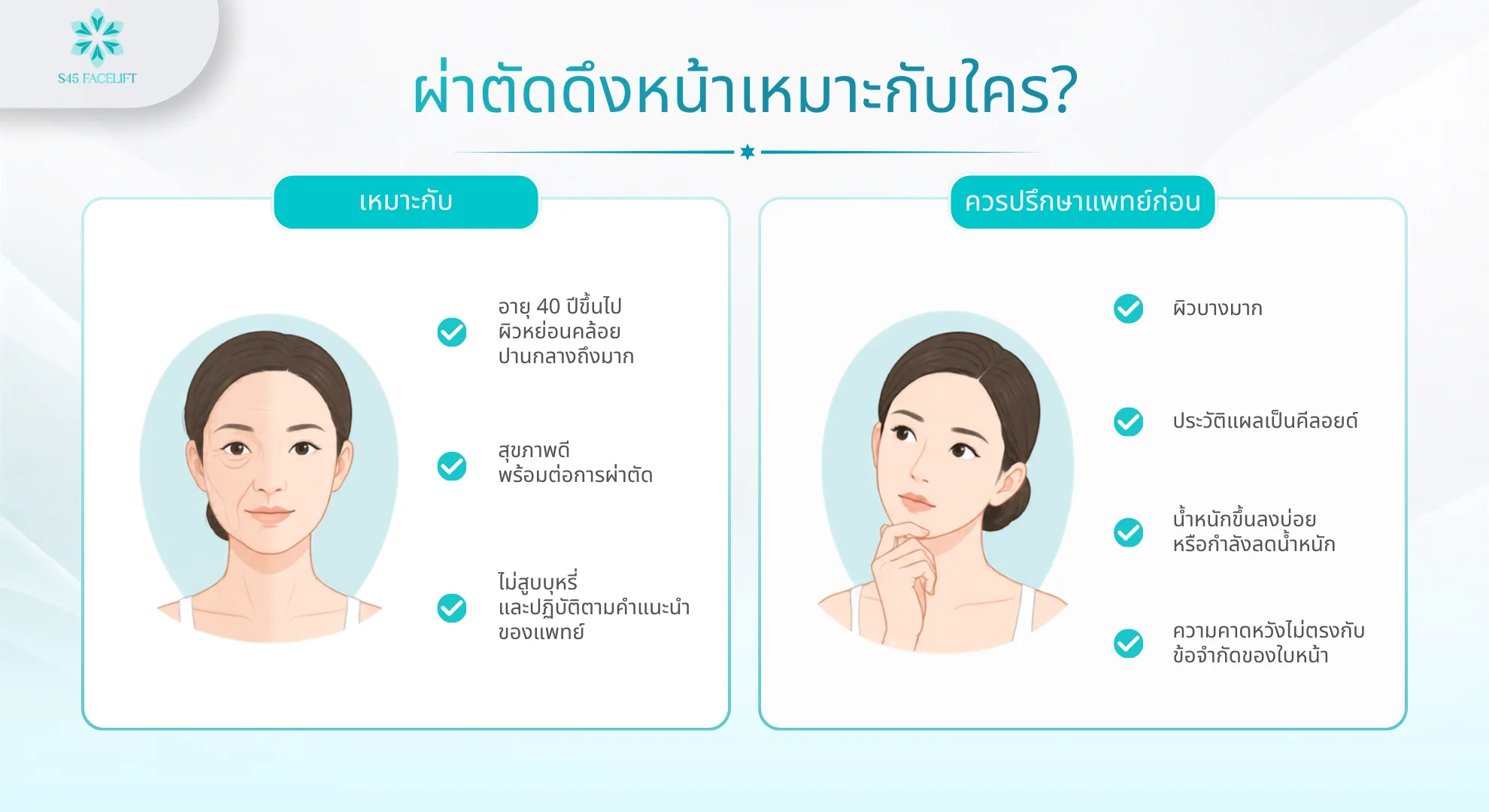
Not everyone gets the result they want from facelift surgery. Whether it suits you depends on your skin, age, general health and what you want.
Who Facelift Surgery Suits
Most are people aged about 40 or over with moderate to severe sagging, or people who have had non-surgical treatments such as microfocused ultrasound, HIFU or thread lifts but have not seen the change they wanted. You also need to be in good overall health for surgery, with no poorly controlled health conditions, and be able to stop smoking both before surgery and after it for as long as the surgeon advises.
People Who Should Have a Consultation Before Deciding
People with very thin skin, a history of keloid scars, frequent weight changes or ongoing weight loss, or expectations that do not match the limits of their facial proportions, should have a detailed consultation with the surgeon before deciding, because these factors may affect the care plan and how stable the results are in the long term.
4 Main Facelift Techniques Used Today
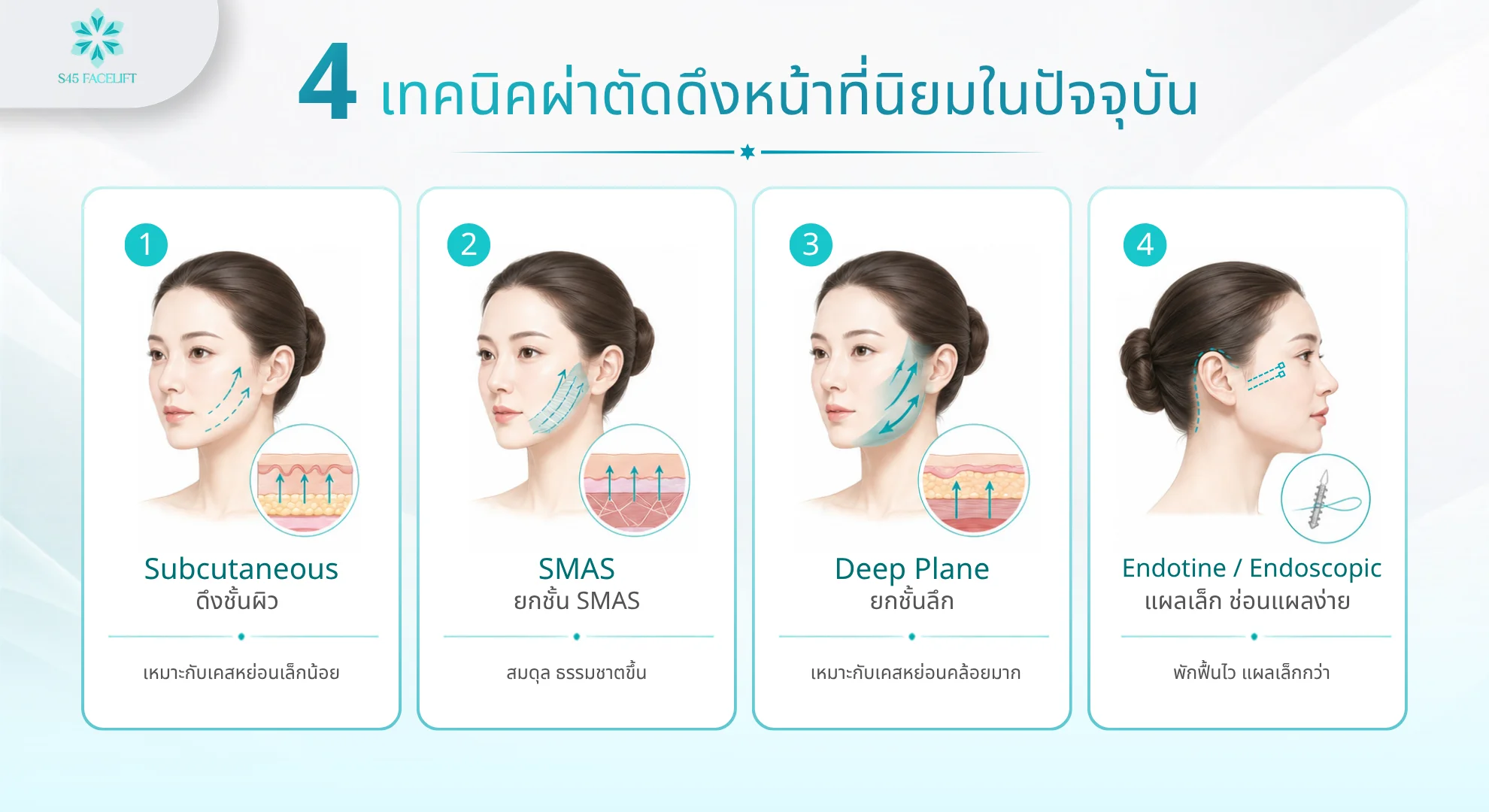
Choosing a facelift technique depends on the level of sagging, your facial proportions and the result you want. No single technique suits everyone. An experienced surgeon recommends a technique after assessing your face in person.
1. Subcutaneous Facelift (Lifting the Skin Layer)
A traditional technique that lifts and removes excess skin without reaching the SMAS layer. Its advantages are a shorter operation and usually a shorter recovery. It suits cases that need only part of the sagging skin corrected. Its limitation is that results do not last as long as with techniques that reach deeper layers.
2. SMAS Facelift (Lifting the SMAS Layer)
A technique widely used as a standard approach today. The surgeon lifts both the skin and the SMAS layer at the same time. Results last longer than lifting the skin alone, because the deeper structures are placed in the right position first and the upper skin layer is then lifted to match.
3. Deep Plane Facelift (Lifting in the Deep Plane)
A technique that reaches the deeper structures of the face by releasing the connective tissue that attaches the skin layers to the bone, then lifting the SMAS layer, muscles and skin together. It suits cases with significant sagging. Its limitations are a longer operation and the need for a surgeon with a high level of relevant experience.
4. Endotine and Endoscopic Facelift (Endoscope and Absorbable Fixation Device)
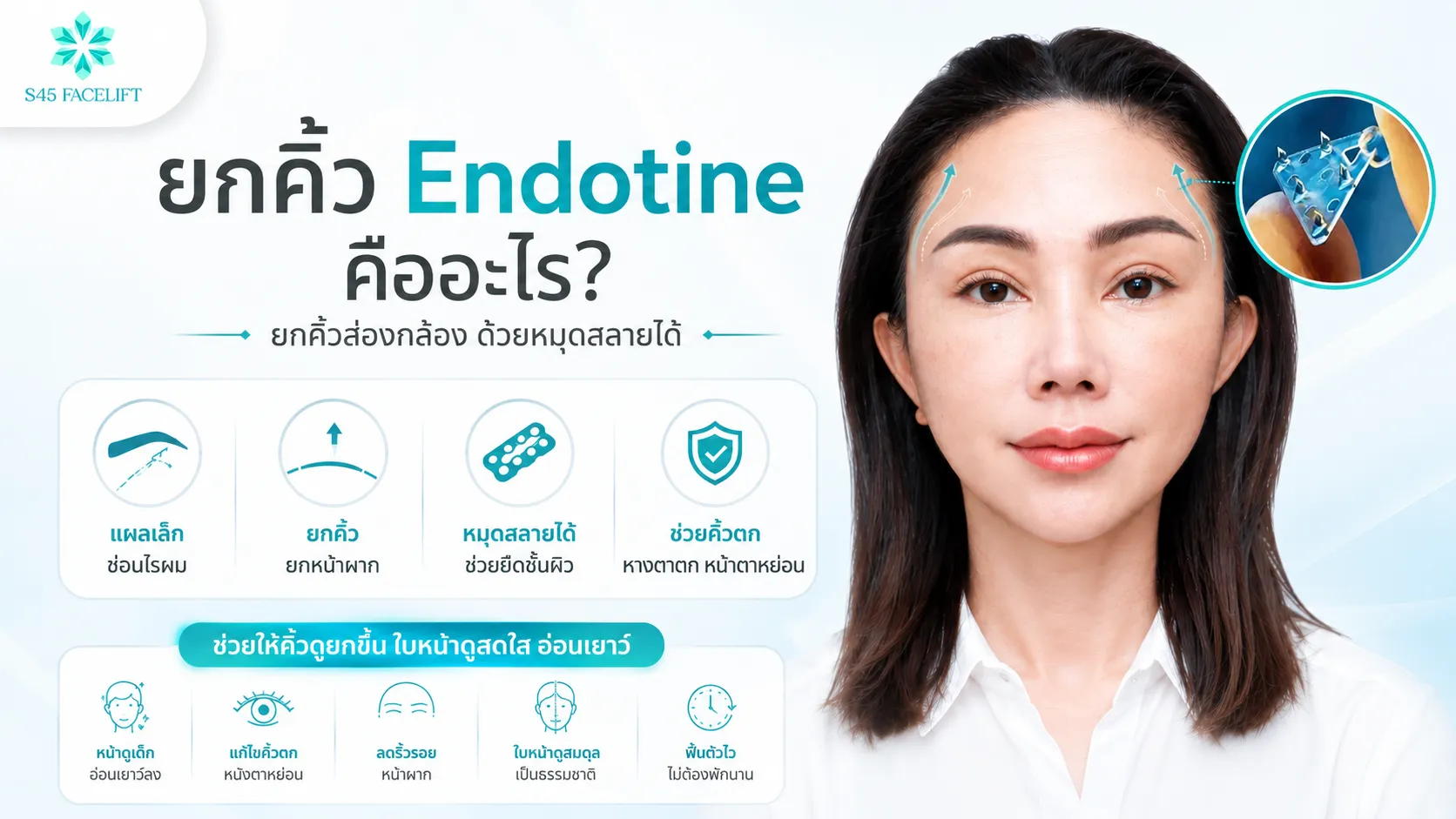
Endotine is a fixation device made from PCL+PLLA that the body absorbs over time. It holds the skin layers in the chosen position after lifting. It is used in an endoscopic facelift, which uses small incisions in the hairline instead of a long incision along the ear, so the incisions are smaller and recovery is usually shorter. It suits cases with moderate sagging, or people who want a forehead lift, brow lift and jawline lift without major surgery.
| Technique | Suitable level of sagging | Recovery time | How long results last |
|---|---|---|---|
| Subcutaneous | Mild or revision | 1 to 2 weeks | 3 to 5 years |
| SMAS Facelift | Moderate to severe | 2 to 4 weeks | 5 to 8 years |
| Deep Plane | Severe | 3 to 5 weeks | 7 to 10 years |
| Endotine / Endoscopic | Mild to moderate | 1 to 3 weeks | 5 to 10 years |
See more about facelifts with Endotine at Endotine
Facelift Surgery Procedure
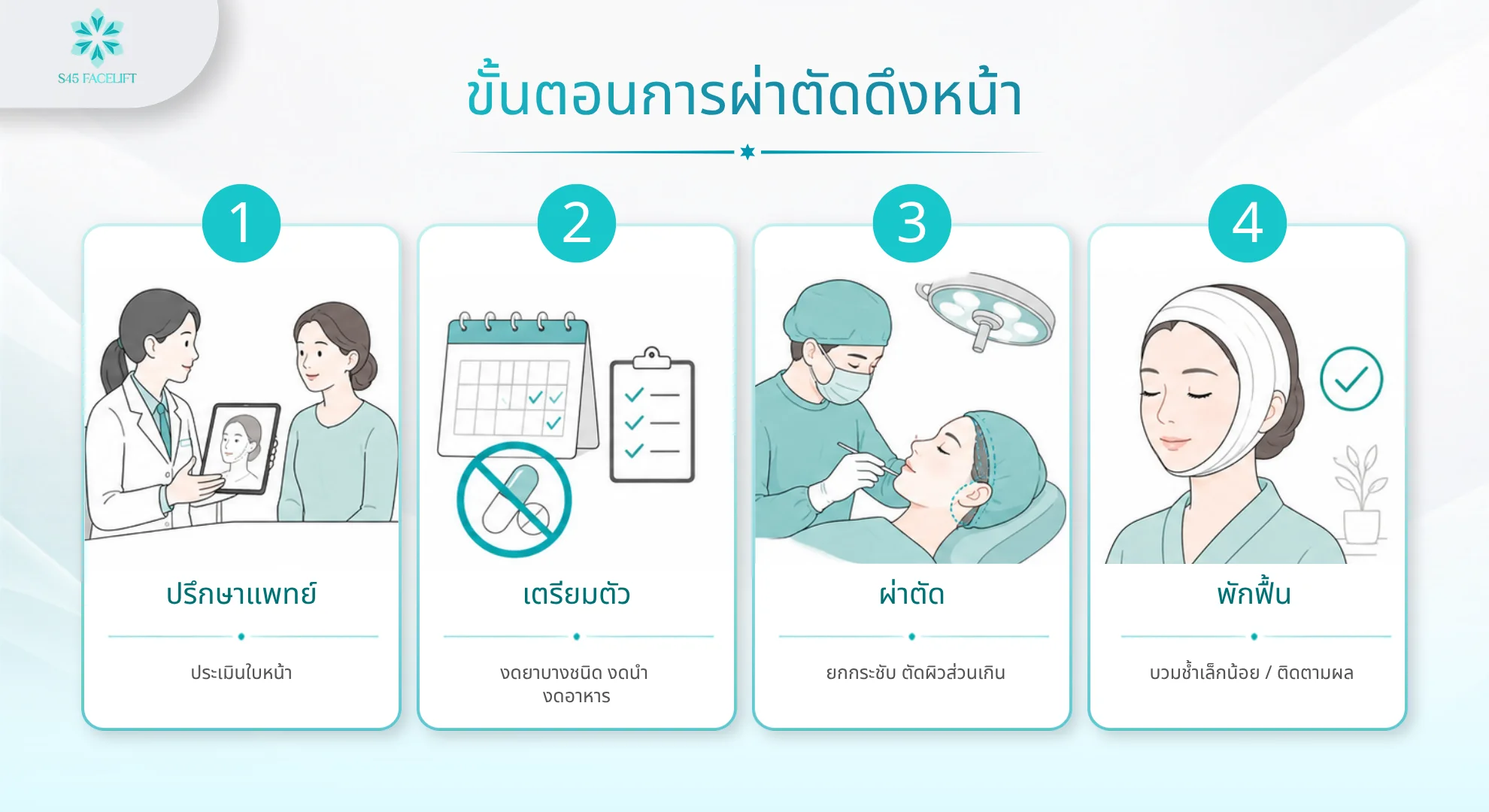
Although the techniques differ, the overall steps of facelift surgery follow a similar order.
Step 1, Consultation and Treatment Planning
The surgeon assesses your skin, facial proportions, level of sagging, health history and current medicines, and talks with you about your expectations and realistic results before designing a surgical plan for you.
Step 2, Preparing for Surgery
Stop medicines and supplements that affect blood clotting (aspirin, vitamin E and fish oil) as the surgeon advises, do not eat or drink before surgery for the time you are given, and prepare a place to recover in advance.
Step 3, the Operation
The operation is done under a general anaesthetic or a local anaesthetic with sedation, depending on the technique and the extent of the surgery. The surgeon makes incisions along the planned lines, which are mostly hidden in the hairline and along the edge of the ear, reaches the layers that need lifting, lifts them, removes excess skin and closes the incisions. The operation takes 2 to 5 hours, depending on the technique.
Step 4, Recovery and Follow-Up
At first after surgery you may have swelling, bruising, tightness and some numbness in parts of the skin. These are a normal part of wound healing. The surgeon schedules follow-up appointments at set times.
Benefits of Facelift Surgery
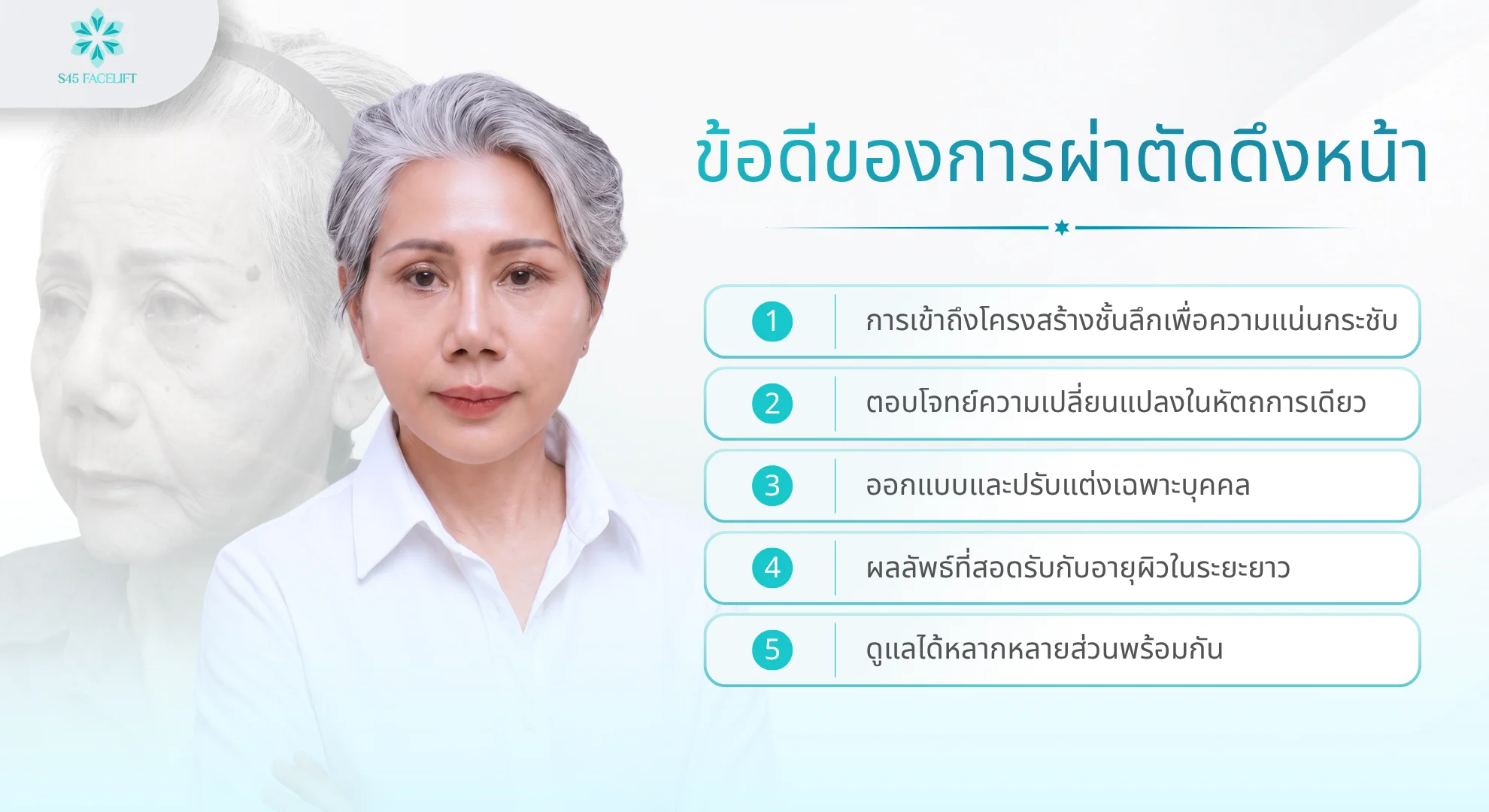
Compared with non-surgical energy-based lifting, facelift surgery differs in the layers it treats and in how long the results last, as follows:
Reaching the Deeper Structures for Firmness
Facelift surgery can reposition and stitch the SMAS layer, which is an important layer in supporting sagging tissue. This is different from treating the skin from the outside, so it helps support the deeper structures of the face.
A Clear Change in One Procedure
It helps you see a visible change in sagging after the procedure, without needing to repeat it as often as heat-based energy treatments, so it may suit people with a large amount of accumulated sagging.
Designed for Each Person’s Facial Proportions
Because each person’s bone structure, fat and skin proportions are different, facelift surgery lets an experienced surgeon assess, analyse and design the direction of the lift in detail to suit each person’s features and face shape.
Long-Lasting Results That Cover Several Areas
With SMAS or deep plane facelift techniques, results can last about 5 to 10 years (depending on your existing skin structure and how you look after yourself). Surgical planning can also treat several areas in one procedure, including the forehead, outer eye corners, deep nasolabial folds, jawline and neck skin.
Points to Consider With a Facelift
Before you decide, understand the points to consider with a facelift so your expectations match what is realistic.
Recovery Takes Time
Facelift surgery needs real recovery time. In the first 1 to 2 weeks you will have visible swelling and bruising, and you need to avoid strenuous activity for 3 to 4 weeks. Plan a suitable time before surgery.
Swelling, Bruising and Temporary Numbness
Swelling gradually goes down over 2 to 4 weeks, and slight swelling may remain for up to 2 to 3 months. Some people may have numbness or unusual sensitivity around the surgical area at first, which gradually improves as the nerves recover.
Possible Risks
As with all surgery, there are risks to be aware of, including infection, bleeding under the skin (haematoma), visible scars or asymmetric results. You can lower the chance of these by choosing an experienced surgeon and a clinic that meets recognised standards.
Preparing for and Looking After Yourself After Facelift Surgery
Before surgery, tell the surgeon about all your health conditions, current medicines, supplements, herbal remedies and drug allergies. The surgeon may advise you to stop some medicines or supplements, such as aspirin, vitamin E, high-dose vitamin C or fish oil, about 2 weeks before surgery, and to stop smoking for about 4 to 6 weeks, both before surgery and after it.
- Weeks 1 to 2: sleep with your head raised to reduce swelling, avoid heavy lifting and exercise, and wash your face and care for the wound as the surgeon advises.
- Weeks 2 to 4: swelling and bruising go down a lot. You can start light activities again, but still take care with strenuous activity.
- Months 1 to 3: the skin and deeper layers gradually settle and the final shape becomes clearer. Use sunscreen every day and look after your skin regularly.
Things to avoid in the long term include smoking, large weight changes and sunbathing without sunscreen, because they directly affect how long the results last.
How Long Does a Facelift Last?
How long a facelift lasts depends on 3 main factors: the technique used, your skin and existing structure, and how you look after yourself after surgery. In general, an SMAS facelift gives results that last about 5 to 8 years, while a deep plane facelift may last up to 7 to 10 years. An Endotine facelift lasts about 5 to 10 years, depending on the techniques used with it. Regular skin care and avoiding things that damage the skin can help the results last longer.
Facelift Surgery Prices
Facelift surgery prices vary with many factors and there is no fixed price, because each case is different. An accurate price needs an examination and a consultation with the surgeon in person.
Factors That Affect the Price
The price depends on the technique used, as each technique covers a different extent of surgery, and on the areas treated, such as a partial facelift, a neck lift, a forehead lift or several areas together. It also depends on the surgeon’s experience, the operating theatre standards, the anaesthesia team and the services included in the quotation.
What to Check in a Quotation and Points to Watch
Ask for a quotation that clearly states whether it includes the anaesthetist fee, medicines after surgery, stitch removal, splint or bandage removal, follow-up and aftercare. A price much lower than the market may reflect lower operating theatre standards, a surgeon with less experience or lower-quality materials.
How to Choose a Clinic for Facelift Surgery
When you ask where to have facelift surgery, the answer depends on factors that matter more than fame or price, because the result of facelift surgery depends mainly on the surgeon and the clinic’s standards. Look for:
- a surgeon with board training in otolaryngology or the sub-specialty of facial plastic and reconstructive surgery, not a general doctor who has only completed a short course
- an operating theatre with the correct licence (form Sor.Por.7) and one-to-one care from the anaesthesia team in cases with a general anaesthetic
- a varied portfolio of facelift cases, with results that do not look tight or overly pulled
- a detailed consultation process before surgery that explains the technique, risks, steps and realistic expected results
- a complete aftercare system, with a team that follows your progress for 1 to 6 months after surgery and a way to get in touch in an emergency
Why Choose S45 Clinic for Facelift Surgery
S45 Clinic provides facelift surgery under the name S45 Facelift, which designs each lift for your own facial proportions rather than using a ready-made template, under the promise “Because all beauty comes from care”. See more at Reasons to consider Endotine
Experienced Surgeons
Our surgeons, trained in otolaryngology with a sub-specialty in facial plastic and reconstructive surgery, assess your face and design a facelift plan that suits your facial features.
S45 Facelift and Endotine Techniques
S45 Clinic uses the S45 Facelift technique and Endotine, made from PCL+PLLA, which the body absorbs over time, to hold the lifted skin layers in the chosen position. It suits cases that want a forehead lift, brow lift, jawline lift or reduced jowls, using small incisions in the hairline.
Operating Theatre and 1 Year of Aftercare
The operating theatre at S45 Clinic runs under the clinic’s healthcare facility licence, with one-to-one care from the anaesthesia team in cases with a general anaesthetic, and a dedicated aftercare team that follows your progress for 3 to 6 months after surgery and continues care during the first year.
Frequently Asked Questions About Facelift Surgery
What Is Face Lift Surgery and Who Is It Suitable For?
Face lift surgery is surgery to lift the skin of the face and neck and the deeper layers. It suits people aged 40 or over with moderate to severe sagging, for whom non-surgical lifting treatments no longer give enough change. You need to be in good health, with no health conditions that rule out surgery.
How Many Hours Does Facelift Surgery Take?
It depends on the technique and the areas treated, and usually takes 2 to 5 hours. A subcutaneous or partial Endotine technique takes less time, while a full facelift with the SMAS or deep plane technique takes 3 to 5 hours.
How Long Does Swelling Last After Facelift Surgery?
Swelling and bruising usually go down a lot within 7 to 14 days, so you can return to office work. By months 1 to 3 most of the swelling has settled, and the result becomes clearer after months 3 to 6, depending on each person.
How Long Does a Facelift Last?
On average it lasts 5 to 10 years, depending on the technique (a deep plane facelift lasts longer than a subcutaneous facelift), skin care after surgery, avoiding sun and smoking, and keeping your weight stable.
What Are the Downsides of a Facelift?
Things to know include a recovery time of 2 to 4 weeks, swelling and bruising at first, possible temporary numbness of the skin, and results that depend on your existing structure and self-care. There are also the general risks of surgery, and you can lower the chance of these by choosing an experienced surgeon and a clinic that meets recognised standards.
How Is a Facelift Different From a Thread Lift and HIFU?
Thread lifts and HIFU are non-surgical lifting techniques that work from the outside and suit mild to moderate sagging. Their results gradually fade within 1 to 2 years and need to be repeated. Facelift surgery reaches the deeper structures directly, giving a more visible change with results that last about 5 to 10 years, depending on each person.
Does Facelift Surgery Need a General Anaesthetic?
It depends on the technique and the extent of the surgery. A full face and neck lift uses a general anaesthetic, while a partial lift or the Endotine technique may use a local anaesthetic with sedation. The surgeon recommends the option that suits your case.
Does Facelift Surgery Hurt a Lot?
During surgery you are under a general anaesthetic or a local anaesthetic, so pain is controlled. After surgery you may feel tightness, mild pain and numbness in some areas, which the surgeon manages with suitable painkillers. Symptoms usually improve step by step over the first week.
Summary
Face lift surgery is a procedure that lifts the skin of the face and the deeper structures. It suits people whose sagging is at a level where non-surgical techniques no longer give enough change. There are 4 main techniques to choose from depending on the level of sagging: subcutaneous, SMAS, deep plane and Endotine or endoscopic facelift.
The main benefit is reaching the deeper structures, while the points to consider include the recovery time, swelling and bruising at first, and results that depend on your existing structure and self-care.
The most important thing is to choose an experienced surgeon with facial training, a clinic with an operating theatre that meets recognised standards and a complete aftercare system, not to decide on price or promotions alone.
Because every face shape…
is different
An otolaryngologist with subspecialty training in facial plastic and reconstructive surgery assesses every case before treatment and gives advice based on your actual concerns.
“Reveal the beauty within you”
Message us online
Surgery and medical procedures carry risks. Find out about them and consult a doctor before you decide. Results depend on each person.