What Causes Downturned Eyes? Treatment and Medical Precautions

Example image used in advertising. Not a real patient.
Key points
- Causes: droopy outer eye corners come from collagen breaking down with age, together with the pull of the muscles around the eyes. The problem is also linked to your facial anatomy and the line of the eye socket bones you were born with, so the main cause is not only sagging of the outer layer of skin.
- Signs to check: eyelid skin drooping down to block your side vision, and your existing eyelid crease becoming hidden. Some people also have folds of overlapping skin that trap moisture or cause irritation. These signs suggest it is time to have a doctor assess you and find care that suits your skin.
- Medical treatment: options include surgery that hides the scar beneath the eyebrow, known as a sub-brow lift, to remove excess skin while keeping your existing eyelid shape. Another option is an endoscopic brow lift (using a thin tube with a camera), which supports both the eyebrows and the outer eye corners at the same time.
- Precautions and recovery: the doctor must always screen for ptosis (weakness of the muscle that lifts the eyelid) before starting. After surgery, stitches are removed at an appointment set by your doctor, which differs by technique. Scars usually fade gradually over about 3 to 6 months. Results and recovery may vary from person to person.
Downturned eyes, or droopy outer eye corners, mean sagging eyelid skin or outer eye corners that slope downwards. This is common with age. It affects how fresh the face looks and may get in the way of your vision. The cause is not only sagging of the outer layer of skin. It is also linked to your facial anatomy, the tendon at the outer eye corner, the muscles around the eyes and age-related changes in the line of the eye socket bones.
S45 Clinic has put together medical information about the causes, the warning signs that it is time to see a doctor, surgical methods to correct the problem, and their benefits and precautions. This information is a basic guide to the anatomy around the eyes and helps you prepare before a doctor assesses you.
In This Article
What Are Downturned Eyes and What Do They Look Like?
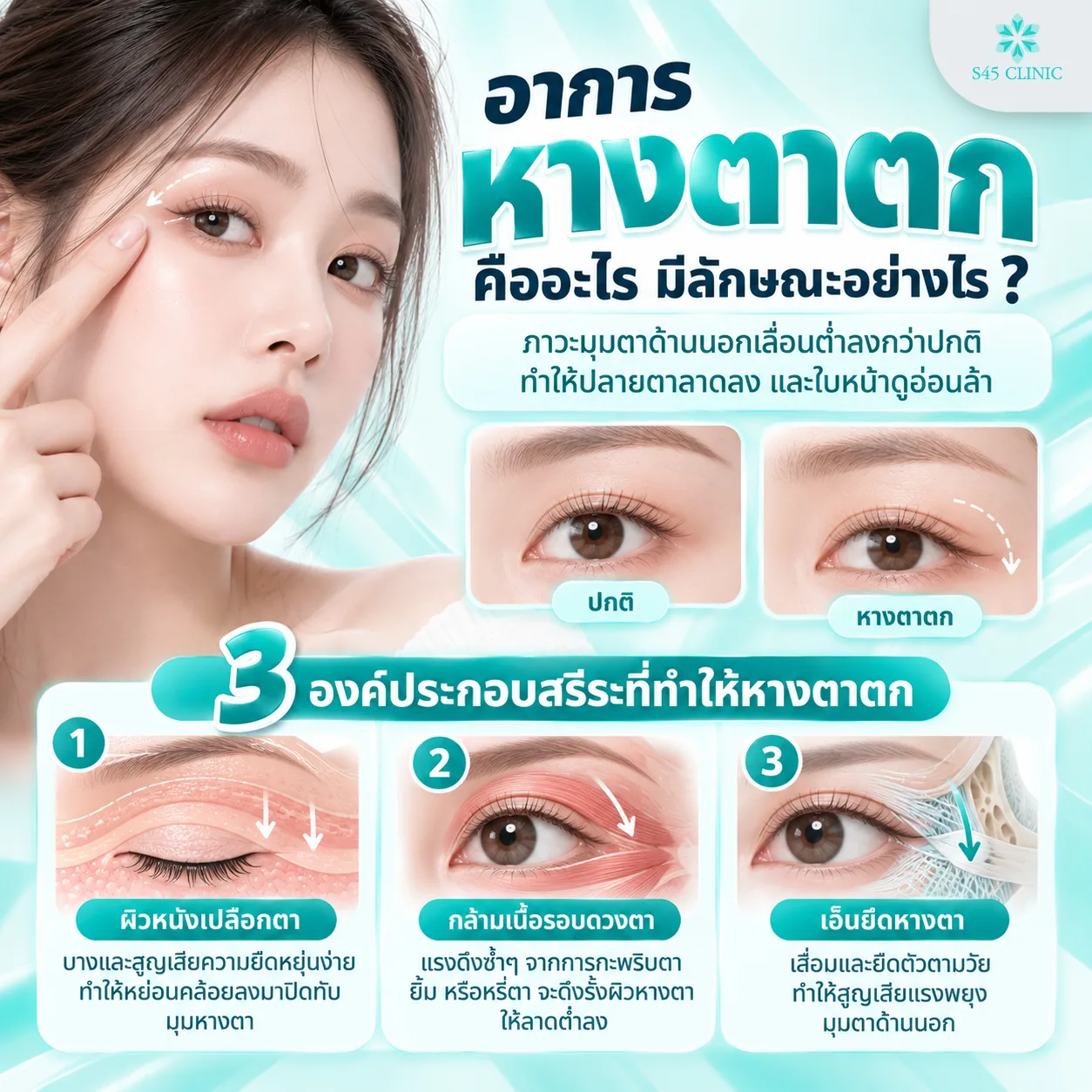
Droopy outer eye corners are when the skin, muscle or tissue beneath the skin at the outer corner of the eye moves lower than its usual level. This makes the end of the eye slope down and the face look tired. The anatomy around the eyes is delicate, with several layers of tissue that work together every time the eyelid moves.
Anatomy of the Eyelid Skin and the Tendon at the Outer Eye Corner
Several parts of the eyelid anatomy affect how firm the outer eye corner is. The main parts are:
- Outer eyelid skin: the skin here is thin and moves every time you blink throughout the day. Over time, it loses elasticity and sags down over the outer eye corner.
- Orbicularis oculi (the ring of muscle around the eye): this muscle blinks and closes the eyelid. Repeated pull from smiling or squinting over a long time creates creases and pulls the skin at the outer eye corner downwards.
- Lateral canthal tendon (the tendon at the outer eye corner): this tendon holds the outer corner of the eye to the rim of the eye socket. When it stretches with age, the outer eye corner loses support and sags downwards.
Downturned Eye Corners From Birth Versus Sagging Eyelid Skin
You can tell eye corners you were born with apart from age-related sagging by looking at how low the corner slopes and how firm the skin is. This helps the doctor choose suitable care. The differences are:
- Downturned eye corners from birth: the outer eye corner sits slightly lower than the inner corner as part of the anatomy you were born with. The skin is still elastic, there are no folds hanging over the edge of the eyelid, and your vision is not affected.
- Sagging eyelid skin: excess skin stretches and hangs over your existing eyelid crease. The outer part of the crease becomes hidden, and the folded skin may hang down and partly cover the outer edge of the iris (the coloured part of the eye).
What Causes Droopy Outer Eye Corners?
Droopy outer eye corners come from several anatomical factors working together, including age-related changes in the skin, the features you were born with and the pull of the muscles around the eyes. This information helps the doctor plan a method of correction that suits each person’s anatomy.
Skin Elasticity That Decreases With Age
Skin elasticity that decreases with age is a main factor commonly found in people with droopy outer eye corners. It comes from changes in the skin layers with age, as follows:
- Loss of collagen and elastin: the body makes less of the protein fibres that support the skin, so the eyelid skin becomes thin and loose.
- Gravity: skin that has lost firmness is pulled downwards continuously, so excess skin builds up at the outer eye corner.
- Rubbing your eyes hard and often: this stretches the tissue beneath the skin, so it sags sooner than usual.
Eye Socket Bones and Inherited Features
The eye socket bones and the features you inherit directly affect the position of the outer eye corners. The related features are:
- An outer eye socket rim that slopes down from birth: there is less area to support the skin layers, so the skin at the end of the eye sags easily.
- Brow bone and eyebrow position: if you have low eyebrows, or a small gap between your eyebrows and eyes, the skin at the outer eye corner is pressed down, so it looks thick and droops over the eye.
- Bone loss with age: the bone of the eye socket and its outer rim gradually shrink, so the tissue around the eyes loses a firm base to hold on to.
Which Droopy Outer Eye Corner Symptoms Need a Doctor?

Droopy outer eye corners need a doctor when sagging skin starts to block your vision or affect your daily life. Noticing the physical symptoms helps you know when to have a clinical assessment. An early assessment can help lower the chance of long-term effects on your vision and the hygiene around your eyes.
Drooping Skin at the Outer Eye Corner Blocks Your Vision
Skin at the outer eye corner drooping down and blocking your vision is an important warning sign that a doctor should assess you to find suitable care. Symptoms you may notice include:
- Narrower side vision: skin at the outer eye corner hangs down and blocks your view to the side, so you need to turn your head to see when driving or walking.
- Constantly tense forehead muscles: you keep raising your eyebrows to stop the eyelid skin blocking your vision. This causes deep lines on the forehead and tiredness in the muscles around the eyes.
- A hidden eyelid crease: this often happens in people who already have a double eyelid crease. The outer part of the crease disappears and becomes hidden, which makes the eyes look less bright.
Folded Skin at the Outer Eye Corner Traps Moisture and Causes Irritation
Folded skin at the outer eye corner that traps moisture and causes irritation is a physical effect in the skin crease, and it often leads to several hygiene problems around the eyes:
- Build-up of sweat and tears: overlapping skin at the outer eye corner traps moisture, so the skin becomes red and inflamed easily.
- Stinging or itching at the outer eye corner: drooping skin rubs against itself, causing ongoing irritation, and the area is hard to clean.
- Eyelashes turning inwards: when eyelid skin presses down on the eyelashes at the outer eye corner, the lashes turn inwards and irritate the cornea (the clear outer layer of the eye).
What Surgical and Other Treatments Are There for Droopy Outer Eye Corners?
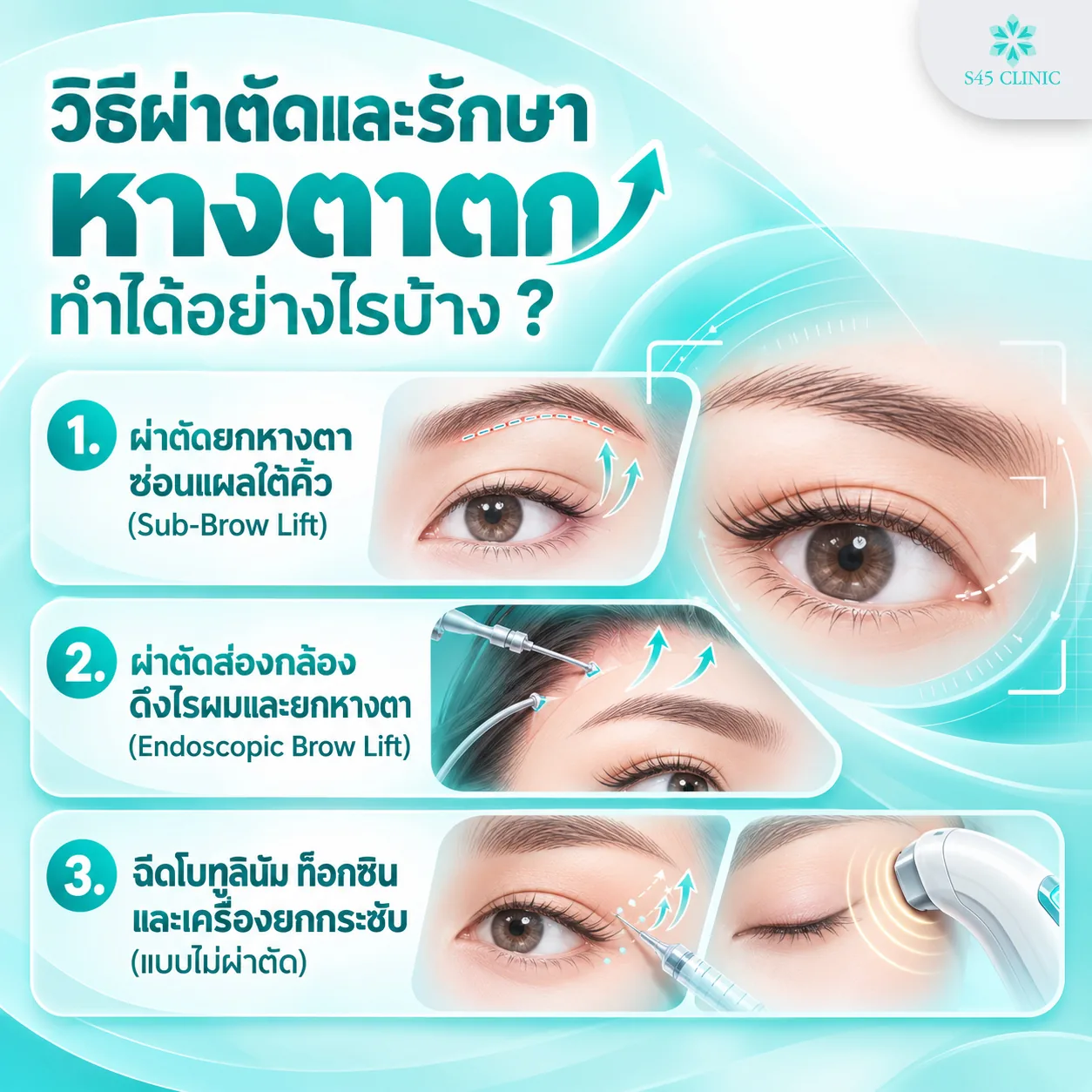
Droopy outer eye corners can be treated with eye lift surgery or with medical procedures. The doctor always assesses where the sagging is, the condition of the skin and the strength of the muscles first. This information is used to choose a care technique that suits each person’s facial anatomy.
Sub-Brow Lift (Hidden Scar Beneath the Eyebrow)
A sub-brow lift suits people who already have an eyelid crease but whose skin at the outer eye corner sags and covers it. It involves:
- Surgical technique: the surgeon makes an incision close to the lower edge of the eyebrow to remove excess skin and the tissue beneath it, then stitches the tissue to the periosteum (the layer covering the bone) beneath the eyebrow.
- Key feature: this method helps open up the outer eye corner and lifts the drooping skin directly without disturbing your existing eyelid crease. The scar is small and hidden close to the eyebrow hairs, which helps it blend in. Results vary from person to person.
Endoscopic Brow Lift Through the Hairline to Lift the Outer Eye Corners
An endoscopic brow lift through the hairline that also lifts the outer eye corners addresses the problem from the upper part of the face. It suits cases where droopy outer eye corners come with droopy eyebrows or a sagging forehead. It involves:
- Surgical technique: the surgeon makes small incisions of about 1cm to 2cm in the hairline, then inserts an endoscope (a thin tube with a camera) to separate the tissue beneath the forehead skin and lift the eyebrows and outer eye corners together.
- Key feature: this method can lift the eyebrows and outer eye corners at the same time. The scars sit in the hairline, a technique that hides them so they are hard to see on the face.
Botulinum Toxin Injections and Skin-Tightening Devices to Support Droopy Outer Eye Corners
Botulinum toxin injections and skin-tightening devices are procedures that support the tissue beneath the skin to slow sagging. They are options for people with early symptoms or who are not ready for surgery. They work as follows:
- Botulinum toxin injections: the doctor injects into the muscle around the outer eye corner to relax the muscle that pulls it down. This may let the muscle that raises the eyebrows work more and help the outer eye corner look more open temporarily.
- Skin-tightening devices: energy is delivered into the tissue beneath the skin to stimulate collagen to contract, which may help support skin with mild sagging.
What Are the Benefits and Precautions of Treating Droopy Outer Eye Corners?
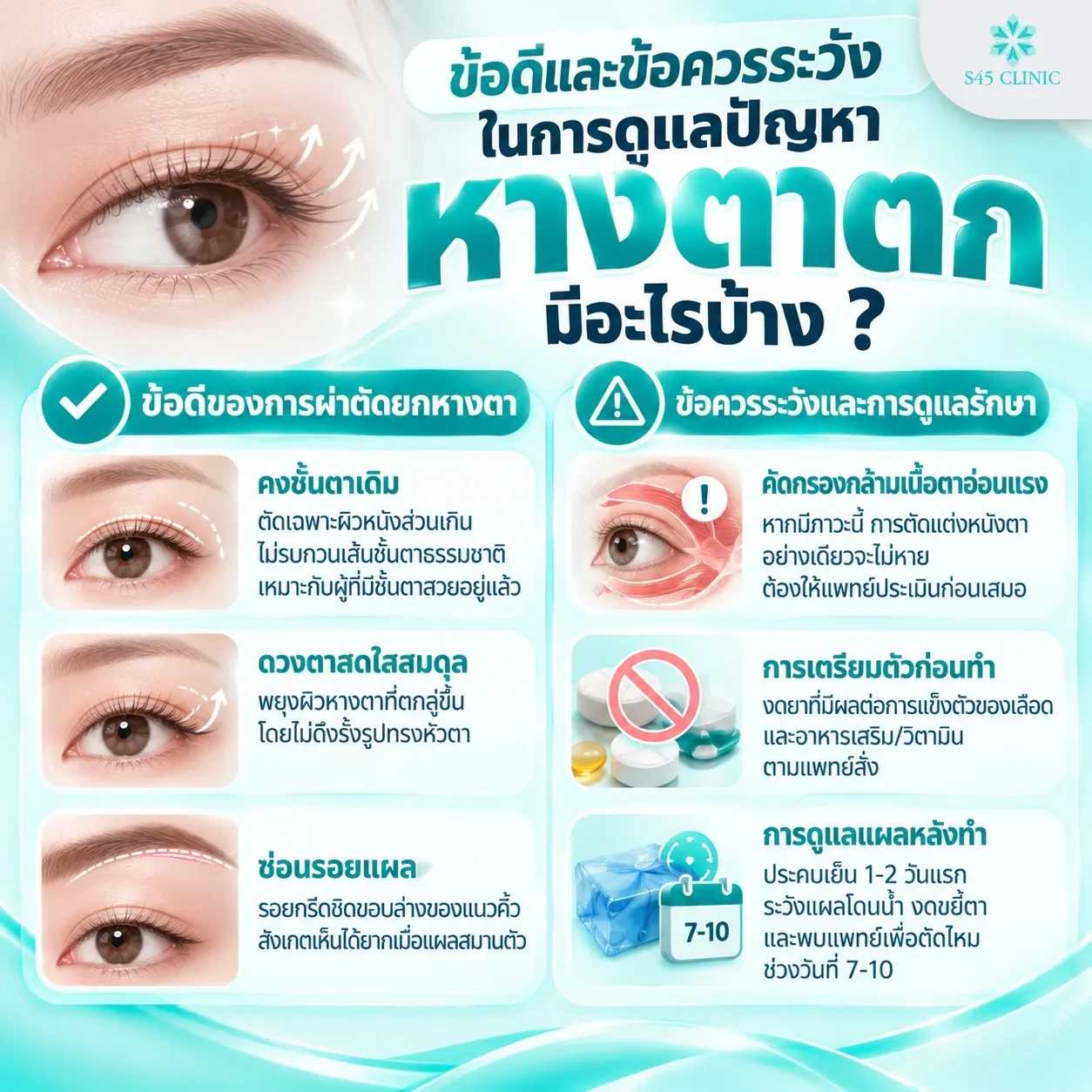
The benefits of treating droopy outer eye corners are that it can help open up your vision and reshape the face in proportion with each person’s features. The precautions are that medical limitations and self-care must always be considered as well. Assessing these factors carefully helps the care plan match the area around each person’s eyes.
Benefits of an Eye Lift for Hiding the Scar and Keeping Your Existing Eyelid Crease
The benefit of an eye lift for hiding the scar and keeping your existing crease is that it uses a technique that hides the scar beneath the eyebrow to remove excess skin while keeping the character of your eyes. The benefits of this method include:
- Keeping your existing eyelid crease: this is possible without disturbing your existing eyelid fold. It suits people who already have an eyelid crease in proportion with their features and want to remove only the excess skin at the outer eye corner.
- Eyes that look fresher and in keeping with your age: the drooping skin is lifted and supported. The doctor plans the surgery so it does not pull on the shape of the inner eye corner or make the eyes look too wide for your face, so the eyes suit your facial proportions. Results vary from person to person.
- A scar that is hard to see: the incision is placed close to the lower edge of the eyebrow hairs, so the scar is hard to see once the wound has healed. How the wound heals depends on each person’s skin.
Precautions About Ptosis and Wound Care
Precautions about ptosis and wound care involve preparing and screening for risks before treatment. The medical limitations and precautions to follow before and after surgery are:
- Screening for ptosis: this is an important step. If the muscle that lifts the eyelid is also weak, removing only the skin at the outer eye corner cannot correct difficulty opening the eye, so a doctor needs to assess you in detail before surgery.
- Stopping medicines and supplements: before surgery, stop medicines that affect blood clotting and some vitamins, as your doctor advises.
- Early wound care: apply cold compresses around the eyes for the first 1 to 2 days. Swelling and bruising may vary from person to person. Keep the wound dry, avoid rubbing your eyes and see the doctor for stitch removal as scheduled. For an endoscopic brow lift, stitches are usually removed about 10 to 14 days after surgery. For a scar beneath the eyebrow, timing depends on the doctor’s assessment.
Why Choose S45 Clinic to Treat Droopy Outer Eye Corners?
The reason to choose S45 Clinic is that we place importance on what suits your facial anatomy, to give you a treatment plan that suits you. Treating the area around the eyes needs a detailed analysis of the anatomy, so S45 Clinic assesses the actual problem before planning every time.
Individual Eye Assessment Before Surgery
The individual assessment of the anatomy around your eyes before surgery at S45 Clinic is a detailed analysis of your facial anatomy to plan care that suits you. The assessment includes:
- measuring the distance and direction of the droop at the outer eye corner compared with your eye level
- checking the muscle that lifts the eyelid, to screen for and rule out other conditions
- assessing the amount of excess skin together with the elasticity of the tissue beneath the eyebrow
- planning the incision to follow the line of your eyebrow hairs, to hide the scar
Operating Room Hygiene and Follow-Up After Surgery
Operating room hygiene and follow-up after surgery at S45 Clinic are continuous care from surgery through to recovery. The details are:
- Operating room: cleanliness is controlled under the medical facility’s system.
- Ongoing follow-up: there is an appointment system to check the wound, remove stitches and closely follow your recovery at scheduled times.
Check before you choose a clinic: Where to Get a Brow Lift? Techniques, Prices and 5 Criteria for Choosing a Brow Lift Surgeon
Frequently Asked Questions About Droopy Outer Eye Corners
These frequently asked questions about droopy outer eye corners cover medical questions to help you prepare before deciding on treatment. They include effects on the shape of your eyes, what the surgical scar looks like and the chance of the problem coming back in future, so you understand and are ready for suitable care.
Will Surgery for Droopy Outer Eye Corners Change the Shape of My Eyes?
An eye lift with a hidden scar beneath the eyebrow aims to keep your existing eye shape, because the doctor removes only the excess skin that has sagged over the eye. This does not pull on the inner eye corner or disturb your existing eyelid fold, so your existing crease often becomes clearer again. Results and recovery may vary from person to person.
Will the Scar From Surgery for Droopy Outer Eye Corners Be Easy to See?
A sub-brow scar is usually hard to see, because the doctor places the incision close to the lower edge of your eyebrow hairs, a technique that hides the scar. The scar usually fades in these stages:
- At first, after the stitches are removed, there may be faint redness along the edge of the eyebrow, which you can cover with makeup or eyebrow pencil as your doctor advises.
- Over 3 to 6 months, the scar usually fades gradually until it blends in with the eyebrow hairs.
Can Droopy Outer Eye Corners Come Back?
After excess skin is removed, the outer eye corners can still sag again as your body changes with age. Results depend on your care and each person’s skin. Avoiding rubbing your eyes, using sunscreen to protect your skin and caring for the skin around your eyes regularly can help slow sagging over the long term.
Summary
Downturned eyes come from age, genetics and everyday habits. They can be cared for and corrected in several ways, from procedures that support the tissue beneath the skin to eye lift surgery with a hidden scar beneath the eyebrow.
An assessment of your facial anatomy by a doctor helps plan suitable treatment. Results vary from person to person.
Because every face shape…
is different
An otolaryngologist assesses every case before treatment and gives advice based on your actual concerns.
“Reveal the beauty within you”
Message us online
Surgery and medical procedures carry risks. Find out about them and consult a doctor before you decide. Results depend on each person.