How to Fix Droopy Eyelids, Causes and Medical Treatments

Example image used in advertising. Not a real patient.
Key points
- Droopy eyelids have 3 main causes: loose eyelid skin, weakness of the muscle that lifts the eyelid, and eyebrows that have moved lower.
- Warning signs that you need treatment are the edge of the upper eyelid covering more of the iris than usual, a narrower field of vision, or tension in your forehead muscles from raising your eyebrows to help you see.
- Medical treatment for excess eyelid skin is removing the extra skin or surgery with the scar hidden beneath the eyebrow. For low eyebrows, the doctor uses an endoscopic brow lift.
- Treatment can help widen your field of vision, and results differ from person to person. Your skin and eyelids continue to change with age. Avoid rubbing your eyes, to help slow sagging over the long term.
Droopy eyelids, loose eyelid skin or downturned outer eye corners are common with age. They directly affect your appearance and your vision. Many people think the only cause is loose skin, but the cause may also be the eyelid muscle or a change in the position of the eyebrows. Leaving these symptoms untreated can make the face look tired and block your vision in daily life.
S45 Clinic has gathered medical information about the causes, warning signs and surgical options, to help you understand eyelid problems. You can use this information to prepare before you see a doctor to have your symptoms assessed.
In This Article
Understanding Droopy Eyelids and the Features Around the Eyes
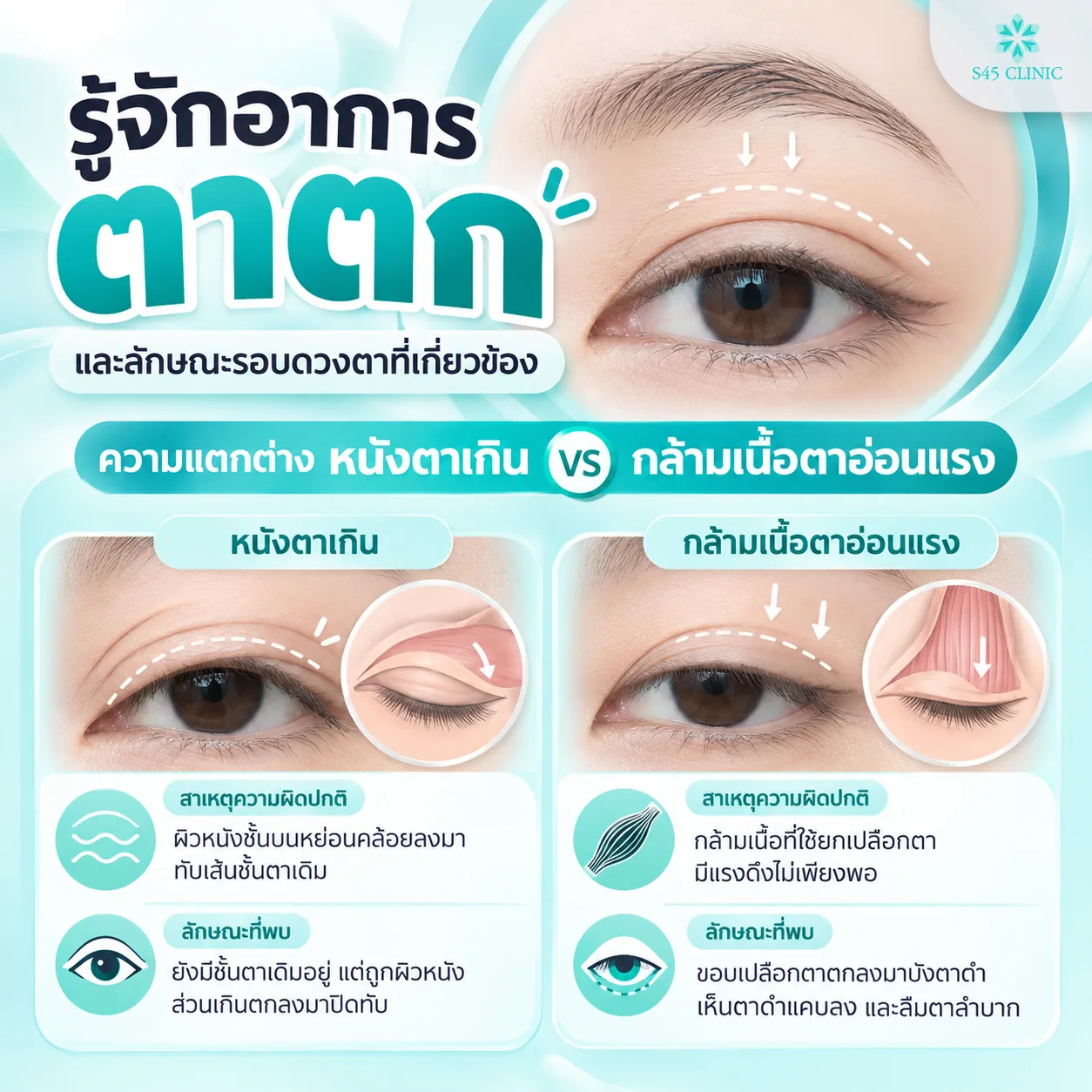
Droopy eyelids happen when the edge of the upper eyelid, or the skin of the eyelid, sits lower than usual. The eyelid is made up of skin, muscle and the fat around the eye socket. Each part works together to control opening and closing the eye.
The Difference Between Excess Eyelid Skin and Ptosis
- Where the problem is: excess eyelid skin is caused by the upper skin sagging down over the existing eyelid crease, while ptosis is caused by the muscle that lifts the eyelid not having enough lifting strength.
- What you see: people with excess eyelid skin still have their existing crease, but skin falls over it. With ptosis, the edge of the eyelid drops and covers the iris (the coloured part of the eye), so less of the iris shows and the eye feels hard to open.
- A simple test: when you lift the excess skin with your finger, an eyelid with excess skin shows its edge at the usual level, while with ptosis the edge of the eyelid still covers the iris as before.
How Eye Socket Fat and Bone Can Make the Eyelids Droop
Changes with age in the fat beneath the skin around the eye socket, and in the eye socket bones, can make the eyelids droop. The fat around the eye socket supports the eyeball and the shape of the eyelid. With age, the orbital septum (the thin layer that holds the fat inside the eye socket) can become loose, so the fat pushes forward and forms a thick bulge in the upper eyelid that presses it down. Some people may instead lose fat, which makes the eye socket look deeper and the skin fold out of shape.
The rim of the eye socket bone affects where the eyelid sits. The bone of the forehead and eye socket gradually shrinks with age, so there is less support beneath the skin, and the eyelid skin moves lower with gravity. The doctor plans care by assessing the changes in your eye features to choose a suitable approach.
What Causes Droopy Eyelids?
Droopy eyelids are mainly caused by changes with age and by lifestyle habits. Identifying the right cause helps the doctor choose a care technique that suits each person’s face.
Changes With Age and Loss of Skin Elasticity
Skin losing its firmness over time is the main cause of droopy eyelids. Collagen production in the skin starts to decrease gradually from early adulthood, and the thin skin of the eyelids loses firmness sooner than skin elsewhere.
When the skin loses its elasticity, the outer skin starts to sag and forms several overlapping folds. The outer corner of the eye, which moves often when you smile or blink, is affected first and droops before the inner corner.
Inherited Eye Features and Rubbing Your Eyes Often
The facial features you were born with, and habits that pull on the eyelids, can both make the eyelids droop. People with a low brow bone, a narrow eye socket, or eyebrows that sit close to the upper eyelid have eyelid skin that looks thicker and droops easily. Some people may also have been born with an eyelid muscle that cannot fully open the eye.
Daily habits can make droopy eyelids happen sooner than usual. Rubbing your eyes hard on a regular basis can stretch the tendon of the muscle that lifts the eyelid (the levator aponeurosis) and pull it away from its original position. Putting in and taking out contact lenses for many years, which often pulls on the eyelids, is another reason the eyelids can sag earlier than expected for your age.
When Should You See a Doctor About Droopy Eyelids?
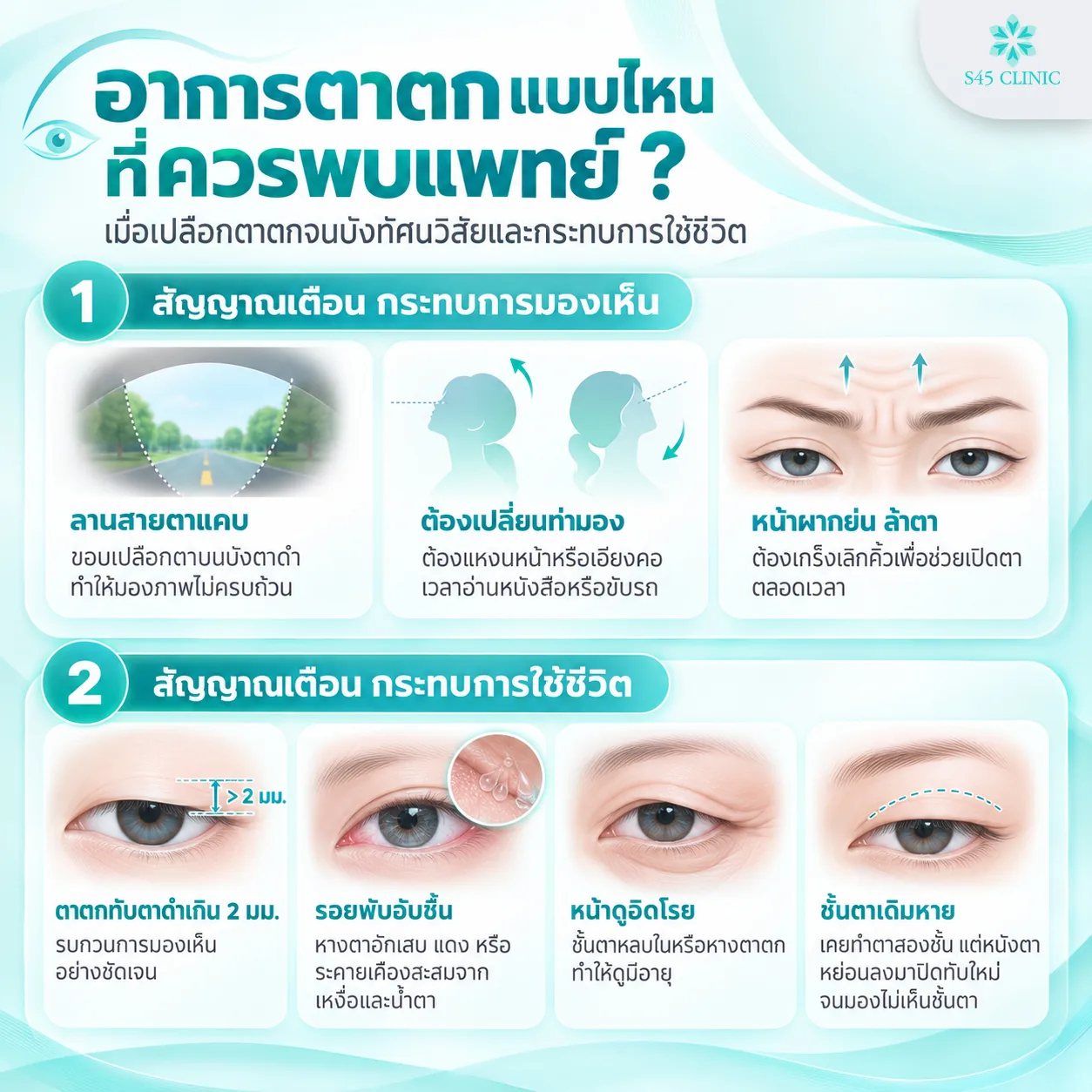
See a doctor when your eyelids droop enough to block your vision or affect your daily life. Severity ranges from changes in appearance to effects on vision. Noticing the warning signs helps you know when to see a doctor to have your eyes assessed. Checking early can help stop the symptoms getting worse and interfering with your vision.
Warning Signs That Droopy Eyelids Are Starting to Block Your Vision
You can tell that droopy eyelids are starting to affect your vision when the edge of the eyelid moves lower and you change your posture to help you see. You can do a basic check around your eyes for these signs:
- the edge of the upper eyelid drops over the iris, so your upper or side vision becomes narrower and you cannot see the whole view
- you need to tilt your head back or to the side to see in front of you when reading or driving
- your forehead muscles are tense all the time from raising your eyebrows to help open your eyes, which leads to deep wrinkles and tired, aching eyes
Droopy Eyelids That Affect Daily Life and Need a Doctor
You can tell your droopy eyelids need a doctor when the edge of the eyelid covers more of the iris than usual (the upper eyelid normally covers only about 1mm to 2mm of the top of the iris), or when irritation builds up and interferes with your daily life. You may notice these effects on your eye health:
- the edge of the upper eyelid covers more of the iris than usual and interferes with your field of vision
- a red, inflamed rash or irritation in the fold at the outer eye corner from trapped sweat and tears
- hooded eyelids, where the crease is hidden under the skin, or outer eye corners that droop a lot and make the face look tired and older
- an eyelid crease from previous double eyelid surgery that has become smaller or can no longer be seen, because the skin has started to sag again
What Are the Medical Treatments for Droopy Eyelids?
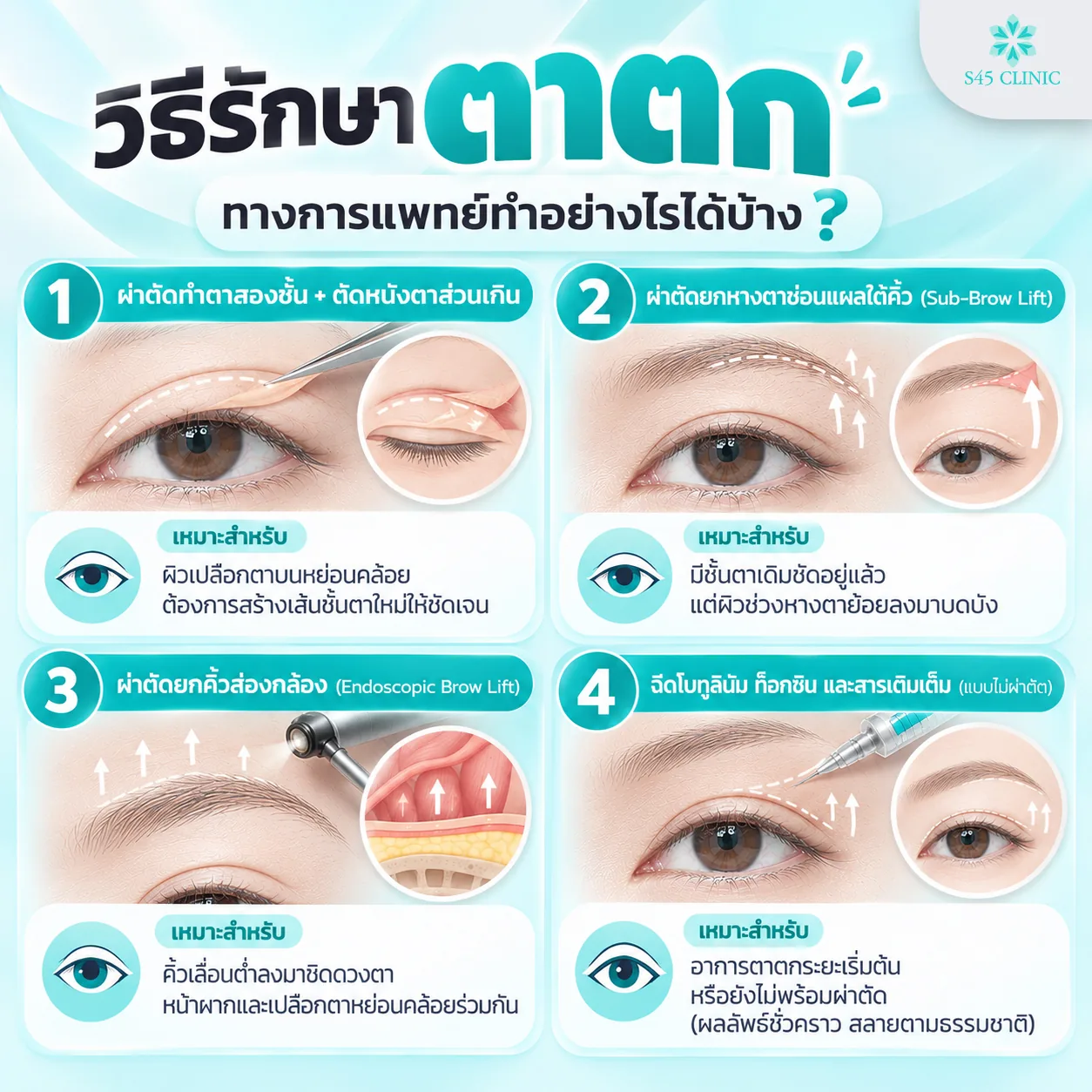
Droopy eyelids can be treated medically with surgery to remove excess skin or with a brow lift, to address the problem at its source. The doctor assesses the cause, how much the skin sags and where the problem is. Choosing a technique that suits each person’s face helps get a result that suits your vision.
Double Eyelid Surgery With Removal of Excess Eyelid Skin for Droopy Eyelids
Double eyelid surgery with removal of excess skin corrects sagging skin on the upper eyelid and creates a new, clear eyelid crease. The doctor marks the incision line on the eyelid, removes the excess skin and a strip of excess muscle, and deals with any thick fat around the eye socket. The surgeon then stitches the skin to the tendon of the eyelid muscle to set the new crease. With this technique, the scar is hidden in the eyelid crease when your eyes are open.
Sub-Brow Lift for Droopy Eyelids (Hidden Scar Beneath the Eyebrow)
A sub-brow lift corrects skin at the outer corner of the eye that sags over the eyelid crease, while keeping your existing crease. This technique suits people who already have a clear crease. The doctor makes an incision close to the lower edge of the eyebrow to remove the excess skin that pulls down the outer eye corner. The tissue beneath the skin is then lifted and secured to the periosteum (the layer covering the bone) beneath the eyebrow, to help open the crease at the outer part of the eye. The scar is small and usually fades gradually into the line of the eyebrow hairs over 3 to 6 months.
Endoscopic Brow Lift for Droopy Eyelids
An endoscopic brow lift corrects eyebrows that have moved lower. The surgeon makes 3 to 5 incisions of 1cm to 2cm in the hairline, then uses a surgical camera to separate the tissue beneath the forehead skin and lifts the eyebrows into a suitable position, to reduce how close the eyebrows sit to the eyes. This method lifts the skin of the forehead, outer eye corners and upper eyelids at the same time, with the scars hidden in the hairline.
Botulinum Toxin Injections and Filler Injections to Support Droopy Eyelids
Botulinum toxin injections and filler injections are care options for people with early droopy eyelids or who are not ready for surgery. Botulinum toxin injections into the muscles around the outer eye corner may reduce their pull and help the outer eye corners look more open. Filler injections at the temples or along the rim of the eye socket bone may help support the skin around the eyes.
These treatments are carried out after a doctor’s assessment. Results differ from person to person, and the body breaks down the substances used over time.
What Are the Benefits and Precautions of Surgery for Droopy Eyelids?
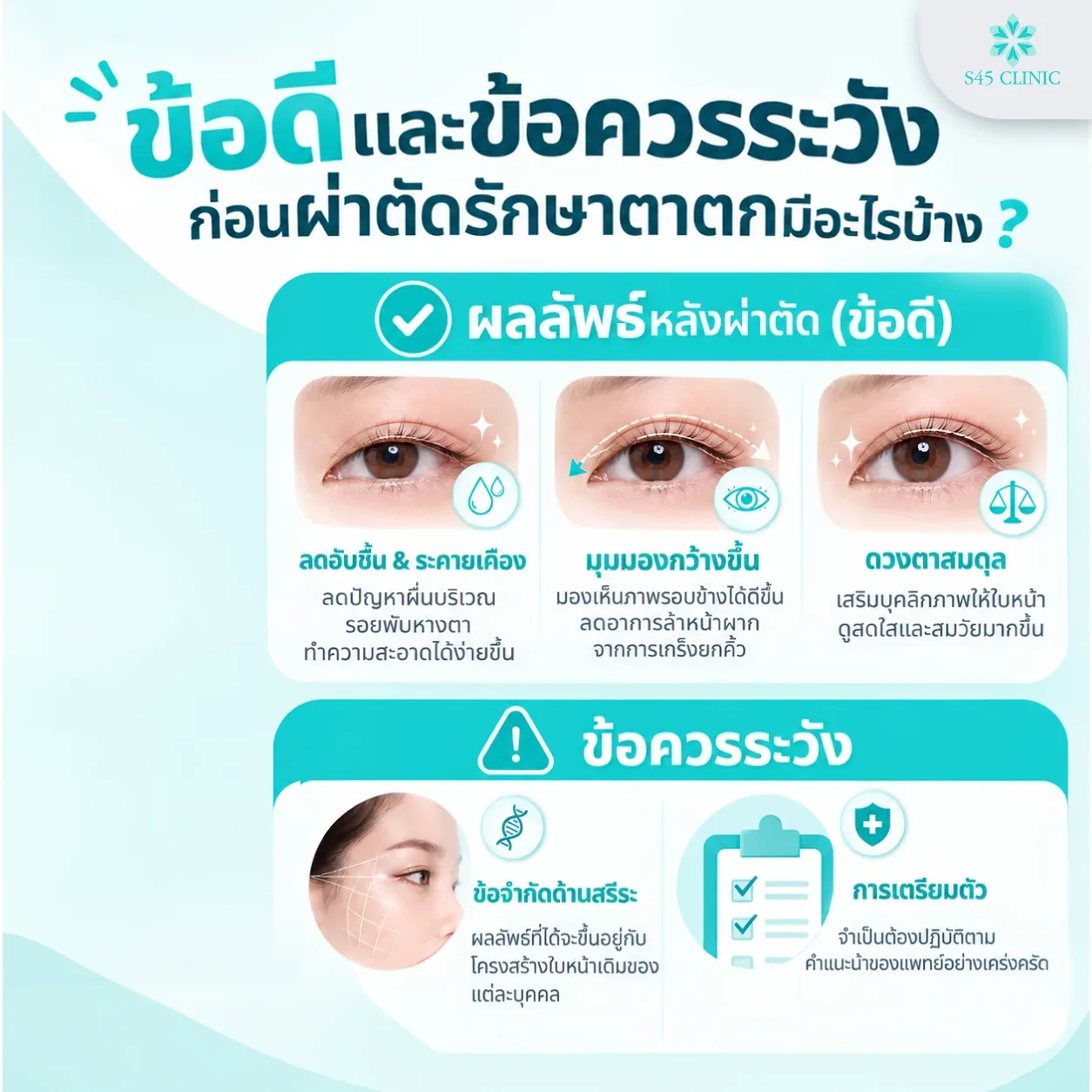
The benefits and precautions to consider before surgery for droopy eyelids include the effects on your quality of life and the limits of your existing facial features. You need to prepare as your doctor advises. Following this advice helps treatment go to plan, for a result that suits each person.
Vision and Eye Shape After Surgery for Droopy Eyelids
Surgery for droopy eyelids can help widen your field of vision and make it easier to keep the area around your eyes clean. You may notice these changes after treatment:
- Less damp rash: irritation in the fold at the outer eye corner usually decreases, so cleaning around the eyes becomes easier.
- Using your eyes: you can see more to the sides, which helps reduce tiredness in the forehead muscles because you no longer need to raise your eyebrows to help you see during the day.
- Eyes in balance with your face: this helps the face look fresher and in keeping with your age. Results differ from person to person.
Medical Limits, Preparation and Wound Care for Droopy Eyelid Surgery
The medical limit of surgery for droopy eyelids is that the result depends mainly on each person’s existing facial features. Factors such as the eye socket bones and the thickness of the skin all affect the assessment. Surgery cannot change your eye shape to something different from your existing facial features.
Before surgery:
- tell your doctor your full health history, any medical conditions and any history of drug allergies
- stop taking medicines that affect blood clotting, including supplements such as vitamin E or fish oil, at least 2 weeks beforehand or as your doctor advises
- plan not to wear contact lenses or glasses for the first 7 days after surgery, or as your doctor advises
Wound care and recovery:
- use cold compresses around your eyes for the first 1 to 2 days to ease symptoms, although how much swelling you get differs from person to person
- keep the surgical wound clean, keep it dry, do not rub your eyes and avoid heavy lifting
- see your doctor at your appointment to have the stitches removed, usually on about day 5 to 7 after surgery for stitches in the eyelid, on about day 10 to 14 for an endoscopic brow lift, and on the date your doctor sets for a scar beneath the eyebrow
Why Choose S45 Clinic for Droopy Eyelid Treatment?
S45 Clinic is an option for surgery to correct droopy eyelids that focuses on assessment, so treatment matches each person’s problem. This procedure needs great care, so S45 Clinic always places importance on analysing your facial features before planning care.
Individual Eye Assessment Before Planning Treatment
At S45 Clinic, the individual eye assessment before planning treatment starts with your medical history and an assessment of the area around your eyes by a doctor. This step is essential for adjusting the care plan to suit your problem. The assessment includes:
- measuring the distance from the edge of the upper eyelid to the middle of the iris, to assess how much your field of vision is blocked
- assessing the lifting strength and function of the muscle that lifts the eyelid, to rule out ptosis
- measuring the height and position of your eyebrows, to see whether low eyebrows are also part of the problem
- testing the elasticity and amount of excess skin on the eyelids and at the outer eye corners
A detailed assessment helps the doctor choose a suitable surgical technique, so the treatment plan is adjusted to each person’s facial features and eye anatomy.
Operating Room and Follow-Up Appointments After Surgery
Surgery at S45 Clinic takes place in an operating room under the medical facility’s cleanliness control system.
After surgery, the clinic cares for you and follows up on your symptoms, with advice on how to look after yourself. The clinic schedules appointments to remove stitches and check the surgical wound at set times, so your recovery follows the treatment plan.
Before choosing a clinic: Where to Get a Brow Lift? Techniques, Prices and 5 Criteria for Choosing a Brow Lift Surgeon
Frequently Asked Questions About Droopy Eyelids
These frequently asked questions about droopy eyelids cover whether surgery is needed, what causes symptoms on one side only, and how long results last. This information helps you prepare before deciding on care.
Does Everyone With Droopy Eyelids Need Surgery?
Not everyone with droopy eyelids needs surgery. The doctor considers treatment based on how severe the problem is and how much it affects your field of vision. If the skin sags only slightly at an early stage and does not yet cover the iris, you can start by changing your habits, avoiding rubbing your eyes and using sunscreen to slow skin ageing, or have a procedure to support the eyelids based on your doctor’s assessment.
The doctor recommends considering surgery when the edge of the eyelid covers the iris enough to affect your vision, or when you also have ptosis. Surgery to rearrange the eyelid crease and muscles is a way to correct the problem to suit each person’s facial features.
What Causes a Droopy Eyelid on One Side Only, and Is It Dangerous?
A droopy eyelid on one side only can be caused by facial features you were born with that are not symmetrical, or it can be a warning sign of a problem with the nervous system. Symptoms that appear suddenly over a short time may be caused by a problem with the nerve that controls the eyelid, or by myasthenia gravis (MG), a condition that causes muscle weakness. If you have these symptoms, see a doctor as soon as possible.
Warning signs that mean you need to see a doctor quickly:
- one eyelid drops suddenly without any history of injury
- you have double vision or blurred vision as well
- your pupils are different sizes, or you have a severe headache together with the droopy eyelid
Can Droopy Eyelids Come Back After Surgery?
After surgery for droopy eyelids, the skin can still sag again over time as it ages. Surgery rearranges the tissue beneath the skin, removes excess skin and secures the tissue in its new position, which helps the eyelid crease keep its shape. The treated skin helps support the shape of the eye, and results differ from person to person.
There are several ways to care for droopy eyelids, depending on how severe they are, including removing excess skin, a brow lift or a procedure to support the skin. Choosing a technique that suits your facial features, and caring for your eyes properly, helps slow sagging. Results depend on each person’s skin and self-care.
Summary
Surgery to correct droopy eyelids rearranges the tissue beneath the skin, removes excess skin and secures the tissue in its new position, to help the eyelid crease keep its shape. Your skin still changes with age, and results differ from person to person.
Treatment results depend on choosing a surgical technique that matches the cause from the start, such as correcting the eyebrows as well for people with low eyebrows. Although the skin continues to change with age, caring for your skin, protecting your eyes from sunlight and not rubbing your eyes can help slow sagging of the skin around the eyes over the long term.
Because every face shape…
is different
An otolaryngologist assesses every case before treatment and gives advice based on your actual concerns.
“Reveal the beauty within you”
Message us online
Surgery and medical procedures carry risks. Find out about them and consult a doctor before you decide. Results depend on each person.